
My previous post, Transit is an Essential Service, sparked some conversation about the funding of transit and the challenges therein. It’s best we understand what it means to be an essential service. Because the shift we need is in attitude, priority, and funding.
Attitude
The main point in my previous post was around the prevalent mindset of approaching transit from a “charity” perspective. The attitude towards transit is one of it being a service that is provided for those in our community who can’t afford a car or who have no other choice. That often results in transit related issues being lower down the list.
There are a couple of recent examples of this attitude.
First let’s consider the 2026 budget response to concerns about the new transit network. As I pointed out in my previous post, following several months of public concern about transit service, Council responded by adding 1 transit planner to respond to public concerns. This is a meagre response to a plethora of calls for better service, and one that comes with absolutely no budget increase for said planner.
Another instance of transit demonstrably taking a backseat is from 2024. In September of that year, Council approved the new transit garage. This is to accommodate the new buses needed to provide the service needed for the Primary Transit Network. But, as with most projects, the cost of the new garage increased from the original estimate of $200M (back in 2020) to $305M. Rather than increase the budget, Council rather decided to scale back the project in order to stay within the original $200M budget.
Contrast that with the widening of Kenaston Boulevard, being considered at the very same time. Kenaston was originally costed at $520M in the 2020 Infrastructure Plan and was ranked at 14th on the priority list, behind such projects at the new transit garage, ranked 7th on the priority list.
Then, in 2024, just ahead of the transit garage report, Council approved moving forward with the widening of Kenaston Blvd, now estimated to cost $737M. Where, two months later, Council refused to increase the budget for the transit garage. As part of approving the Kenaston widening, Council undertook a “cost benefit analysis” of the project to consider what the return on the investment of $737M would be. That analysis, which was deeply flawed, found a benefit of $20M over 30 years. I believe that works out to a return on investment of 0.09% per annum. But, as I said, it is a deeply flawed analysis, as is shown in this article in the Winnipeg Free Press.

Of further note, a year later, in 2025, the project cost has now increased to $758M, while the benefit has been reduced from $20M over 30 years in 2024 to only $10M. If you thought that an annual return on investment was bad at 1/10th of a percent, cut that in half!!
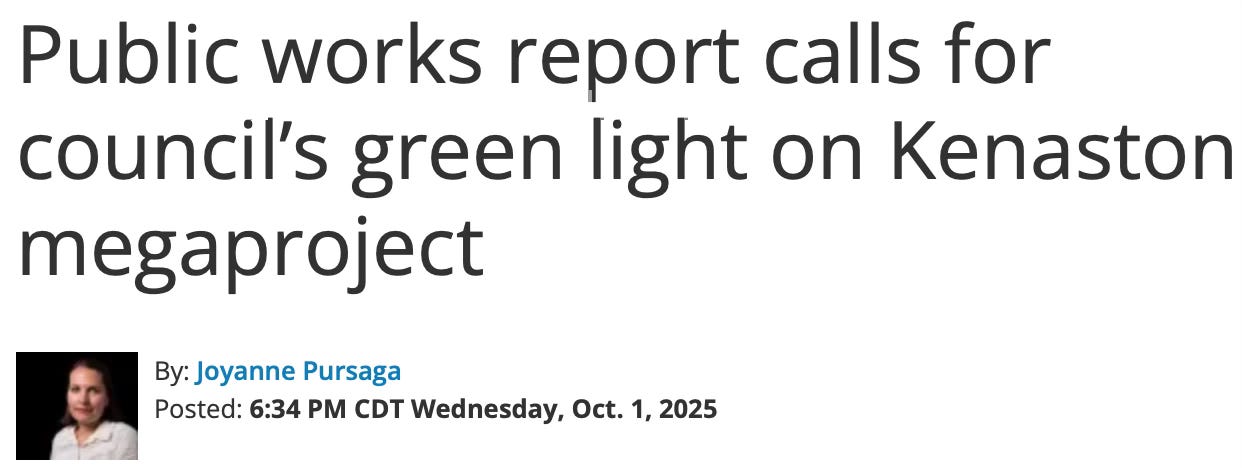
All this belies the stated commitment from Winnipeg City Council that transit is important. The clear attitude is that public transit, something that benefits all Winnipeggers, will consistently and constantly take a backseat to roads.
Priority
As we’ve seen in the attitude towards transit, despite it being declared a priority for the city, the proof is rarely in the pudding. We see it clearly in budget decisions, but there are other areas where transit is clearly not a priority, demonstrated every day.
Buses are not cleaned. Transit shelters are not cleaned or maintained. Snow clearing at bus stops is secondary, if done at all. Buses, that have dozens of people aboard, are stuck in traffic moving at the same pace as the cars with only one person in them.
Fixes and improvements that are standard fare in other municipalities, such as bus only lanes or shatter proof glass on shelters, are slowly considered in Winnipeg, and then “piloted” rather than being implemented.
Hal Anderson and I chatted about this on his show back in December. The conversation was in response to the city saying “it might be a good idea” to have bus only lanes on Portage Ave. The city consistently thinks too small about transit.
Every snow bank at a bus stop that prevents a person with any kind of mobility issue to easily access the bus, every time it takes weeks to clean a bus shelter, every time a bus does not get cleaned, every time a bus passes a stop because it is already full, every transfer that is missed because the bus doesn’t show up demonstrates how public transit is simply not a priority for the City of Winnipeg, regardless of plans and “pilots”.
Funding
It all ends up being about money. The attitude reflected in the council priorities, results in a significant underfunding of transit. And this is clearly where we see that City Council considers public transit to be a “charity” rather than an essential service.
Consider the recent budget where they added 1 transit planner, as long as it doesn’t cost any money. Or that transit was told to redesign the entire transit network, with no additional dollars. Or that when a key transit project, the bus garage, to support better service for residents has an increased cost, rather than find the funding, as proposed by city staff, Council opts to scale back the project, thereby ensuring fewer buses and worsening service for everyone.
These financial decisions all reflect the attitude that public transit is not a priority. There is nothing new to this, it has been ever thus for countless generations of City Councils. Over time, transit service (along with many other public services provided by the City of Winnipeg) has eroded due to lack of funding. That transit has been approached as a charity is not new, nor is it limited to City Council. It is a broader attitude across the community.
In 2021, City Council approved the Winnipeg Transit Master Plan. This is a 25 year plan to improve transit service across the city. It includes the new transit garage and the primary transit network as first steps. Winnipeg Transit is moving forward with this $1Billion plan.
At the time of the plans approval almost 5 years ago, my only criticism of the plan is that we should accomplish it in a much shorter timeframe. That if transit is the priority it needs to be, then this 25 year plan should actually be a 5-10 year plan. But much of the larger criticism of the plan, from Council, pundits, and the public, was about the overall price tag. Many found the idea of spending $1B on public transit to be outrageously rich.
One Billion dollars over 25 years works out to $40M a year. At the very same time that Council regularly celebrates, year after year, record investment in road renewals of $170M. At the same time as $1B for transit over 25 years is questioned, there is absolutely no hesitation to approve $787M for 3 kms of Kenaston Blvd and $750M for a 10Km extension of Chief Peguis Trail.
The Road Ahead
As discussed in my previous post, the challenges we face with our transit system are not about the new network, they are about the level of service. The good news is it’s easily fixed by increasing the funding. Funding for more buses, more drivers, more routes, more bus shelters, more bus cleaning, more bus priority lanes. Winnipeg Transit has built a solid foundation on which to be able to deliver the service that Winnipeggers need and deserve.
To achieve this, we need to understand that our attitude towards transit needs to shift. That it needs to become the priority in our transportation system, and requires the committed funding to achieve that. We need to understand that transit is one of the few services the city provides that benefits every single resident, whether they use transit or not. Each person on transit is one less car on the road, less air pollution, and less GHG emissions. That one person taking the bus is improving everyone’s lives, one ride at a time.
Who and What is Essential
Public transit is the communal benefit we all need. It is essential to the financial, social, and environmental sustainability of our city. During the COVID pandemic, we all discovered who our “essential workers” were. They are the attendants at the hospital, the people taking care of our public spaces, and public servants far and wide. Many of the “essential workers” of our community are working a low wage jobs. They often rely on transit. While we celebrated and recognized our “essential workers” stocking the shelves of the stores and cleaning the floors of the hospitals, we did nothing to make their lives easier. We don't consider their means of transportation as an “essential service”.
Those of us who need to or want to drive everywhere get priority over those who have no other choice but to take transit. Those who use transit are benefitting every single one of us. While collectively we do little to improve the transit riders experience, each transit rider is doing their essential part to make the car driving experience better.
Essentially Essential
That is what it means to recognize public transit as an “essential service”. Transit, that works for the majority, is essential for our community. Council needs to take action, rather than sitting back and looking to other orders of government to step up with funding. They need to look at their priorities, and recognize their commitment to transit needs to reflect the essential service it is.
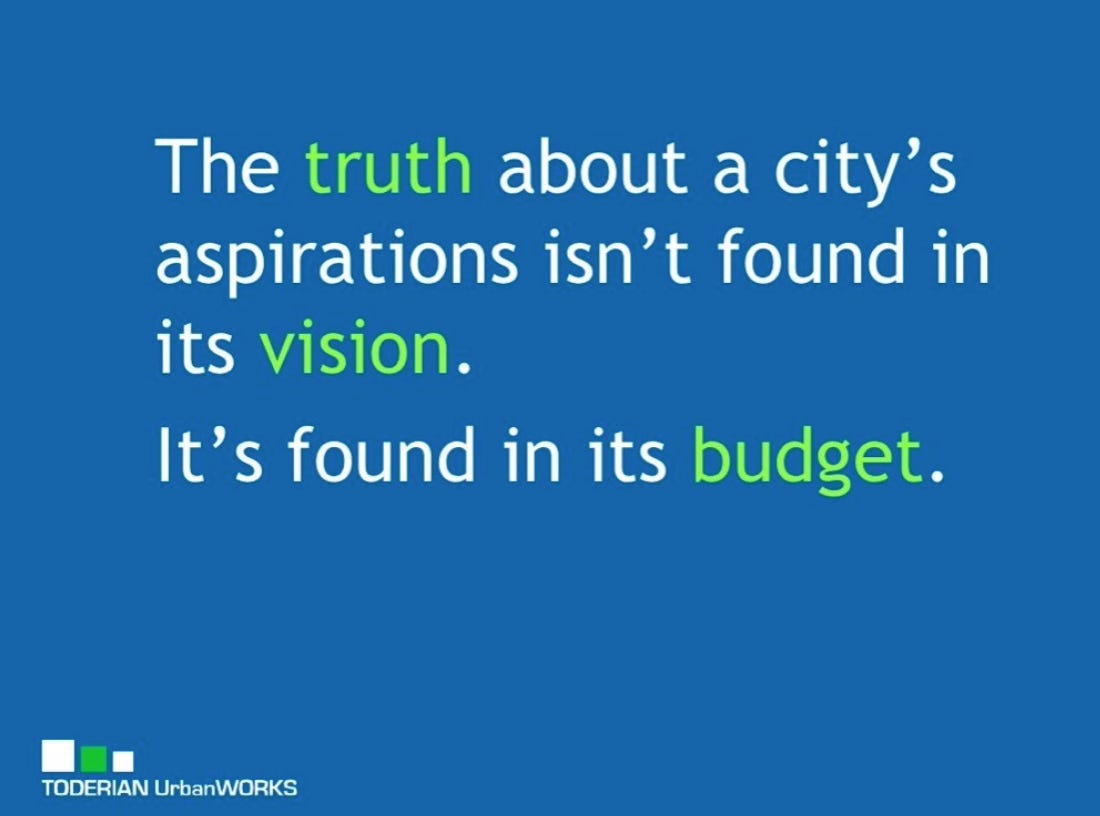
Sadly, we aspire to so little.
brian
Comments
Nothing yet. Say the first thing.
Sign in to join the conversation.