
Here we go again! World events are affecting our cost of living and particularly the price of gas. It is fascinating how we track the effects of world events, be they wars, natural disasters, or pandemics by the price of gas. Someone pointed out that it is because it is the only product where the price is advertised in big bold signs pretty much everywhere.
Gas prices also seem to be incredibly volatile and quickly responsive to world events. Six years ago the headlines were that gas prices were “plummeting” as they dropped below $1/litre to a low of $0.85/litre. Then, four years ago, as the pandemic hit, they began to skyrocket, reaching a peak of over $2.00/litre in the summer of 2022. And, here we are, after dropping back to a low of close to $1.00, they are on the way up again.
Each time the price goes up, consumers are upset. News stories about how people can no longer afford to drive, how they are worried about getting their kids to activities, about the potential effects throughout their life. Governments, provincial and federal, try to find ways to mitigate the impacts of the increased prices. They reduce taxes on fuel, eliminate climate change programs, and discuss how to increase the amount of fossil fuels being produced to lower the cost of gas.
All these actions have limited short term results, with substantial long-term consequences. At the very political level, which after all these measures all are, the actions of government have had very little effect to improve the votes sympathy towards government.
It is human nature to look to others to solve our problems. When it comes to the cost of living, we look to government specifically to help solve the problem. Government solutions are typically not about reducing the cost of living but helping people of lower income to manage their cost of living. In our “free market” society, governments have very few tools to reduce the cost of living. They can reduce taxes and reduce regulation, both of which impose additional cost on goods. But that comes with cuts to services and programs and broader long-term consequences.
There is in fact one order of government that works every day to give us options to control our cost of living. Municipal governments right across the country put in place programs available to everyone to manage costs. And when it comes to the price of gas and the cost of transportation, cities do more than all other orders of government combined. We already pay for the things we need to reduce our cost of living.
The most obvious of the services provided to us by our tax dollars is public transit. Cities spend hundreds of millions of dollars to provide a transit service that gives citizens the choice to leave their car at home or in a park ‘n’ ride. Not only is this more cost effective for the city to maintain, but it is a more cost effective choice for people to use and manage their cost of living.
If you are a reader of this substack, then you will know that I have pointed out repeatedly the need of good public transit from the city’s point of view. It is far cheaper to the operating budget to have more transit than to facilitate (and subsidize) people getting around in personal automobiles. Here are a couple i’ve written. Yes, there are more in the history (and no doubt will be more in the future).
But, from the rider’s point of view, transit is also a great economical choice. There are tools out there to help understand the cost and cost savings of using transit. The American Public Transportation Association has a couple of good calculators to show the differential costs.
But, the most complete comparator and Canadian comparator, comes from the City of Calgary. They have built a tool to allow people to calculate the costs of travel in various modes: walking, cycling, transit, and driving. They include all costs in the calculation, from personal costs to societal costs. They also calculate any benefits that each mode might provide. The costs are based on Calgary costs, but they are comparable to pretty much every city in Canada.
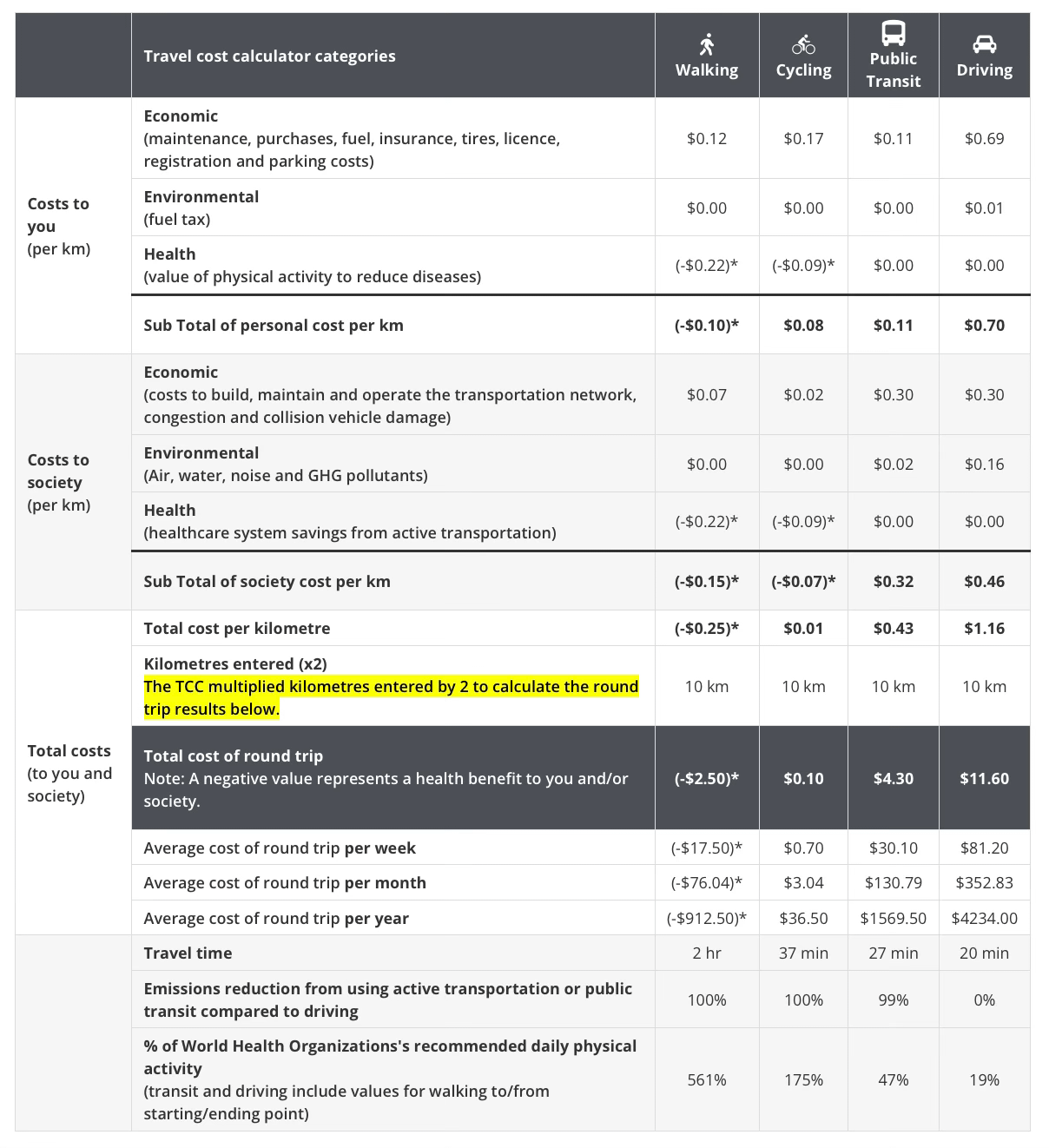
The calculator on their website allows you to enter the distance you are going to travel (one way) or, if you are in Calgary, you can use a map to indicate start and end points of your trip.
The result is a chart that shows the cost and benefit breakdown of every mode for your trip. This is the result for a 5km one-way trip, 10Km round-trip. We often consider 5km as being a reasonable maximum distance for a walking trip.
The next most obvious choice, as illustrated above, is walking or cycling. This choice is available to fewer people, as it requires you to be within the walking or cycling distance to your destination, and it requires ability to be able to do it. For cycling, it also requires the investment in a bike. Though, no matter what kind of bike you get from a utilitarian 2nd hand bike to an electric cargo bike, they are considerably cheaper than owning and operating a car.
Cities are spending a lot of money to improve walking and cycling choices. At each budget meeting they are being lobbied and encouraged by residents to do more. Yes, it is fundamentally cheaper to build more walking and cycling infrastructure at the city, but it is equally important to individuals as a tool to control our costs and benefits as we travel around our community.
Here is a comparison for a 5km one-way trip, 10Km round-trip in all modes from the City of Calgary tool. We often consider 5km as being a reasonable maximum distance for a walking trip.
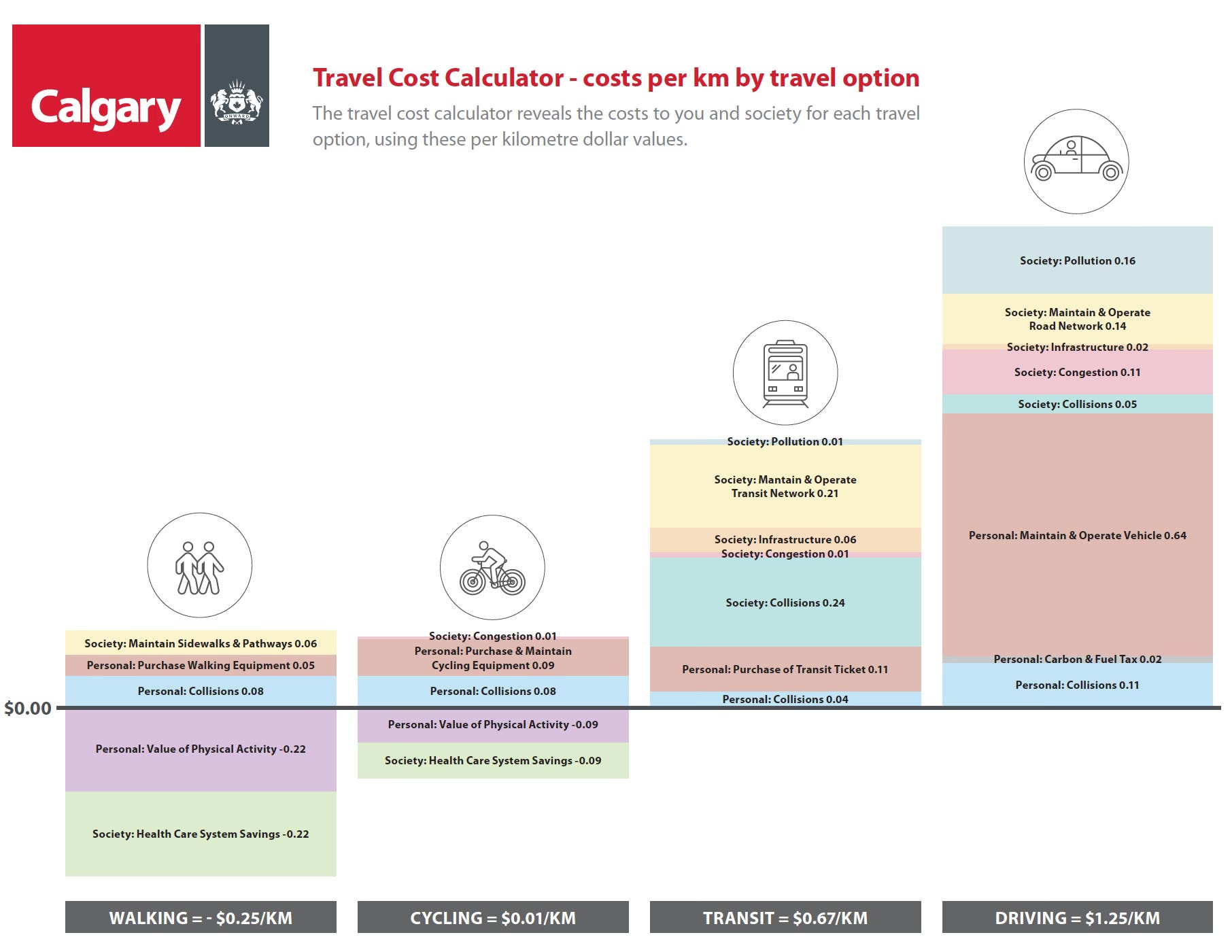
The choice of using transit or walking and cycling, are available to us to reduce our cost of travel. These are choices available to us that we already pay for. They don’t reduce the price of gas, as provincial & federal governments try, but by giving us the option to drive less, they reduce the cost of gas.
One other choice available to us is what vehicle we use. We expect businesses and government to “right-size” their operations so that we, as consumers, get the best bang for our buck. We can do the very same thing in our lives, particularly with our vehicle choice.
Cost of car ownership is high in Canada. Between car payments, maintenance, insurance, gas, and depreciation the average cost of car ownership in Canada is over $15,000 a year.
“When we crunch the numbers, in 2026 the total cost of owning a car is about $1,373 per month, based on the average purchase price, loan terms and ongoing expenses. This is a slight increase in cost year over year (YoY), with 2025’s total coming at $1,370.”
The Canadian Automobile Association has a great tool on their website that allows you to compare the operating costs various vehicle models. The vehicle we drive comes with different costs, beyond the sticker price. The cost of operating a vehicle also goes beyond gas mileage. The cost of depreciation and insurance also depends on the vehicle we chose to drive.
The CAA Car Cost Calculator is a great tool that lets you estimate the full cost of operating a vehicle. It allows you to choose make, year, and model as well as total yearly driving distance and type of driving. Right-sizing your vehicle to your need will help manage your cost of driving.
Beyond taking alternatives to driving and making sure that when you do drive you have the right tool for the job, there are other considerations.
If transit or cycling works for you, but you do occasionally need a vehicle, car shares are a great option, such as Peg City Car Co-op. But not every city has car share, so consider the cost of ride hailing such as taxis or Uber. When you really need a car you can rent one for your needs, such as getting that load of gardening supplies. Yes, these cost, but, when you factor in that the average cost of car ownership is about $15,000 per year, that’s a lot of taxi trips and vehicle rentals before you are losing money!
We love to idle our vehicles. In the winter we like to warm them up so they are nice and toasty when we get into them. We cool them off in the summer so that the air conditioning is going when we are ready to drive. And with remote starters it is even easier to turn the car on before we head out. But, we are not warming that car up for the car, it is solely for our comfort. Chose to not warm up your car, but wear you gloves until the heater is going full blast.
One of the things we believe is that we need to warm up our car for the engine to operate properly. That is no longer true with modern cars. In fact, we are doing more damage to our vehicle by letting it idle. We are also wasting gas, that we are paying dearly for.
(I know next to nothing about cars, but I am told that carbureted engines really are a thing of the past, and if you have a carburetor you most likely know far more about cars than I do!)
While we can’t do anything to control the price of gas and government can do little as well, we do have the tools available to us to control the cost of gas. We already are paying for some of them through our municipal taxes. We have our municipal government working to give us choices that will save us money, as well as saving them money.
We are not helpless victims of the oil companies and the prices they charge. We can take control of our costs.
The City is there, giving us the tools right at our doorstep, to help us take control of our costs and have a better experience in the process!
brian
* yes, I believe that municipal government is the best order of government
ps. There is a clear distinction between price and cost. Price is external to us set by others, whereas cost is under our control with the choices we make. We are able to control cost in how we respond to price.
No posts
Comments
Nothing yet. Say the first thing.
Sign in to join the conversation.