
Based on urgency, this is the second in my “Vancouver’s plan to die” series of posts around the 22 issues degrading Vancouver. I started writing about the Vancouver Plan, a.k.a. The Vancouver Official Development Plan (VODP), more than four years ago. It was #9 on my original list of Vancouver’s 22 poor planning and urban design choices but is now second up as it may be referred to public hearing next Tuesday.
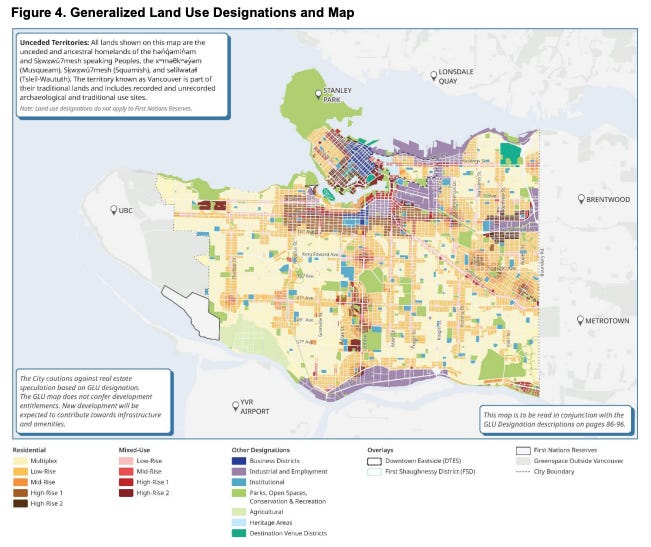
This is one of only two diagrams in the Vancouver Official Development Plan (VODP) referral report. The actual VODP appended to the referral report is 249 Pages, with 12 policy areas and 34 maps—an easy read and respond exercise in 12 working days.
The 199-page Referral Report for approval of the VODP was released on January 20—ten days ago—and may be referred to public hearing next Tuesday, February 3rd. The proposal to consider the report next Tuesday was only announced publicly two days ago. After referral, City Council will not be allowed to hear from citizens until the hearing itself. Such is democracy in Vancouver.
How do you analyze a 200+ page document between now and next Tuesday? Faced with this impossibility, I decided to focus not so much on the VODP details, rather on what the referral report says about how the VODP will operate. What follows are bullet points extracted directly from the referral report, followed by my brief editorial remarks.
“Under provincial legislation, applications that are consistent with the ODP may have their Public Hearing waived by Council or the Public Hearing may be prohibited by the Vancouver Charter if the development proposes at least 50 per cent residential floor space.”1 (emphasis added by me)
The operant clause here is “Public Hearing may be prohibited.” The report is unclear but the provincial legislation is clear about prohibiting Public Hearings for ODP-compliant proposals. Many municipalities (but not Vancouver) have strenuously objected to this prohibition.
“In April 2024, the Province enacted Bill 18, Vancouver Charter Amendment Act (No. 2) to amend the Vancouver Charter to require that Council adopt an interim city-wide Official Development Plan (ODP) by June 30, 2026. A city-wide ODP is a statutory policy document adopted by by-law that describes the long-term vision for the city, including direction for planning and land use management and setting direction for growth and development.”2 (my emphasis added)
As with the previous clause, many municipalities (but not Vancouver) have strenuously objected to this requirement.
“Consultation requirements: Council must consider whether to consult with certain persons or organizations, including:
Metro Vancouver Regional District;
The council of any adjacent municipality;
First Nations; and
Provincial and federal governments and their agencies.
Council must consult with boards of education on certain planning of school facilities.”3
Notice the absence of “citizens,” “the general public”, etc., in this list of who must be consulted as part of the ODP process. This theme recurs elsewhere in the referral report.
“Public Hearings:
A Public Hearing is required to adopt, amend, or repeal an ODP by-law, and to adopt / amend a zoning by-law unless it is consistent with the ODP
Public hearing must not be held if the zoning by-law is consistent with the ODP, and its sole purpose is to permit a development with at least 50 per cent residential gross floor area.”4
This is where Public Hearings are to be prohibited for most residential development.
“Future planning work following adoption of the ODP includes the Villages planning program.”5
The public were recently advised that the Villages planning program would not be part of the VODP, so nothing new here except this planning initiative remains on the work program.
“Housing needs report: Council must…ensure that the ODP creates enough capacity to meet number of housing units needed over the next 20 years.”6
The combination of existing spot rezonings in progress or approved, approved mega projects and other committed projects large and small in Vancouver results in more than 200,000 homes over the next 20-30 years. That’s a 60 year supply of homes.7
“Generalized Land Use (GLU) designations: Designations that envision significant residential floor space (such as Residential or Mixed-Use designations) include height ranges that reflect the key building typologies for low-rise, mid-rise, and high-rise forms.”8
To measure the effectiveness of this, please note that last week Council approved a 25-storey residential development in an area zoned industrial. Council approved the proposal unanimously over public and staff objections.
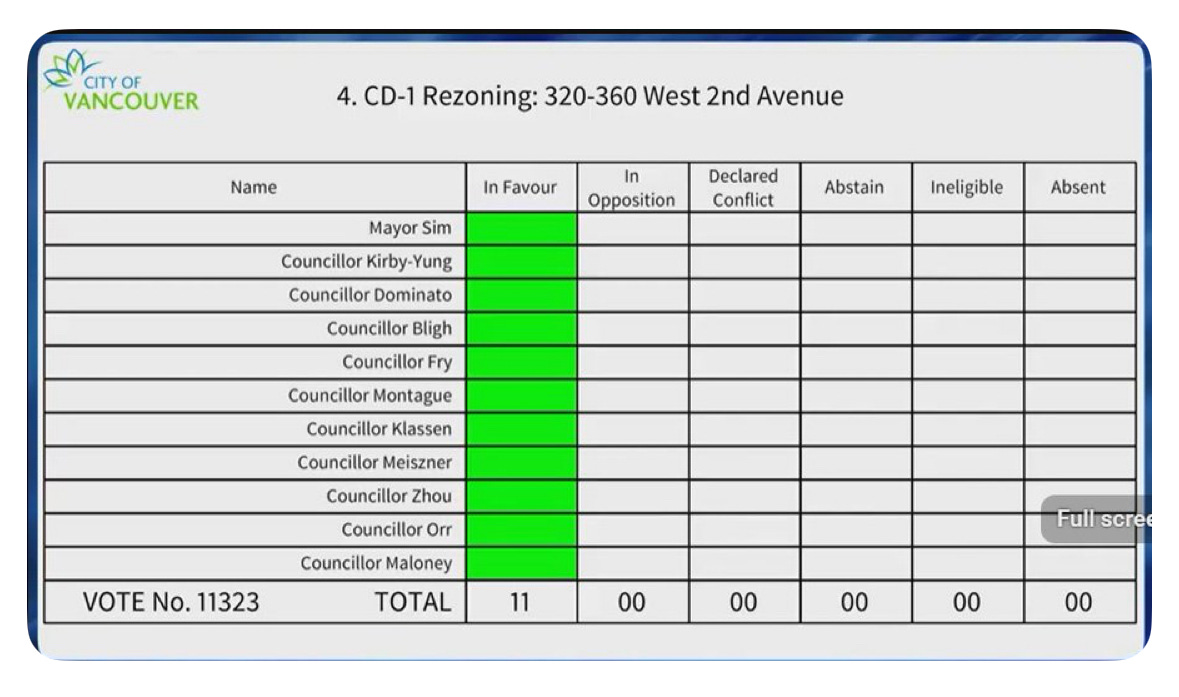
Voting record for mostly residential development on industrial zoned site.
“Parks and Public open space: A new map shows current parks and open spaces, as well as future public spaces and parks already identified or secured through Council-approved planning processes or parkland acquisitions.”9
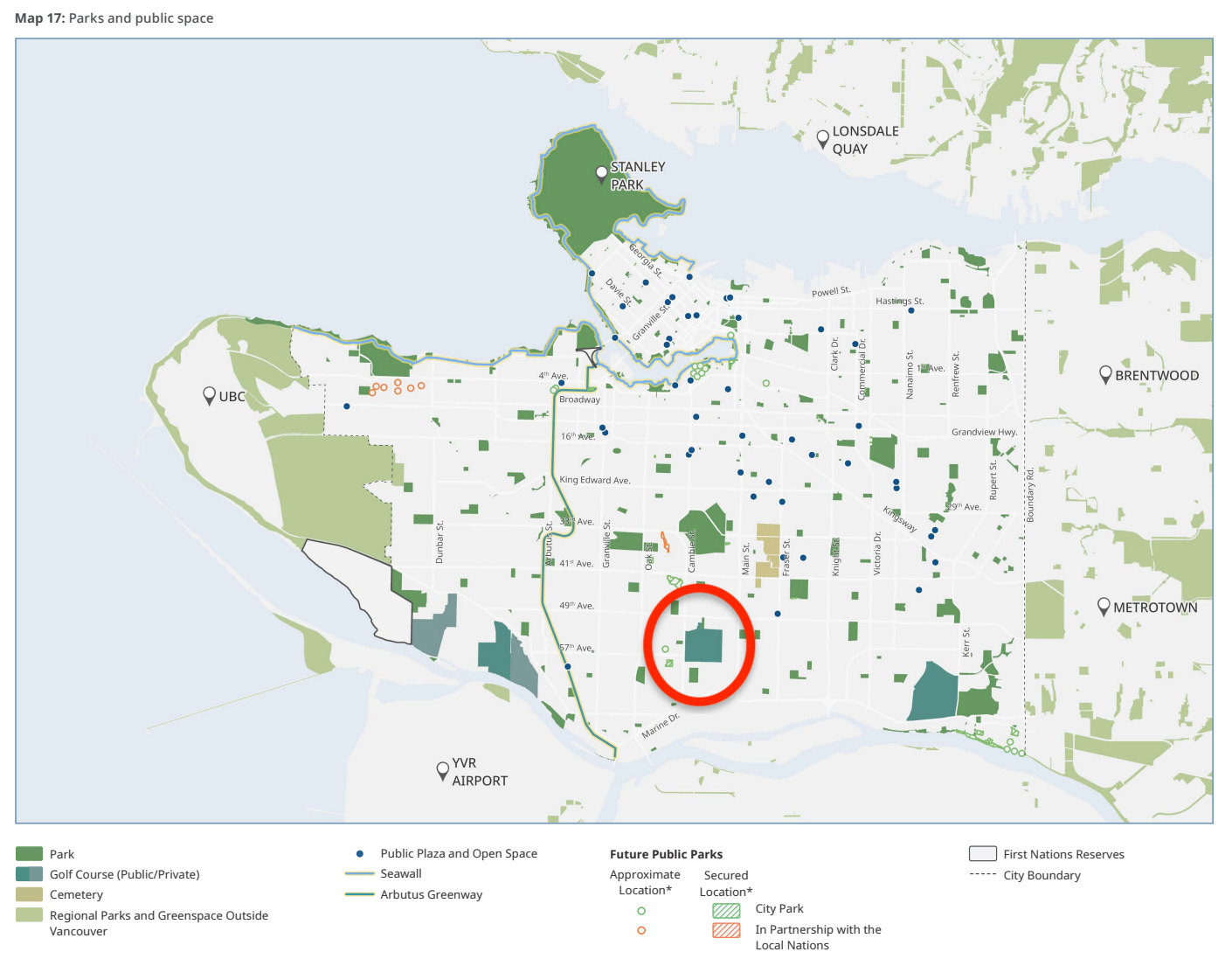
This is that map10. At the historic ratio of 2.75 acres of new dedicated park per 1,000 new residents11, projected population increases will require new park area totalling 10 times12 the size of Langara golf course (circled in red above). What’s on offer are a series of tiny parks and several dozen small plazas and open spaces, shown as dots on the map.
“Community infrastructure: Existing school sites are protected as places to meet the educational and learning needs of school aged children, and other complementary community-serving uses.”13
The Vancouver School Board (VSB) is actively engaged in a program to dispose of up to 40 existing school sites that will make them unsuitable for expanded or new school use.
If you agree that this is all an appropriate way to plan our city, by all means stay silent or confirm your support. If, like me, you believe that the processes noted above are undemocratic and incomplete, please say so to the Mayor and each member of Council by next Monday.
This post is just over 900 words not including footnotes, somewhat more than the 3-5 minutes citizens are allowed when they speak to the current Vancouver City Council, in their efforts to suppress democracy. If you appreciated this post, please share to your social media and consider becoming a free subscriber to City Conversations at
Brian Palmquist writes in the ancestral lands of the Musqueam people. He is a Vancouver-based architect, building envelope and building code consultant and LEED Accredited Professional (the first green building system). He is semi-retired, still teaching, writing and consulting a bit, but not beholden to any client or city hall. City Conversations mix real discussion with research and observations based on a 50-year career including the planning, design and construction of almost every type and scale of project. He is the author of the Amazon best seller and AIBC Construction Administration course text, “An Architect’s Guide to Construction.” A glutton for punishment, he is threatening to write a book about how we can Embrace, Enhance and Evolve the places where we love to live. Some of its content may appear above.
Vancouver Official Development Plan referral report, page 2
200,000 x 2.2 residents = 440,000 divided by 7,000 per year = more than 60 years.
Vancouver Official Community Plan page 159
2.75/1000 was the ratio used at False Creek North and Coal Harbour, but not at any of the Official Development Plans since. We are surviving off that legacy.
440,000 / 1,000 times 2.75. Langara is 100-120 acres depending on where its boundaries are drawn.
Comments
Nothing yet. Say the first thing.
Sign in to join the conversation.