
This is the third in my “Vancouver’s plan to die” series of posts around the 22 issues degrading Vancouver. I started writing about the deliberate hiding of information the public should see more than 2-1/2 years ago. It was #14 on my original list of Vancouver’s 22 poor choices but is now third up as local government continues to hide their words from their citizens, most recently its thoughts about proposed legislation that will remove oversight of design and construction from professional bodies. This Tuesday’s referral report about Vancouver’s official development plan will put an end to most Public Hearings.
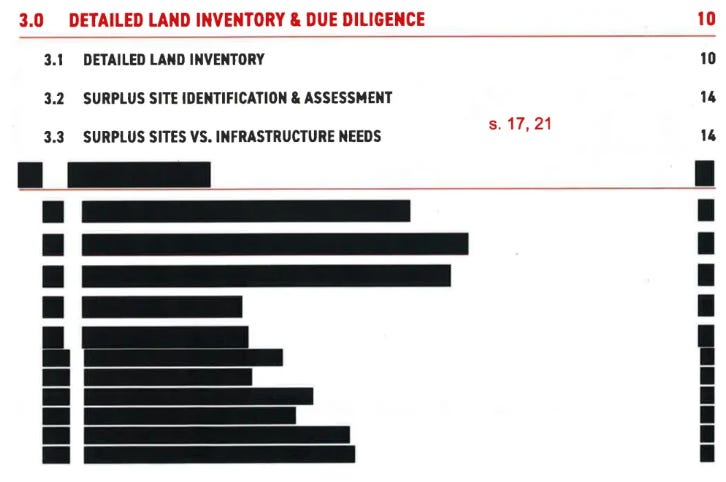
What the Vancouver School Board thinks we should know about their plans to sell up to 40 schools. The document detailing these proposals has since been removed from the web.
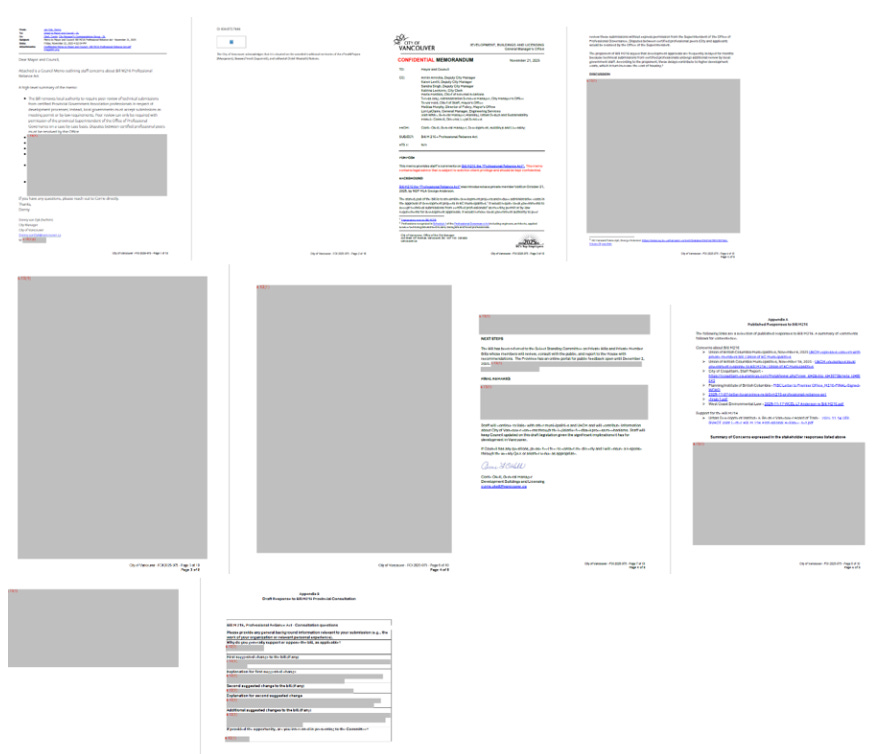
This recent FOI response by the city to a CityHallWatch request shows what city staff thinks the public should know about their recent report about the proposed Professional Reliance Act.1
What’s particularly weird about this second exercise in redaction is that the city’s own submission to the provincial government is visible on the provincial government’s website, which advises the city is opposed to this Bill (as are many of us). So why the redaction?
Do politicians and their staffs not realize that every time they withhold information that should be public, they damage trust.
Do politicians and their staffs not realize that they have an obligation to be open and transparent?
Do politicians and their staffs not realize that their discourse is seldom privileged? That they are privileged to serve their electors? That their privilege can and will be removed by a public they’ve scorned?
It was not so long ago that the only portion of a Council meeting that was in camera, i.e., not visible to the public, was a portion considering the hiring or firing of senior staff, the status of litigation, or a portion involving the consideration of certain kinds of competitive bids for city goods and services. Now almost every Council meeting has an in camera beginning where it often appears all the substantive business is completed and the deals are made. Because those meetings are in camera, I and others can only speculate—and we will.
A Way back to Democracy
There should be once again only a very small list of in camera matters, and when a meeting starts in camera, that agenda should be explained to all before the public meeting commences, e.g., “We were considering the hiring of a new Director of Planning,” or “We were reviewing competitive bids and staff recommendations for a major contract for facility construction,” etc.
Reports to Council should be made available to the public as soon as Council sees them—and that should be weeks rather than days before they are discussed on a meeting agenda.
And finally, regardless what provincial legislation says2, all projects that used to be considered at Public Hearing should once again be heard at Public Hearings, with broadly published information well in advance. And at those public hearings, public presentation time should be extended from as little as three minutes and Councillors should be permitted, in fact encouraged to ask questions of members of the public who have taken the time and energy to come to city hall and speak their minds.
Today’s Clear question for candidates for public office
“If elected, will you commit to making the meetings and the information supporting them fully transparent, and will you commit to restoring the respect for citizens that city staff and politicians once but no longer have?”
Coda
After CC #203 was published, a very respected and accomplished reader wrote me this (slightly modified to protect identities):
“One thing you mentioned is that council will not be able to speak to anyone after the referral report. That is not true in law- it is just a practice Council chooses to follow. We had a bit of an argument with a Councillor about this last week and they said they would follow up with legal staff. There is some case law that suggests this practice goes against democratic processes in that it prevents citizens from having their voice heard.”
This post is just about 650 words not including footnotes, somewhat more than the 3-5 minutes citizens are allowed when they speak to the current Vancouver City Council, in their efforts to suppress democracy. If you appreciated this post, please share to your social media and consider becoming a free subscriber to City Conversations at
Brian Palmquist writes in the ancestral lands of the Musqueam people. He is a Vancouver-based architect, building envelope and building code consultant and LEED Accredited Professional (the first green building system). He is semi-retired, still teaching, writing and consulting a bit, but not beholden to any client or city hall. City Conversations mix real discussion with research and observations based on a 50-year career including the planning, design and construction of almost every type and scale of project. He is the author of the Amazon best seller and AIBC Construction Administration course text, “An Architect’s Guide to Construction.” A glutton for punishment, he is threatening to write a book about how we can Embrace, Enhance and Evolve the places where we love to live. Some of its content may appear above.
Provincial legislation now prohibits Public Hearings for many scales and types of proposed projects. To my mind, this is what the city’s lawyers should be arguing against.
Comments
Nothing yet. Say the first thing.
Sign in to join the conversation.