
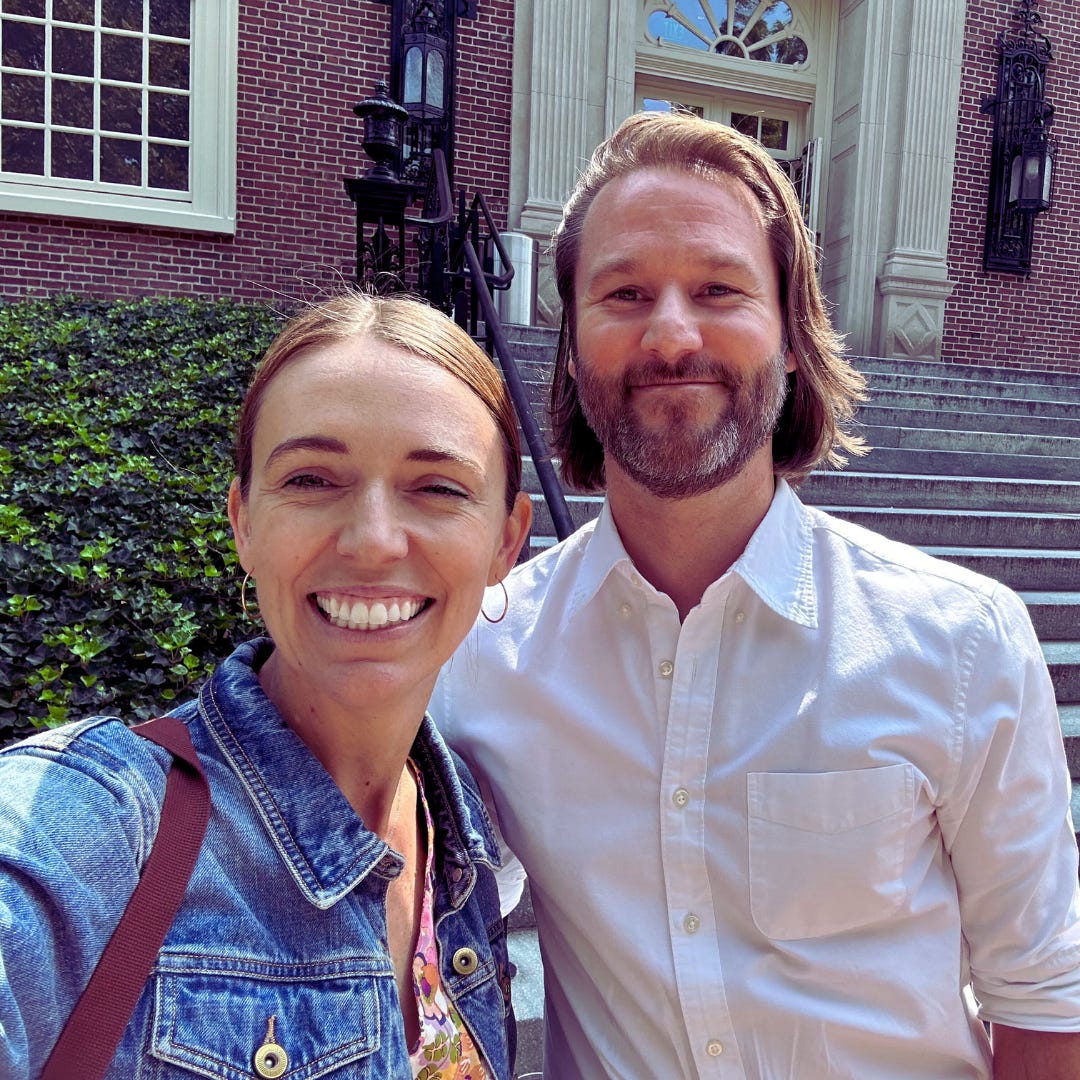
After a few hopeful emails led to a series of unlikely replies, I found myself walking across Harvard Square one year ago this past week, heading toward the art museum where I was scheduled to meet Jacinda Ardern, the former Prime Minister of New Zealand.
When I arrived, she was sitting on the front steps among a handful of other visitors waiting for the museum to open. None of them seemed to recognize her.
I walked up cautiously, introduced myself, and we started chatting about Boston, good lunch spots, and where to get the best hot chocolate before heading inside and finding a seat at the museum café.
The meetup was informal, and the conversation shifted naturally from our experiences living abroad, to the book-writing process—which she was in the middle of, and I was just starting—and the ways we had grown up in similar but very different worlds.
I left nearly two hours later feeling the way you do after time spent with an old friend from high school. She asked me as many questions as I asked her, encouraged me along the way, and carried a steady, hopeful energy.
As we walked out of the museum, she kindly asked me to send my best to my daughters, which I said will make their day. She quickly responded, “well, let’s send a picture then, too.”
See: Jacinda and Me in Boston
In 2017, Jacinda Ardern became Prime Minister of New Zealand at the age of 37. The five years she spent as head of state were marked by enormous difficulty and tragedy: the Christchurch mosque shootings, a global pandemic, and a steep rise in the cost of living.
Her promise to lead with “focus, empathy, and strength” was tested almost immediately. Not even three months into her first term, she announced that she was pregnant and would be taking six weeks of maternity leave.
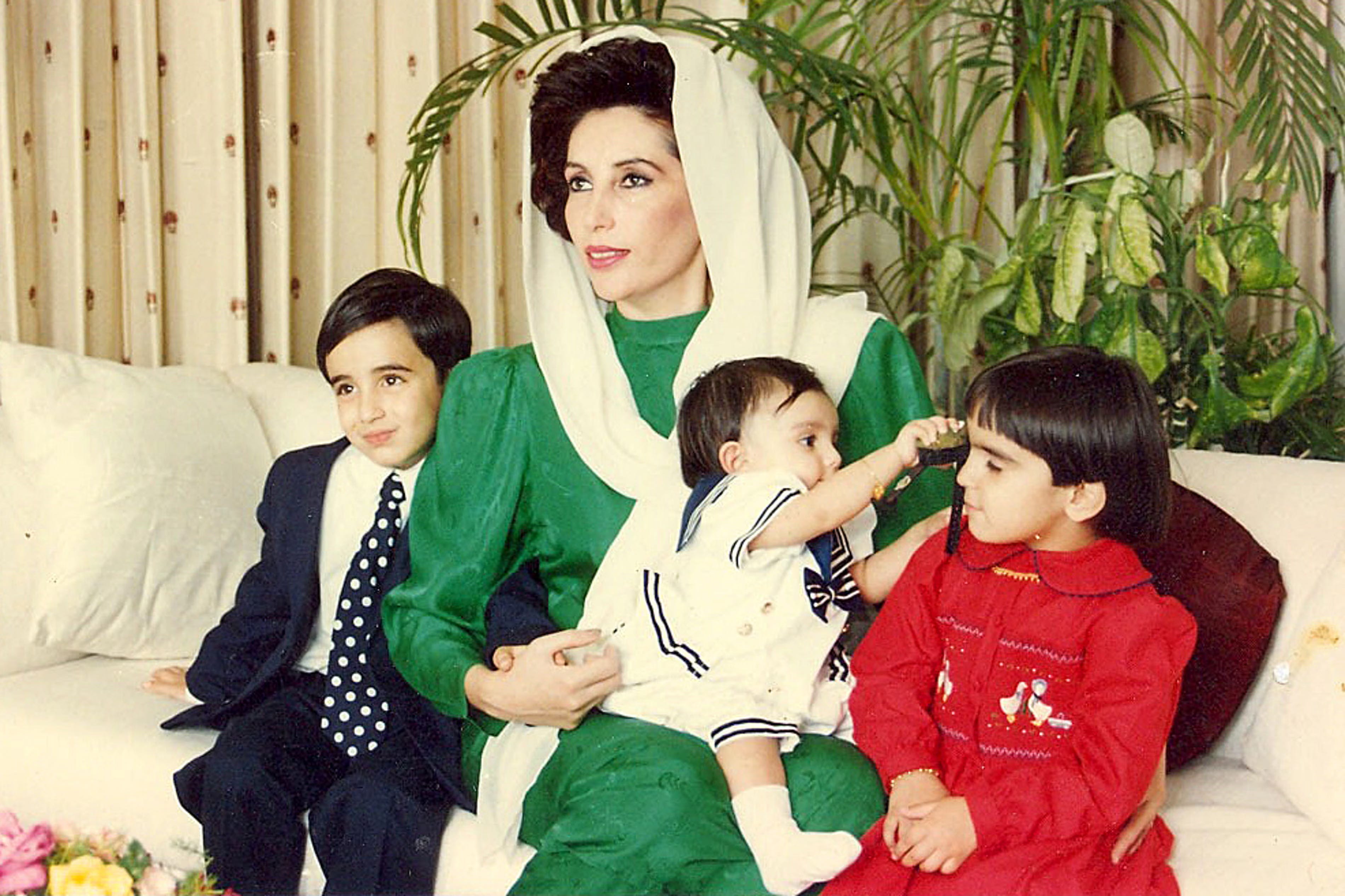
At that point in time, the only other world leader to give birth in office was Pakistan’s Benazir Bhutto in 1990.
Also 37 at the time and near the onset of her first term in office, Bhutto had kept the pregnancy hidden from nearly everyone, and for good reason. Her leadership at the time was under constant attack by opposition parties who openly called for her dismissal simply because of her gender and motherly responsibilities.
When news did break, one of her primary opponents in parliament “called Bhutto ‘greedy’ and accused her of wanting to have ‘motherhood, domesticity and glamour’ rather than serving her country”—an especially dense response given that the prime minister had just powered through a C-section and returned to work the next day.
Decades later, her son Bilawal Bhutto Zardari reflected on that period after Jacinda Ardern announced her own pregnancy as Prime Minister. Writing in The Guardian, he put words to what his siblings could only understand in hindsight:
“At the time, as her children, we didn’t appreciate how extraordinary her life was. Looking back it is clear that despite her accomplishments, every day she had to prove that as a woman she had every right to be who she was, larger than life and leading from the front, every step of the way.
As her children we didn’t comprehend the scale of her challenges because we never saw her complain, not even in private, about how she was held to a different standard just because she was a woman.”
See: Benazir Bhutto and family, courtesy of Bilawal Bhutto Zardari via The Guardian
Jacinda Ardern faced an objectively more tolerant political environment compared to Benazir Bhutto, but the decision to take leave after the birth of a child had never been made by any head of state—regardless of gender—and quickly unleashed a flood of news and criticism. She took the attention in stride, telling one news outlet,
“I'm looking forward to the day when we won't have new stories about this because it won't be nearly as unusual, but for now I accept that that's just the way it is.”
Jacinda had not planned to have a child while serving as Prime Minister. In nearly every way, it would have been easier if she hadn’t. Becoming a mother was not supposed to be a political statement or a defining headline of her premiership.
And yet, life rarely respects our linear plans. Neuroscientist Anne-Laure Le Cunff calls this the trap of “big goals”—we put all our meaning into a single basket, and when that basket tips, we’re left questioning our worth. Her antidote—and the title of her excellent book—is what she calls “tiny experiments”: instead of chasing one grand purpose, we make room to create, adjust, and respond in real time.
Creating is one of the most powerful practices for discovering meaning in our lives, but it slips out of reach when we make meaning the goal itself. That’s the paradox: the more we try to chase meaning, the further it eludes us. But when we create in response to life’s demands or out of personal curiosity—drawing on our lived experiences and experimenting in the moment—meaning often follows.
As Viktor Frankl wrote in Man’s Search for Meaning, “Success, like happiness, cannot be pursued; it must ensue.” The same is true of meaning. It takes shape when we live, respond, and create from what’s in front of us.
Jacinda didn’t plan to become only the second world leader in history to give birth while in office.
She didn’t plan to be the first world leader to take maternity leave.
She didn’t plan to be the first world leader to sit in the UN General Assembly with her child.
But by answering to the moment instead of clinging to a plan, she created a new perspective on leadership that has expanded our understanding of who should lead, and how. A perspective she shared during her final address to parliament.
“Most of you here know my story. I don’t consider myself to have had anything in my life that made me especially extraordinary. I was a child of the 80s, born to the son of a drainlayer and the daughter of a farmer.
I’m sensitive, or as [some] have called me—a precious petal. I thought that I would need to change dramatically to survive. I didn’t change. I leave this place as sensitive as I ever was. And I am here to tell you, that you can be that person, and you can be here.
I am a crier and a hugger. That’s instinctive to me. I would rather be criticized for being a hugger than being heartless. You can be that person, and you can be here.
I am a mother. I obviously didn’t start out that way. When I ran for parliament in my 20s I remember being afraid that I was choosing a path that meant I wouldn’t get to have children. But I leave knowing I was the best mother I could be. You can be that person, and be here.
I cannot determine what will define my time in this place. But I do hope I have demonstrated something else entirely. That you can be anxious, sensitive, kind and wear your heart on your sleeve. You can be a mother, or not, an ex-Mormon, or not, a nerd, a crier, a hugger – you can be all of these things, and not only can you be here – you can lead. Just like me.”
These themes fill the pages of her New York Times Bestseller, A Different Kind of Power. It’s an innovative reflection on what it means to lead with empathy and still hold your ground, to create meaning by releasing the pressure of one perfect plan and learning to experiment with and respond to the possibilities of each moment.
It’s one of the best books on leadership I’ve ever come across.
Creating. Meaning. Everywhere.
Thanks for reading about my visit with Jacinda Ardern and her new book.
This fall I’ll be teaching in Boston and traveling around the world to meet with people who are creating meaningful change in their communities.
About 3–4 times a month, I’ll share reflections on what I’m learning—stories from the road, insights from my work with entrepreneurs and leaders, and thoughts on how we create meaning through what we build.
If that resonates, I’d love for you to follow along.
Comments
Nothing yet. Say the first thing.
Sign in to join the conversation.