
Hotel Receptionist: “Your wife has been very worried about you—she’s been calling every hour since eight o’clock this morning. May I kindly suggest you call her back.”
It’s been twelve years, but I still remember the wry smile of the hotel receptionist at the Sheraton hotel in Addis Ababa, Ethiopia when he met me at the front entrance and politely relayed this message. I had been observing surgical safety practices at a rural hospital about four hours from the capital city where I was staying.
And I had been uncharacteristically out of touch for over 24 hours—no texts, no updates, nothing.
There may have been a few more pressures compiling on Katie’s end that were ratcheting up the blood pressure. Just two days earlier, she had said goodbye to me in Abu Dhabi, where we’d celebrated Christmas and New Year’s together as a family. Then she boarded a long-haul flight back home to Boston—alone—with our two-year-old and five-year-old in tow.
They woke her up around 4:00 a.m. the next morning, fully rested and convinced it was lunchtime. Also worth noting: she was four months pregnant.
See: Photo Katie sent of our jetlagged daughters during my trip around the world

Looking back, I realize I’ve often justified my absences with the fact that Katie is a ridiculously capable parent. Whatever the place is called between embarrassment and shame, I live there rent free. So when I say that I started laughing while Katie informed me that I had missed my flight to New Delhi and left her wondering if something terrible had happened between Wolisso and Addis, I’m not proud of it.
After encouraging me to continue living my best life while she kept two jetlagged toddlers alive, Katie shifted gears and asked how my visit with the physician nuns at St. Luke Catholic Hospital had gone. It was the fourth stop on a whirlwind journey I’d started just before the holidays, studying how hospitals around the world were using the surgical safety checklist.
See: Surgical Safety Research Project Schedule
Day 1: Athens, Greece
Day 3: Abu Dhabi, United Arab Emirates
Day 13: Dubai, United Arab Emirates
Day 14: Addis Ababa, Ethiopia
Day 17: Wolisso, Ethiopia
Day 18: New Delhi, India
Day 22: Hong Kong
Day 26: Hanoi, Vietnam
Day 30: Sydney, Australia
Day 35: Buenos Aires, Argentina
Day 37: Boston, USA
I initiated the project after two years of running the pediatric surgery center organization I founded. That experience shook my confidence—both in myself and healthcare delivery—and left me urgently searching for innovations that could make surgery safer.
That’s when I came across The Checklist Manifesto by Atul Gawande.
I hadn’t discovered some flashy new piece of technology. Instead, I found something profoundly simple: a surgical checklist — modeled after the ones pilots use before takeoff — that had the power to dramatically reduce complications and save lives. Gawande, a world-renowned surgeon and public health researcher, helped lead the World Health Organization’s global effort to design, test, and scale this tool across a wide range of hospitals.
Its potential to improve care and save lives is well documented. Studies indicate a reduction in major complications from 11.0% to 7.0% (a 36% drop) and a decrease in mortality from 1.0% to 0.8% (a 47% decrease).
See: The WHO Surgical Safety Checklist — used across six continents
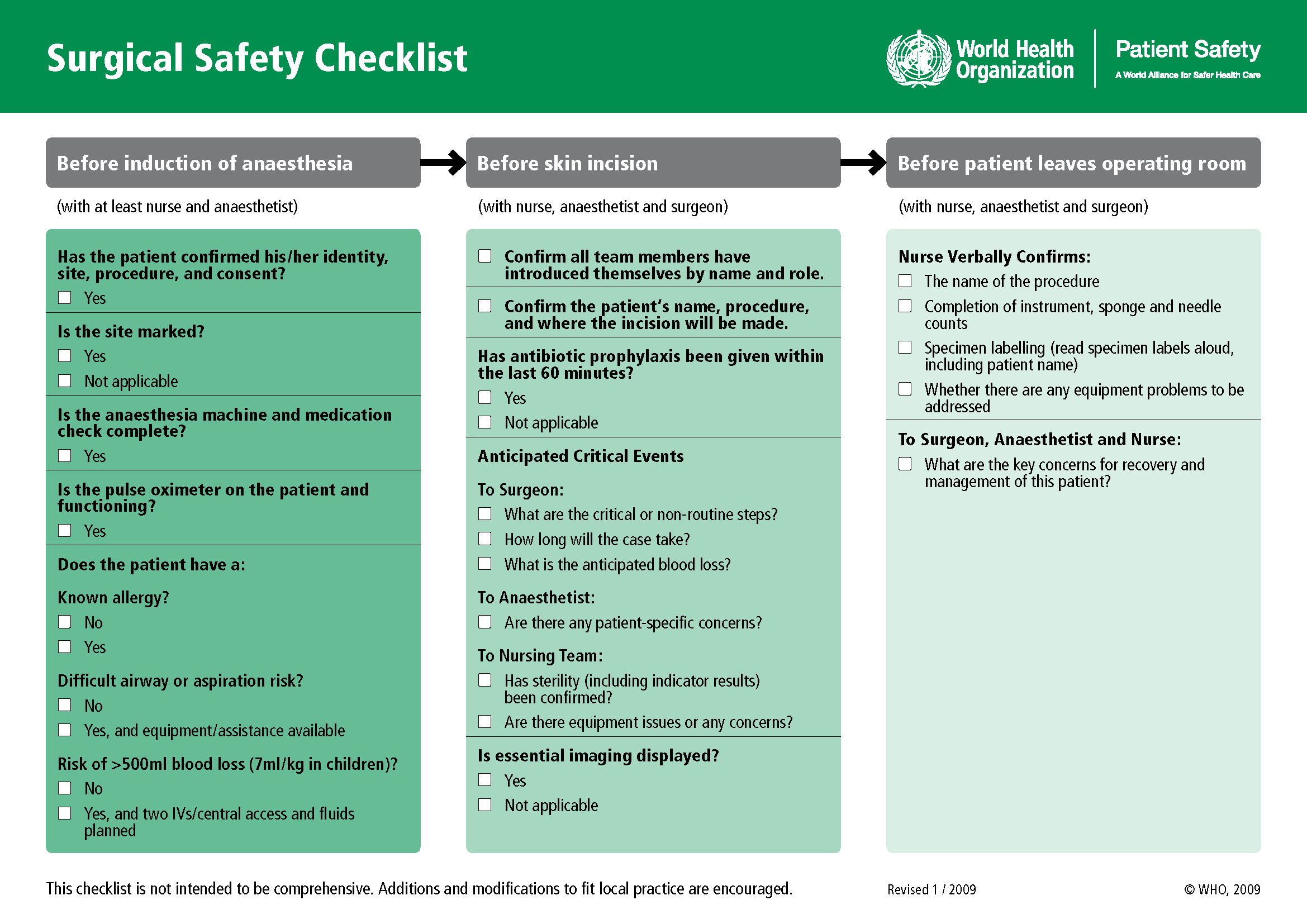
To this day, it remains one of the most impactful healthcare innovations I’ve ever encountered.
Over the course of 37 days, I visited hospitals across six continents at a dizzying pace. In every location, I saw the same surgical safety checklist in use. Some were electronically displayed on large flat screen monitors. Others were printed and taped to the wall. Most were translated into other languages.
But no matter where I was or how the checklist looked in the operating room, I saw the same moment occur: an audible timeout, a team gathered around the patient, and a two-minute moment of careful confirmations.
By the time I reached Vietnam—about midway through my trip—the process began to feel sacred. Like a prayer:
Nurse: Timeout. Let’s complete the surgical safety checklist
Surgeon: Thank you. Before we confirm the patient’s name, procedure, and incision location, let’s have each member of the team introduce themselves by name and role.
That same scene played out again and again—sometimes in English, sometimes in Hindi, Vietnamese, Spanish. But the ritual held. A pause. A breath. A shared responsibility spoken aloud.
Looking back, what moved me most was the checklist’s ability to be embraced and implemented in places that were objectively—and sometimes wildly—different. In an industry as hierarchical, regulated, and deeply cultural as surgery, the idea that one shared act of care could cross borders, languages, religions, and resource constraints feels nothing short of miraculous.
In most conversations about innovation and entrepreneurship today, the spotlight is firmly fixed on technology—especially artificial intelligence. The dominant narrative tells us that if it isn’t smart, scalable, and software-based, it probably isn’t worth building.
And yet, the most probable way to improve a surgical procedure—even today—is a paper checklist.
No code, no cloud, no machine learning.
That’s not a rejection of technological progress. Far from it. I’m in awe of what tools like AI are beginning to unlock, especially in the hands of people like Dr. Bharti Khurana, whose algorithm now helps detect signs of intimate partner violence hidden in radiology scans. We desperately need entrepreneurs like Bharti to help us harness technology to save lives.
And we also need to keep creating things that can change the world with nothing more than a piece of paper and some ink.
Creating. Meaning. Everywhere
Thanks for reading about Atul Gawande and the Surgical Safety Checklist.
This summer I’ll be traveling to Poland, Pakistan, Sri Lanka, the U.S., Ethiopia, and a few other places to meet with people who are creating meaningful change in their communities.
About 3–4 times a month, I’ll share reflections on what I’m learning—stories from the road, insights from my work with entrepreneurs and leaders, and thoughts on how we create meaning through what we build.
If that resonates, I’d love for you to follow along.
Comments
Nothing yet. Say the first thing.
Sign in to join the conversation.