
I travel by train whenever I can. Whether it’s an Amtrack ride between Boston and New York or a quick jaunt to the Munich Airport, I’m obsessed with the allure of traveling on the ground and watching the world pass by through the glass.
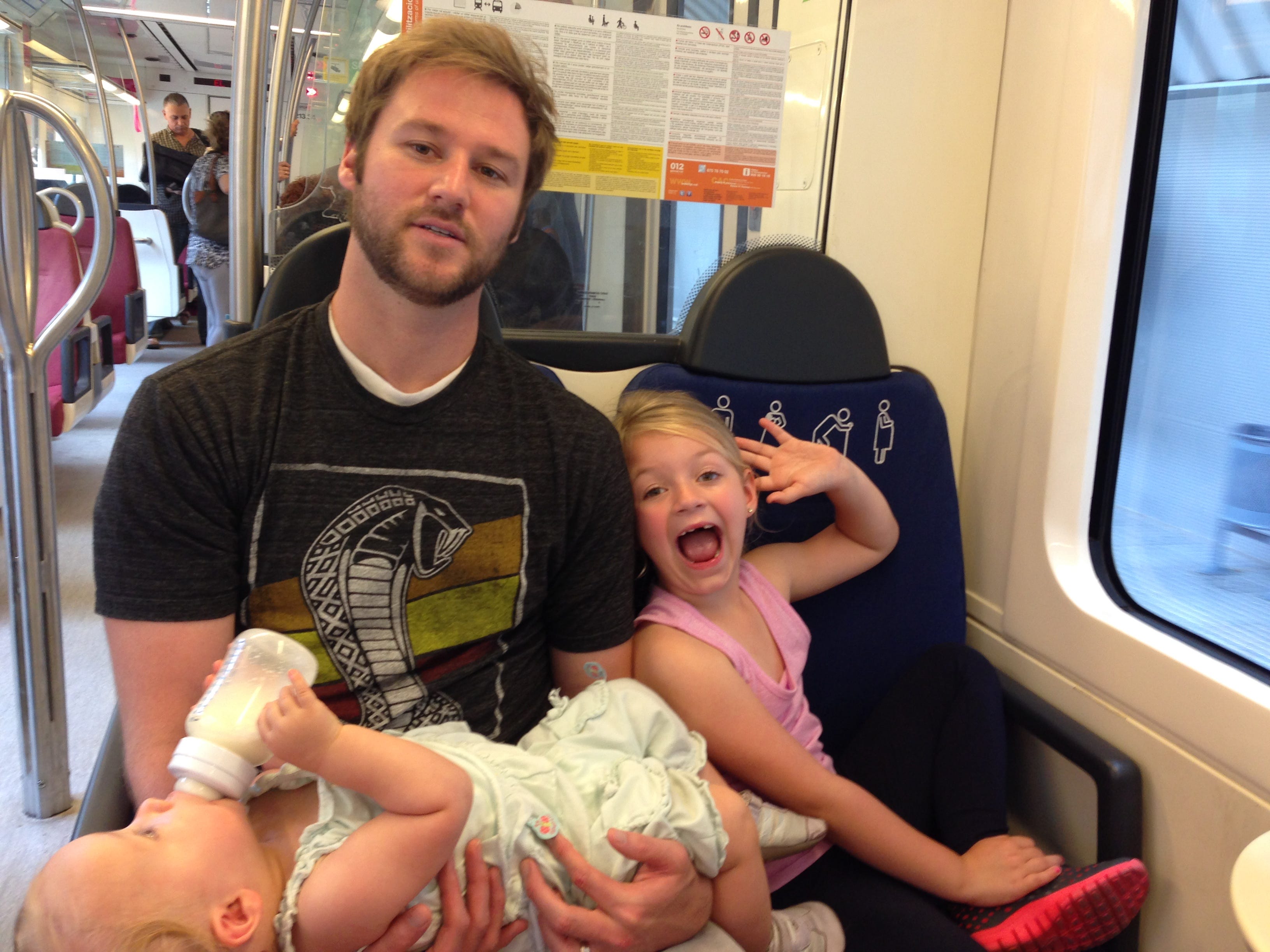
That doesn’t mean train travel always goes well for me. I’ve missed my stops more times than I’d like to admit, given bad directions to a kind elderly couple traveling through Europe for the first time, and sighed in defeat to a crowd of passengers who watched as all three of my kids projectile vomited—one after the other—in the aisle.
In my head though, I’m always Daniel Craig on a night train traveling toward Montenegro in Casino Royale. I’m sitting across from my wife, Katie, and we’re trading half smiles and casually loaded one-liners. To be fair, we’ve managed to pull this off a few times. But we’ve also had a good share of these moments as well:
See: Brian en route to Montserrat from Barcelona
Still, one of my favorite parts about living in Europe is having the excuse to travel by train and meet friends who are on vacation or speaking at a conference somewhere within a six-hour radius of Salzburg. I pack a book, grab a sandwich at the station before I board, and then sit back and look out the window.
Dr. Bharti Khurana and the AIRS Initiative
That’s how I ended up on a train to Vienna this past February to meet Dr. Bharti Khurana at the European Congress of Radiology, where she had been invited to speak about a healthcare technology she created. The innovation—an AI powered clinical support tool—aims to identify and address Intimate Partner Violence (IPV), which the CDC defines as physical, sexual, or psychological abuse by a spouse or partner.
Bharti and I first met at a student-led event at Harvard, where she delivered the kind of talk that had everybody in the audience wide-eyed and shaking their heads in disbelief—an action I saw repeated at the convention in Vienna.
She’s a leading voice in her field and checks all the boxes. An Emergency Radiologist at Brigham and Women’s Hospital. An Associate Professor at Harvard Medical School. The Founder and Director of the Trauma Imaging Research and Innovation Center.
And there’s much more to Bharti than these well-earned accomplishments. While working intensive ER shifts and publishing widely circulated research over the last 20 years, she’s also been focused on solving a problem that she sees way too often: abuse by someone who’s supposed to love and protect. Sadly, intimate partner violence is alarmingly common, affecting over a third of women and nearly a third of men in their lifetimes.
Yet most cases go undetected. For example, an estimated 44% of IPV-related homicide victims had visited the emergency room in the two years prior to their deaths.
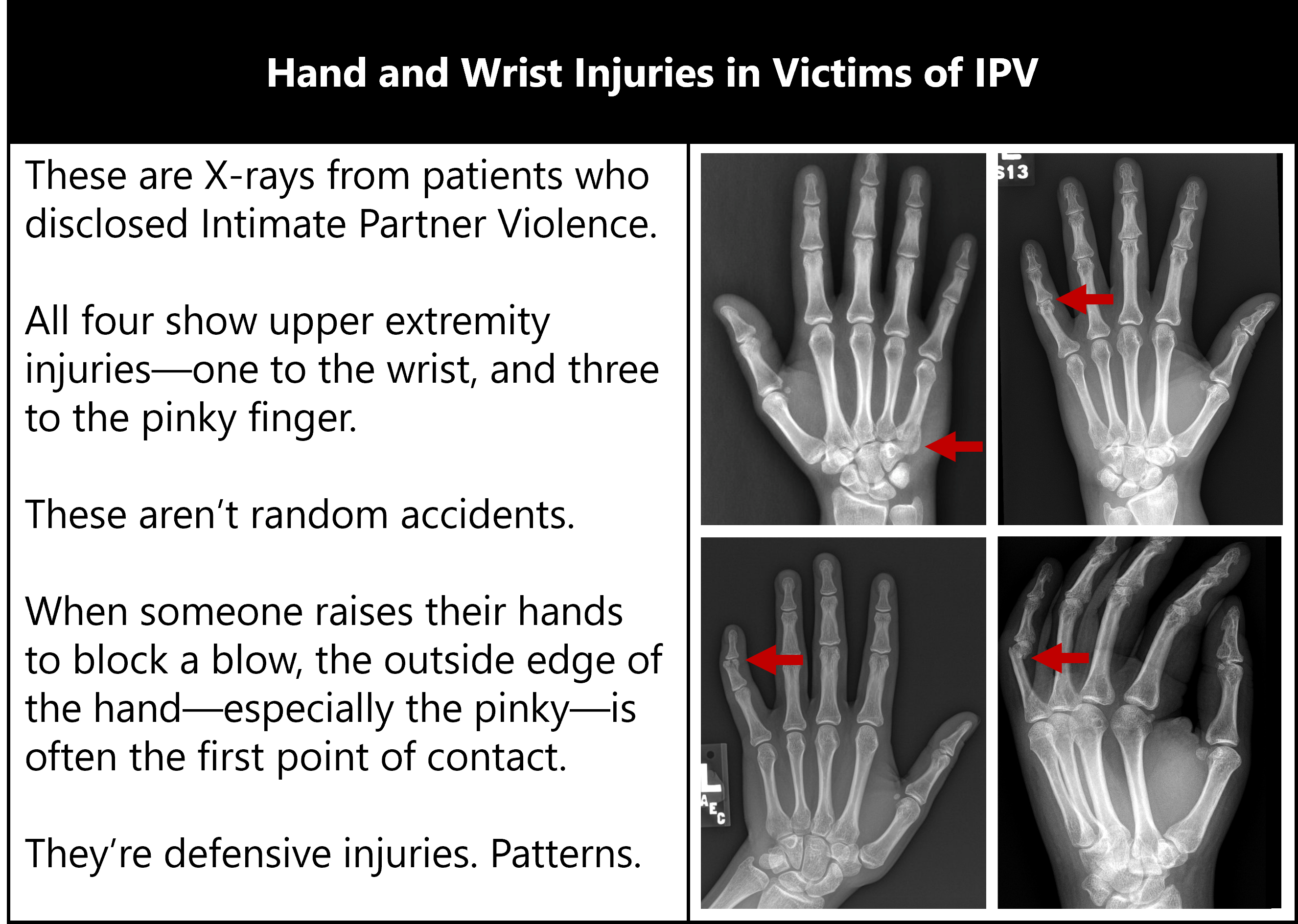
Here’s the problem: when someone arrives at the ER with a broken arm or a bruised rib, emergency physicians and nurses are trained to treat what’s immediately visible. They check the surface, confirm the injury with an X-ray, and move on—because that’s all time allows. But the body often carries a deeper history of trauma that doesn’t show up in conversation or visible wounds. For example:
A series of old fractures in the small bones just below the wrist can happen when someone instinctively raises their arms to shield their face from a blow.
Spiral fractures on the forearm might come from the violent twisting of an arm.
And some injuries simply don’t match the story that’s been told—like a “slip on the stairs” that results in damage more typical of blunt-force trauma.
See: X-rays of IPV trauma from study published in European Radiology
The clues are often subtle and scattered across past scans or buried in medical records that don’t seem relevant to the visit at hand. And in a busy ER, they’re easy to overlook.
Bharti is working to change that. She and her team have developed a breakthrough tool called AIRS, Automated Intimate Partner Violence Risk Support, which feels like something out of a medical detective series. Using AI trained on thousands of past cases, AIRS quietly scans patterns in X-rays and medical records—fracture types, injury locations, even timing between ER visits—and flags when something doesn’t add up.
Where most of us see a broken bone, AIRS sees a breadcrumb. A clue. A story.
Sometimes that story points to a fall or an accident. But sometimes, it suggests something far more dangerous: a pattern of trauma that is invisible on the surface and that victims often can’t say out loud with their partner or spouse in the room.
And once AIRS puts the clues together, its goal is to help change the ending. It equips clinicians with clear, evidence-based ways to intervene—and gives patients support tools they can access safely in their own time.
See: Bharti and Brian at the European College of Radiology Convention
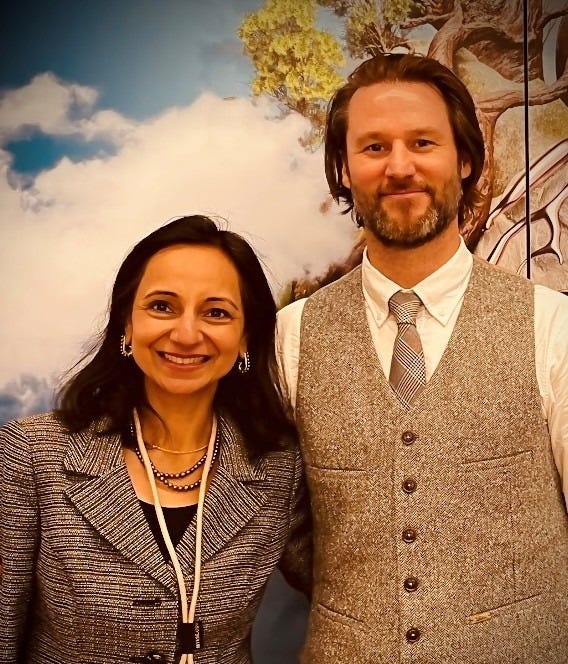
I knew that watching Bharti’s presentation in Vienna would drum up a mix of emotions. It’s a heart wrenching topic, and she navigates it in a way that draws people in with clarity and care. She’s my favorite Radiologist.
What I didn’t know about this visit to Vienna is that I would also get to meet her son, who is a brilliant pre-med student. We sat together and talked for a while as his mom was kindly answering questions and shaking hands with a line of attendees after her remarks concluded.
For me, these are the best parts of my visits with entrepreneurs—the unexpected moments that offer a glimpse into the relationships and connections that add texture and weight to the work. Bharti’s innovation stands on its own. And still, there’s something powerful about watching the call to medicine move through generations: through presence, example, and the gravity of watching someone do it well.
The meaning behind it all.
After Bharti finished with the crowd, we all sat down in a nook off one of the main hallways of the convention center, and they told me about plans for Medical School, their recent visit to the Belvedere Museum, and how they were thinking about spending the rest of the day. I gave them my classic recommendation for Vienna: go visit the Shakespeare & Company bookstore and make sure to grab some Tel Aviv-style street food at Hungry Guy when you’re done.
Then I went back to the train.
Creating. Meaning. Everywhere
Thanks for reading about Dr. Bharti Khurana and the AIRS Initiative.
This summer I’ll be traveling to Poland, Pakistan, Sri Lanka, the U.S., Ethiopia, and a few other places to meet with people who are creating meaningful change in their communities.
About 3–4 times a month, I’ll share reflections on what I’m learning—stories from the road, insights from my work with entrepreneurs and leaders, and thoughts on how we create meaning through what we build.
If that resonates, I’d love for you to follow along.
Comments
Nothing yet. Say the first thing.
Sign in to join the conversation.