
Well, March is here. We made it. Somehow. Let the (basketball) madness commence.
As the final week of the ACC regular season began, Monday’s matchup between No. 1 Duke and NC State may have produced a lopsided result, but it still offered several noteworthy takeaways, including a few defensive wrinkles from both teams, Duke’s zone offense flexing its muscles and the two-way impact of Maliq Brown.
NC State’s recent backslide over the past three weeks has been significant. The Pack are 1-5 in their last six contests, with the lone victory coming in Raleigh against a UNC squad missing its two best players: Caleb Wilson and Henri Veesaar.
In a vacuum, losing to teams like Louisville, Miami, Virginia and Duke is understandable. These are really good teams. Each ranks inside the Top 35 nationally in KenPom’s adjusted efficiency metric. The issue is the clustering effect, with the losses piling up as the regular season winds down.
Moreover, it’s the manner of those defeats that stands out. NC State has been blown out in three of the losses, falling to Louisville, Virginia and Duke by a combined 99 points. For the most part, the offense has performed at a respectable clip during this stretch (110.4 points per 100 possessions), but the defense has gone sideways.
Among ACC teams, NC State’s defense now ranks 12th in adjusted efficiency in league play. Since the Feb. 9 road loss at Louisville, when Mikel Brown Jr. went crazy, the Pack have been outscored by 20.1 points per 100 possessions, according to CBB Analytics. During that span, they’ve allowed 130.6 points per 100 possessions, and in four of those games, opponents have scored at least 128 points per 100.
If you remove the UNC game, NC State’s opponents have averaged 137.5 points per 100 possessions across the five losses.
Over this six-game stretch, opponents have shot 38.4 percent from 3-point range and 59.1 percent on 2-point attempts, including 70.2 percent at the rim, per CBB Analytics.
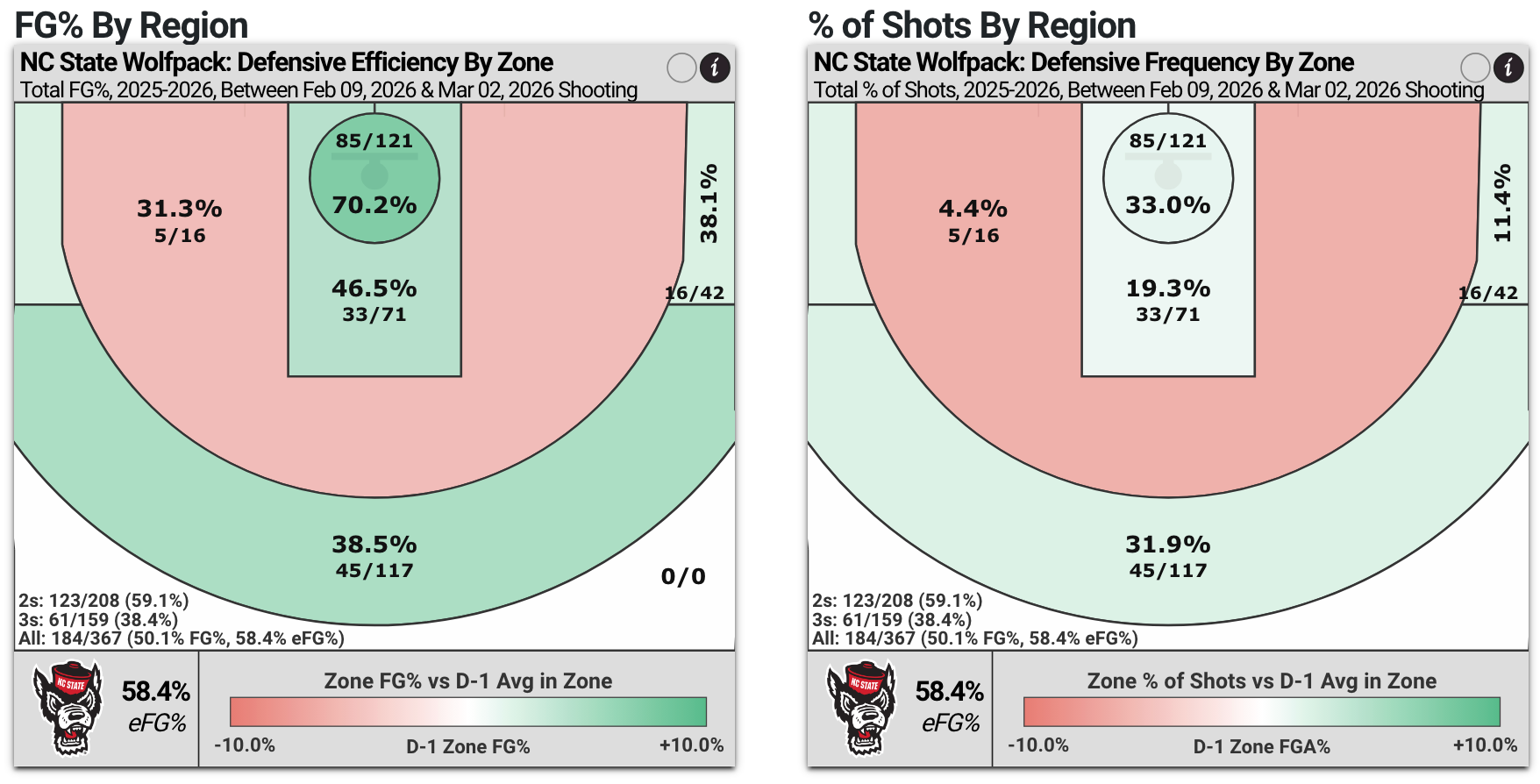
Transition defense is influenced by a number of factors, and it has been an inconsistent issue for NC State all season. Lately, though, it’s worsened. Over the past six games, opponents have averaged 12.9 fast break points per 40 minutes, compared to just 5.7 for the Pack, along with 38.5 points in the paint per 40 minutes.
According to CBB Analytics, opponents have scored 1.3 points per possession against NC State following a made field goal (66.7 2P%), 1.5 points per possession after a made free throw and 1.27 points per possession after a missed NC State field goal (42.6 3P%). On possessions lasting 10 seconds or fewer, opponents have scored a staggering 1.49 points per possession.
When things are unraveling defensively, Duke is about the last offense a team wants to see on the schedule. The Blue Devils rank No. 1 nationally in defensive efficiency, but they also bring an elite offense to the table — one that’s uniquely versatile in its play style and ranks in the Top Five nationally in both overall efficiency and 2-point shooting (61.4 2P%).
One of NC State’s biggest defensive issues is a lack of identity. Over the full season, this hasn’t been a bad unit — it ranks inside the top 60 nationally in adjusted efficiency — but the Pack have rarely looked fully settled in their base scheme.
Because of their commitment to pressure and early help, whether doubling the post or digging into gaps on drives, they’ve surrendered a high volume of 3-point attempts. NC State ranks No. 337 in Division I, with 45.3 percent of opponents’ field-goal attempts coming from beyond the arc.
In pick-and-roll coverage, NC State opened the season by switching everything 1-5. This was anticipated after how his team at McNeese State operated last season. With new personnel and a bump in competition, though, the results were mixed.
After losses to Seton Hall and Texas in Maui, NC State moved away from switching 1-5 as its primary coverage and began hard hedging more ball screens. Starting with the Auburn game, the Pack brought Ven-Allen Lubin and Musa Sagnia up to the level of the screen before retreating to their man, the screener, while the other defenders rotated behind the play.
Since then, it’s been fluid. For most of the season, NC State has toggled between those two coverages: switching and hard hedging.
However, when the Pack traveled to face SMU in early February, they shifted to drop coverage. In that game, Lubin and Sagnia played below the level of the screen, allowing NC State to stay out of rotation and avoid switching smaller defenders onto Samet Yigitoglu, a bruising 7-foot-2, 270-pound center.
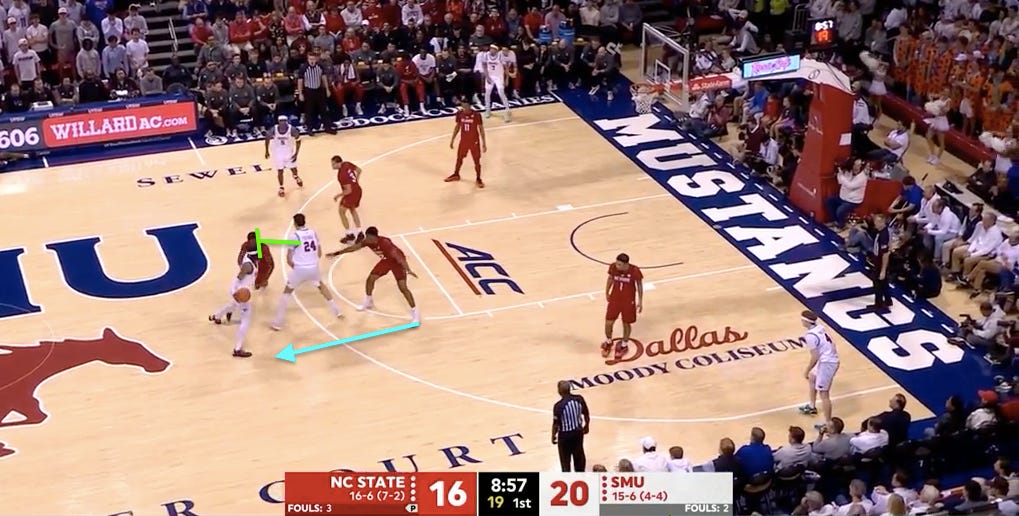
The reasoning behind the adjustment was sound, but the results were mixed, as SMU’s guards exploited the extra space with pull-up jumpers and drives to the rim. Eventually, NC State reverted to its previous approach, with its centers switching or hard-hedging SMU’s ball screens later in the game.
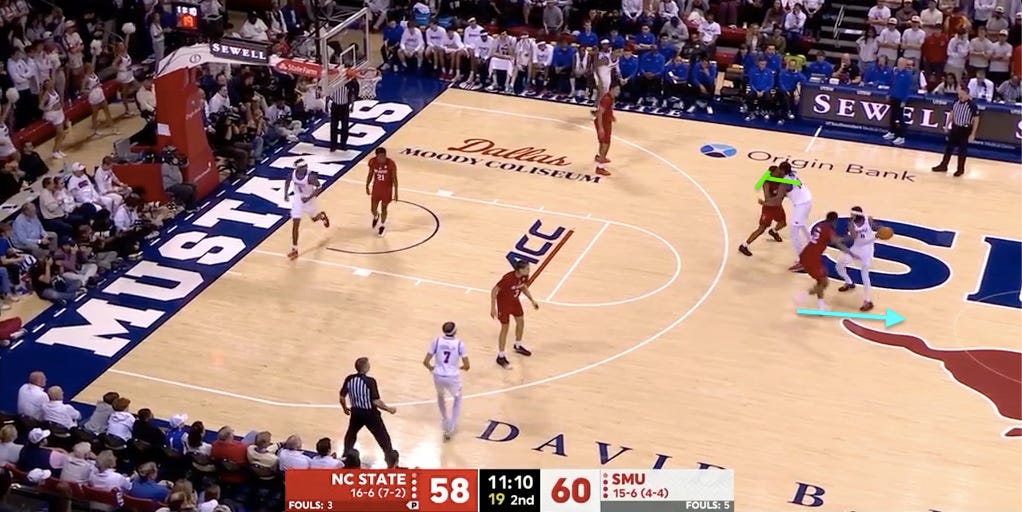
It’s one thing to be schematically versatile and nimble with coverages and matchups. In fact, it’s important to be less predictable and show opposing offenses different looks, while also going in different directions — when necessary — to combat an opponent’s structural advantage. Even then, a defense needs principles and concepts to fall back on for a game-in, game-out basis.
To me, NC State has never quite fortified its base. Without that, the changes and adjustments feel more reactive, more out of necessity, than they do from a position of strength.
It’s like a baseball pitcher who relies on a mix of fastballs and sliders to get hitters out but struggles with command, and then suddenly tries to throw in a changeup, just trying anything to make it through an inning or two. And right now, NC State’s defense is giving up a few too many extra-base hits.
When NC State opened in a 2-3 zone against Duke on Monday, I was intrigued. How would it work? And how long would it last?
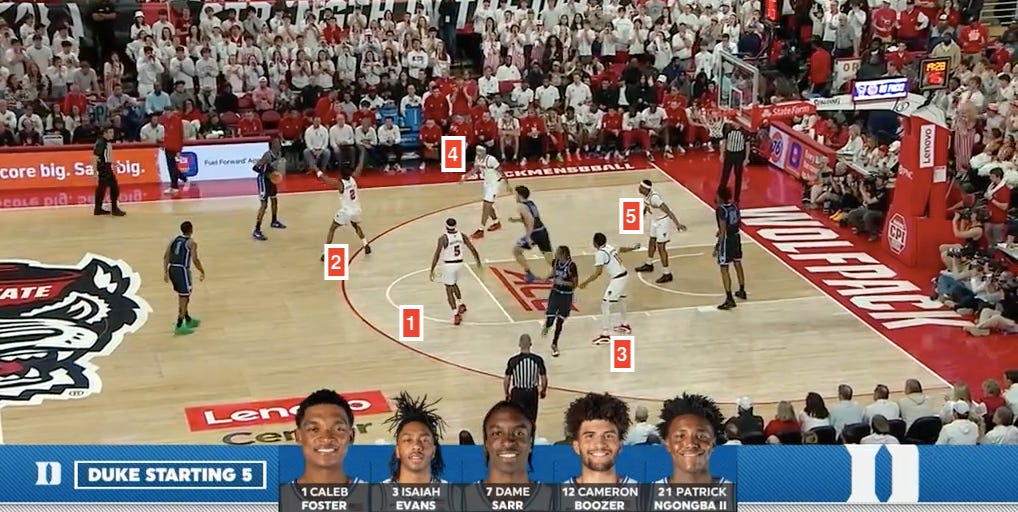
The approach harkened back to how Will Wade and McNeese State flummoxed Clemson’s offense in the first round of the 2025 NCAA Tournament, when the Cowboys used a zone to disrupt Clemson’s rhythm and timing en route to a major upset.
In theory, the zone would allow NC State to stay out of rotation and avoid tricky off-ball switches against Duke’s 5-out offense, clog the lane against Cameron Boozer and Patrick Ngongba, and protect Lubin while Sagnia came into the game compromised with an ankle injury. Get back in transition, take away Duke’s go-to half-court actions and reads and score efficiently on the other end: that would be the roadmap for another upset.
Duke, however, isn’t Clemson. The Blue Devils may not have as many quick-twitch 3-point shooters as last season, but they’re still a tough team to zone. Isaiah Evans is built to bust up zones; the sophomore hit four 3-pointers, three of them against NC State’s set zone defense. Duke also has size and is an elite offensive rebounding team, grabbing 36.9 percent of their own misses (No. 19 in Division I). Above all, they’re an elite passing team anchored by one of the best at-the-nail offensive players in the country: Cameron Boozer.
There were stretches when the zone clicked for NC State, though Duke never appeared uncomfortable against it. According to my charting, Duke’s offense recorded only two turnovers against the zone: one on an illegal screen set by Ngongba, and the other on a poor entry pass from Dame Sarr to Boozer in the right post.
According to my charting, NC State ran 30 possessions of half-court zone defense (not including possessions when NC State applied a full-court press and Duke attacked in secondary offense). Four of those possessions ended in a foul. On the remaining 26 half-court possessions, Duke scored 43 points — a sizzling 1.65 points per possession.
So, how did they do it? Let’s take a look at a few instances where Duke poked holes in NC State’s 2-3 zone.
Flashing to The Nail
The Blue Devils kept their attack on the zone simple but cycled through a few different actions that put their players in favorable spots — starting with Boozer at the nail.
Opposing defenses haven’t deployed much zone against Duke this season, but when they do, the priority is challenging the high-post feed to Boozer at the nail as much as possible. If he catches the pass cleanly and turns to face the basket, he becomes extremely difficult to stop.
NC State tried to have one of their defenders from the top of the 2-3 zone drop down and challenge Boozer — either by pressuring him on the catch or by denying the pass in the lane, as Paul McNeil Jr. did on the last play of the first half. With the clock winding down, McNeil completely vacates the slot and positions himself between the Boozer twins, while Terrance Arceneaux and Quadir Copeland aggressively shade toward the middle of the floor.
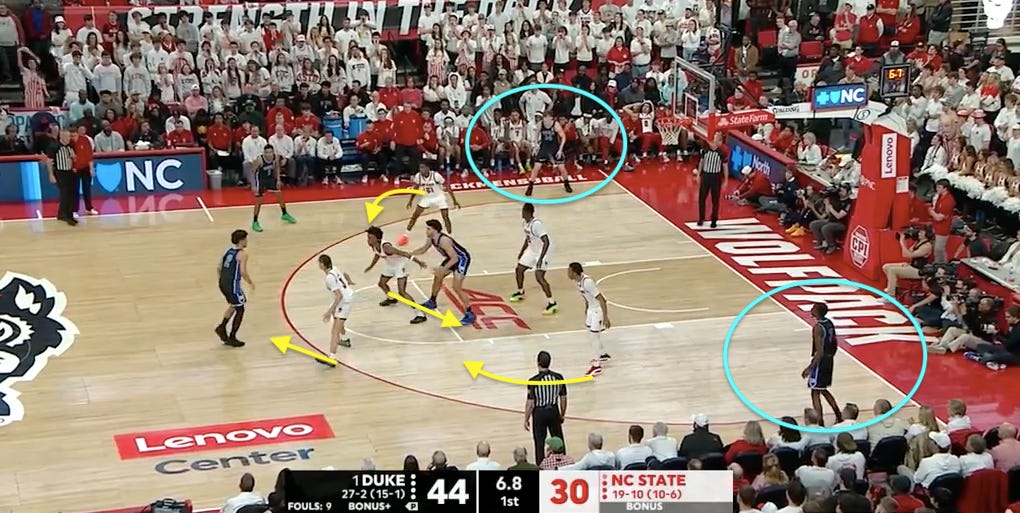
Duke makes this approach even more difficult by going small: Boozer serves as the de facto 5, surrounded by four perimeter players. With an extra 3-point shooter on the floor and NC State loading up on Cam Boozer at the nail, Duke can create a quick swing-swing opportunity — from Cayden Boozer to Caleb Foster to Nik Khamenia — before the zone can fully rotate.
According to CBB Analytics, the Blue Devils are now +16 over 40 minutes with Cam Boozer at small-ball center and Ngongba and Brown on the bench, scoring 1.25 points per possession on offense. It’s another card for Duke to play.
From The Nail: Big-to-Big Passing
As dangerous as Boozer can be as a scorer — whether facing up or cutting down from the foul-line area — he can also use this location as a playmaking hub.
On this after-timeout possession, Duke flashes Boozer to the nail while Maliq Brown patrols the dunker spot. As Khamenia prepares to throw the entry pass to Boozer, Evans spaces out to the weak-side wing, hovering near Wade. This leaves Darrion Williams in a difficult position on the backside.
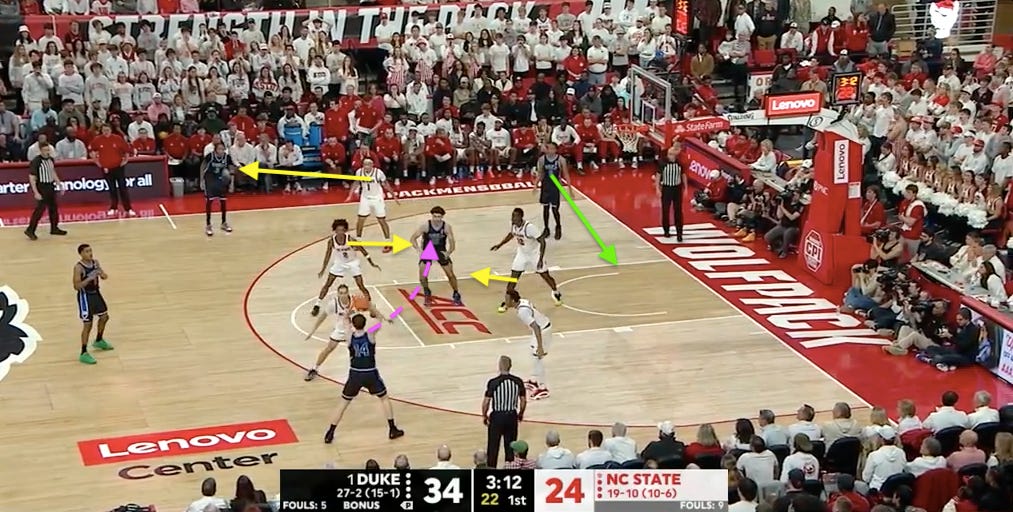
It’s simple geometry: the gravity of Evans (47.2 3P% over his last 7 games) pulls Williams out toward the arc, leaving Brown isolated on the weak side.
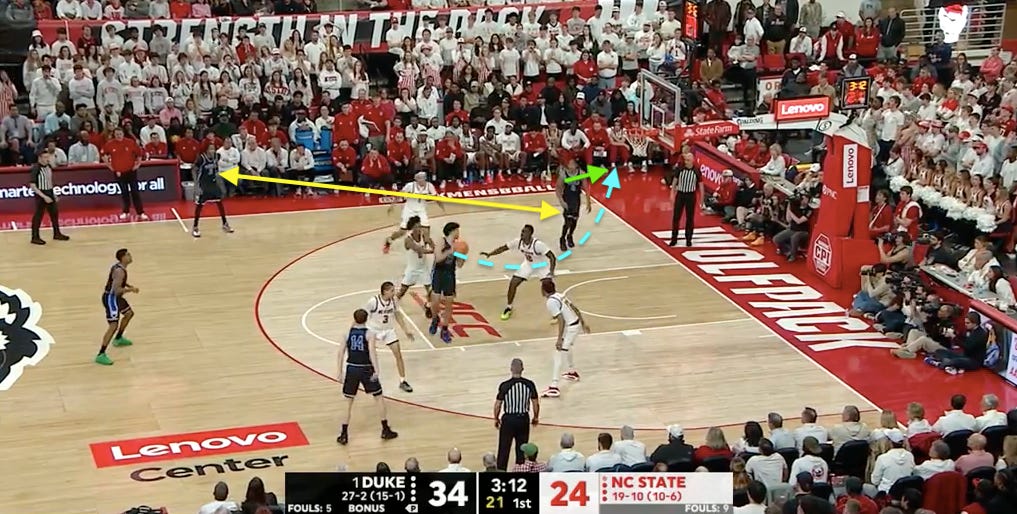
McNeil tries to help down from the top of the zone on Boozer, but as Boozer receives the pass, Scottie Ebube also takes a small step toward him. That leaves no one to cover Brown, and the rim is wide open. Boozer reads the defense instantly, delivering a quick touch pass over the top to Brown.
When I saw this play in real time, it reminded me of other recent standout 4-5 passing combos for Duke against zone defenses, particularly the Kyle Filipowski–Dereck Lively connection at Syracuse in the 2022–23 season.
Or this quick-hitter from Paolo Banchero to Mark Williams during the 2021–22 season at Syracuse.
Given the passing skills of Ngongba (15.8 percent assist rate) and Brown (14.8 percent assist rate), combined with Boozer’s interior finishing ability (72.8 2P% at the rim), Duke can easily invert those roles.
About a minute later, Ngongba flashes to the nail while Boozer seals Copeland in the weak-side dunker spot. Ngongba lofts a high pass, and Boozer showcases his touch, deftly redirecting it through the net.
Early in the second half, just before NC State abandoned the zone, Ngongba flashed to the nail and lobbed the ball over the top to Boozer in the dunker spot.
The Blue Devils will look to run this same action — flashing one of the bigs to the nail and looking for a short lob over the top to the other big in the dunker spot — against different zone coverages and with different player combinations.
SMU ran a relatively compact 1-3-1 zone in the first half at Duke, with little pressure on the ball at the point of attack. Ngongba and Brown started the possession on opposite sides of the lane, splitting the back-line defender. When Cayden Boozer swung the ball to Evans on the right wing, Ngongba lifted from the left post to the nail. Evans pulled the zone defenders high up the floor, leaving the right short corner open; Brown cut, and Ngongba delivered the lob for the finish.
Baseline Runner
Another tactic Duke used against NC State’s zone was its baseline runner action, where one of its shooters sprints across the baseline to occupy the strong-side corner and create overloads.
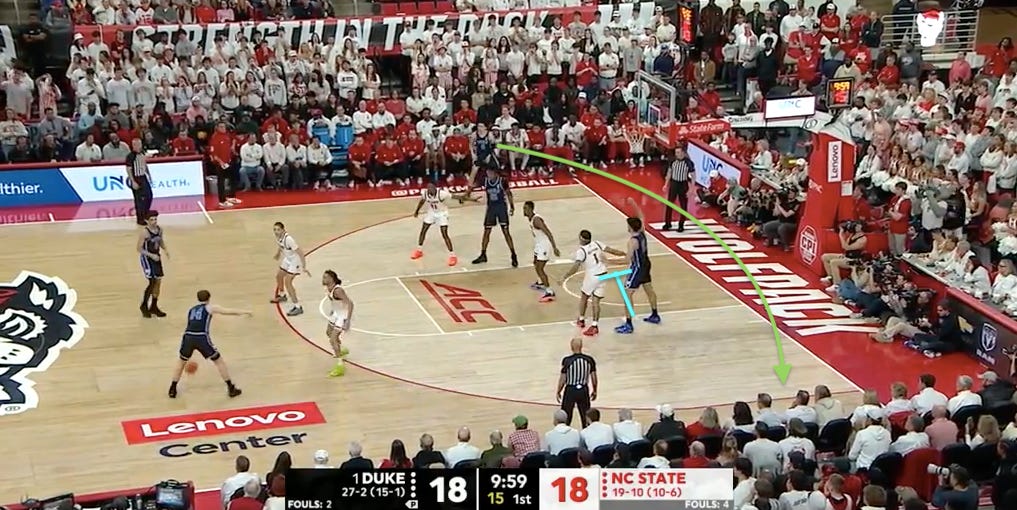
This simple cut by Darren Harris pulls Williams out to the right corner, opening up some space in the mid-post for Boozer. After the entry pass, Boozer and Khamenia execute an impromptu give-and-go, with Khamenia using a shot fake to get past Alyn Breed and set up the cut-and-finish opportunity for Boozer.
Earlier in the season against Florida, Duke ran the same baseline runner action — this time with Evans moving along the baseline — into a mid-post touch for Boozer. The Gators shifted from a 2-3 zone into a matchup look, but Boozer maneuvered to the rim and drew a foul on a put-back attempt.
Flare Screens
Brown is one of the most intuitive screeners in the country. Whether in half-court sets or in transition, he roams the floor looking for opportunities to set screens. He constantly works to free teammates for open 3-pointers with flare screens or to create driving lanes with deep seals in the paint.
Boozer is also a strong screener, and it’s not just because of his sturdy 6-foot-9, 250-pound frame. As a dangerous scorer, he forces defenses into tough decisions whenever he sets a pick: who switches and who stays? He embraces contact, using his physicality to carve out space and generate off-ball opportunities for himself and his teammates.
On this after-timeout play against NC State, with the Pack still sticking to their zone, Brown and Boozer cut across the formation. Brown moves from the left wing to the right block, while Boozer does the opposite, ending up on the same side of the floor as Evans on the left wing. As the ball swings to Foster, then Sarr, and back to Foster, Boozer rises and sets a flare screen on Williams.
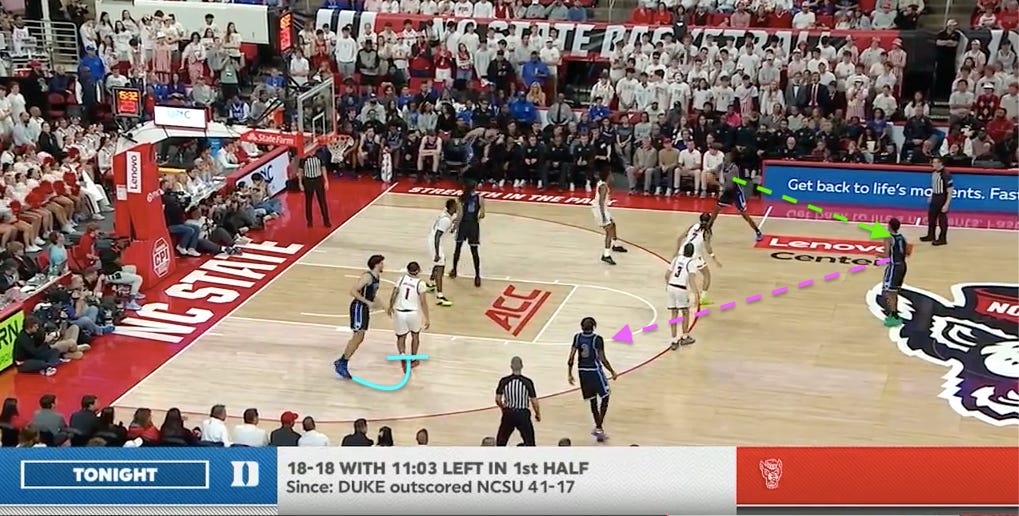
Matt Able is tasked with staying in front of Foster, which leaves Williams as the only defender on the left side of the floor responsible for two dynamic offensive players: Boozer and Evans. As always, Jon Scheyer looks for ways to manufacture these types of 2-on-1 scenarios in the half-court; he’s a master at drawing them up. When Boozer sets the flare screen on Williams, he effectively neutralizes the only nearby defender, springing Evans open for a 3 he calmly drills.
Coming out of the timeout: this isn’t an accident. It’s by design.
Screening the Top and Bottom of the Zone
One of Duke’s go-to actions against zone defenses this season has been a double-screen setup: a ball screen atop the defense by the 4, paired with an off-ball screen by the 5 on the middle low man in the zone. As the guard dribbles off the ball screen, the opposite guard defender slides over to fill the gap, creating a kick-out opportunity to an off-ball guard in the opposite slot.
For example: against Syracuse, Cam Boozer sets the ball screen for Sarr while Brown seals in the lane against center Ibrahim Souare. Kiyan Anthony slides over toward Sarr, leaving Cayden Boozer open in the right slot.
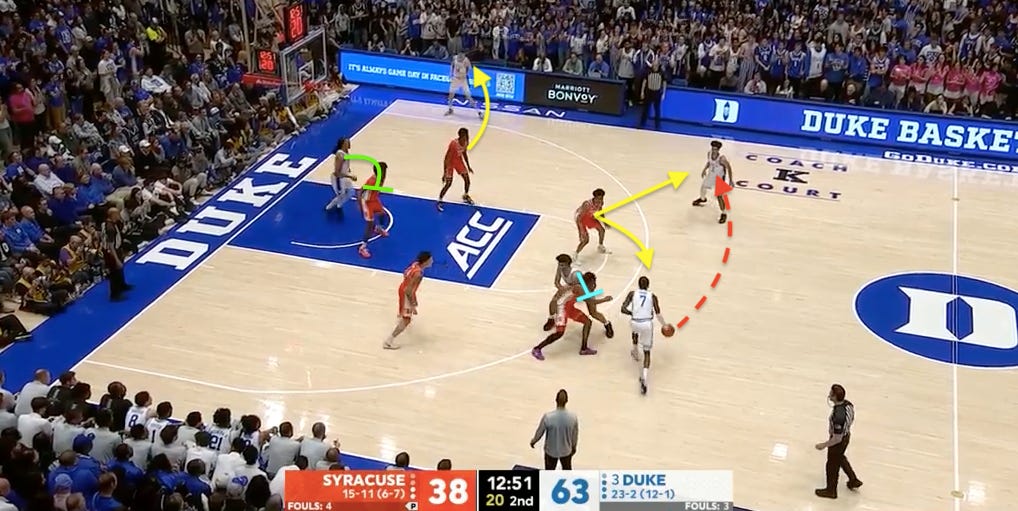
Sarr does a great job leading Cayden Boozer into space with his pass, and Boozer catches it on the move rather than at a standstill. This subtle stampede cut allows him to blow by a poor closeout from Anthony. With Brown sealing Souare in the paint and Tyler Betsey closing all the way out to Khamenia in the right corner, the proverbial red carpet is rolled out for Boozer to attack the rim for an uncontested layup against the zone.
That was certainly poor defense from Syracuse, but Duke has successfully run this concept in other games, including the matchup at NC State.
This is the very first play of the game in Raleigh, which results in a driving finish for Foster, who gets into the gap off the double screens.
Here’s the same look, this time with Khamenia initiating the action from the left wing and Harris spaced in the right corner. Once again, Cam Boozer sets the ball screen while Cayden Boozer positions himself near the opposite slot/wing. As Khamenia drives off the ball screen, Breed provides early help on the ball, leaving Cayden open on the right.
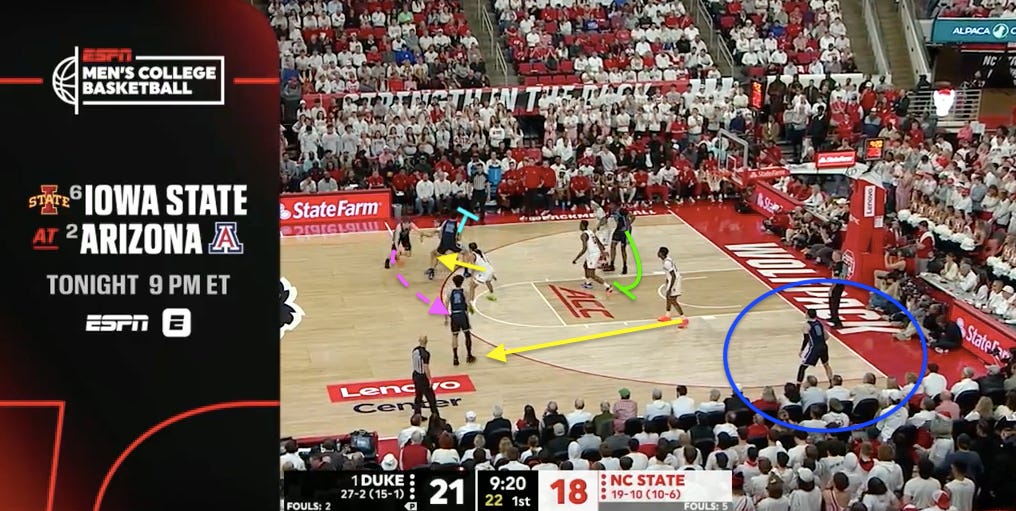
With Ngongba sealing Sagnia in the post, Khamenia’s pass to Boozer puts Arceneaux in a tough spot: hang back and let Boozer attack the gap, or rotate up and leave a dangerous shooter, Harris, open in the corner. Arceneaux closes out on Boozer and tries to rotate back to Harris, but Sagnia can’t get there in time. Thanks to a quick, precise extra pass from Boozer, Harris is left with all the space he needs to drill an open corner 3.
According to CBB Analytics, 96.1 percent of Harris’ field goal attempts this season have been 3-point attempts or at the rim. He’s connected on 8-of-19 3-point attempts (42.1 3P%) from the corners, too.
Duke got to this same action when going up against Stanford’s funky matchup zone. Khamenia drives off Boozer’s handoff/screen, Ngongba seals in the paint and Evans is left open in the weak-side corner for a spot-up 3.
In the New Year’s Eve matchup against Georgia Tech, Duke employed this approach with its jumbo lineup on the floor — Boozer, Brown and Ngongba — with a slight tweak. Using a screen from Ngongba, Boozer operated as the pick-and-roll ball handler. Georgia Tech, however, didn’t provide nearly as much early help as Syracuse or NC State. Lamar Washington sagged in the gap before sticking with Foster, who spaced out to the left wing.
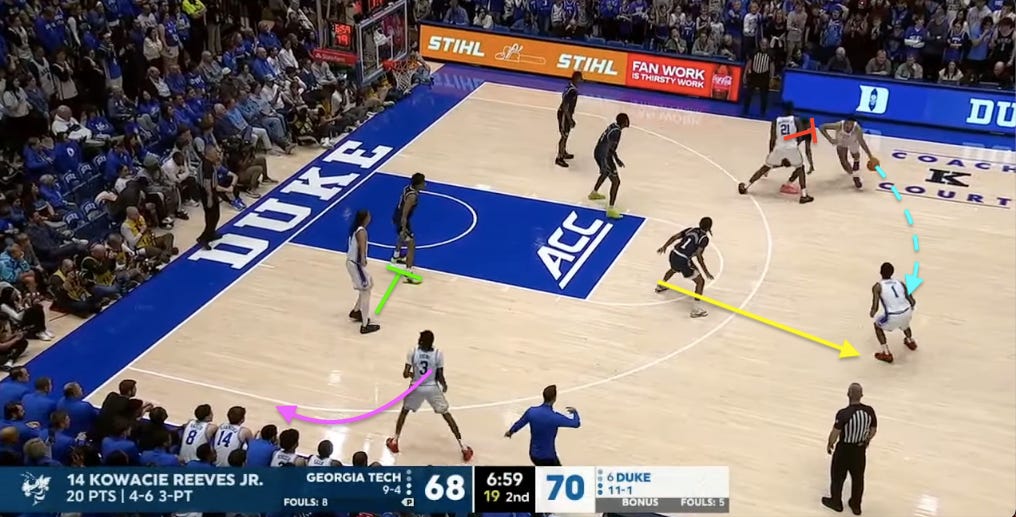
Instead of sealing the middle low man, Brown does what he does best: using flare screens to catch unsuspecting defenders off guard. Boozer kicks the ball to Foster, with Washington on him, leaving Jaeden Mustaf to handle another 2-on-1 situation. Foster quickly redirects to Evans, who uses the Brown screen and knocks down a big 3-ball.
The Wolfpack ran zone for a handful of possessions to start the second half before abandoning it and returning to man-to-man. Despite ongoing issues with transition and press defense, there were some positives in NC State’s half-court man-to-man. The post doubles on Boozer were effective, generating two turnovers on the possessions I charted as fully committed double teams.
That said, the 1-5 switch approach still put NC State in difficult spots — particularly against Duke’s pick-and-roll sets and 5-out spacing.
On NC State’s first possession in half-court man-to-man, Duke ran what I call its “Stack Low” action to create an advantageous switch.
The play begins with Cam Boozer initiating, Sarr and Foster in a stack formation near the foul line in the middle third of the floor and — importantly — Ngongba spaced in the right corner. Foster starts by popping out to the right wing off a brush screen from Sarr.
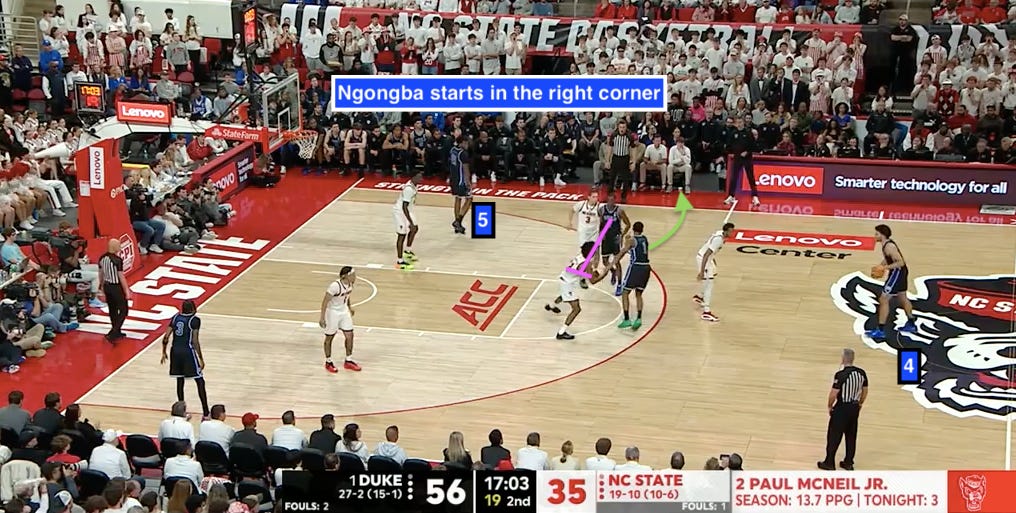
When Boozer passes right to Foster, it triggers a step-up ball screen from the 5, with Ngongba lifting from the corner to set a pick on Able.
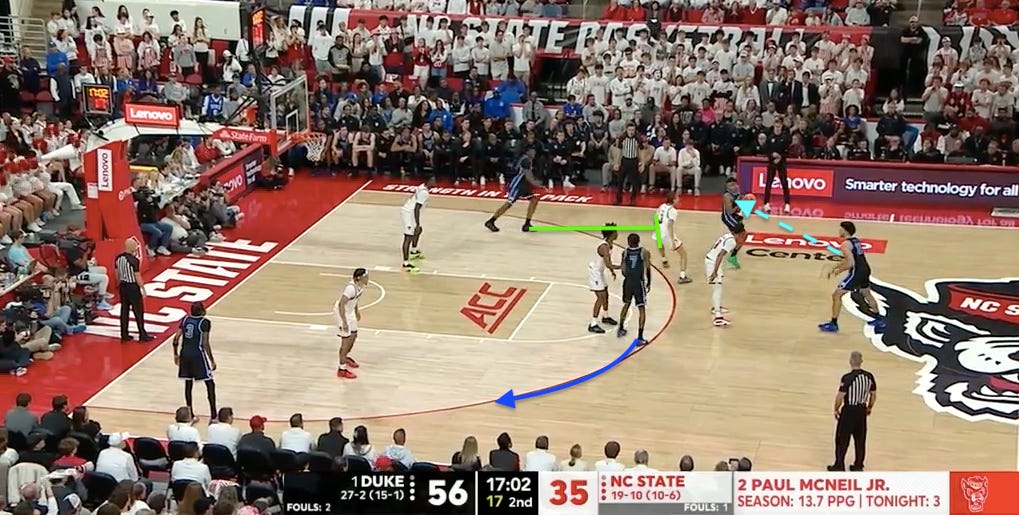
NC State switches 1-5 on this possession, placing the 6-foot-10, 280-pound Ebube on Foster and the 6-foot-6, 205-pound Able on the 6-foot-11, 250-pound Ngongba.
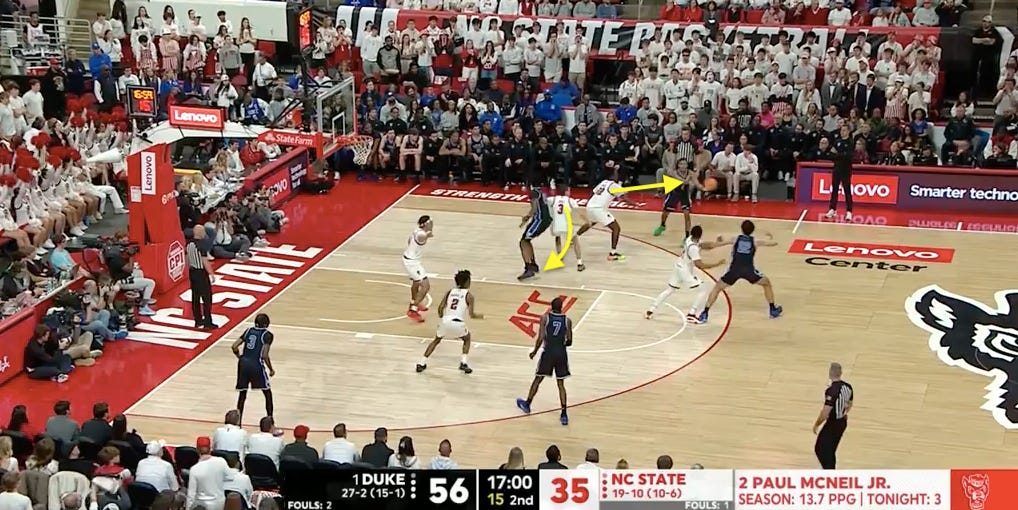
Duke knows how to exploit that interior mismatch. The Blue Devils space the floor, lifting four players above the arc while Ngongba seals in the post. Foster has a clear angle for the entry pass and lobs it over the top. Williams comes over from the weak side, but he’s too late and doesn’t apply enough pressure to disrupt the pass. From there, Ngongba has an easy finish.
Duke hasn’t run Stack Low much this season, but it was a pretty heavily featured pick-and-roll action last season, especially with Kon Knueppel and Khaman Maluach.
A few minutes later, Duke runs one of its primary actions designed to get Foster going downhill. Utah Jazz head coach Will Hardy has referred to this action as “Dribble Ray Back Side,” but for my purposes, I label it “5 Back Side” or “5 Zoom.”
It’s a 5-out set that begins with the 1 (Cayden Boozer) dribbling down the right side of the floor and executing an early handoff with the 3 (Evans) sprinting to the right corner. On the weak side, the 4 (Cam Boozer) cuts from the middle to the left wing, using a small brush/flare screen from the 5 (Ngongba), while the 2 (Foster) is positioned in the left corner as the play’s intended ball handler.
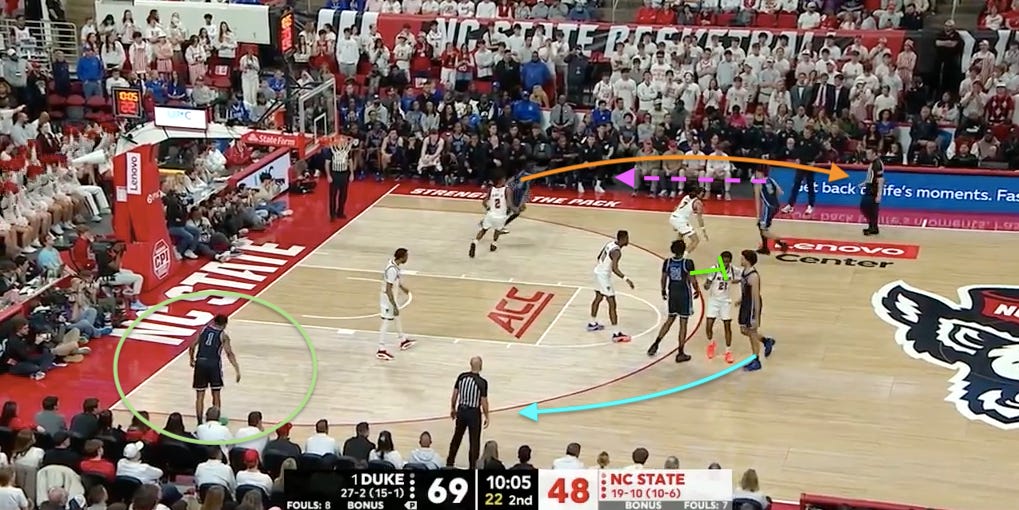
Next, Evans passes the ball to Ngongba at the top of the key, triggering the back-side Zoom action for Foster: a down screen from Boozer leading into a dribble handoff with Ngongba.
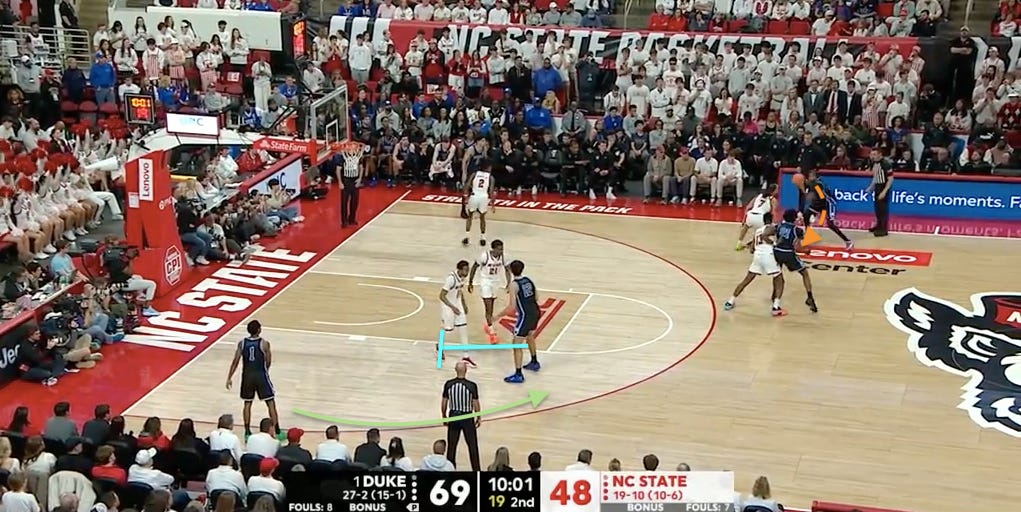
As Ngongba, Cam Boozer and Foster run the back-side Zoom action, Duke clears out space on the right side of the floor: Cayden Boozer cuts along the baseline, and Evans fills the right corner, where he started. When Foster exits the handoff, there’s no help defender on that wing.
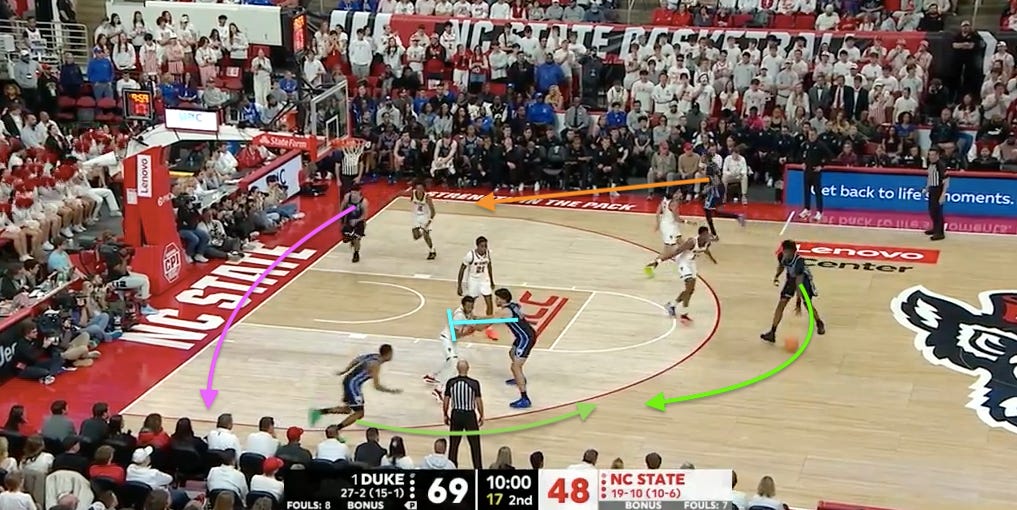
As Foster dribbles off, NC State switches across three positions: Sagnia takes Foster, Arceneaux scram switches to Ngongba rolling to the rim and Copeland goes to Boozer on the left wing.
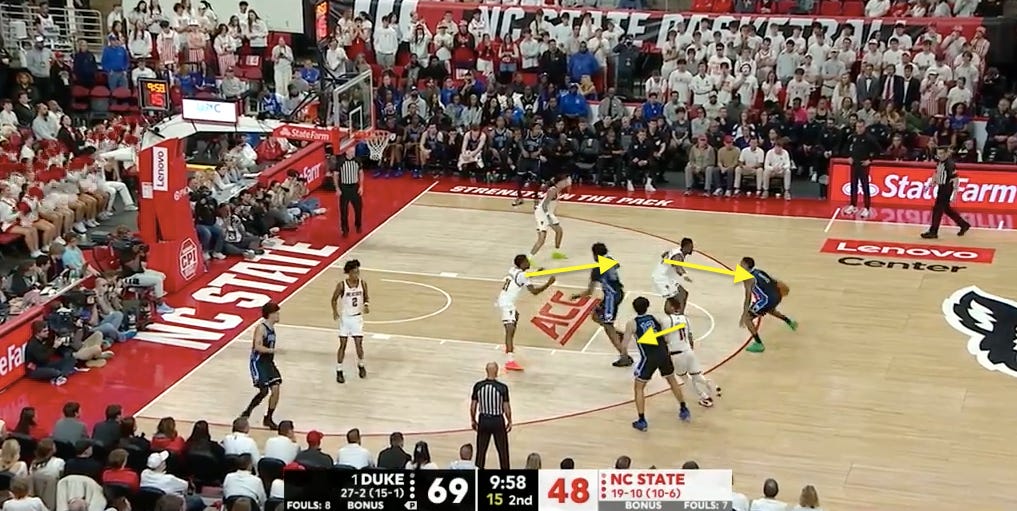
With the smaller Arceneaux on him, Ngongba immediately drops into the post and seals. As Arceneaux fronts him, Duke spaces the floor in a 4-around-1 alignment. The Boozer twins take turns assessing who has the better angle for the entry pass. Breed, the low-man help defender, can’t sag too far off Evans in the right corner, as Cam can easily skip the ball over to his corner shooter.
When the ball is swung back to Cam in the left slot, he knows it’s time to go inside. Boozer lofts a perfect hi-lo lob over Arceneaux’s reach. Ngongba high-points the ball, shields it from a late challenge by Breed and finishes with a dunk.
5 Zoom can be effective against a variety of coverages. In last Saturday’s win over Virginia — a strong defensive team that uses drop coverage rather than switching its centers to keep the ball in front and protect the rim — Duke ran this set to get Foster driving downhill. Foster made smart “paint decisions,” patiently probing the drop, waiting for the defensive 5 to step toward him and then looking for Ngongba on the roll.
The Blue Devils also attack defenses that rely heavily on off-ball switches with their 5-out split game: one of the bigs initiates in the middle third of the floor while the off-ball players move and cut around.
On this late-game possession, Brown runs the action atop the key. Cayden Boozer sprints down from the right wing, seemingly to set a down screen for Khamenia. This puts the onus on Arceneaux, defending Khamenia, and Breed, guarding Boozer, to communicate and execute the switch properly.
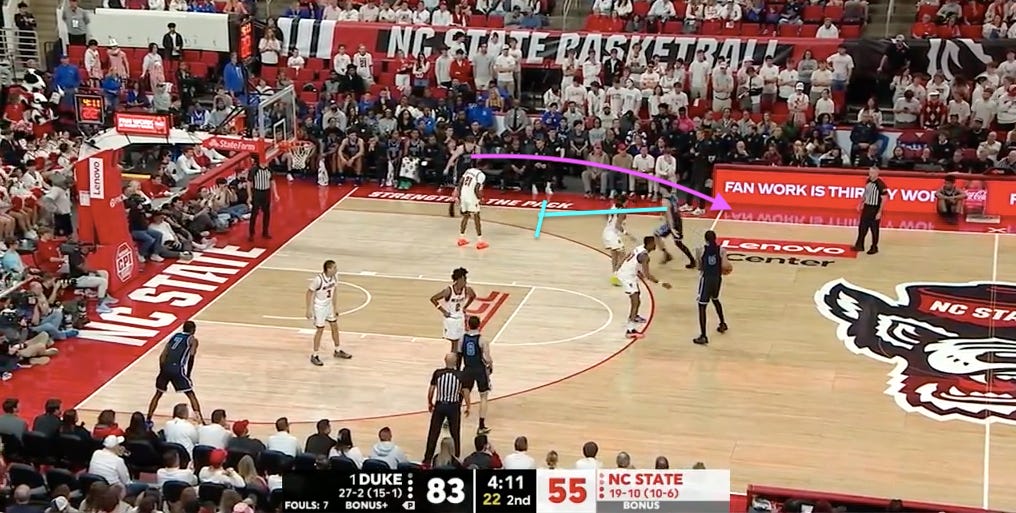
Just before Boozer sets the screen for Khamenia, he slips and cuts toward the basket, making things even trickier for Arceneaux and Breed. No screen is actually set, but the two defenders read the play differently: Arceneaux stays with Khamenia, while Breed switches off Boozer onto Khamenia.
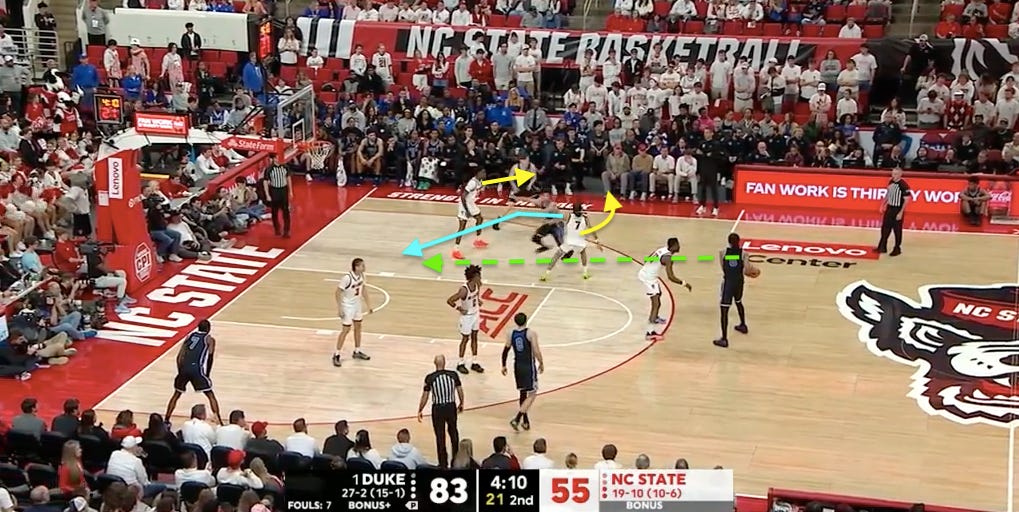
That creates a major problem for the defense, leaving Boozer completely unguarded. Brown recognizes it and delivers an easy pass to Boozer for a cutting layup.
Brown is averaging 1.8 rim assists per 40 minutes this season (96th percentile among bigs), according to CBB Analytics, accounting for 47.3 percent of his total assists (78th percentile).
NC State wasn’t the only team making defensive adjustments in this matchup. Duke also shifted its pick-and-roll coverage, moving from its base approach — hedging ball screens with both the 4 and 5 as screen defenders — to more of a 1-5 switch scheme.
On the very first play of the game, NC State is ready for Ngongba to hedge the screen, and the Pack run some effective empty-corner pick-and-roll action with Copeland and Lubin. The ball screen occurs in the right slot, while the three other offensive players remain spaced on the left side of the floor.
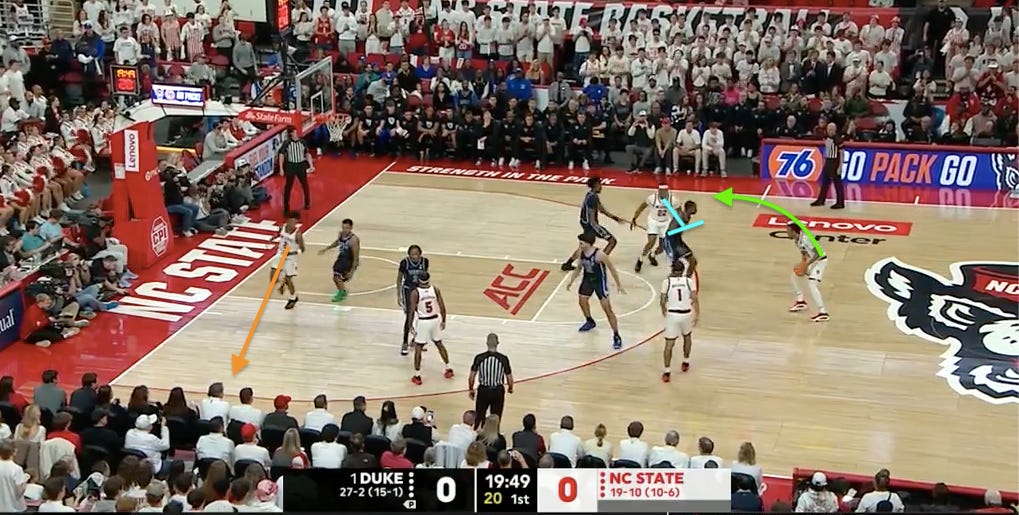
By hard hedging the screen, Duke puts two defenders on the ball: Ngongba and Sarr, who fights around the screen to stay with Copeland. As Lubin rolls to the rim, he’s largely unguarded; Boozer briefly tags him, but with Williams stepping up the floor, he’s pulled away from the paint.
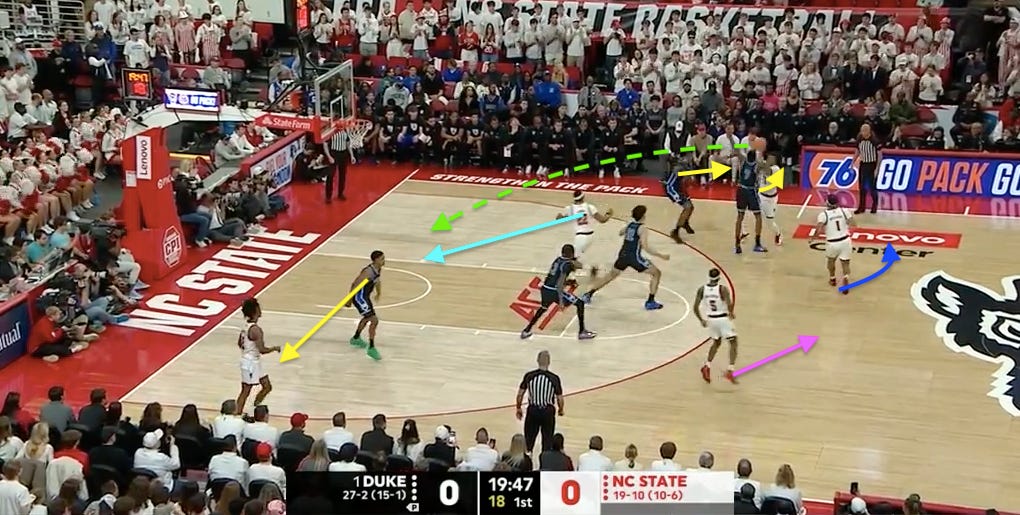
Foster is the low man on the left side, but he stays a bit too attached to McNeil, another talented long-range shooter, whom NC State uses similarly to Evans: their 3-point threat stretches defenses and distorts coverages. Foster clearly had a mandate to take away McNeil’s shot, as his 3-point shooting is a key factor in raising NC State’s offensive ceiling. Foster did a solid job chasing him around the floor, but that level of attention comes at a cost.
The bottom line: no one fully rotates to Lubin, and Copeland has the size to pass over Ngongba and Sarr. The result is a wide-open dunk: Lubin’s easiest finish of the game.
Less than two minutes later, NC State goes to “Angle” pick-and-roll from the right wing with Tre Holloman and Lubin. Once again, Ngongba hedges the ball screen, placing a second defender — momentarily — on Holloman, along with Evans.
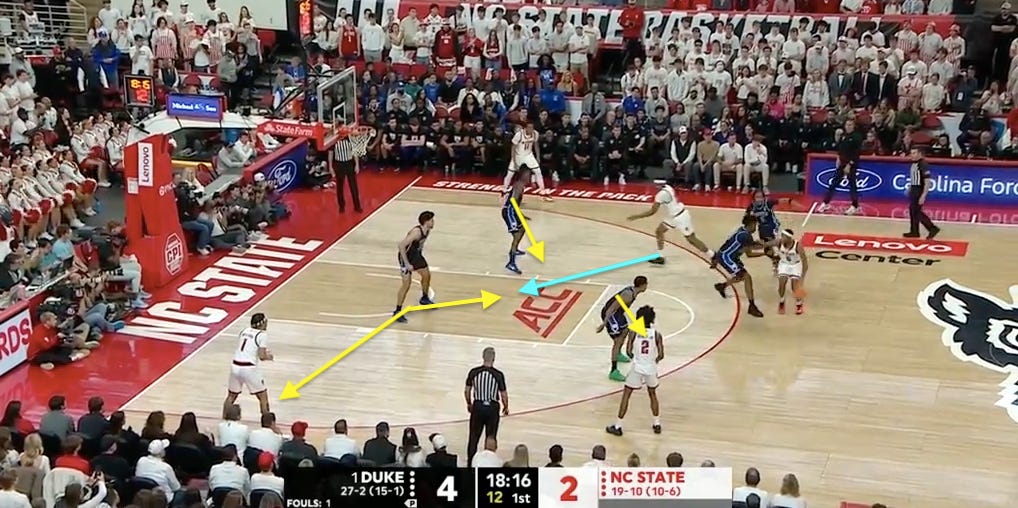
As Lubin rolls into space, Sarr steps off Copeland in the right corner to tag him, but Boozer, the weak-side low-man help defender, is also in position to defend the roll. Boozer is so far into the paint, however, that he completely leaves Williams (39.3 3P%) alone in the corner. Holloman skips the ball out to Williams, who knocks down a clean look from beyond the arc.
Nearing the midway point of the first half, Duke moved away from having its bigs hedge ball screens. Scheyer prefers to have his defenses switch as much as possible, and over the years, he’s made similar mid-game adjustments when Duke’s pick-and-roll coverages weren’t working. (The 2023 win over Pittsburgh comes to mind, when that adjustment helped the team find its defensive identity, anchored by the versatility of Lively.)
On Monday night at The Lenny in Raleigh, Scheyer returned to that approach as the primary defense for the remainder of the game: switching 1-5 against NC State’s ball screens.
Following a missed 3 from Sarr, Duke was already cross-matched on the possession, with Boozer on Copeland. As NC State ran its “Horns Twist” for Copeland, the play created an easy switch opportunity for the Blue Devils: Brown switched onto Copeland, while Boozer took Lubin, eliminating any threat of a downhill roll to the rim. Duke kept the ball in front. Copeland managed to get around Brown, but wary of a potential contest from the ultra-quick Brown — his former Syracuse teammate — Copeland rushed his layup attempt and missed.
Later in the first half, as NC State runs an empty-side ball screen with Breed and Sagnia, it’s Ngongba’s turn to switch onto the opposing point guard. Breed isn’t as explosive a driver as Copeland, but Ngongba is able to contain him, with a little help from Harris, who shows at the right elbow before recovering to Able to contest the 3-point attempt.
Finally, on this after-timeout possession, the Pack run what I call their “Strong Circle” action: two consecutive staggered down screens set by the 4 and 5 — Arceneaux and Ebube — for McNeil and then Copeland. After Copeland exits the staggers, Ebube sets a step-up ball screen, which Brown switches onto, putting him on Copeland. Duke has already contained the initial actions fairly easily, and as State scrambles to generate offense late in the clock, Ebube sets another ball screen for Copeland, triggering another switch. Duke returns to its original matchups, with Brown on Ebube and Sarr back on Copeland.
Copeland is a confident passer, but he should know better than to try this against Brown. There’s hardly any passing angle, and Brown gets into the lane to grab the steal.
With two blocks and two steals against NC State, Brown now has five straight games with two or more steals. He and 6-foot-9 Santa Clara freshman forward Allen Graves — an analytics darling for NBA scouts — are the only two players in the country with at least a 2.0 percent block rate and a 5.0 percent steal rate. Brown ranks second nationally in steal rate (5.3 percent), which is remarkable for a big man, and first in ACC play with a 5.7 percent steal rate.
Duke’s defense averaged 8.7 steals per 40 minutes with Brown on the court this season (94th percentile) and 7.1 steals per 40 with him on the bench. Brown drives turnover creation and havoc-type plays for this defense.
One game at a time, right?
At the moment, Duke and NC State are two ships heading in opposite directions. The Pack will need to execute their game plan more effectively this weekend in the regular-season finale against Ebuka Okorie and Stanford. For Duke, now on a seven-game winning streak — six of those by double digits — it’s a rematch with the last team to beat them: UNC.
Stay tuned for a Duke-UNC Preview, Part 2, later this week!
No posts
Comments
Nothing yet. Say the first thing.
Sign in to join the conversation.