
With a renewed ACC this season, the league’s crown jewel event — the ACC Tournament — delivered, culminating in a Saturday championship heavyweight bout between Duke and Virginia that served as a fitting coda.
Down two starters and playing with a seven-man rotation, Duke exchanged jabs early before landing a knockout punch on one of the nation’s best teams, further cementing its status as the No. 1 overall seed for the NCAA Tournament.
Thanks for reading Split The Action! Subscribe for free to receive new posts and support my work.
Let’s take a look at two pick-and-roll concepts Duke used to crack one of the most impenetrable vaults in college hoops: Virginia’s defense, anchored by Ugonna Onyenso.
The Delete Key
Broadly speaking, Virginia’s defense is one of the best in the country because of its ball pressure, versatility and ability to protect the paint with elite rim protection.
I wrote about this for Basket Under Review back in December, but Ryan Odom’s defense picks up the ball as early as possible, applying full-court man-to-man pressure. After burning valuable time on the shot clock with its press, Virginia settles into its half-court defense, where the Cavaliers primarily switch 1-4 and play drop coverage when the center is involved in the screening action.
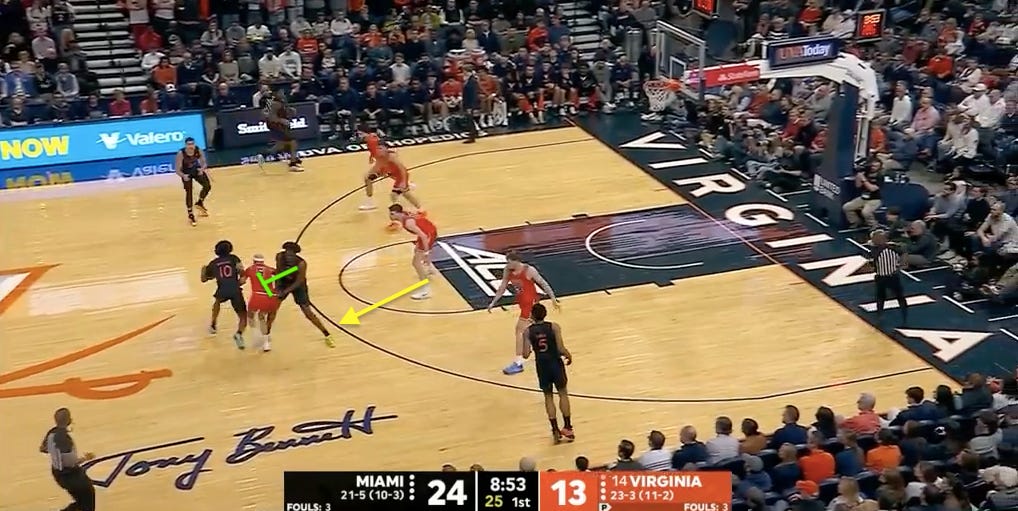
Over the course of 34 games (29 wins), opponents have averaged a possession length of 18.7 seconds against Virginia’s defense — one of the slowest marks in the country, ranking 354th out of 365 Division I teams.
According to CBB Analytics, Virginia allows just 0.76 points per chance on offensive possessions that last 20-30 seconds, with nearly 28 percent of its defensive possessions falling into that shot-clock window.
This drop-coverage approach differs from Tony Bennett’s Pack Line principles and Duke’s base pick-and-roll coverages, though there is some statistical overlap as both teams execute their schemes at a high level. While Jon Scheyer prefers his defense to be multiple — capable of switching 1–5, playing drop coverage or “weaking” ball screens — this year’s team has evolved to having its centers and Cam Boozer hedge ball screens.
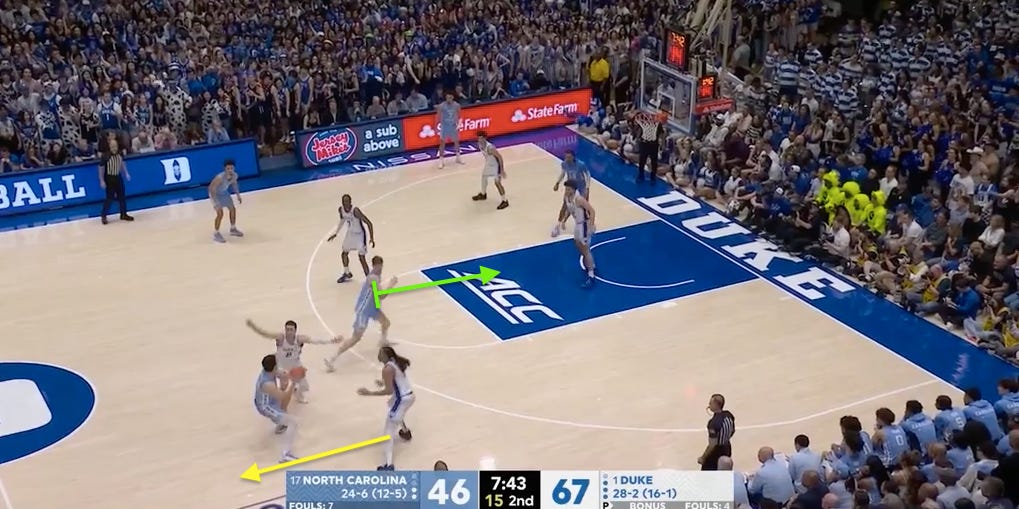
Johann Grunloh and Ugonna Onyenso, Virginia’s two centers, are rejection artists. The duo blocks shots in nearly every fashion imaginable, from key contests in the post to weak-side rim protection. That said, both are often in position to shut down the paint and rack up blocks because of Virginia’s drop coverage scheme.
As a team, Virginia ranks No. 2 nationally in block rate, rejecting 17.5 percent of opponents’ 2-point attempts, per KenPom. Individually, Onyenso (17.7 percent) and Grunloh (11.6 percent) rank first and eighth, respectively, in block rate.
Opponents are shooting just 55.6 percent at the rim against Virginia this season (95th percentile) and 36.1 percent on 2-point attempts in the paint but outside the restricted area (95th percentile). That math is baked into Virginia’s pick-and-roll coverages.
When Grunloh or Onyenso are the screen defender in these actions, they stay between the ball handler, the screener/diver and the rim. This positioning allows Virginia to defend many pick-and-rolls essentially 2-on-2 — as the on-ball defender fights over the screen — enabling the other three defenders to stay home on shooters spacing the arc. This is one of the reasons why opponents have shot just 30.9 percent against Virginia (No. 32 Division 1) this season.
There are several ways to attack an elite defense focused on making life miserable in the paint while staying out of rotation, but none are easy.
In the matchup with Michigan, Duke flexed its 5-out muscles: Cam Boozer, Patrick Ngongba and Maliq Brown operated as high-post hubs, slinging passes around the arc and hitting cutters.
To get Cayden Boozer going early against Virginia’s defense — while also finding ways to involve Darren Harris — Duke moved away from its 5-out cutting actions and dialed up Spain pick-and-roll.
An Evening Constitutional Along Las Ramblas: Spain Action
The benefits of an evening stroll can be profound, both physically and mentally. Charlotte may not be Barcelona when it comes to walkability, but the Blue Devils found plenty of upside with their Spain action in Uptown.
Spain — or Stack — pick-and-roll can be customized in many different ways, but at its core it’s a spread pick-and-roll that incorporates a third player into the action.
It’s a classic counter to drop coverage, forcing the defensive five to navigate an off-ball back screen while simultaneously accounting for the ball handler and the rim runner. Duke used it on a handful on possessions during the first meeting with Virginia this season, but it was far more potent in the ACC title game.
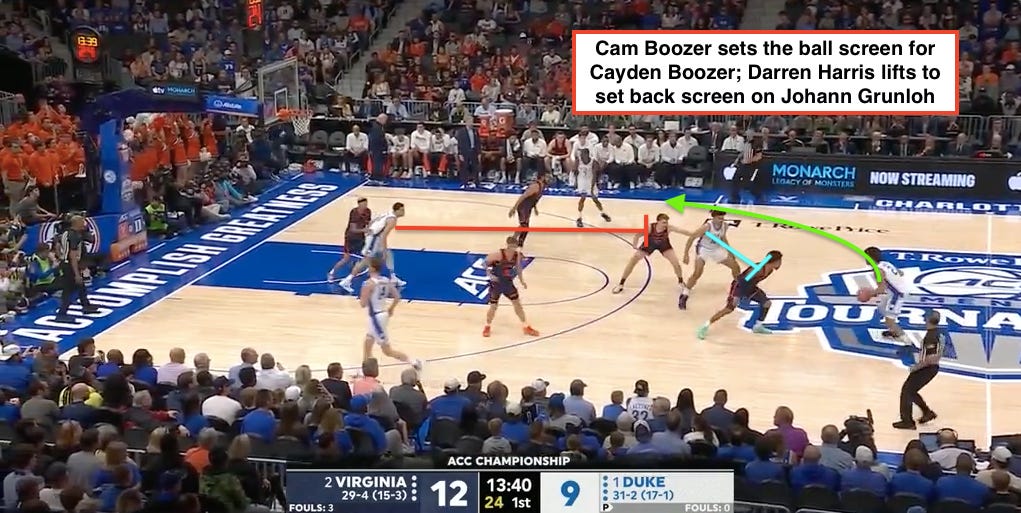
Moreover, Spain action forces the defense to drag a third defender into the coverage, making it more difficult to stay home on off-ball shooters. There’s more movement. The off-ball shooters aren’t stationary.
Given this pressure point, offenses often use their best off-ball shooter to set the back screen. At Duke, that role typically falls to Isaiah Evans or — in this case — Darren Harris, though others, like Cam Boozer and Nik Khamenia, are also used as back-screeners in the Blue Devils’ system.
Let’s see the play in action, shall we?
With Duke’s offense stuck in the mud — scoring just nine points in the first six-plus minutes while mired in a 1-of-7 shooting stretch — Scheyer turns to Spain action: Cayden Boozer as the ball handler, Cam Boozer setting the ball screen and Harris setting the back screen on Grunloh, the defensive 5.
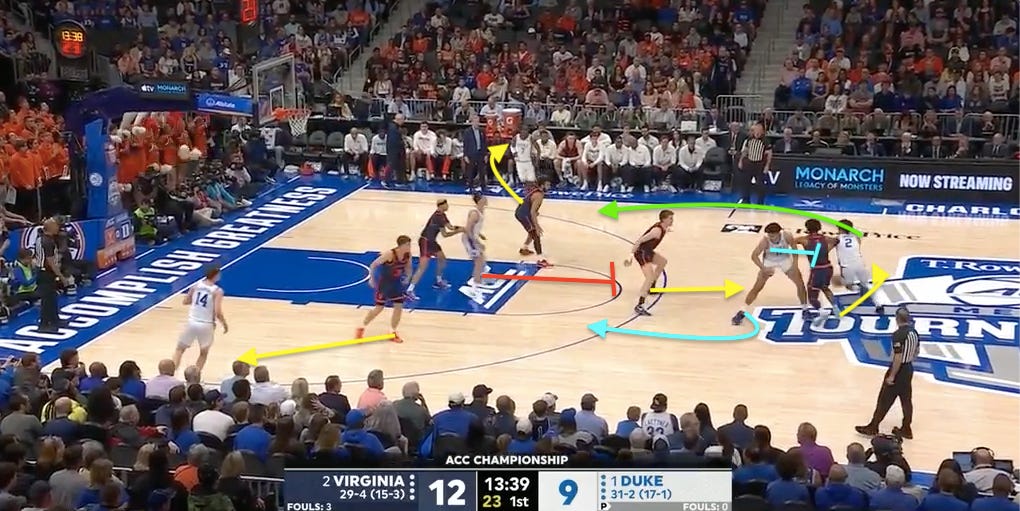
Virginia starts in its normal shell: Grunloh is still fairly high on the floor, but he drops several feet below the level of the Boozer twins’ screen while Malik Thomas fights over the top. Dallin Hall and Devin Tillis sit in the gaps, though they remain close enough to Nik Khamenia and Dame Sarr, respectively.
As Cam Boozer rolls to the rim, he’s bound to draw significant defensive attention. That puts Grunloh and Jacari White in difficult spots. White may want to follow Harris — a dangerous roving shooter who just set the back screen on Grunloh — but he’s now the closest defender to the paint. He also has to be ready to help on the roll.
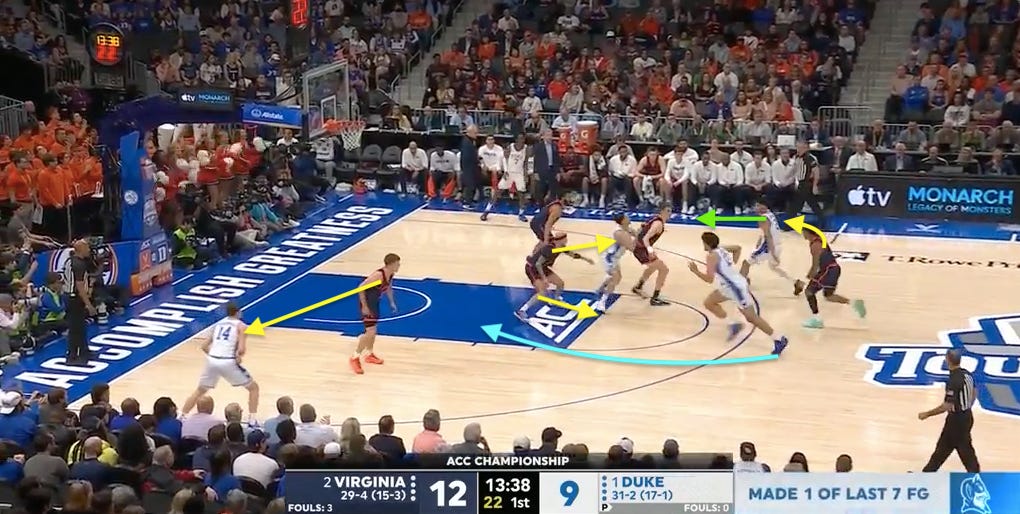
Grunloh is usually steady at controlling this action, but here he shows some sea legs, peeling off Harris’ back screen to recover to Cam Boozer and removing himself from the space between Cayden Boozer and the rim. He also errs by turning his back to the ball. Thomas remains attached to Cayden Boozer but trails from behind in rearview pursuit. White is now the only defender between Cayden Boozer and the basket, but he’s also dealing with Cam Boozer’s roll and Harris. This is a win for Duke, as the offense neutralizes the load-bearing beam of Virginia’s defensive structure.
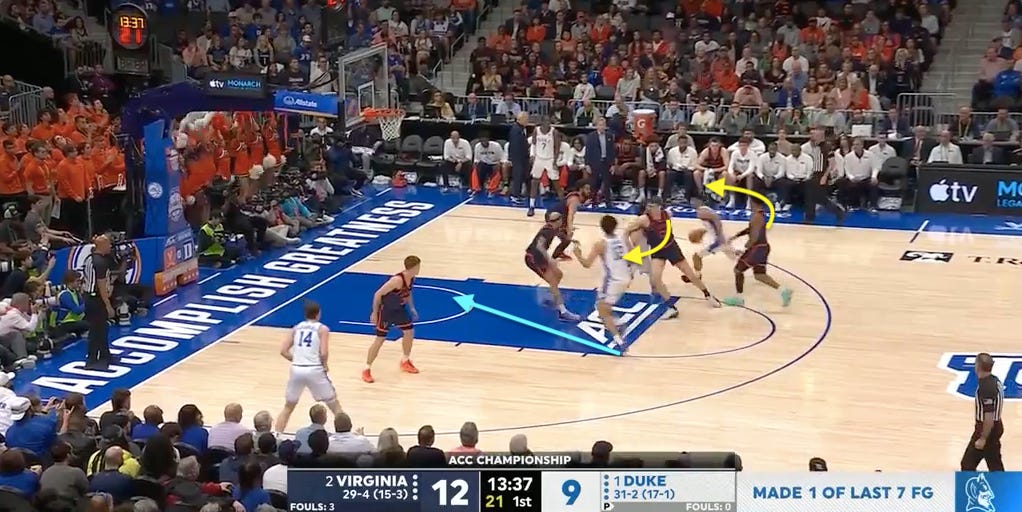
As Cayden Boozer turns the corner, White slides over but offers a weak contest at the rim. Boozer blows past him, and with Grunloh stuck on the floor, he has a clean look at the basket.
One minute later, it’s the same Spain set from Duke — now with Brown setting the ball screen for Cayden Boozer.
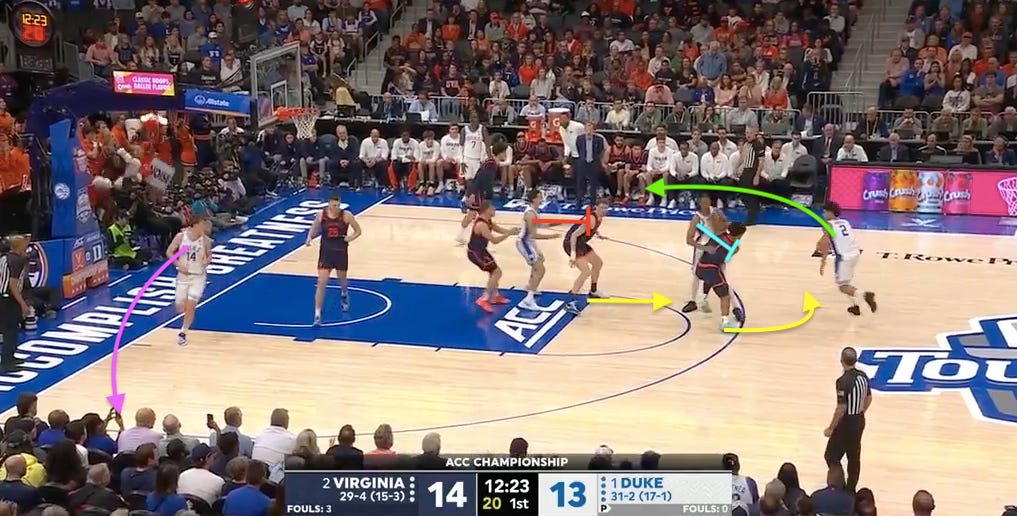
This trip, Grunloh does a better job shedding Harris’ screen. Most importantly, he doesn’t turn his back to the ball, staying between Brown and the rim. However, by sticking with Brown, Grunloh is no longer in front of Boozer. Dallin Hall, now the low-man defender instead of White, must peel off Harris and help on the drive, while Thomas again trails from behind.
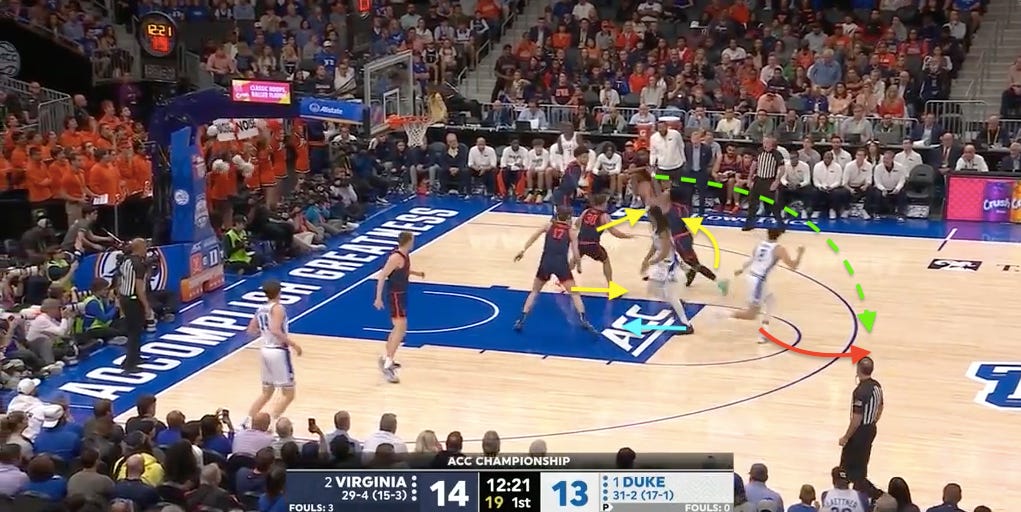
Virginia has the paint packed, but with two defenders committed to the ball, Harris is left wide open beyond the arc. Thomas must scramble to close out, but he’s nowhere near Harris as the shooter begins his motion.
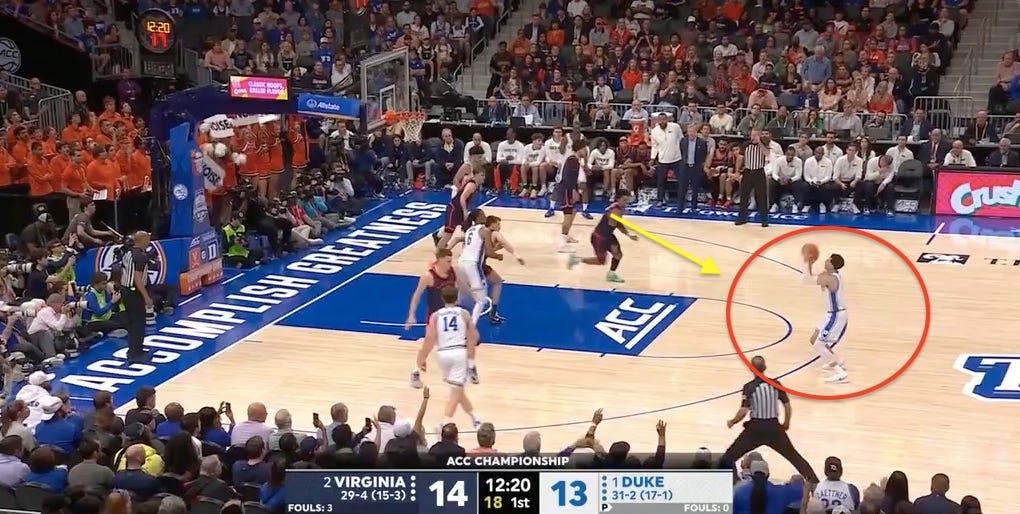
This is about as good a 3-point look as an offense can hope to generate in the half court against Virginia’s set defense. Harris misses, but it’s a great opportunity and a strong use of his skill set. That’s why this sequence felt almost as notable for Cayden Boozer as it was for Harris, a backend rotation player now in an elevated role for Duke’s postseason run.
As I wrote last season, the Blue Devils signal Spain action with a head-tap motion — either from Scheyer on the sideline or from one of the players on the floor. With about 11 minutes remaining in the first half, Boozer brings the ball up the floor as Scheyer taps his head with his right hand. (This is also why I refer to this as Duke’s “Tap” series.)
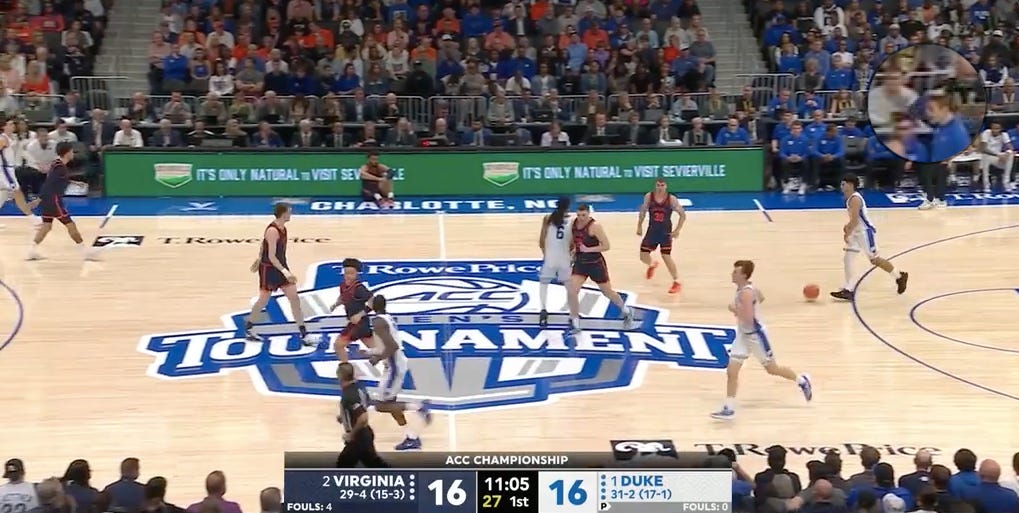
Once again, it’s the same offensive setup: Spain action, with Brown setting the ball screen and Harris on the back screen. Hall defends Boozer at the point of attack and will now be tasked with fighting over Brown’s pick. Grunloh, of course, remains in drop coverage.
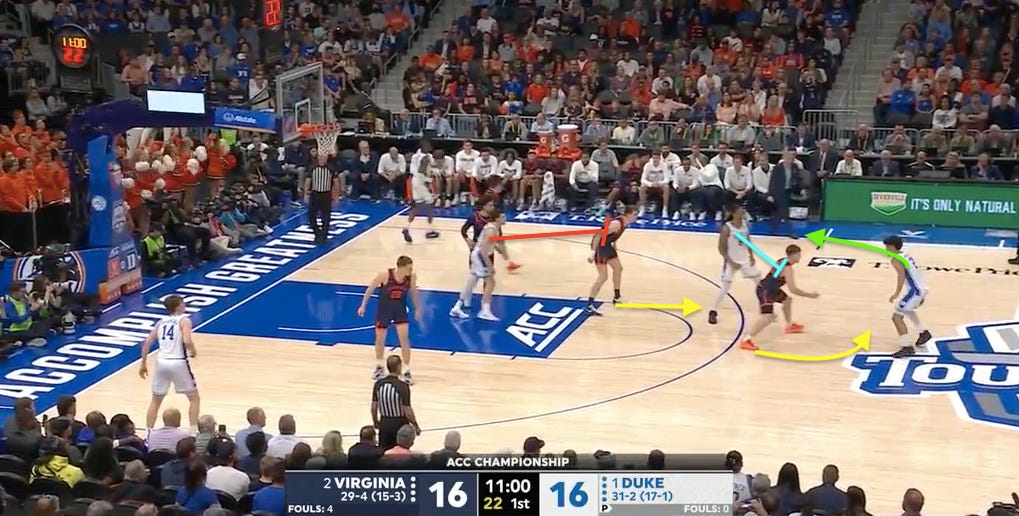
After giving up two quality looks the first two times Duke ran Spain action, Virginia takes a different approach this time. Many defenses try something similar against Spain action. Virginia opts to late switch within its coverage: Sam Lewis will switch off Harris and cover Brown’s dive, Grunloh will shift from drop coverage to become the primary defender on Boozer and Hall will peel off his pursuit of the ball to guard Harris on the pop.
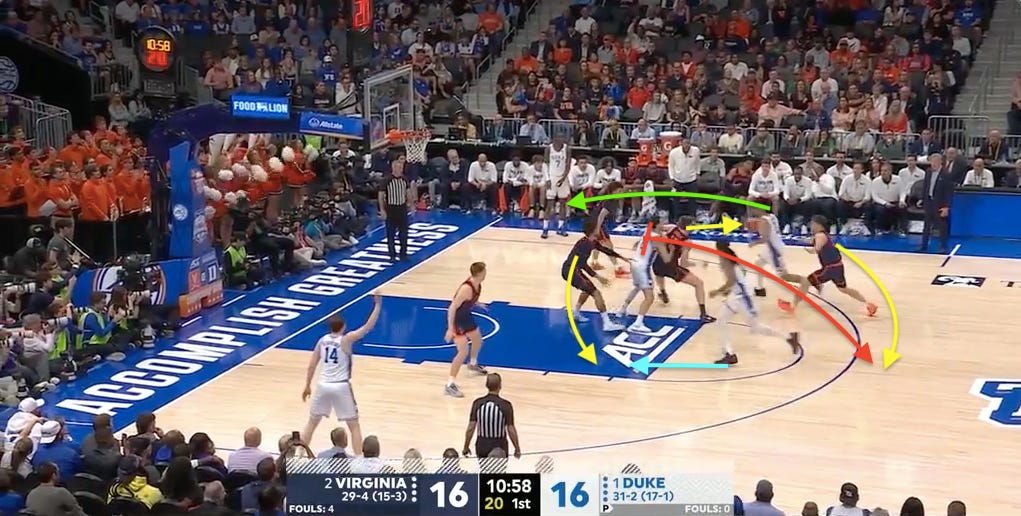
In theory, this approach allows the defense to keep the ball in front and prevent the rim runner from getting behind for a lob, while also maintaining a defender on the back screener to deny a potential open 3-point attempt. However, mismatches now appear in the paint, including Grunloh, who must do something he isn’t used to: navigate a ball screen (Harris) and stay in front of a ball handler with momentum.
Boozer gets leverage on the flat-footed Grunloh, who fails to recover. The result is an uncontested layup for Boozer. Once again, Duke’s Spain action has neutralized the strength of Virginia’s defense.
Two minutes later, Cam Boozer is back on the floor for Duke. He’ll again be involved in Spain action, though in a different role. Boozer signals the play by tapping his head.
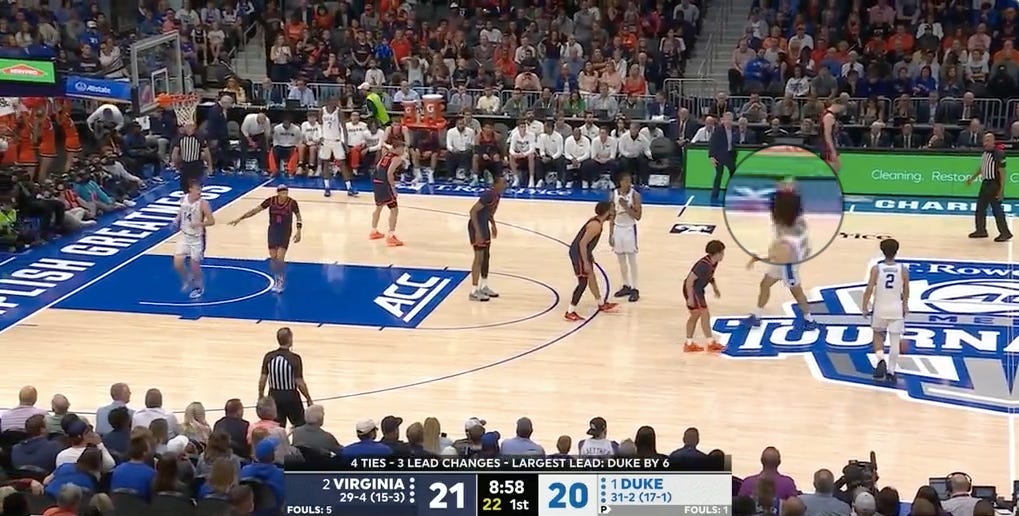
Instead of setting the ball screen for his brother — that’s Brown’s job — Cam takes Harris’ place, working as the back screener in the set. Onyenso comes in for Grunloh, and while he remains in drop coverage, Virginia adjusts its approach to this action once again. Chance Mallory is at the point of attack on Cayden Boozer, but when Brown sets his screen, Mallory won’t fight over; he goes under and meets the ball on the other side.
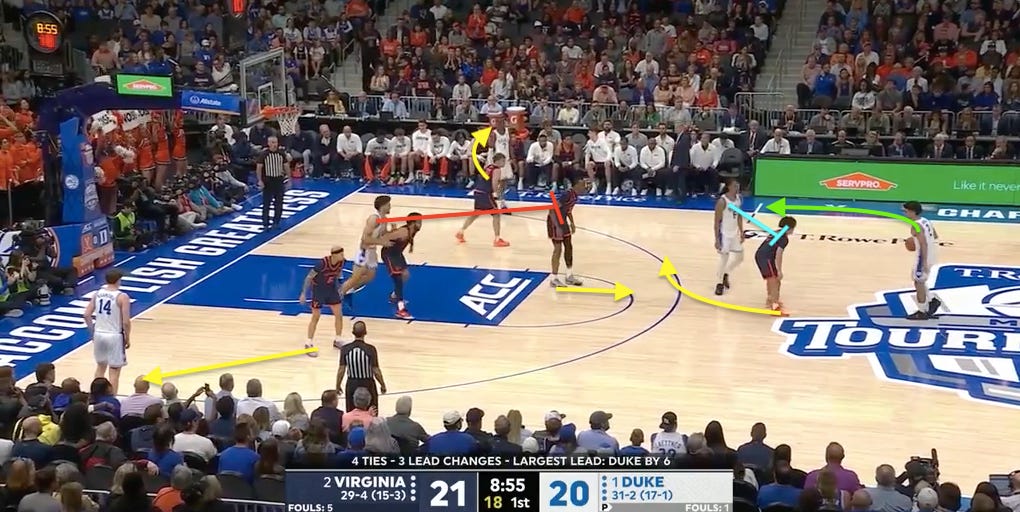
Mallory is a disruptive defender, and he gets to the spot, staying in front of the ball. Onyenso, who was outstanding defensively in this game, does a terrific job navigating Cam Boozer’s back screen and staying with Brown on the roll. As Boozer lifts up the floor — instead of immediately popping beyond the arc — he sets a second ball screen on Mallory, this time bringing his brother to the left side of the floor.
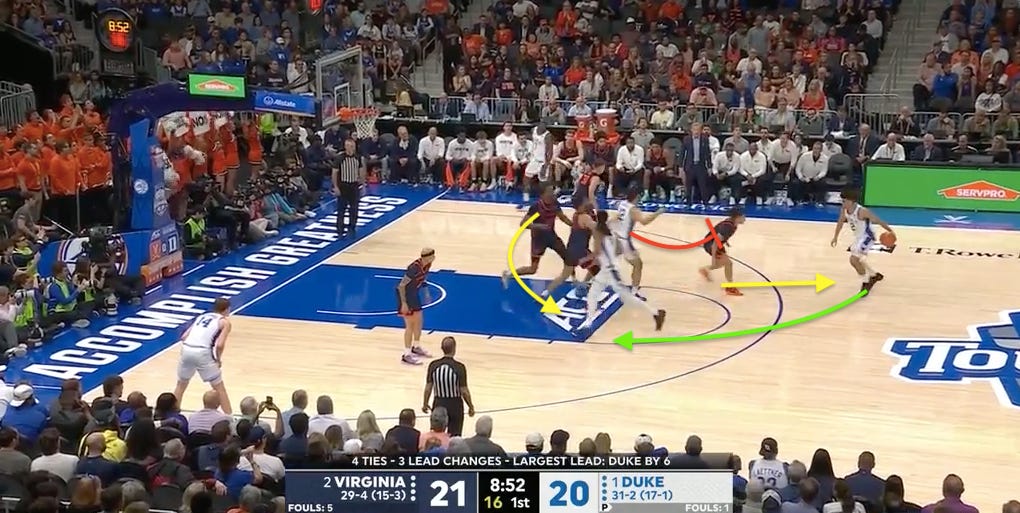
On the second screen, Mallory can’t go under; he must fight over the top, allowing Cayden Boozer to turn the corner. Tillis stays with Cam Boozer, so when Cayden turns the corner, there’s no immediate defender in his path. And like a wide receiver blocking downfield in football, Brown sets a deep seal in the paint — one of his specialties — complicating Onyenso’s challenge.
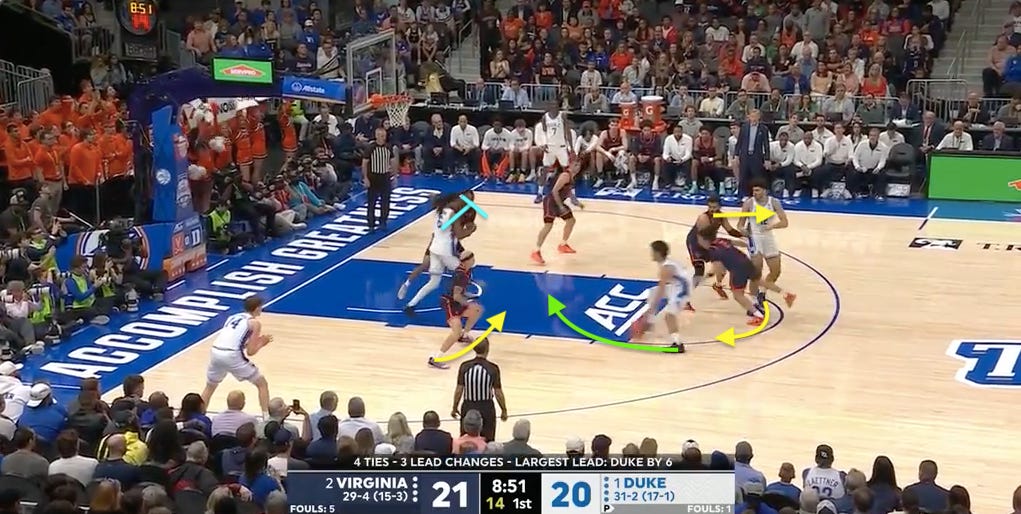
White must come off Khamenia in the left corner, but he can’t quite get in front of Boozer, who arguably deserves more than two points for a rare win in a battle at the rim with Onyenso.
Unstoppable Force vs. Moveable Object
Onyenso’s rim protection turned this game on its head. He capped off an incredible week in Charlotte with a defensive masterpiece against Duke. In 22 minutes with Onyenso on the floor, Virginia outscored Duke by one point and held the Blue Devils to just 1.02 points per possession. With Onyenso patrolling the paint, Virginia blocked 45.8 percent of Duke’s 2-point attempts and limited them to 37.5 percent shooting at the rim, according to CBB Analytics.
In both matchups this season, Virginia has largely sagged off Duke’s centers — Patrick Ngongba and Brown — when they space out around the arc. Less concerned with their 3-point shooting, UVA prioritized keeping its defensive 5 in the paint to clog cut opportunities and driving lanes.
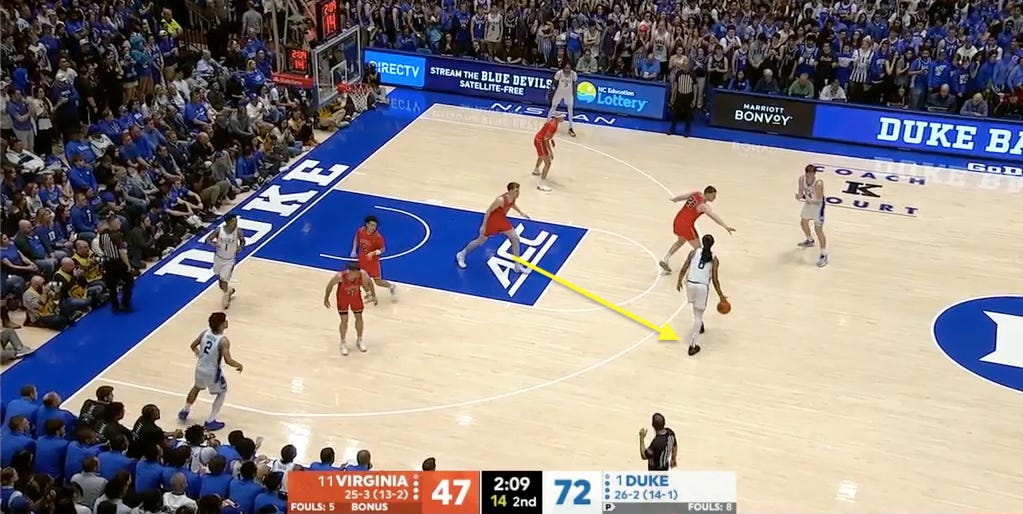
Duke has seen this type of coverage plenty this season, and the Blue Devils know how to handle it. Ngongba (8-of-29 3PA) and Brown (5-of-29 2PA) have the green light to let it fly from deep; however, Duke can be even more explosive and efficient against these defensive looks when they use off-the-ball spacing to turn the bigs into handoff hubs and flare screeners.
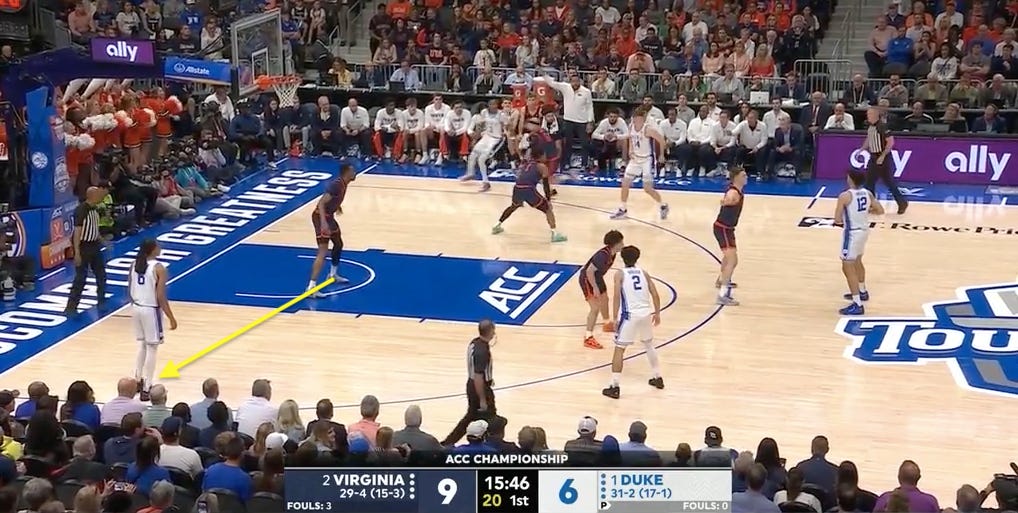
Onyenso was in Terminator mode throughout the tournament, especially in the title game: nine blocks against the Blue Devils.
Matched up against Brown, whether the Duke center was beyond the arc or in the dunker spot, Onyenso was around the basket at all times, serving as a dynamic weak-side rim protector.
Dealing with some first-half foul trouble, Brown played just 17 minutes in this game. In that span, Duke was outscored by eight points, scoring only 1.01 points per possession.
The Blue Devils needed to either find ways to hit jumpers over the top or pull him out of the paint. This led to a lineup reconfiguration, leaning on Cam Boozer at point-center.
Boozer has seen some time at center for Duke this season, a useful option for Scheyer. According to CBB Analytics, Duke has played 104 minutes (+44) this season with Boozer on the floor as the de facto 5 while Brown and Ngongba sit on the bench. With Ngongba out of the ACC Tournament, 54 of those 104 minutes came over the last three games (+31), with Duke scoring 1.37 points per possession on offense and allowing 1.01 points per possession on defense.
Of course, Boozer presents a unique set of challenges. He’s an excellent 3-point shooter (40.9 3P%), which pulls defenders out to the arc. By moving him to the 5, Duke was able to draw Onyenso away from the basket.
Similar to the Michigan game, Duke loosened up an elite defense with top-tier rim protectors by running its 5-out split action and look for cutters in the half-court setting.
As Boozer initiates up top, there’s an exchange on the right side of the floor, with Sarr and Evans swapping spots. After cutting to the wing, Sarr pivots and moves toward Evans — as if to set a down screen for Duke’s top shooter. Instead, he slips the screen and gets behind Hall, receiving a bullet pass from Boozer for the cut layup.
Thanks for reading Split The Action! Subscribe for free to receive new posts and support my work.
Inverted Screen-Roll
Duke runs an excellent 5-out motion and passing attack, but Virginia can take many automatic looks away with its positional size, off-ball switches, and schematic know-how. The Blue Devils needed to attack the Cavaliers in their pick-and-roll offense while keeping Onyenso away from the rim as much as possible.
The late-game solution, as it has been all season, was an inverted pick-and-roll with Cam Boozer and Evans.
With under seven minutes to play, Duke began cycling through different variations of this action. The first was a spread look, with Cam Boozer handling in the middle of the floor, pulling Onyenso out to the top of the key, while Evans crept up from the right wing to set a screen.
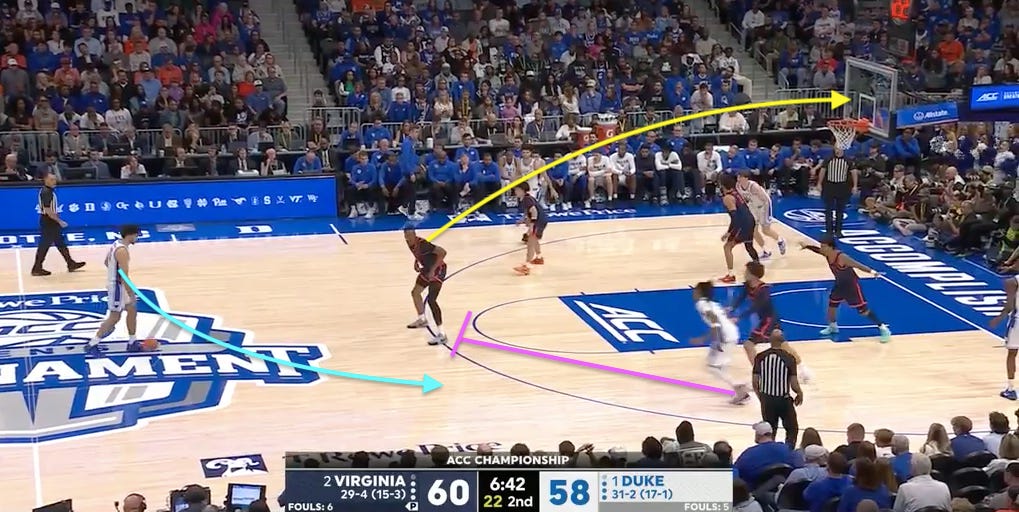
At the last second, just before setting the screen, Evans “ghosts” the action and blurs out to the left wing, running off a flare screen from Cayden Boozer. Because Evans never actually sets a screen, his defender, Lewis, neither switches nor shows toward Cam Boozer. This not only forces Onyenso to move laterally to stay in front of Boozer, but also removes a help defender from that side of the floor, opening up another gap.
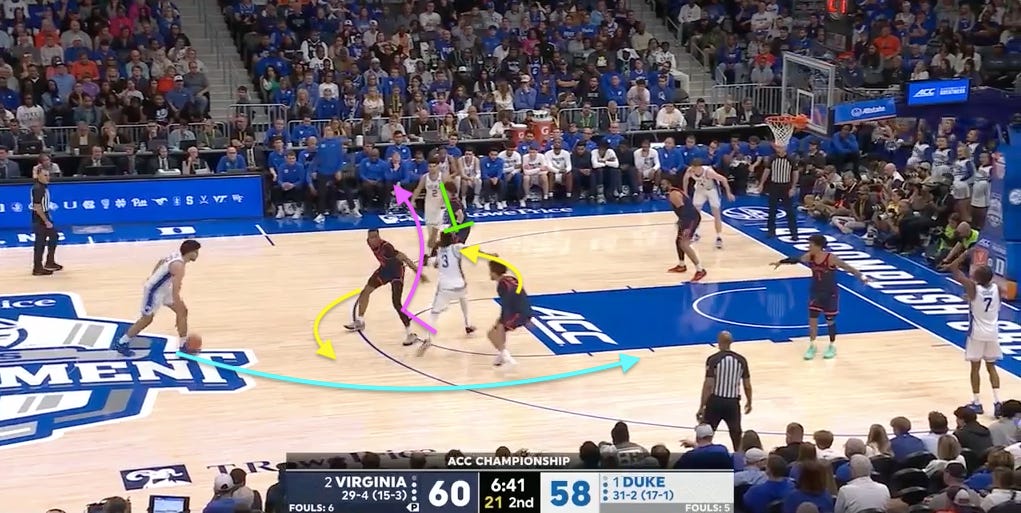
Boozer struggled at times to create space in the midrange against Onyenso; going forward, he’ll need a few more counters. Here, however, he gains the advantage, driving past Onyenso and forcing Thomas to help off the strong-side corner, creating an easy kick-out to Sarr.
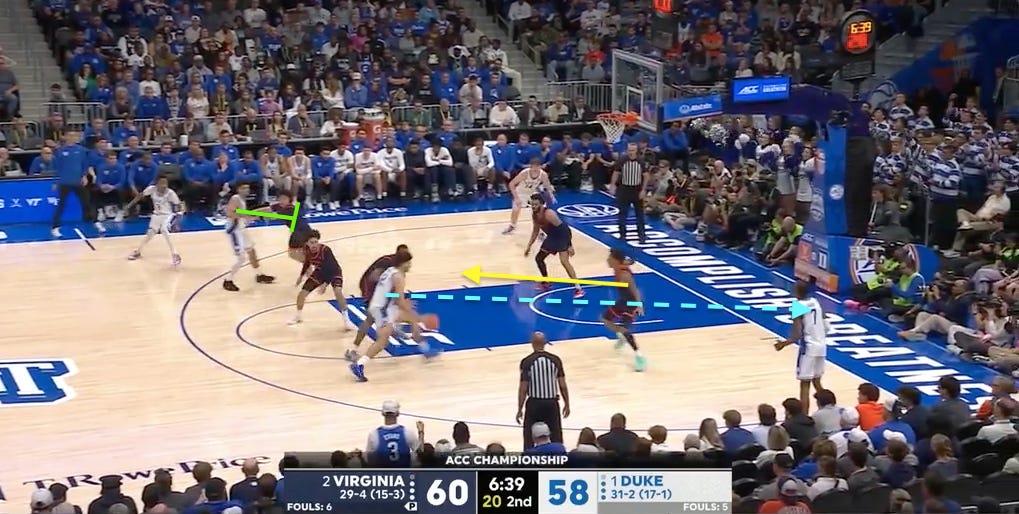
Sarr has connected on 40.8 percent of his corner 3-point attempts this season (3.9 corner 3PA per 40 minutes). He misses this shot, but it’s a good look, with Boozer showing trust in his teammate. Boozer saves and finishes the play with one of his best displays of strength this season, ripping a contested rebound away from Onyenso (19.5 percent defensive rebound rate), shot faking and exploding back up for an and-one bucket.
On the next trip up the floor, Grunloh replaces Onyenso, and Duke returns to its inverted pick-and-roll with Cam Boozer and Evans. This time, Evans sets and holds his screen on Grunloh, triggering a switch with Lewis (6-7, 210) on Boozer (6-9, 250). There’s no weak-side flare screen for Evans on this possession. Regardless, Boozer takes advantage of the matchup, powering to the basket and drawing a foul on his second put-back attempt.
About a minute later, coming out of a timeout with the game tied at 63, Scheyer unveils some late-game offensive mastery. He uses Harris and Evans together in the action, both working with Cam Boozer in inverted ball screens.
First, Harris runs up and sets a screen on Onyenso, drawing a switch: Thomas goes to Cam Boozer, and Onyenso follows Harris. If Duke drives on this possession and Onyenso collapses, there’s now an obvious kick-out target: Harris.
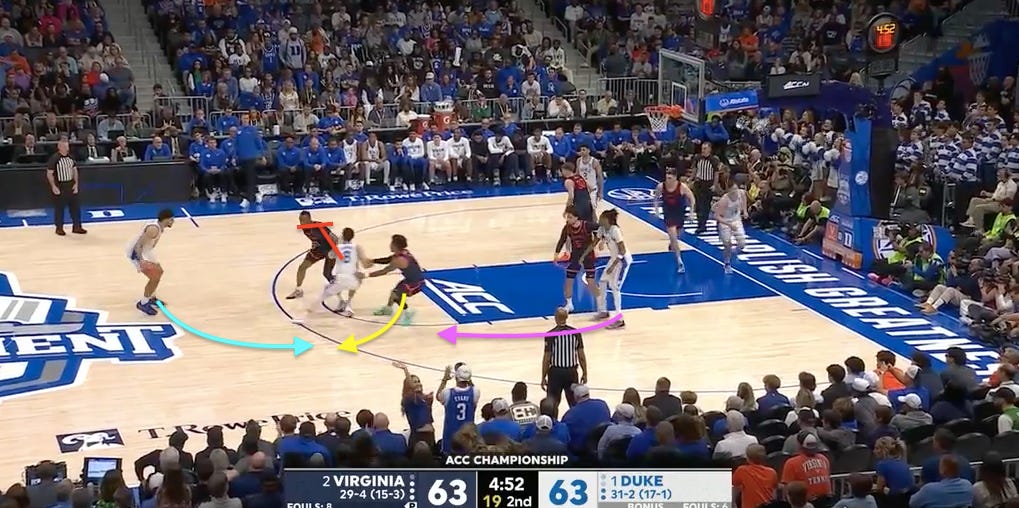
Next, Evans lifts toward Boozer, as if to set another inverted ball screen on Thomas. Similar to the first inverted possession highlighted above, Evans ghosts the screen — moving toward Thomas before slipping out to the left wing.
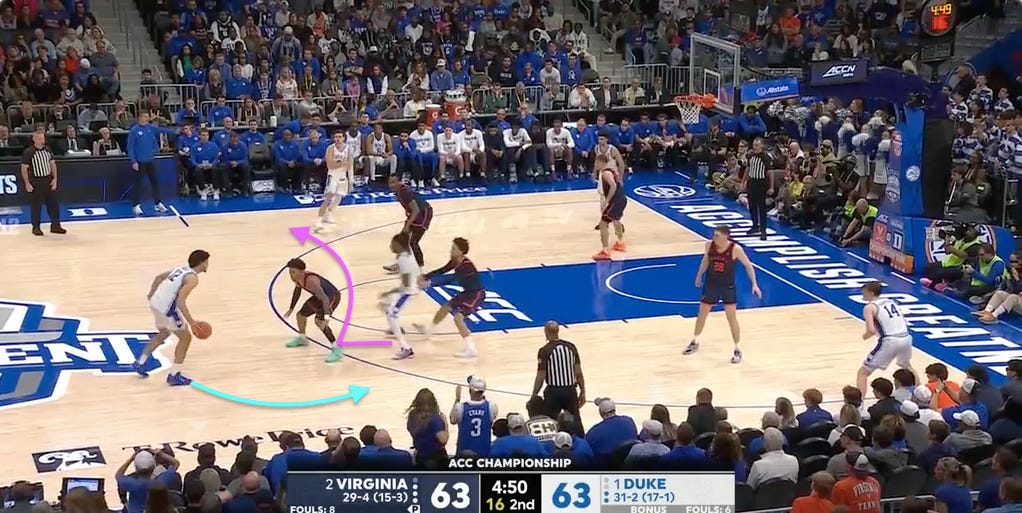
Lewis, after getting burned by this slip a few minutes earlier, shows for a half-second on Boozer — ready to help Thomas if necessary. It’s a minor adjustment, and Lewis quickly scrambles back to Evans, but that brief and slight angling of his body is enough for Boozer and Evans, who has one of the quickest releases in the country, to capitalize.
According to my charting, this is the ninth pick-and-pop 3-pointer Evans has hit off a Cam Boozer pass this season, including the game-winner against Florida. Overall, Boozer has assisted 41 Evans field goals this season, which is the most on the team by a lot.
Duke has played just 78 minutes with Evans and Harris on the floor together this season (+48), scoring 1.31 points per possession. This is one way Duke can structure its lineups and scheme without Foster: Harris takes on some of the guard minutes, while Cam Boozer assumes more play-creation responsibilities.
On the next offensive possession, Duke runs the same action. This time, however, Virginia defends it differently. Onyenso doesn’t switch to Harris; he stays with Cam Boozer. Lewis sticks with Evans as well. On the backside, UVA executes a textbook X-out: Hall leaves Cayden Boozer in the corner to guard Harris, while Thomas sprints to the left corner.
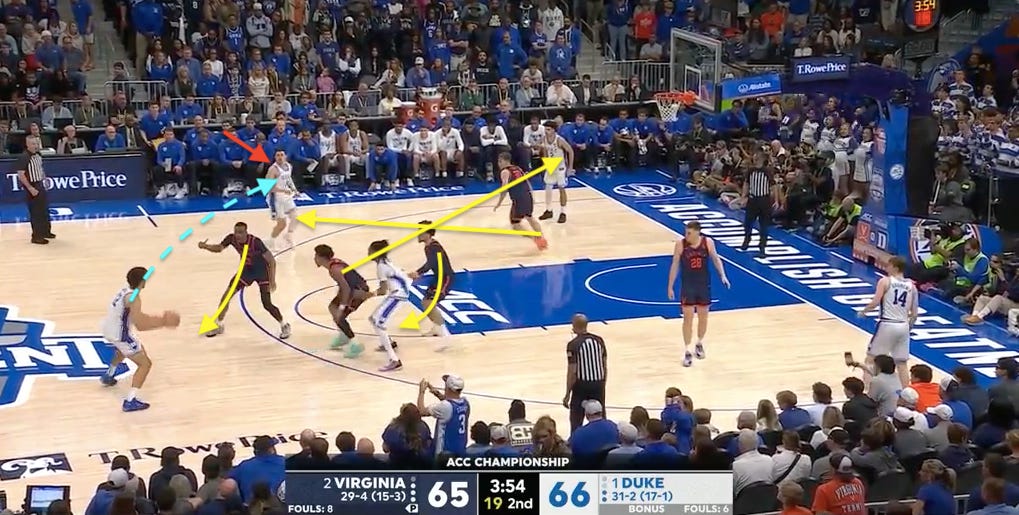
Virginia keeps the ball in front. Duke resets and runs another inverted screen between Evans and Boozer. Onyenso does a good job containing Boozer’s drive, altering his shot at the rim with a well-timed contest.
After another timeout, Duke continued to run the inverted Boozer-Evans action, albeit with a different look.
The possession starts in what I call Duke’s “L” series — with Cam Boozer zipping up from the left corner to the top of the key, where he receives a pass from his brother. After screening for Cam Boozer, Khamenia cuts to the left corner as Sarr fills the right corner, while Evans lifts up to set the ball screen.
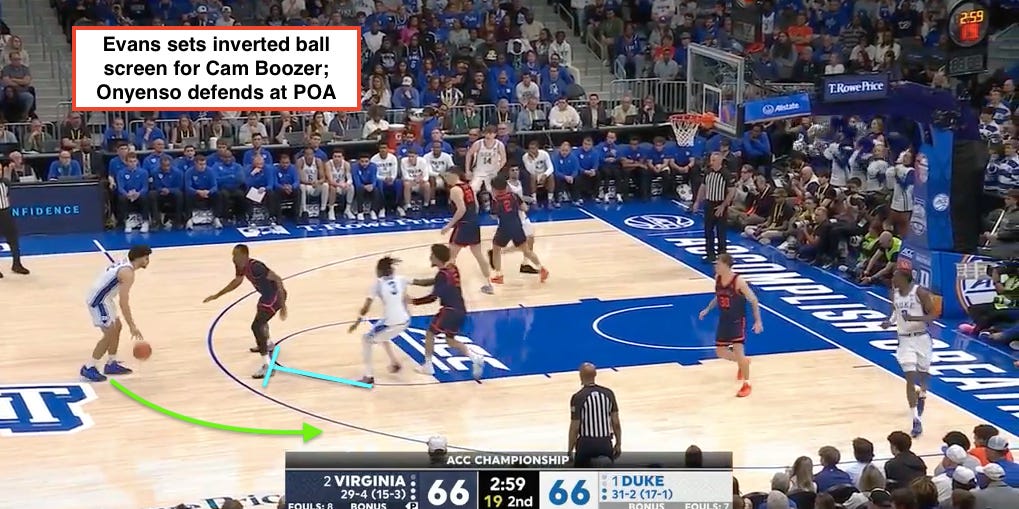
Throughout the season, this action has put even high-level defenses, like Virginia, on skates. The Cavaliers alternated between switching the action and showing-and-recovering. Here, Lewis switches onto Boozer, but Onyenso fights over the top of the screen, leaving Evans open with two defenders on the ball.
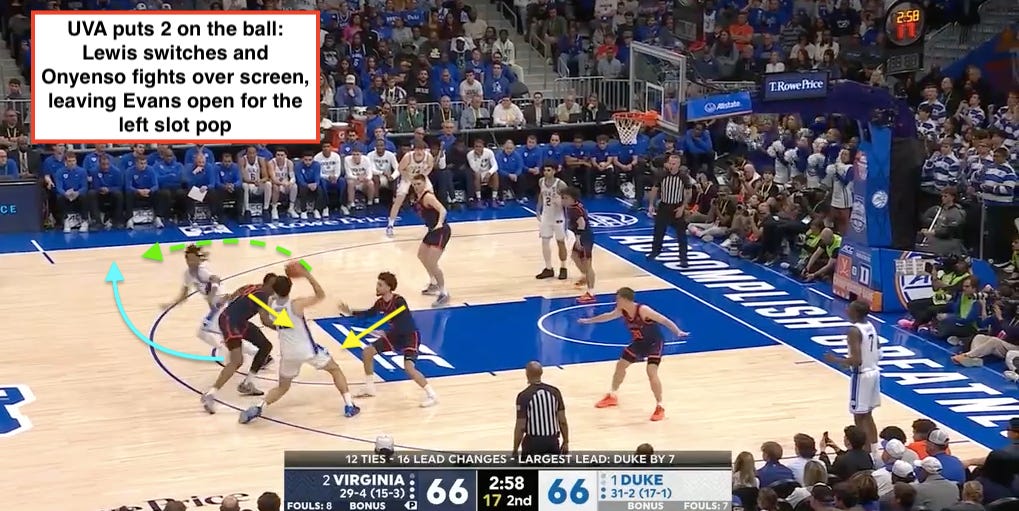
This creates a full-blown panic, forcing Virginia’s weak-side defense into rotation. With Evans open, Thijs De Ridder sprints off Khamenia in the left corner as Onyenso scrambles back to cover Evans. With no defender in front of him, Khamenia crashes from the corner.
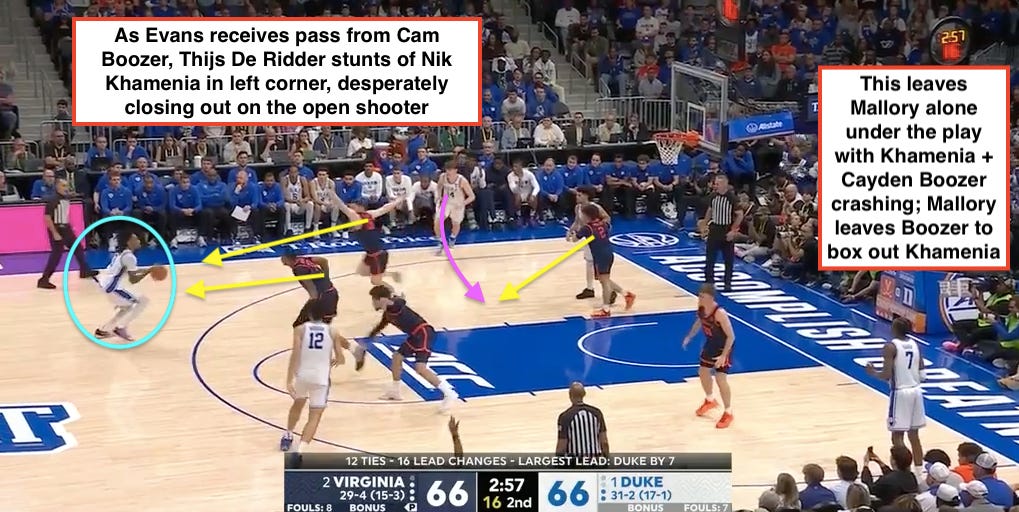
As the 3-point attempt goes up, the smallest player on the floor, Chance Mallory (5-10, 185), is forced to handle two Blue Devils crashing the glass: Khamenia and Cayden Boozer. Mallory chooses to box out the larger Khamenia, leaving Cayden Boozer unattended right at the front of the rim.
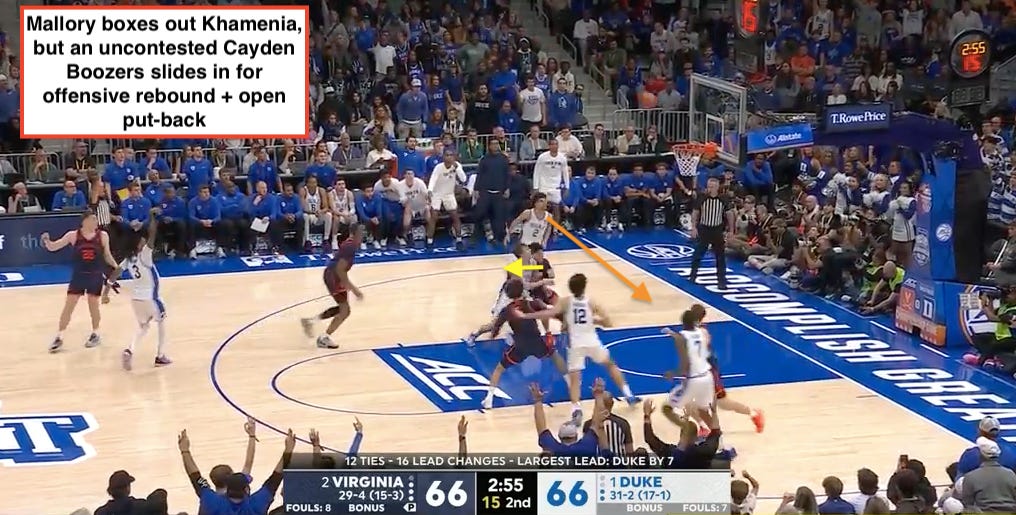
This is how Boozer is able to glide in, grab an uncontested rebound and finish an uncontested layup, which proved to be the game-winner.
This play is the same action Duke ran at the end of the game against Florida, which led to the Evans game-winning shot: the “L” series into an inverted pick-and-pop with Boozer and Evans.
Coming Down With a Case of March Madness
As impressive as it was to see Duke band together and win three games in three days with 40 percent of its starting lineup riding knee scooters around the Spectrum Center, the real test starts now. Cayden Boozer and Khamenia appeared to take massive steps forward during the week in Charlotte. That’s a testament to Duke’s player development infrastructure, but is it sustainable? Is it enough to win six more?
While Foster’s return seems a bit murky, there’s reason to believe Ngongba will be back for the NCAA Tournament, which is mission critical. Ngongba is an exceptional player, and his presence adds multiple dimensions to Duke’s arsenal: frontcourt depth, lineup versatility, scheme versatility, rim protection, two-way rebounding, finishing and playmaking. If he’s back and ready for the stretch run, Duke has a chance for a deep postseason push. Combine that with a little luck — which is always necessary in the chaotic randomness of March and April — and who knows? Maybe this team gets to cut down a few more nets.
For those of us on the sidelines, enjoy the games — and best of luck with your brackets (and with calling in sick to work for a case of March Madness).
Thanks for reading Split The Action! Subscribe for free to receive new posts and support my work.
Comments
Nothing yet. Say the first thing.
Sign in to join the conversation.