
The famed cherry blossoms are still a few weeks from peak bloom, but Duke and Michigan offered an early flourish of their own this weekend in Washington, D.C. Duke emerged victorious, 68-63, but this showdown between two of the nation’s elite was a slugfest, with both heavyweights trading blows.
The Blue Devils controlled the win-probability chart for much of the second half, yet the up-and-down affair appeared ready to tilt in favor of the maize and blue with just under four minutes to play. After Yaxel Lendeborg drilled a 3-pointer at the 3:49 mark, Duke clung to a 57-56 lead against the No. 1 team in the country, with Michigan in the double bonus and Cameron Boozer saddled with four fouls.
After a Trey McKenney foul on Caleb Foster triggered the under-4 media timeout at the 3:24 mark, Duke put on an offensive clinic against the nation’s No. 1 defense: no turnovers, no empty possessions. In doing so, the Blue Devils gritted out a victory in this clash of titans.
Let’s pick it up from that moment and break down the ensuing four possessions that swung the game and sealed a statement win in a Final Four-type atmosphere.
On the first three offensive possessions after the timeout, Duke scored seven straight points by running variations of the same action: Patrick Ngongba initiated 5-out offense from the right slot — pulling 7-foot-3 Michigan center Aday Mara (12.8 percent block rate) out of the paint and away from the rim — while Boozer set a back screen to the empty side before popping out to the left wing.
The Blue Devils opened by inbounding from the right sideline, with Foster as the trigger man. Boozer cut from the right wing to the left wing. Ngongba lifted from the nail to the right wing. Dame Sarr cut through from the left wing to the right corner, while Isaiah Evans remained stationed at the top of the key.
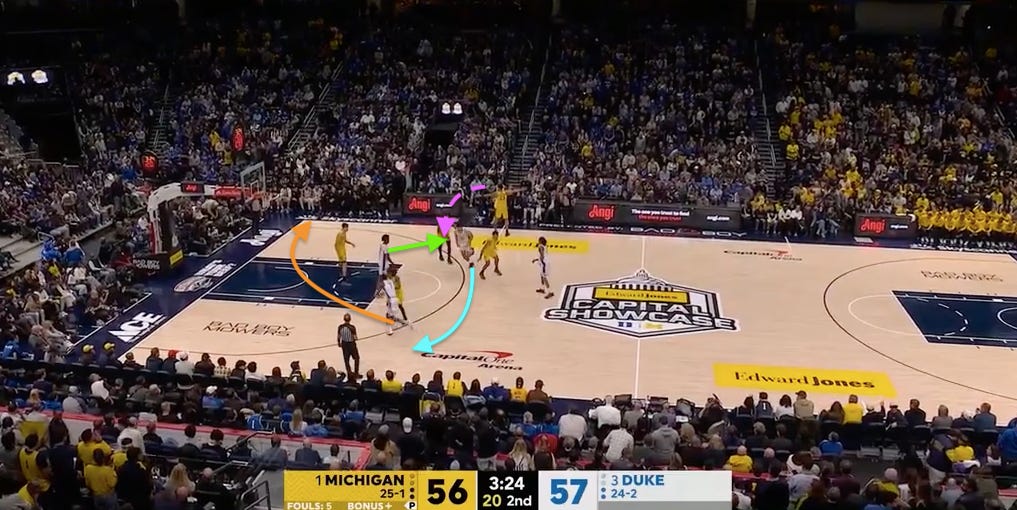
After receiving the pass from Foster, Ngongba turned to face the floor. Mara (15) is a strong space defender for a player his size, but by pulling Michigan’s 5 out of the paint, Duke opened up the rim. Boozer followed and sprinted up to set a back screen for Evans.
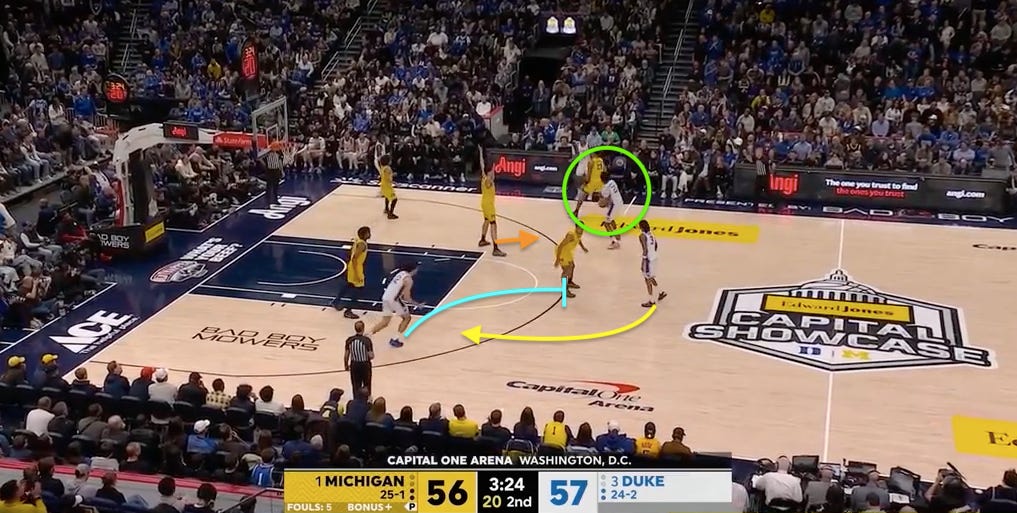
Boozer’s back screen pulls Morez Johnson (5.2 percent block rate) outside the paint as well, and with no other Blue Devil spaced to the left side, there’s no help defender. Evans has a straight line to the rim, with one of the nation’s best big-man passers surveying the floor.
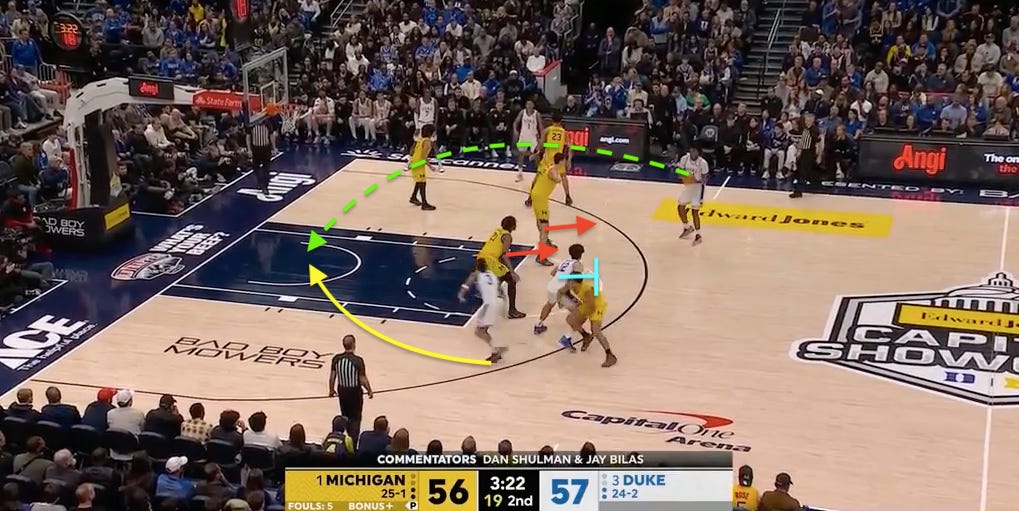
McKenney (1) gets hung up on a solid screen from Boozer. Johnson and Mara are both dragged above the free throw line, and Elliot Cadeau (3) is stationed well outside the lane while defending Sarr. The result: with McKenney trailing the play, there’s no help at the rim. Ngongba caps off a beautifully designed set from Jon Scheyer by floating a lob to Evans for the finish.
Heading into Saturday night, Michigan ranked second nationally in block rate. They make life extremely difficult around the basket, allowing opponents to attempt only 20 percent of their field goals at the rim (100th percentile nationally) and converting just 58.2 percent of those attempts (86th percentile), according to CBB Analytics.
However, by pulling Mara, Johnson (21) and Lendeborg away from the restricted area, Duke could undercut the rim protection that anchors this dominant defense.
On the next possession, after Cadeau missed a layup on a backdoor cut, Duke ran what I refer to as its “L” series: a set of plays that begins with one of the guards positioned in the corner and the 4 and 5 next to one another in the middle third of the floor.
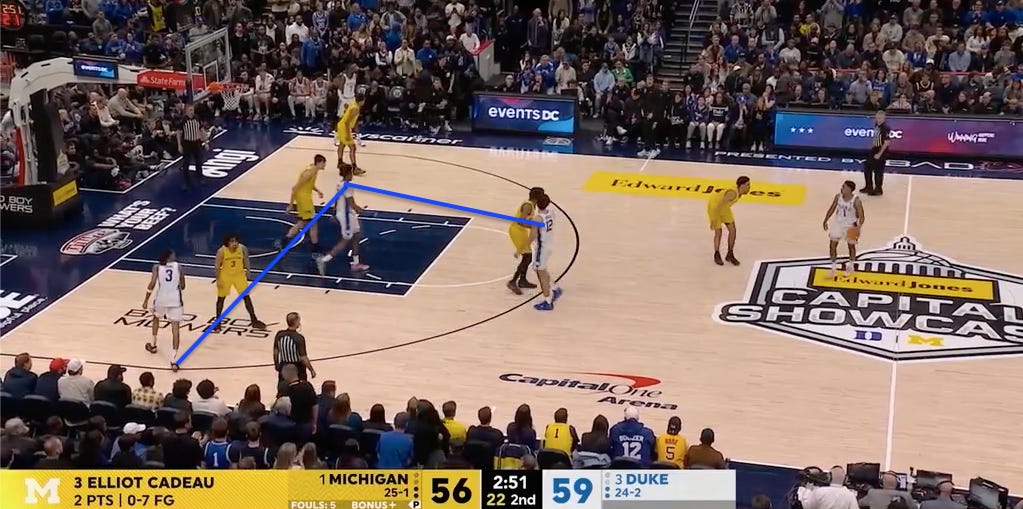
From this setup, which resembles the letter L, Duke can run countless options. Typically, the play flows into a few different directions: either a post-up for Boozer in the left mid-post, or one of the guards (Evans, in this case) zipping up the middle off staggered screens from the 4 and 5. In this instance, however, everyone branched out above the arc into a 5-out alignment, which is another popular pathway for Duke’s offense.
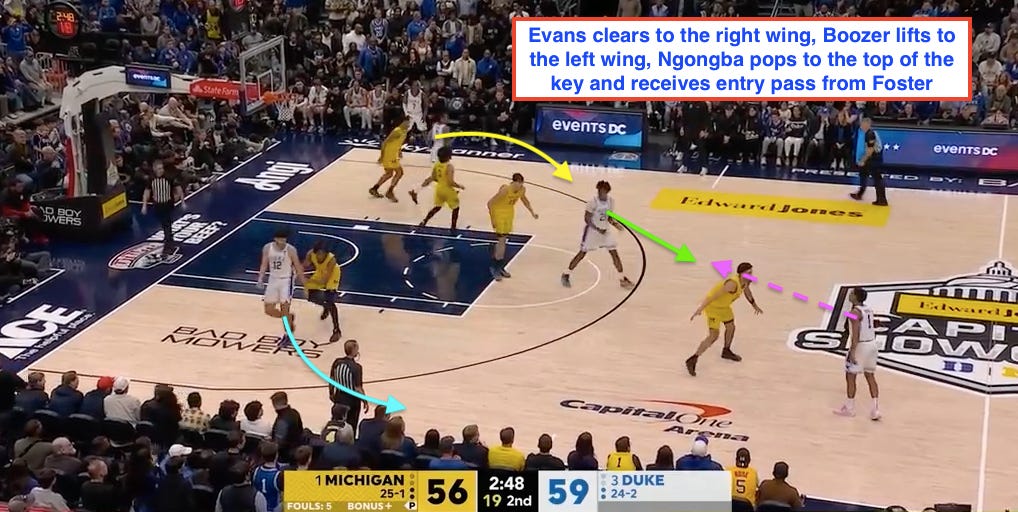
Ngongba pops toward the top of the key and receives a pass from Foster, giving Duke its 5-out spacing template. On the right side, Sarr and Evans execute a quick exchange, swapping spots to manipulate the help defense: Evans cuts down to the corner while Sarr moves up to the wing. Meanwhile, Boozer lifts and sets a back screen on the left wing — this time for Foster.
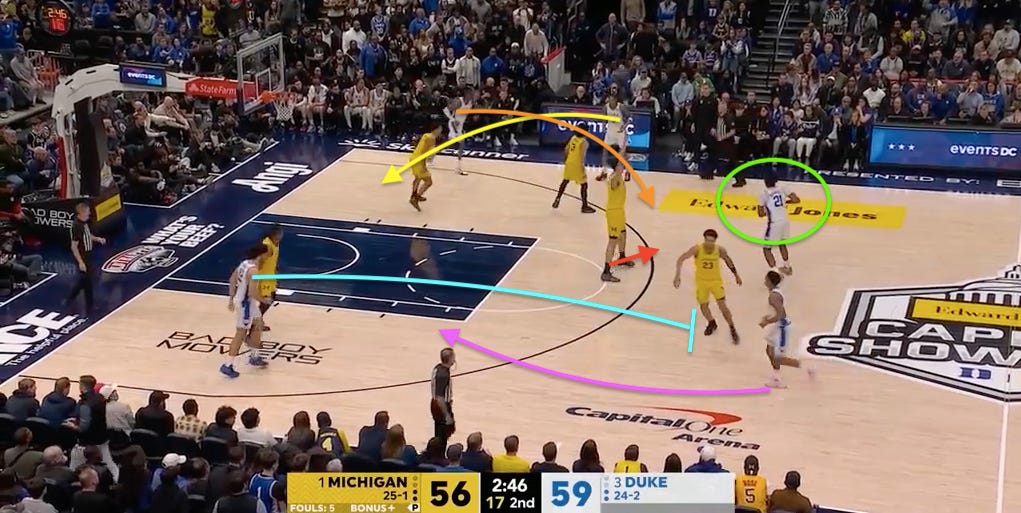
Lendeborg (23) navigates Boozer’s screen and stays attached to Foster. Meanwhile, Johnson stunts off Boozer and sags a step into the paint, trying to deter any passing lanes from Ngongba to the cutting Foster. The Blue Devils quickly transition to the play’s next progression: a pitch-and-chase pick-and-roll between Ngongba and Boozer with an empty corner. Ngongba tosses the ball toward Boozer and immediately sprints over to set the ball screen.
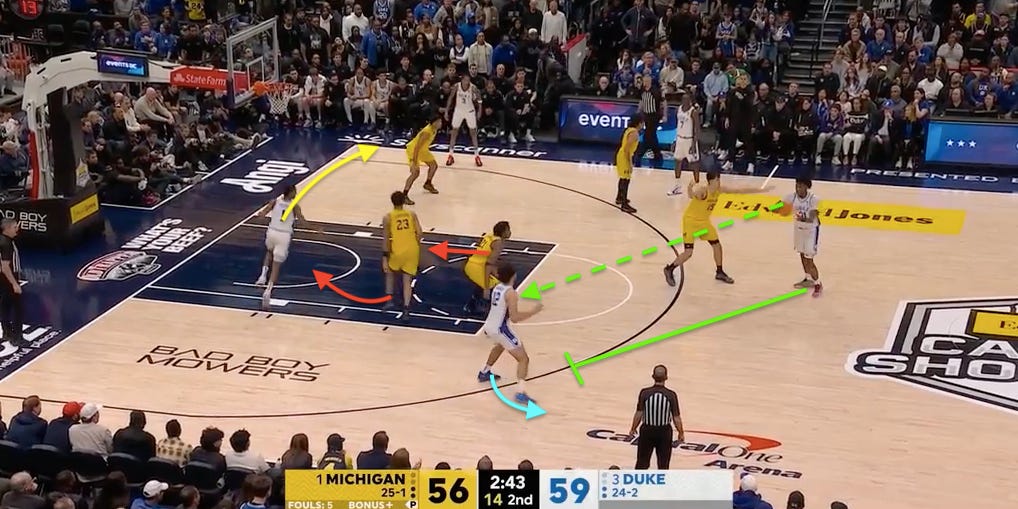
Michigan opts to switch the 45 pick-and-roll, leaving Mara isolated against Boozer. Sarr buzzes toward Boozer before drifting out to the corner, trying to complicate things at the point-of-attack for Mara. Boozer glides left around Mara, but with Ngongba stationed in the weak-side dunker spot, Johnson is nearby and rotates over to contest the layup, forcing a miss. This, however, is where Boozer’s combination of strength, quick second jump, determination and guile comes into play.
Boozer’s initial drive displaces the burly Johnson (6-9, 250), knocking him temporarily out of the play. Mara, taller and in solid rebounding position, is beaten to the ball as Boozer plucks his own miss, shot fakes to get two defenders off their feet and then attacks again, drawing the shooting foul.
In recent games, Duke has increasingly flowed into empty-corner 45 pick-and-rolls — with the 4 (Boozer) as the ball handler and the 5 (Ngongba or Maliq Brown) setting the screen — as a way to generate offense late in the shot clock.
For example, after a timeout against Clemson, Duke started in the L series, shifted to 5-out and then ran a 45 pick-and-roll with Boozer and Brown with under 10 seconds left on the shot clock. Boozer drew a switch and comfortably knocked down a 3 over RJ Godfrey (0).
Back to the Michigan game: after two free throws from Boozer, Mara cut the lead back to three with a layup in the post — rolling downhill off a pick-and-roll from a Michigan “Horns” set and finishing 1-on-1 over Ngongba.
On Duke’s next possession, it’s the same sequence: L series into 5-out, with Ngongba running the show. Zoom in closely, and Foster’s right hand even traces the shape of an L.
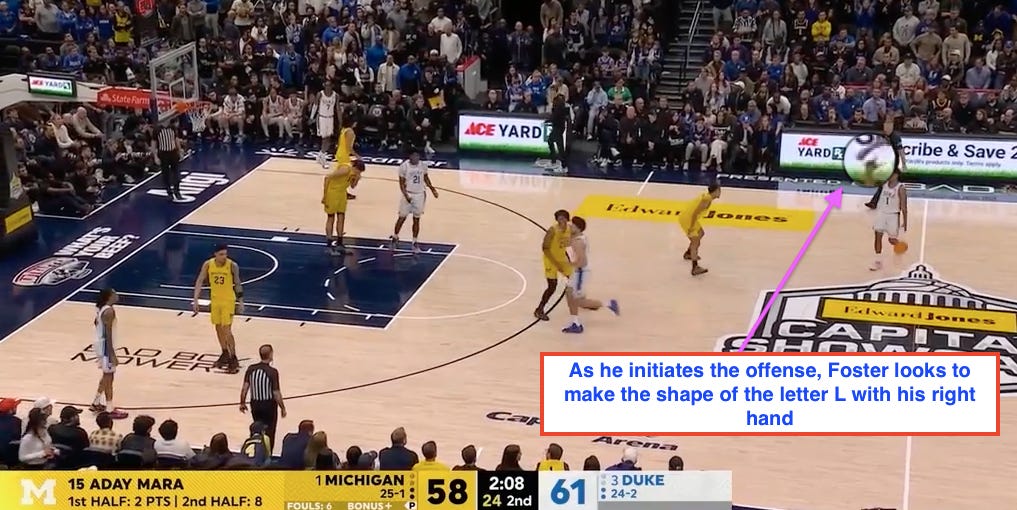
Once again, Ngongba faces up in the right slot, Sarr and Evans execute their exchange on the right, and Boozer sets the back screen for Foster.
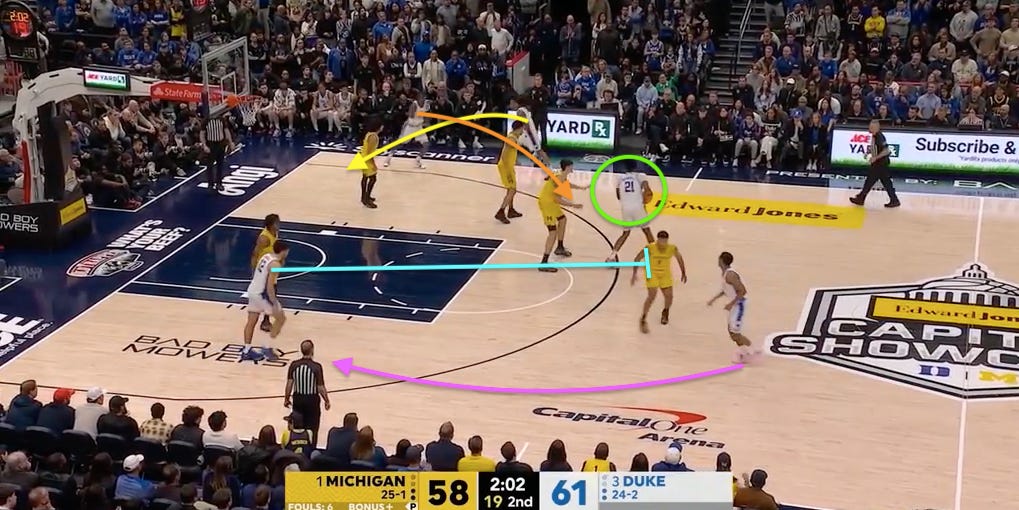
McKenney is an excellent freshman wing, but for the second time in roughly 90 seconds, he gets caught as the chase defender on Boozer’s screen, allowing Foster to cut into open space with the 4 and 5 pulled out. Over on the ball, Mara has adjusted against Ngongba, no longer sagging off and applying more pressure. While this has its advantages, it also opens up the lane. As soon as Ngongba sees Foster gain a step on McKenney, he lifts the ball above his head and delivers a perfectly timed, leading pass to the moving target.
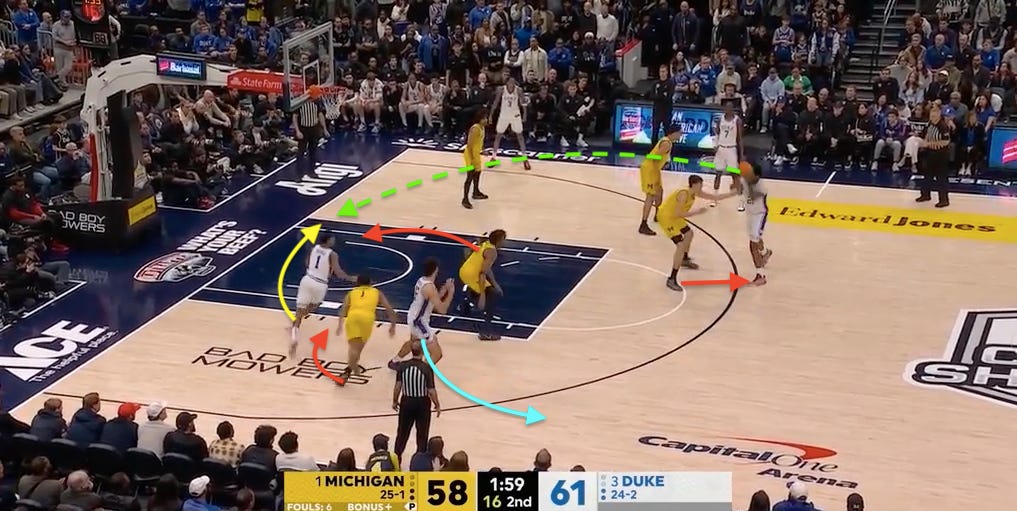
Foster is immediately swarmed the moment he touches the ball. Johnson and Mara sprint to close down the rim, and the Wolverines quickly make the rim a no-fly zone. However, these extreme late-game rotations have one glaring vulnerability: Boozer (39.6 3P%) all alone on the left wing. Foster takes one power dribble, lets McKenney sail by and kicks out to an open Boozer for a dagger 3.
As Duke landed body blow after body blow, Michigan’s late-game offense managed just enough to keep the drama alive. Cadeau matched Boozer’s pop 3 with his first field goal of the game: a 3-pointer with 1:39 remaining. Up 64-61, the Blue Devils only needed to run some clock, avoid a turnover and score one more time to put a lid on this epic matchup. Given the stakes, it wasn’t surprising that Scheyer chose to run an inverted pick-and-roll with Boozer and Evans.
Throughout the season, as I’ve noted, the inverted ball screen with Boozer has become a staple of Duke’s offense. One could argue it’s the team’s go-to play in high-leverage situations.
Save for the December win over Lipscomb, I’ve charted every Duke game this season, including exhibitions against UCF and Tennessee. According to my database, Duke has run some form of the inverted pick-and-roll with Cam in “end-of-half” scenarios 31 times — seven of which came directly after a timeout. These possessions have appeared in several of Duke’s primetime matchups: Kansas, Florida, Michigan State, Texas Tech, SMU, Louisville, UNC and now Michigan.
This set against Dusty May’s squad didn’t come directly after a timeout, but as the clock ticked down, Scheyer orchestrated from the sideline, placing Duke in a “1-4 Flat” alignment: Boozer with the ball up top and four teammates spaced evenly along the baseline.
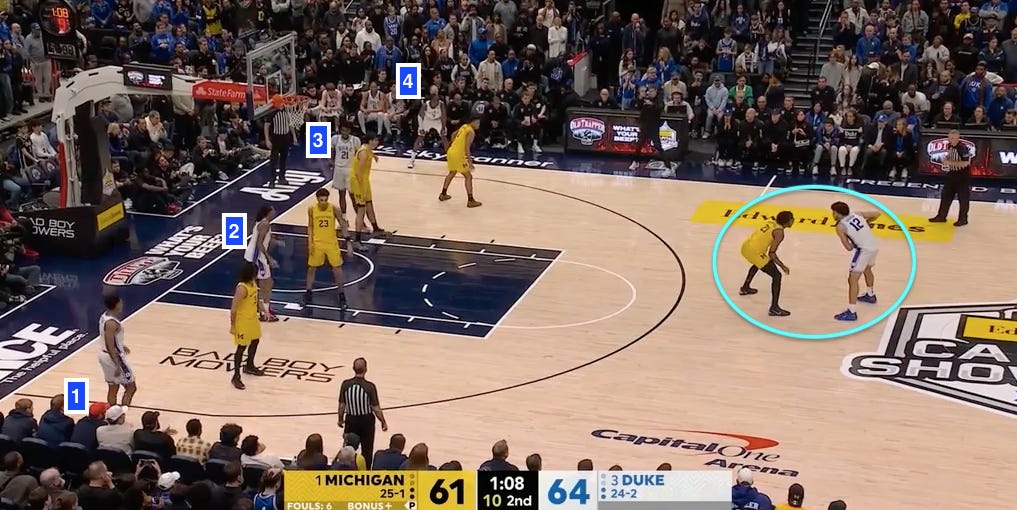
Evans has been the primary screening partner in these inverted actions, though several other guards and wings — including Foster, Sarr, Nik Khamenia and Darren Harris — have also filled the role. On this possession, Evans is chosen as the screener. He starts near the left block and sprints toward Boozer, who is defended by Johnson. Just before reaching Johnson, however, Evans slips and drifts out to the right wing.
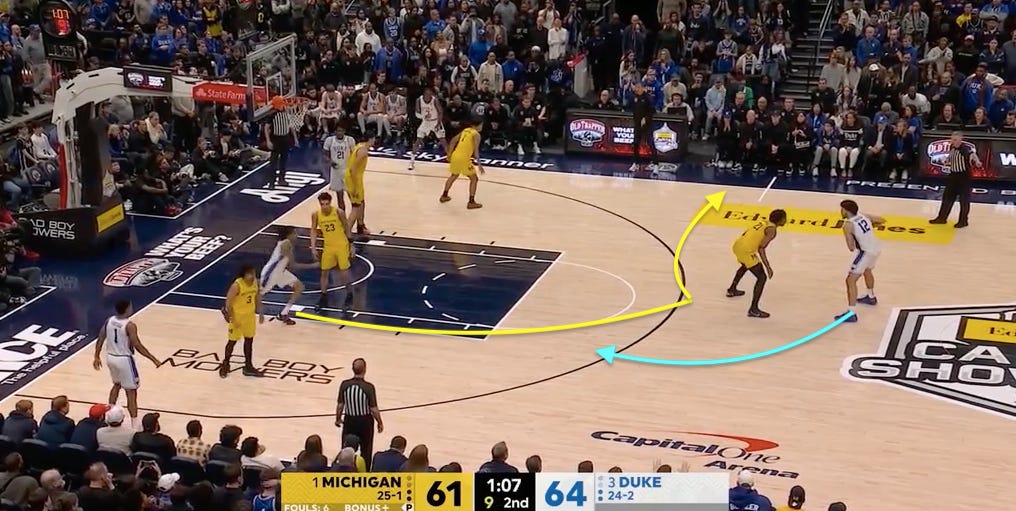
Because Evans doesn’t actually set the ball screen on Johnson, Michigan — if it wanted to — has no real opportunity to switch. If Evans had held his screen for Boozer, perhaps Lendeborg, defending Evans, would have switched onto Boozer, slowed the drive, flattened things out and kept the ball out of the paint. Instead, the ghost action forces Johnson — a big man in space — to navigate an obstacle, flip his hips and try to stay in front of Boozer.
By pulling Evans and Lendeborg to the right side of the floor, Duke widens the lane for Boozer to attack. There’s only one potential help defender on that side — Cadeau — and he’s unlikely to leave Foster, a 39.8 percent 3-point shooter, stationed in the strong-side corner. Boozer (2.2 assists on 3-pointers per 40 minutes this season) can drive downhill to his left, mostly confident that a help defender is unlikely to challenge his dribble. If Cadeau leaves Foster, it’s an easy kick-out pass.
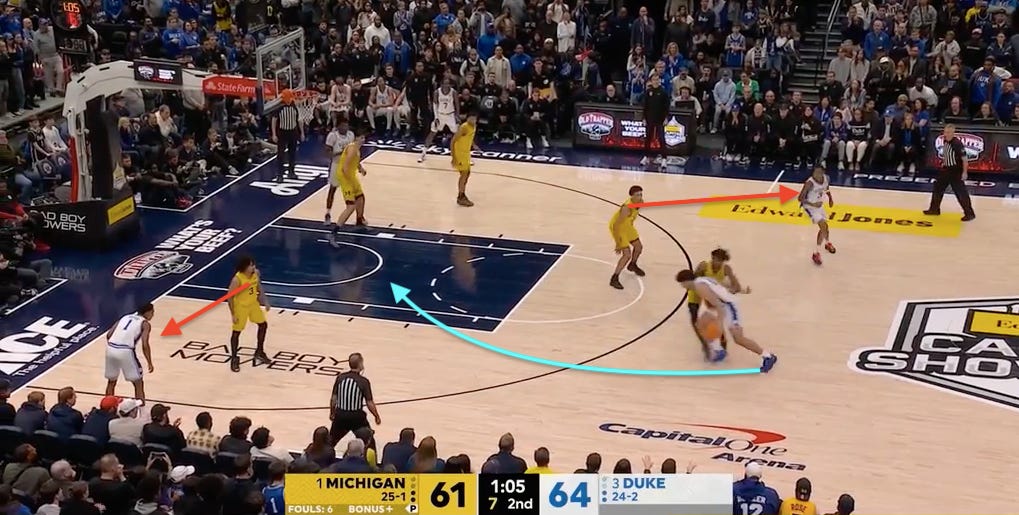
With the left side of the floor cleared and just enough leverage on Johnson, Boozer drives downhill and shifts into one of his go-to moves: spinning off his right shoulder and returning to his right hand. The maneuver allows him to chisel his way closer to the rim and create separation from Johnson. Working against a high-level defender, Boozer executes perfectly. Mara arrives to contest the shot but makes a critical error, committing an obvious goaltend that erases the doubt of the shot even going in.
The 1-4 Flat design, and how it allowed Boozer to get into a gap against an elite defense in a leverage situation, was a clever call from Duke’s staff. According to my database, I’ve only charted one other instance this season of Duke running an inverted pick-and-roll with Boozer out of this 1-4 Flat alignment. That occurrence came five weeks ago in another end-of-half scenario, albeit at the tail end of a blowout win at Cal.
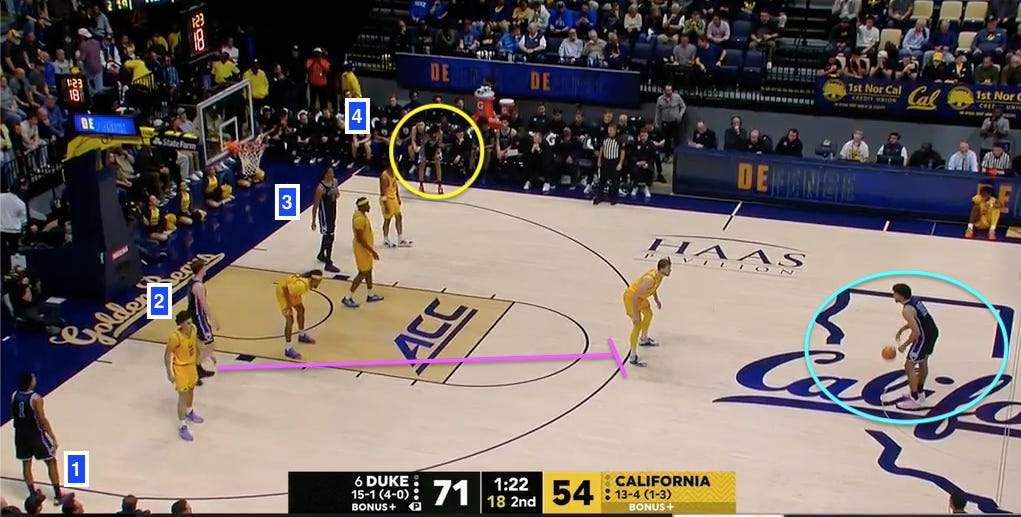
There are some similarities between the two plays: Foster again spaces to the left corner, and the 5 — Brown — is positioned in the right dunker spot, just as Ngongba was against Michigan. However, the play unfolds differently: Evans starts in the right corner, and it’s Khamenia who sets the first inverted screen, lifting from the left dunker spot to pick for Boozer. I’ve labeled this action “1-4 Twist 41” because as soon as Khamenia sets the screen and clears out, Evans sprints up from the right corner, delivering a second (“Twist”) screen and running the inverted ghost action with Boozer.
Cal stayed in front of the ball, and with no clear lane to drive, Boozer settled for an off-dribble 3-point attempt.
It’s an absolute certainty that Michigan prepped for the inverted action between Boozer and Evans: assignments, coverages and rotations. The staff may have even looked at every screening action between the two this season. But it’s still tough to cover, especially when Duke can organize its spacing and launch the action from a different look.
We’re so close to March…I’m pretty sure Jon Rothstein is practically burbling with face-melting excitement.
Duke now heads north to South Bend for a matchup with a Notre Dame team ranked in the KenPom Top 100 on both ends of the floor, featuring two of the ACC’s best shooters: Braeden Shrewsberry and Cole Certa.
After that, three games remain before the postseason and the ACC Tournament — three KenPom Top 30 opponents: Virginia, NC State and a rematch with UNC.
Make sure you stop and smell the flowers. The stretch run is here.
No posts
Comments
Nothing yet. Say the first thing.
Sign in to join the conversation.