
As the second week of the 2026 NCAA Tournament approaches, let’s take a look back at the Round of 32. There were some tense moments for Duke in its matchup with TCU, but the Blue Devils prevailed thanks to key contributions from several players, including sophomore center Patrick Ngongba, who returned to the lineup for the first time in weeks.
Read on for a detailed look at Duke’s offensive approach against TCU, including strategies to counter TCU’s pressure, Ngongba’s role as a high-post passing force and a healthy dose of Point Cam.
TCU’s Top 25 defense thrived this season on its ability to create havoc. Jamie Dixon’s team ranked in the Top 35 nationally in both opponent turnover rate (19.6 percent) and block rate (12.6 percent). Those metrics fueled a TCU offense that scored 11.3 points per game off turnovers (84th percentile), according to CBB Analytics.
The Horned Frogs generated all that chaos despite lacking elite size. According to KenPom’s weighted height metric, TCU ranked 322nd nationally in average height. As a result, the team relied heavily on ball pressure and active, swarming defense to produce that level of disruption.
There is a tradeoff, though. This degree of pressure comes at a cost. Offenses can exploit a defense that sends two defenders to the ball in pick-and-rolls, the post and off-ball actions. Jon Scheyer and his staff had counters lined up and ready.
Here’s Duke’s first bucket of the game. The Blue Devils open the possession in their “Thru” series: Cayden Boozer passes to Isaiah Evans on the right side, then cuts through the lane and pops back out to the left wing as the ball swings his way.
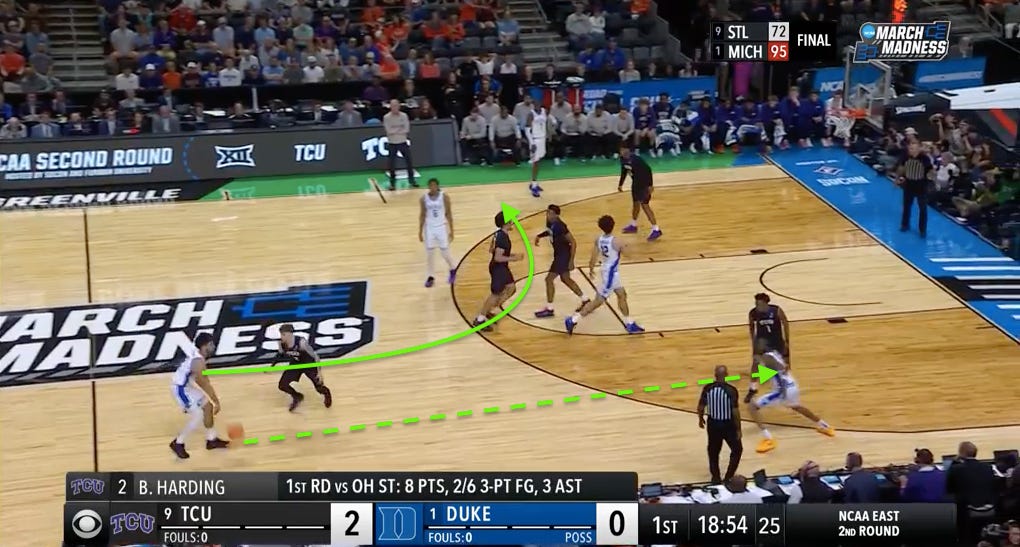
Evans then centers the ball to Maliq Brown at the top of the floor. Brown keeps it moving by dribble over to Boozer and flipping a pass in his direction, setting up an empty-corner pick-and-roll between Duke’s point guard and center.
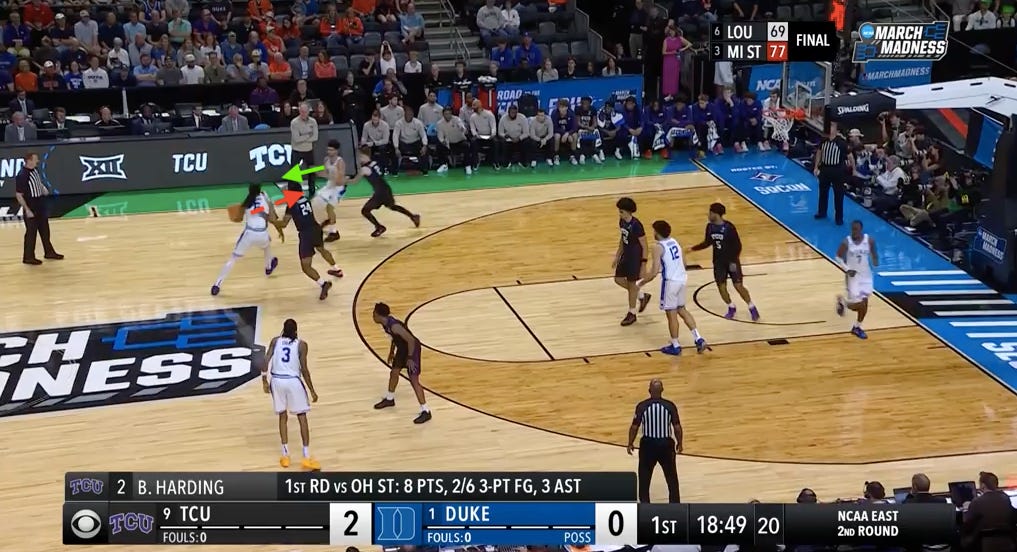
This is where TCU’s two bigs — Xavier Edmonds and David Punch — spring into action. Edmonds blitzes Boozer on the ball screen, forcing him out toward midcourt, with point guard Brock Harding also pressuring the ball. Brown short-rolls into space, but that real estate is quickly swallowed up by Punch, who leaves Cameron Boozer to tag Brown.
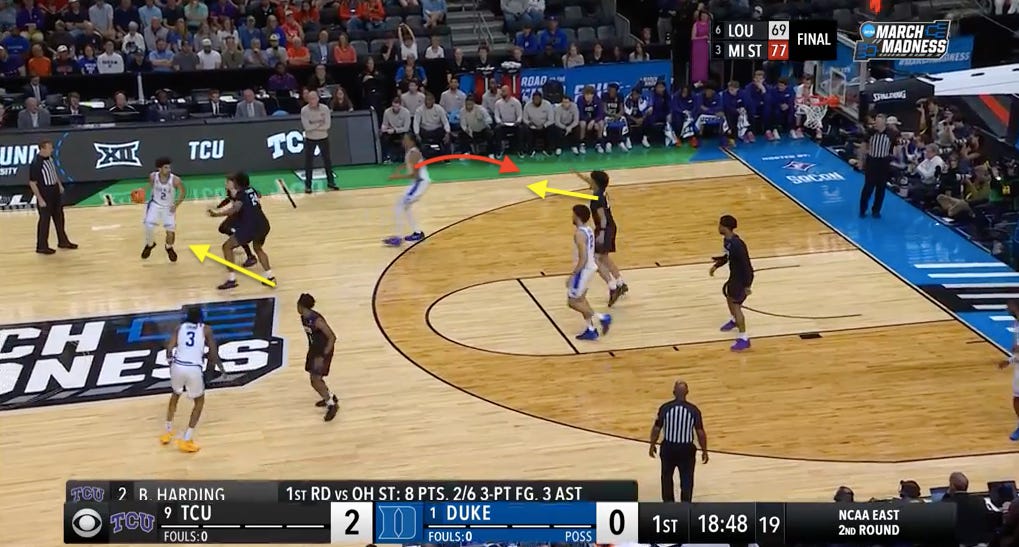
Here’s where a key element of TCU’s pressure scheme comes into play: tagging the short roller and taking away the easiest outlet for a ball handler facing a double team at the top of the floor. The Blue Devils, however, are ready for this tactic. To counter, Duke “shorts” the coverage: Cam Boozer, instead of remaining stationary near the post, cuts to the nail in the middle of the floor, presenting himself as an outlet for his brother.
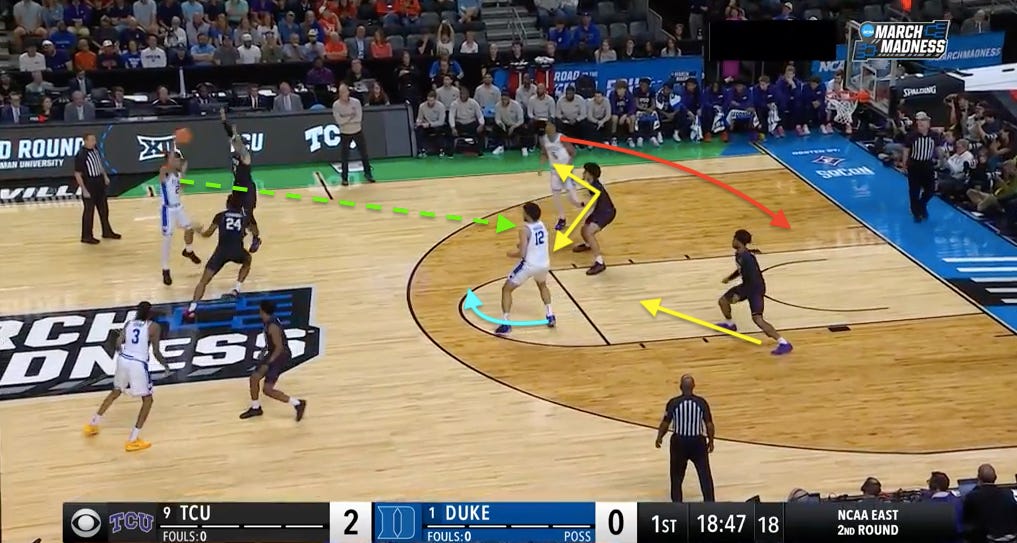
As soon as Cam receives the ball, TCU’s defense is exposed: it’s a 3-on-2 with an elite frontcourt passer and processor in the middle of the floor. Punch tries to recover to Cam Boozer, while Micah Robinson stunts toward him, momentarily leaving Dame Sarr in the right corner. Brown continues his cut to the basket, with Edmonds nowhere near recovering. Cayden Boozer finds Cam, who quickly redirects the ball with a volleyball-style set pass to Brown for a lob dunk.
I’m telling you: this is exactly how Duke drew it up. Tic-tac-toe basketball. Also, this kind of cutting and passing shows how an offense can exploit the right spots on the floor against a trap. In fact, Scheyer has used this same “short” tactic in the past to counter hard-hedging defenses.
From Duke’s blowout 2024 win over Virginia: Jordan Minor hedges out on Kyle Filipowski’s slot ball screen for Jeremy Roach. As that happens, Sean Stewart — like Cam Boozer — lifts up the floor as an outlet. Roach passes to Stewart, who quickly redirects the ball to Filipowski, continuing his roll to the rim, similar to Brown against TCU.
This kind of augmented short-space passing was also part of Duke’s baseline-under package against TCU. Jon Scheyer has a deep playbook for these situations, but one of his go-to options on baseline-out-of-bounds plays is simply clearing one side of the floor and letting Cam Boozer work in isolation off the inbound pass.
Normally, after throwing the entry pass to Boozer, the inbound passer will cut to the opposite side of the floor, like Caleb Foster does here at Stanford.
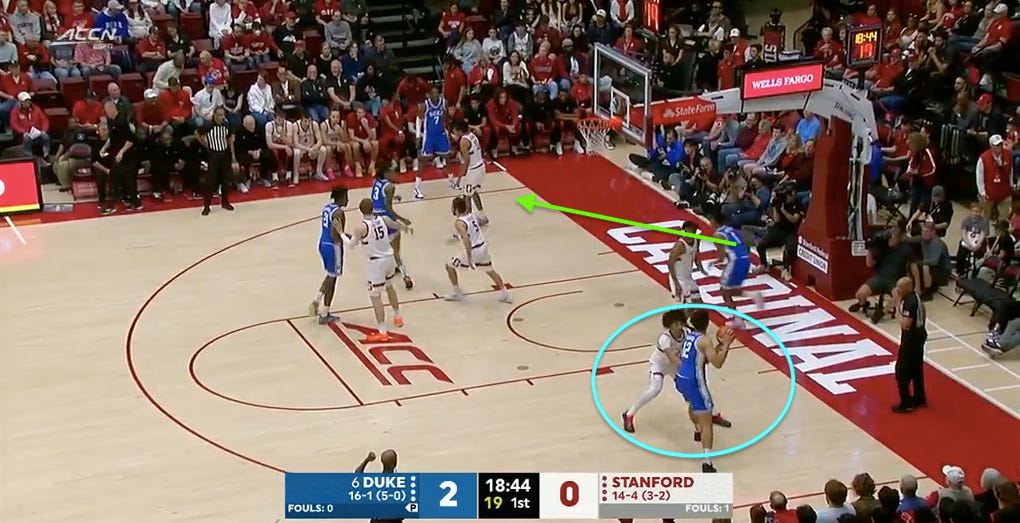
Against TCU, the Blue Devils made a slight alteration: Duke had the inbound passer feed the ball to Cam Boozer and take a single step onto the court — staying on the right side of the floor, ready as a potential outlet against the double team.
On this possession, Cayden passes to Cam, who draws two defenders toward the right corner, including TCU guard Jayden Pierre, who started the play defending Cayden.
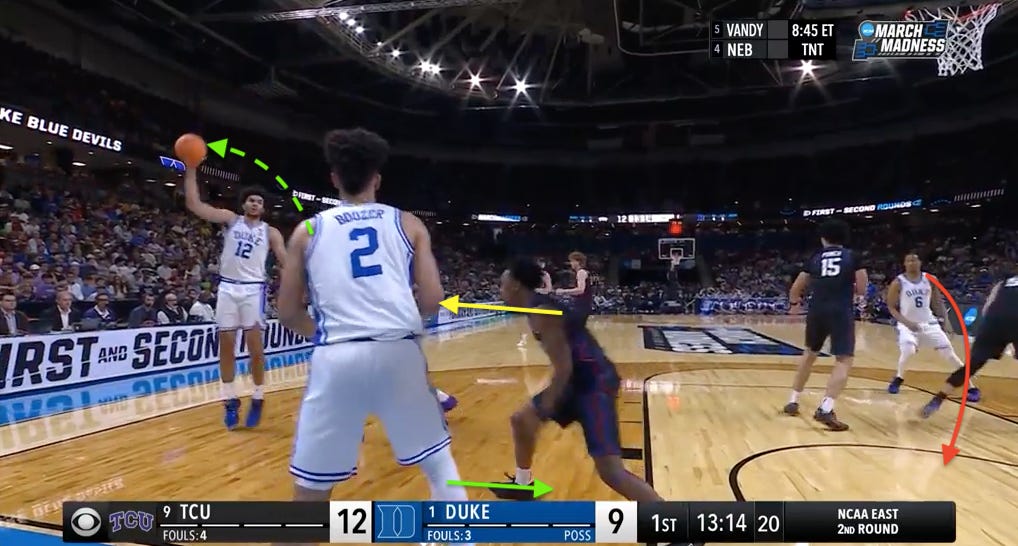
This leaves no TCU defender on Duke’s point guard as he steps into an open pocket in the right short corner. Cam quickly passes back to Cayden, and this give-and-go from the Blue Devils triggers another defensive rotation: David Punch comes off Brown, who is at the nail, to guard Cayden.
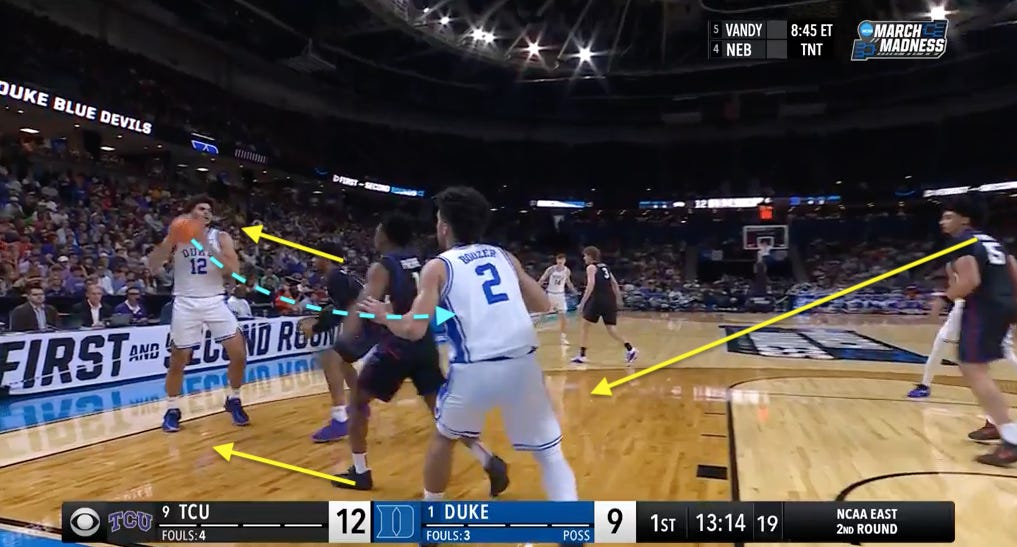
Of course, this leaves Brown momentarily open, and he smartly cuts to the basket, slipping behind Punch’s rotation and before Tanner Toolson can rotate off Darren Harris in the weak-side corner to provide help in the paint.
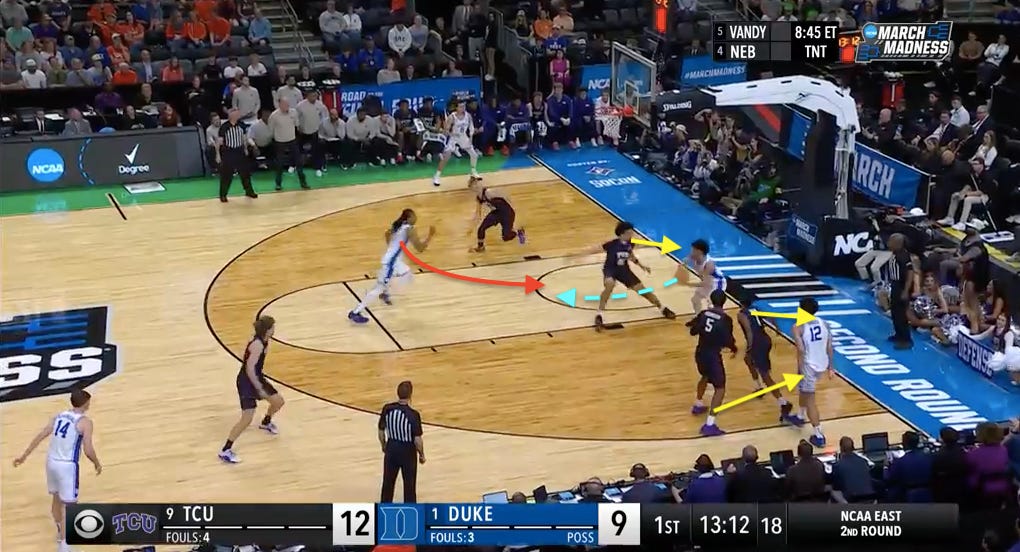
The Blue Devils have to work efficiently to stay ahead of TCU’s rotations, but Cayden, Cam and Maliq are quick processors. They do an excellent job creating, building and capitalizing off the initial advantage.
TCU heats things up whenever the opportunity arises. This defense aims to put two on the ball not only on post-ups and ball screens but also on off-ball actions; Dixon wants his team applying pressure everywhere. That means offensive players coming off down screens can expect a second defender — the screen defender — lunging toward them.
Opposing offenses can counter these coverages with aggressive curls and fades, re-screen actions and slips, where the would-be screener cuts toward the basket just before making contact with the defender. Ohio State showcased a few of these tactics during their opening-round matchup against TCU, presenting a blueprint of sorts for how to unlock off-ball activity against the pressure.
In the second half. Ohio State comes out in its “Iverson Ricky” action, which starts with shooting guard John Mobley (41.1 3P%) cutting across the lane over two Iverson screens from the 4 and 5.
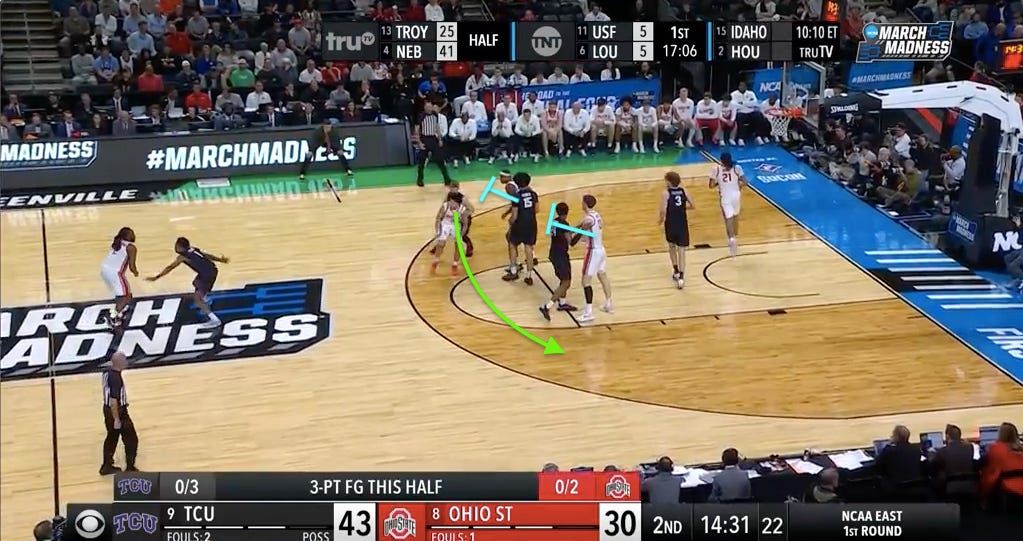
As Mobley cuts toward the right wing, point guard Bruce Thornton kicks the ball out to power forward Amare Bynum at the left elbow. Mobley then changes the angle of his cut, curling off Christoph Tilly’s screen toward the ball. This motion opens up a potential back-cut opportunity for Mobley, with Bynum positioned at the opposite elbow.
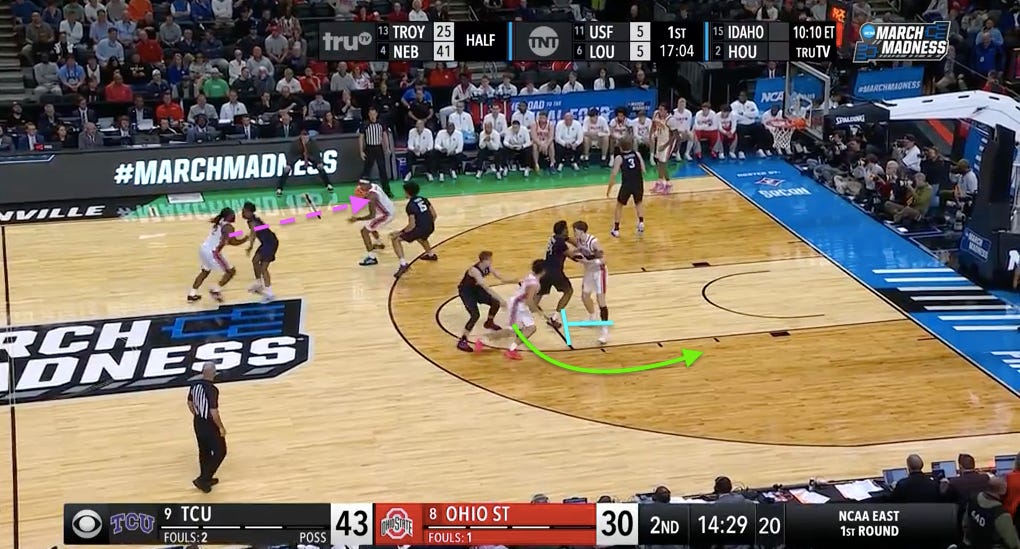
Instead of cutting all the way to the rim, Mobley brakes sharply and — while Tilly swivels his hips the other way — runs back up the floor off a down screen from the 7-foot center.
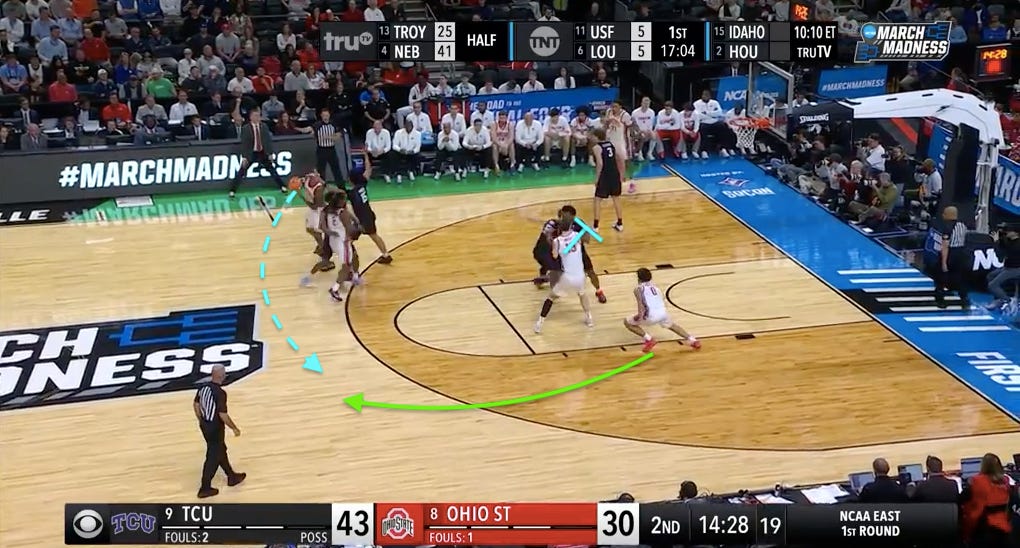
This re-screen sequence — the back screen into a down screen — is known in basketball circles as “Ricky” action. Toolson is caught off guard, left trailing as Mobley cuts back toward the ball. With the screen defender Edmonds showing on the ball, Mobley at least has a hand in his face.
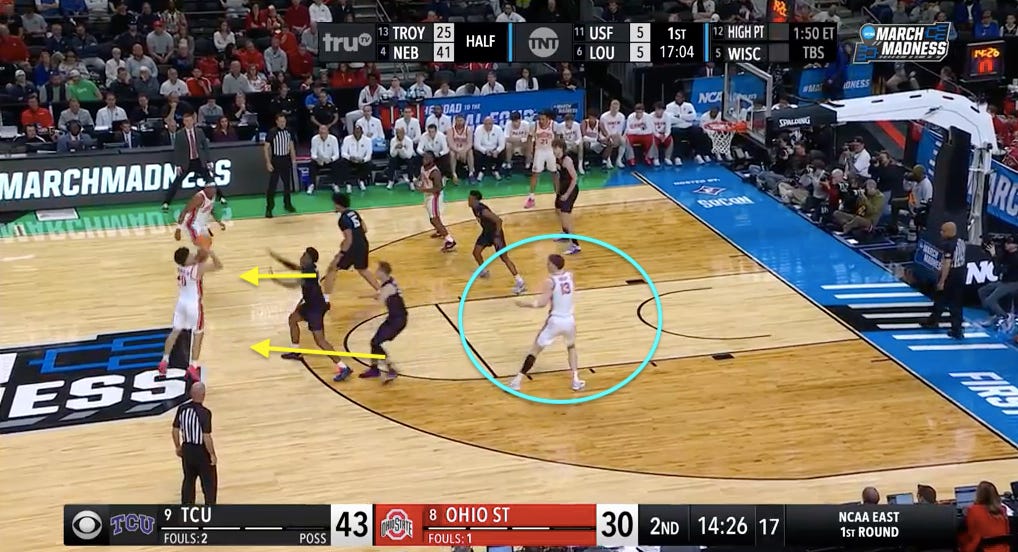
Mobley is a talented shooter with deep range, and he knocks down this 3-ball despite the contest. Equally noteworthy on this possession is how open Tilly is after setting the re-screen pindown. Mobley is rewarded for calling his own number, but Ohio State knows it can also get the screener open on a basket cut.
Later in the second half, the Buckeyes return to the same action: Iverson Ricky, this time with Thornton (another outstanding 3-point shooter) acting as the off-ball mover. Just before forward Devin Royal sets the re-screen down screen, anticipating that Robinson will step out to pressure Thornton, he slips to the rim.
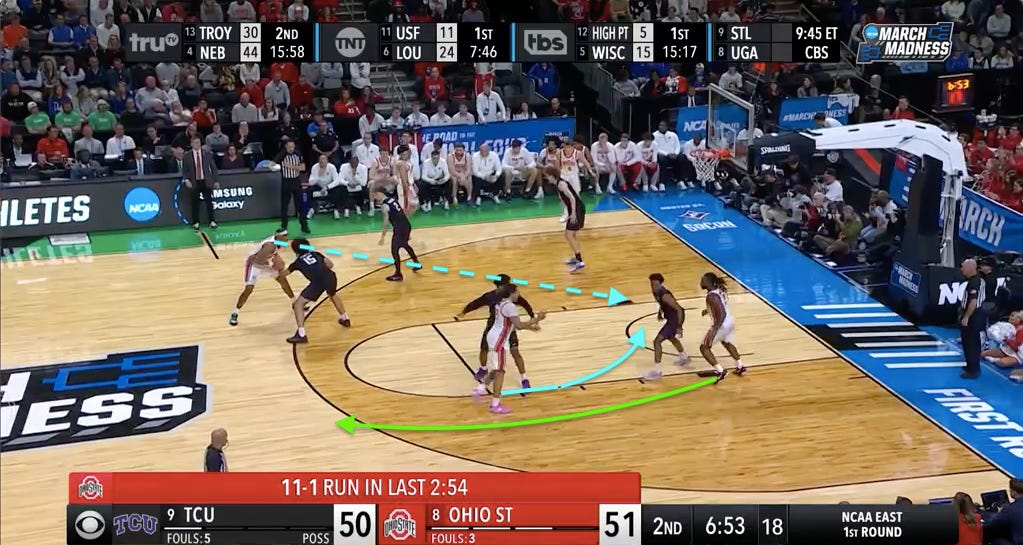
Like a tight end running a skinny post up the seam, Royal slips into space behind the defense, and Amare Bynum delivers the pass for an easy layup.
Two days later, Duke looked to exploit the same vulnerabilities in TCU’s off-ball defense.
After a timeout with about five minutes remaining in the first half, the Blue Devils ran what I’ve called their “Triangle” or “Wave” series this season, which I detailed back in early February. The series begins with Evans in the far corner, while the 5 and 4 set up on his side of the floor to run staggered down screens for the shooter coming out of the corner.
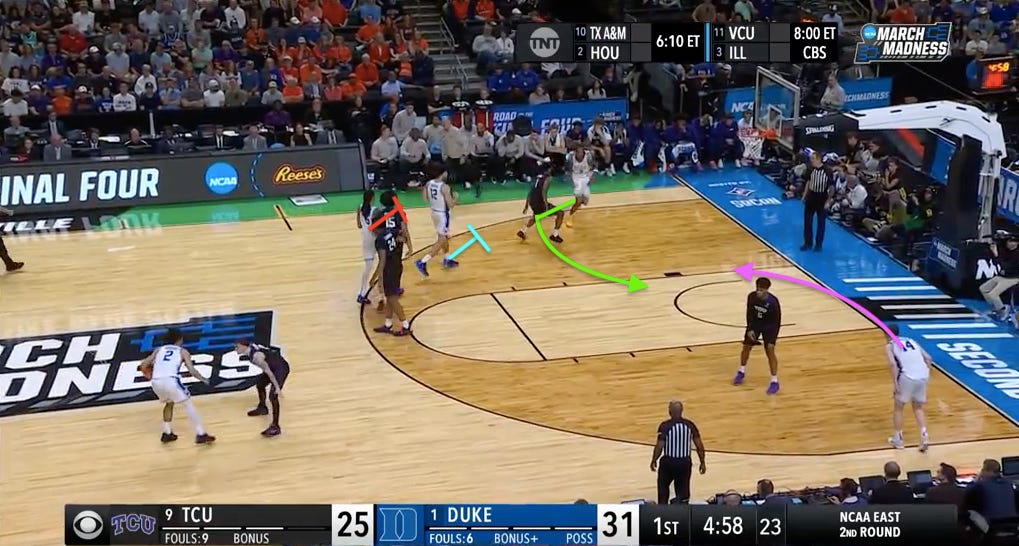
The Blue Devils utilize a variety of plays out of this Wave setup, including “Floppy” action for Evans, which is what they ran on this possession. Evans rejects the down screens from Cam Boozer and Brown, cutting down toward the rim and positioning himself under the basket. Brown lifts above the arc in the middle of the floor and runs a quick give-and-go with Cayden Boozer.
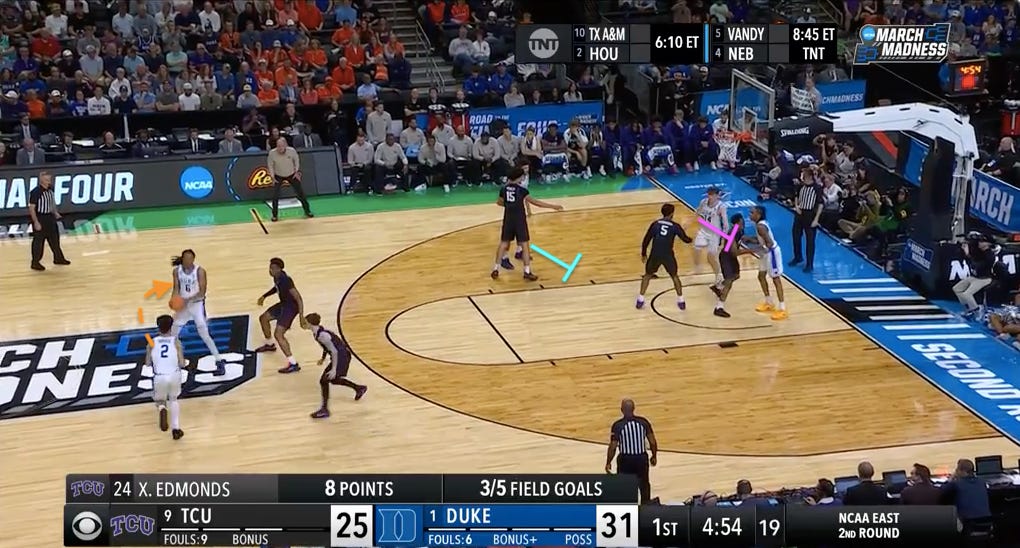
As soon as Brown flips the ball back to Cayden, he cuts toward the right side of the floor. With Evans deep in the paint, Duke sets up a single-double alignment for Floppy action: Evans can choose to cut toward the left wing off staggered down screens from Cam Boozer and Nik Khamenia, or toward the right side off a single down screen from Brown.
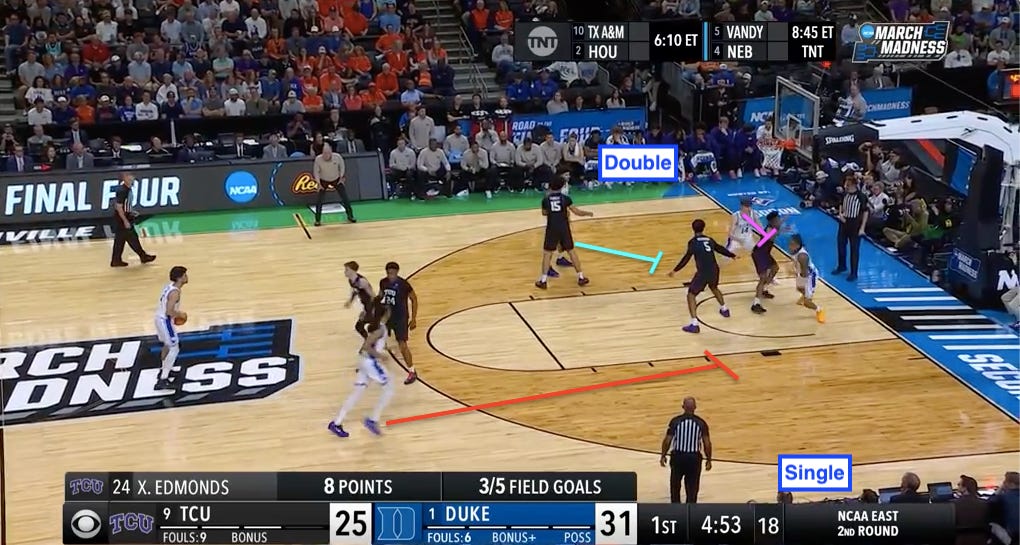
Evans chooses Brown’s side and cuts off the screen, drawing the attention of two TCU defenders: Pierre, who trails him around Brown’s pindown, and Edmonds, who comes off Brown to pressure the passing lane and contest a potential pass to Evans. With Evans occupying two defenders, Brown is left open in space and takes advantage by slipping toward the basket.
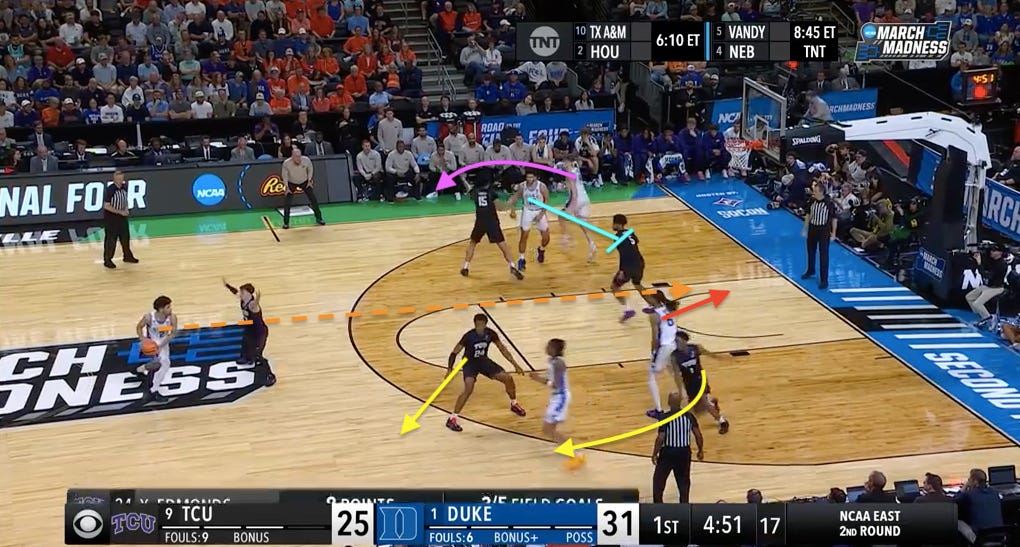
In theory, Robinson would be positioned on the weak side to deny an over-the-top pass to Brown. However, with Cam Boozer setting a decoy down screen on the left side for Khamenia, Robinson is pulled away as a back-line helper. Cayden Boozer and Brown are perfectly on the same page: Boozer threads a laser pass through the teeth of the defense, finding Brown for a cutting dunk at the rim.
Duke received a major boost before its matchup with TCU with the return of sophomore center Patrick Ngongba. Simply put, Ngongba is one of the top players and NBA prospects in the country: a two-way force at the center position who can protect the rim, clean the glass and dissect defenses with his 5-out face-up passing.
In his 13 minutes of action, Duke outscored TCU by 20 points, posting an offensive rating of 1.31 points per possession, according to CBB Analytics. Ngongba contributed four points (2-of-2 FGA), grabbed four rebounds, dished out four assists and blocked a shot.
With Duke trailing by two early in the second half, Scheyer called a timeout at the 16:11 mark and subbed in Ngongba and Khamenia. Out of the timeout, needing a play, Scheyer put the ball in Ngongba’s hands. Duke ran its “Elbow” action: a pass to Ngongba at the right elbow, followed by a back screen for Cam Boozer set by Evans.
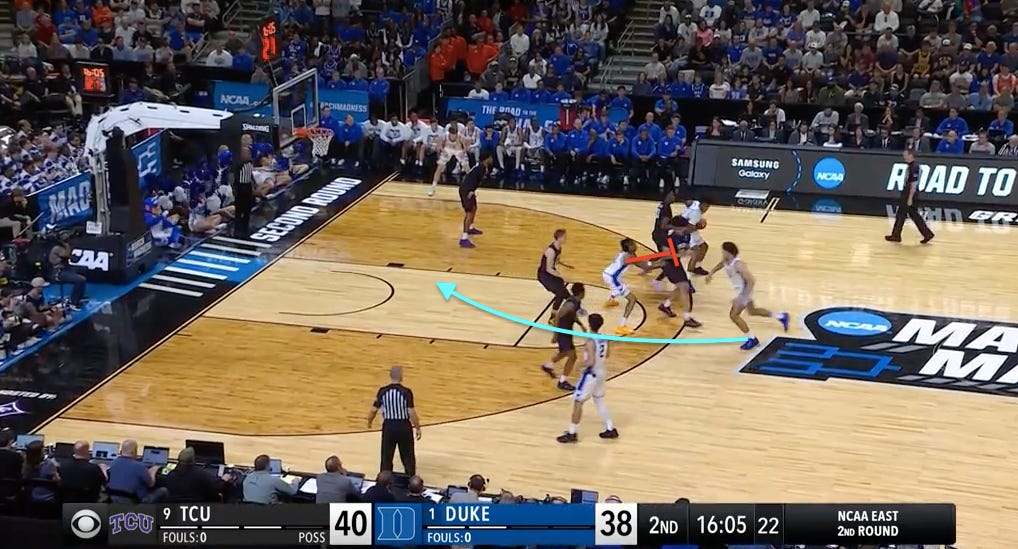
Punch doesn’t see Evans coming, as the sophomore wing smacks him with a great back screen. Toolson stays attached to Evans, and now Duke has the defense lifted, the ball in the hands of a top-flight frontcourt passing hub and Boozer cutting downhill into open space. Once again, this is exactly how Duke drew it up.
The Blue Devils boast one of the best offenses in the country when it comes to lifting opposing defenses with their 5-out scheme and high-post passers: Boozer, Ngongba and Brown. These concepts create opportunities to pull rim protectors away from the hoop and, against an aggressive defense like TCU, serve as a way to counteract the pressure on the ball and the various screening actions.
Duke ran the same Elbow action again less than two minutes later. This time, TCU defended it more effectively, but the Blue Devils found rhythm in their flow game, and Evans was able to drive downhill for the finish and draw a foul.
On Duke’s next offensive possession, the Blue Devils ran their “L” Series: Evans slides from the left corner to the opposite wing as Ngongba moves up to the top of the key. After a pass to Ngongba from Cayden Boozer, Duke is back in its 5-out alignment, with Ngongba in the middle of the floor and screening action occurring on both sides.
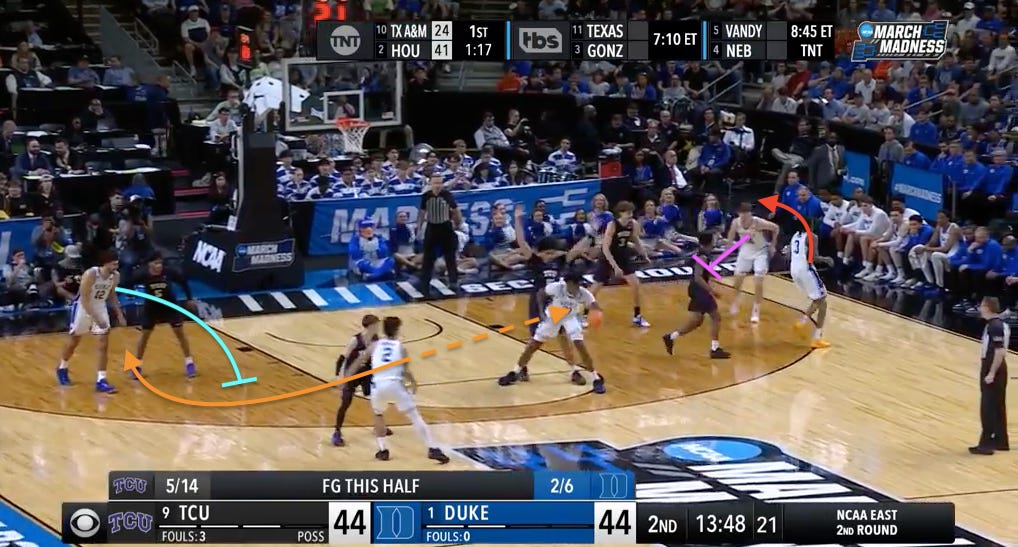
Working against TCU’s overplay, Duke’s off-ball movement orbits around Ngongba with dual back screens: Khamenia for Evans and Cam Boozer for Cayden Boozer. Once again, Robinson is positioned above Cam’s screen for Cayden, challenging the pass, while Harding fights over and stays attached to Cayden. Help defenders on the right side are occupied with Evans and Khamenia, who are screening and spacing beyond the arc.
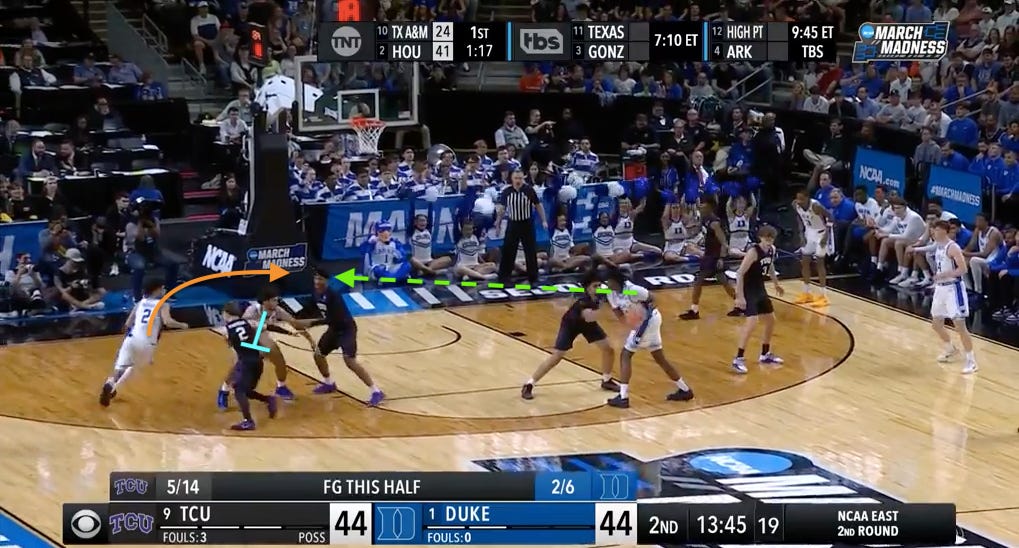
Cam sets a study back screen, creating separation between Cayden and Harding, and with Robinson pulled up the floor, there’s no one near the basket to help on the cut. Ngongba sees Cayden breaking free and delivers for the layup.
As Duke’s lead widened, the Blue Devils started to tap into hi-lo activity between Cam Boozer and Ngongba, with the offense continuing to flow through Ngongba’s high-post touches.
With under eight minutes to play, Duke set up in a Box formation: Evans and Sarr at the low blocks, with Cam Boozer and Ngongba at the elbows. The play is designed to feed Ngongba in the left slot and then run another back screen for Boozer, set by Evans.
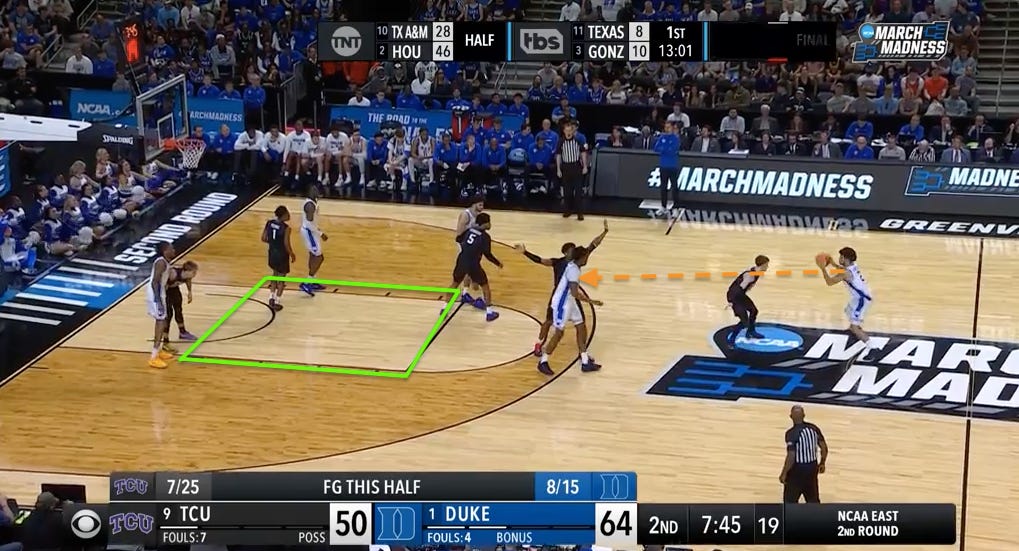
Cayden Boozer enters the ball to Ngongba and cuts down to the left corner, with Ngongba faking a handoff back in his direction. Sarr trails, zipping up the right side of the floor before curling out to the left wing. Meanwhile, Evans lifts and is ready to set the back screen on Robinson for Cam Boozer.
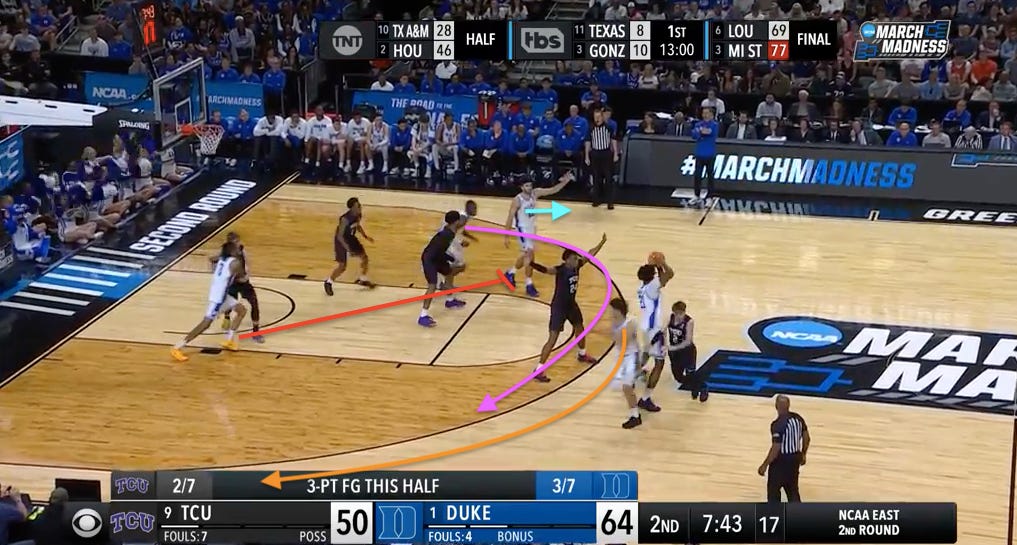
TCU opts to switch this screen, though, placing the 6-foot-5, 174-pound Toolson in a mismatch in the post against Boozer (6-9, 250). What happens next is Duke making an automatic read against this matchup: Boozer seals Toolson in the post as the other four Blue Devils space above the arc. The table is set for big-to-big hi-lo action.
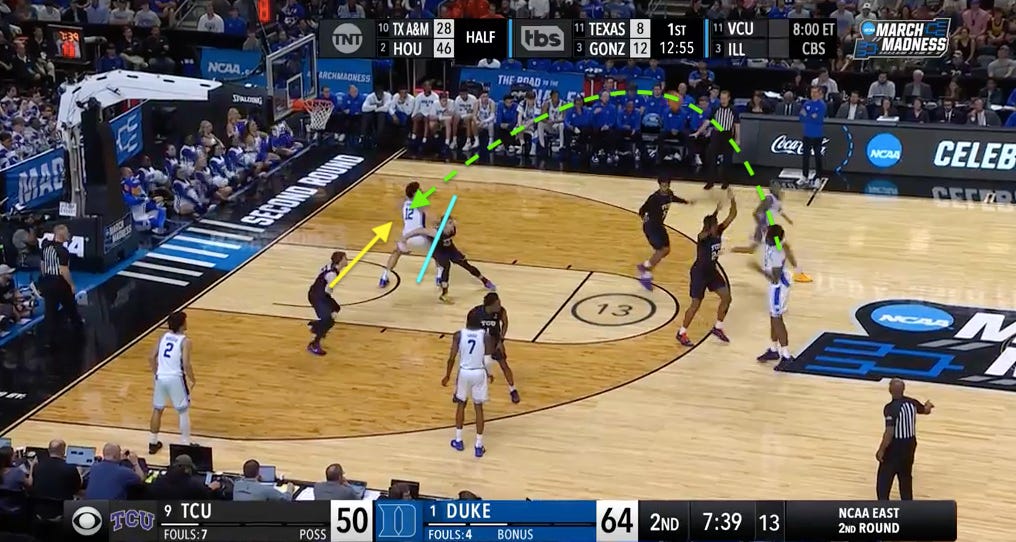
Ngongba has time and plenty of room to throw a lollipop hi-lo post-entry feed over the top of the defense. Harding comes off Cayden Boozer to try and deter the pass, but Cam does a nice job high-pointing the ball and coming down for an easy finish.
With TCU grasping at straws, the Horned Frogs switched to a 2-3 zone. Duke immediately responded: Ngongba flashed to the nail and Cam Boozer sealed at the right block, leading to another improvised lob pass over the top for a layup.
Ngongba has 23 assists to Cam Boozer this season — 11 more than his next closest link-up: 12 assists from Ngongba to Evans. With these two on the floor, Duke has been special: +340 in 532 minutes, scoring 1.29 points per possession on offense and holding opponents to 0.90 points per possession on defense. Their talents speak for themselves, but over the course of the season, their chemistry has developed as Duke’s staff has found more ways to synchronize their skill sets.
In the five postseason games without Foster, Cayden Boozer has stepped up in a big way. Thrust into a larger role in a string of must-win games, he’s played with confidence and poise. There have been some bumps and bruises, but Cayden has delivered, averaging 34.8 minutes, 13.8 points, and 3.2 assists to 1.8 turnovers per game. Over those contests, Duke has a +49 in 174 minutes with Cayden on the floor, scoring just under 1.19 points per possession.
Cayden isn’t the only Boozer brother forced to increase his on-ball contributions since Foster left the UNC game with a fractured foot. Cam Boozer has adapted his game to meet the moment, serving as a playmaker for Duke in 5-out sets, post-ups and pick-and-roll actions.
Over the last five games, according to InStat, Cameron Boozer has averaged 3.6 used possessions per game as a pick-and-roll ball handler, accounting for 19.4 percent of his total possessions — both increases from the first 31 games of the season, when he averaged 1.5 pick-and-roll possessions per game and 8.6 percent of his total used possessions.
He’s also averaged 2.0 used isolation possessions per game over this five-game sample, up from 1.0 per game in the first 31 contests.
According to my charting data, Duke ran 10 pick-and-roll possessions with Cameron Boozer as the primary ball handler against TCU, scoring 14 points: 1.40 points per possession. Some of these came during the brief first-half stretch when Cayden Boozer was on the bench.
Duke’s primary pick-and-roll look with Cam as the ball handler against TCU was an inverted version of its “3 Across” spacing template. One of the guards — Isaiah Evans in this case — sets a screen for Cam, while three players space along the baseline, including the 5 positioned near the rim in one of the two dunker spots.
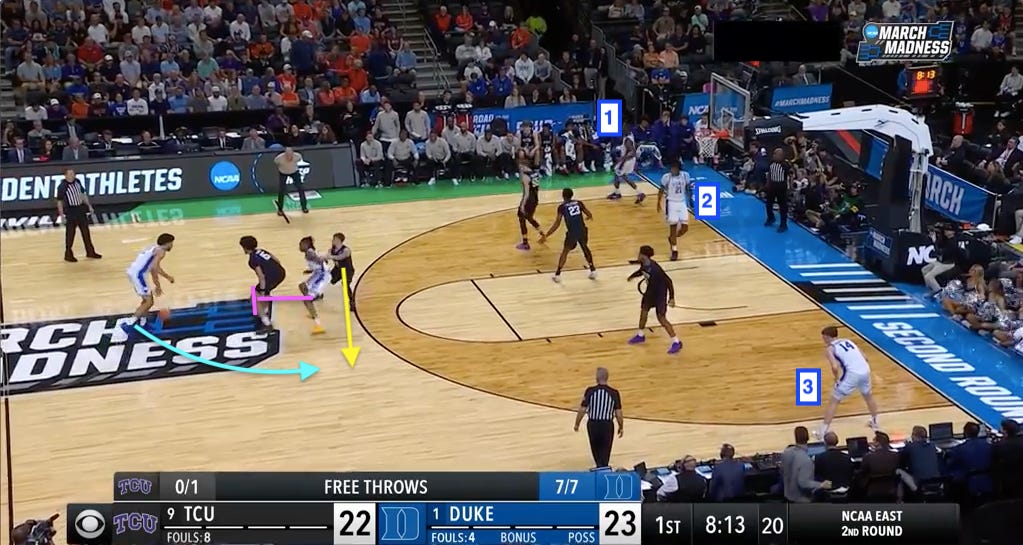
All season, opponents have struggled to find the right coverage for the Cam Boozer–Evans inverted pick-and-roll. Duke deliberately involved TCU’s smallest defender — Harding (6-0, 160) — as the screen defender: Evans lifts to set the pick on Punch. TCU initially had Harding show hard on Boozer before attempting to scramble back to Evans, who popped out to the left wing.
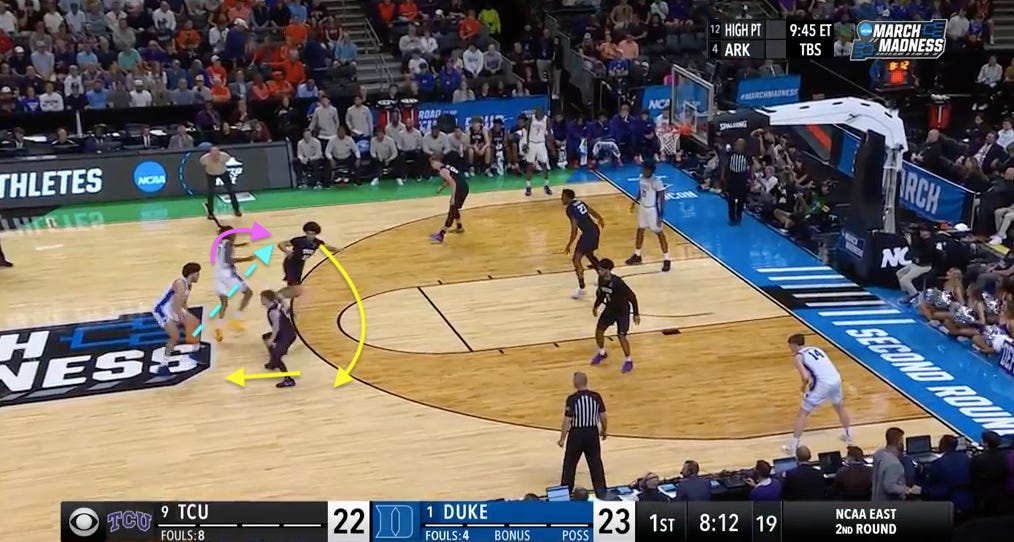
Harding sticks with Boozer and tries to route him back up the floor, but this buys more time and space for Evans, one of the quickest shots in college hoops. When Boozers passes left to Evans, Harding must scramble on the closeout. Evans shot-fakes, gets Harding in the air and then leans into the defender to draw contact and earn a four-point play.
One minute later, the Blue Devils organize their half-court offense with Point Cam in the same 3 Across setup. TCU has different defensive matchups, though: Pierre is on Evans in the left corner, while Harding is now on Sarr. Once again, Harding is the defender with a target on his back. Duke wants him involved as the screen defender, so Sarr is the one called in to set the pick for Cam in the middle of the floor.
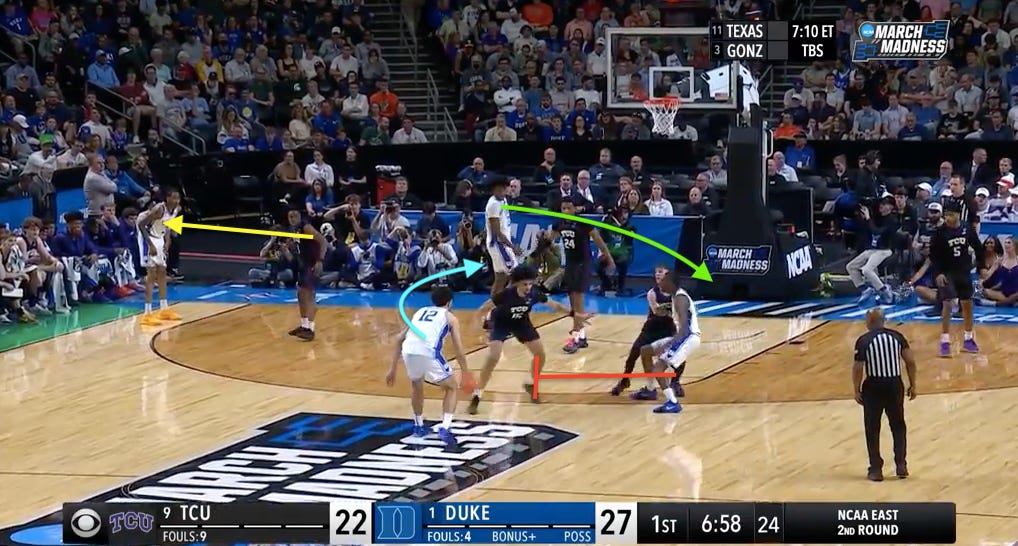
As Cam rejects Sarr’s screen, he drives downhill to the left side. Ngongba sees Cam’s drive and cuts from the left dunker spot to the right side of the paint. Pierre face-guards and refuses to help off Evans in the strong-side corner, which would create an easy kick-out for a corner 3. So when Edmonds slides over to help on Cam’s drive, Duke’s center is open with inside position on the doorstep of the rim.
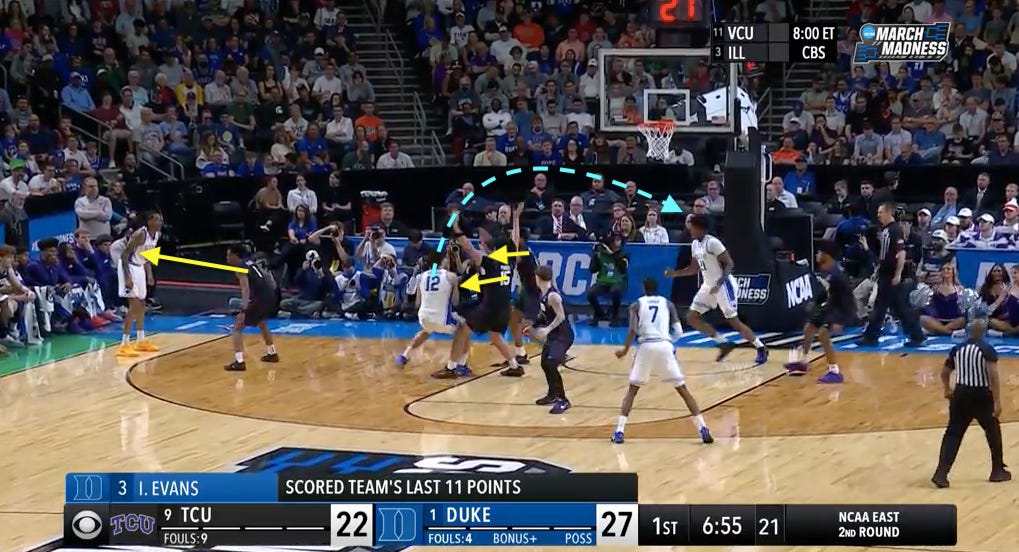
Punch and Edmonds make it difficult for Cam by applying pressure in a tightly compacted quadrant of the court; however, Duke’s star forward still manages to deliver a lob pass over the top, which Ngongba showcases his touch by redirecting into the rim for a close-quarters alley-oop.
It’s worth highlighting just how impressive Sarr was against TCU — arguably the best two-way performance of his career. The freshman wing helped swing the game with relentless ball pressure while (as always) excelling at the dirty work: eight rebounds, two steals and a block.
As the cherry on top, Sarr showcased some of the finest shooting since arriving in Durham, knocking down a career-high four 3-pointers. When the Blue Devils gets this type of offensive production from the wings — Sarr, Khamenia and Harris — they become very tough to beat.
Stay tuned for a Duke-St. John’s preview later this week!
No posts
Comments
Nothing yet. Say the first thing.
Sign in to join the conversation.