
Caleb Foster did the damn thing.
With about 15 minutes left in the Sweet 16 matchup between Duke and St. John’s, sophomore guard Ian Jackson hit an elbow jumper against Duke’s zone defense to push the Red Storm into a 10-point lead, 65-55. From the outside, it looked as though a long season and an extended postseason run, compounded by two of its starters missing chunks of time, had finally caught up with Duke. The Blue Devils seemed to have run out of steam against Rick Pitino and his team’s amped-up defensive pressure.
At the risk of hyperbole, what happened next would change the course of basketball history. Look around, the ripple effects are seismic. In the madness of March, Foster — less than three weeks removed from surgery on a fractured foot — stepped up and unearthed a legacy performance.
Foster delivered 11 points (5-of-7 2PA), two assists, two crucial rebounds and no turnovers in 19 minutes of action. Facing one of the nation’s Top 10 defenses, Duke scored 1.37 points per possession with Foster on the floor (1.19 PPP without him) and shot 57.1 percent on 2-point attempts. St. John’s is one of the best defenses at turning teams over, but with Foster on the floor, Duke’s offense recorded just two turnovers.
Today and tomorrow bring more basketball. In just a few short days, the 2025–26 season will be over. It’s bittersweet. A champion will be crowned. For now, though, let’s stay in the moment and look back at a performance that will outlast whatever happens over the next 10 days: Caleb Foster’s historic outing, how Duke got him going in the second half, how he picked his spots and the monumental contributions of Cameron Boozer and Isaiah Evans.
As Duke looked to respond to a 15-1 run by St. John’s, Jon Scheyer called for a pick-and-roll between Foster and Cam Boozer. Rather than using spread pick-and-roll — with the three off-ball players spaced beyond the arc — or an empty-corner pick-and-roll, with Foster and Boozer aligned to one side, Scheyer opted for Duke’s “3 Across” setup.
Boozer set the screen for Foster in the middle third of the floor, while three players were spaced along the baseline: Dame Sarr and Isaiah Evans in the corners, and Patrick Ngongba in the dunker spot.
3 Across and Spain
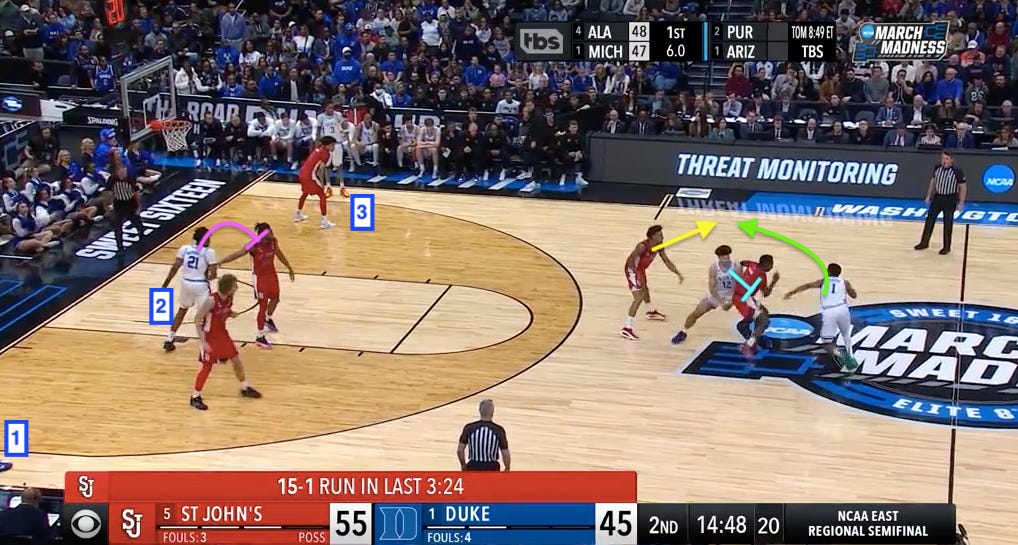
Ngongba’s positioning here is key. Instead of spacing out to the arc — and potentially bringing his defender, Zuby Ejiofor, a powerful rim protector, with him — Ngongba stays near the basket. As Foster drives downhill, Ngongba seals deep in the paint, angling his body between Ejiofor and the rim.
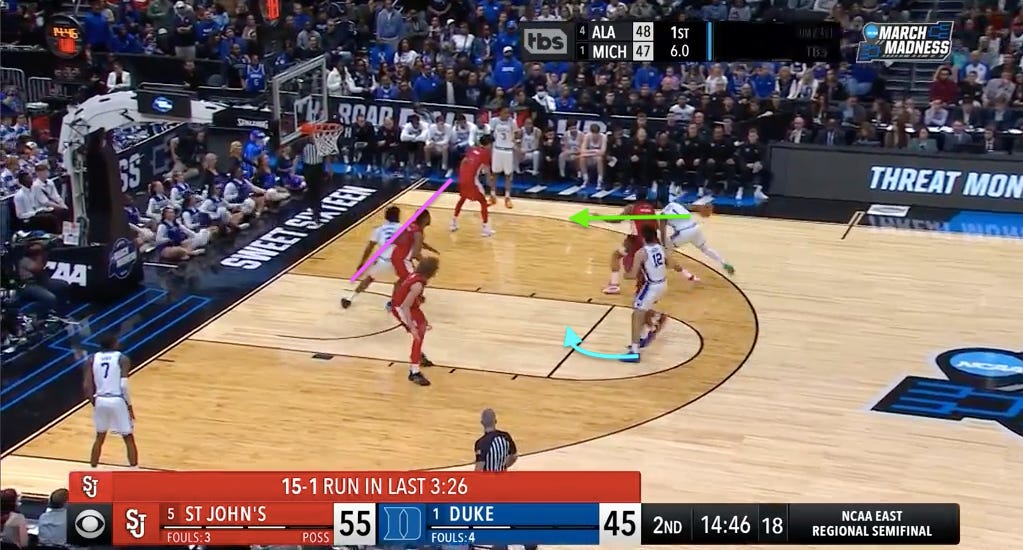
St. John’s defends the action well, aided by on-the-fly switching from Ejiofor and Ruben Prey. However, through a combination of length and sheer will, Duke wins two crucial offensive rebound battles: first Ngongba, then Sarr. Crashing in from the left corner, Sarr wins a contested rebound over Jackson, tips the ball to Foster,and uses his wingspan to shield off two defenders as Foster lays it in.
Duke rebound 41.4 percent of its own misses against St. John’s. This was an import factor for the Blue Devils to win. If this possession unfolds differently, and St. John’s scores on the other end, who knows what happens. Facing postseason mortality, Duke clung to life…for at least one more possession.
After a defensive stop, the Blue Devils returned to the same “3 Across” ball-screen action between Foster and Boozer, with Sarr, Ngongba and Evans spaced along the baseline: 1, 2 and 3.
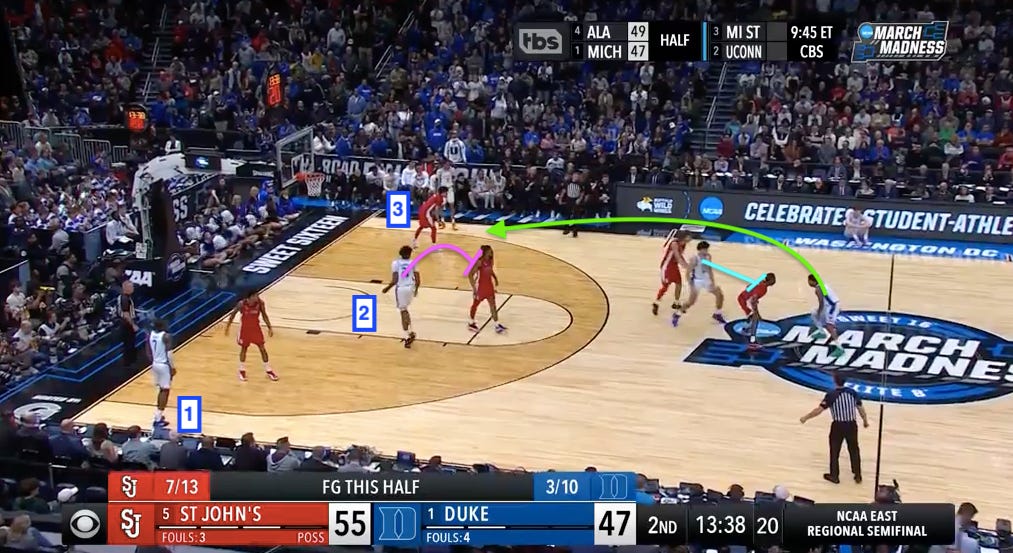
Prey switched onto Foster following Boozer’s screen, but Foster still mustered enough burst to turn the corner, challenging the big man’s momentum with a slight hesitation just outside the lane. As Foster approached the rim, Ejiofor (7.2 percent block rate) shifted toward him, but before he could contest, Ngongba delivered another deep seal, allowing Foster to slip in for an uncontested layup.
This is one of the hidden benefits of the “3 Across” spacing template. While it creates more traffic in the lane — with the 5 man stationed in the dunker spot compared to a 4-around-1 spread pick-and-roll — those deep seals can generate high-percentage looks at the rim by keeping shot-blockers away from the ball.
Plus, with no offensive players spaced on the wings — Sarr and Evans are in the corners — the ball handler has a double gap to attack on either side of the floor. There’s no help defender one pass away waiting to rotate over.
Following a made jumper by Dylan Darling against Duke’s zone, St. John’s pushed its lead back to eight. To counter Darling’s full-court pressure on Foster, Ngongba set a bone-crushing screen, helping Foster get the ball across the timeline. Darling (6-1, 175) recovered to get back in front, but Foster (6-5, 205) showed impressive strength and determination, powering his way to the basket.
Let’s be clear: this is an absurd play by Foster, who manages to keep his pivot foot down — the same right foot he fractured three weeks ago — while shot-faking and finishing over a smaller defender.
If it ain’t broke, don’t fix it. On the next trip down the floor, Scheyer goes back to the same call: “3 Across” with Foster, Boozer and Ngongba, plus Nik Khamenia and Darren Harris spaced in the corners.
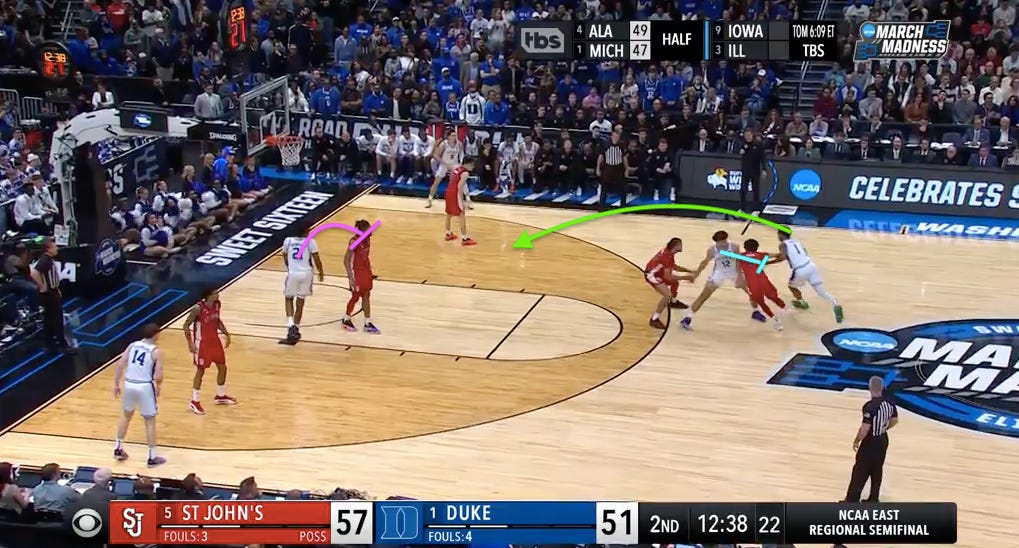
This time, St. John’s opts not to switch the action: Bryce Hopkins stays with the screening Boozer, while Oziyah Sellers fights over the screen. Sellers does a solid job of staying attached to Foster, who doesn’t quite have his usual burst. Foster compensates with some of his tightest ball-handling and strength, changing tempo with a live-ball crossover to create separation, then slamming back into Sellers to draw the foul.
Trailing by five following an Ejiofor miss, Foster pushes the ball up the floor for another middle ball-screen with Boozer. This time, instead of “3 Across,” Duke, with Scheyer signaling the call by tapping his head, runs its Spain (or “Tap”) pick-and-roll. Ngongba clears out of the lane as Harris lifts to set a back screen on Dillon Mitchell, Boozer’s defender.
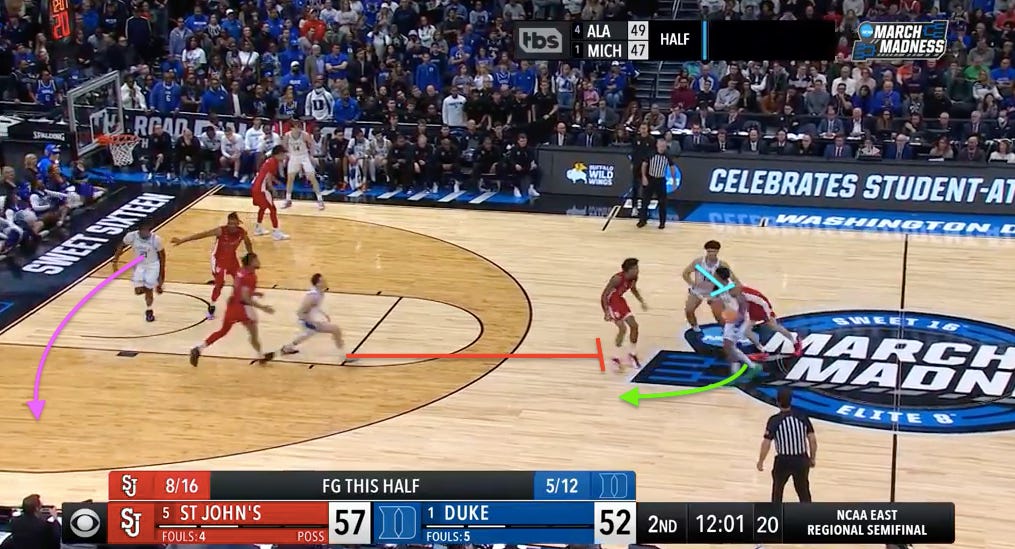
The back screen ends up being superfluous. After repeatedly allowing Foster to get downhill to his dominant right hand, St. John’s adjusts its coverage. This time, Pitino has his defense “weak” Boozer’s pick for Foster: Mitchell up close to the level of the screen and Darling angling his body between Foster and Boozer. The goal is to force Foster left, toward his weaker hand, hence the name.
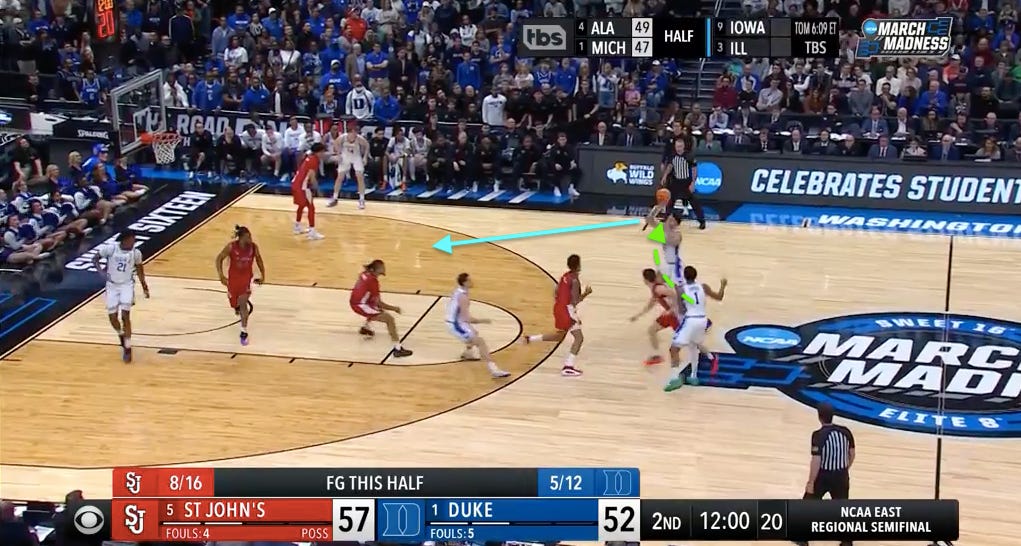
One of the most effective counters to this aggressive “weak” coverage is to outlet the ball to the screener on a short roll, moving away from the defender. Foster makes the simple read and finds Boozer in space. Boozer drives downhill with inside leverage on Mitchell, while Ngongba helps neutralize Ejiofor as a rim protector by cutting toward the left corner.
On the next trip down, the Blue Devils return to “3 Across”: Foster, Boozer and Ngongba. As Boozer pops to the left slot, Ngongba cuts to the opposite dunker spot.
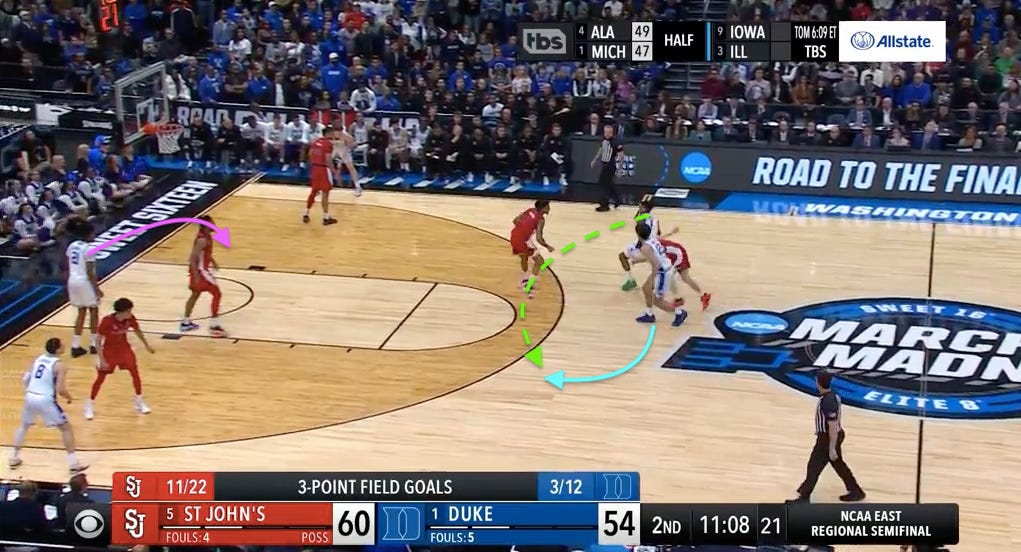
Darling tries to funnel Foster to his weaker left hand, but Duke’s point guard again uses his size and craft to get where he wants. Foster spins off Darling’s pressure at the point of attack and returns to his right hand, with Boozer holding his ground to screen Darling. With Darling a step behind, Mitchell has to slide further left to contain Foster, opening up space for Boozer on the pop. Boozer attacks Mitchell’s closeout, drives into the paint and grabs his own miss for a put-back layup that cuts Duke’s deficit to four.
On the next half-court possession, following Boozer’s layup, Duke returned to its zone defense. With Khamenia providing a solid contest atop the zone, Darling’s late-clock heave misses. As the loose ball bounces toward the left corner, Ejiofor (12.2 percent offensive rebound rate) scrambles to grab it. Foster, however, has other plans; the junior guard beats Ejiofor to the spot. Even without getting two hands on the ball, Foster manages to slap it out of bounds off Ejiofor, earning Duke another offensive possession.
Special stuff from Foster, who empties the bucket to secure a contested rebound against one of the nation’s top offensive rebounders.
Following Foster’s valiant effort, Duke runs more Spain/Tap pick-and-roll, with Scheyer and Boozer signaling the play call.
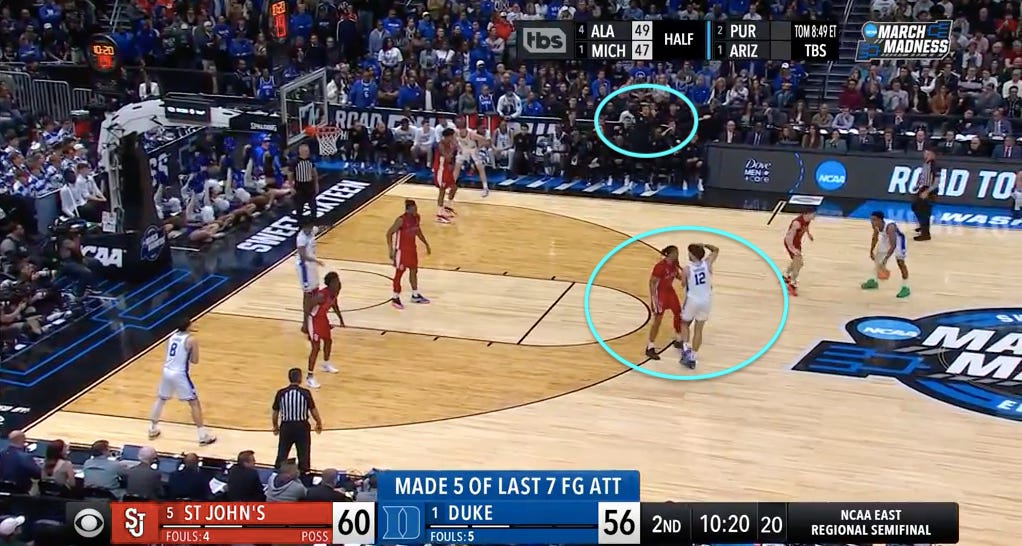
St. John’s tries to force Foster to his left hand with Darling’s positioning, so Foster takes the low-hanging fruit: he finds Boozer on the short roll, just as he did two possessions earlier.
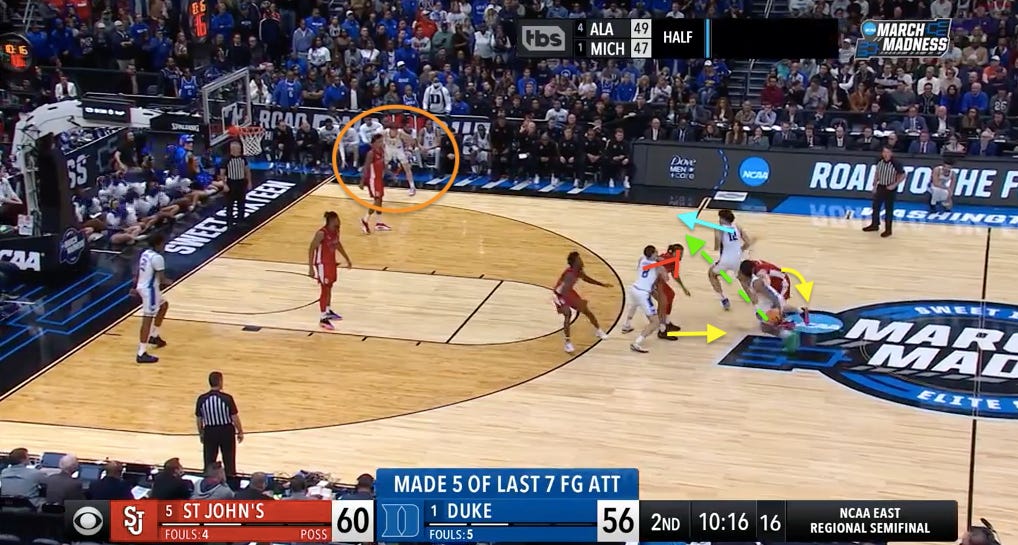
Boozer’s short-roll drive draws extra attention this time, though. As Hopkins recovers, Ejiofor slides over to help, too, leaving Ngongba open in the left dunker spot. Boozer sees Ngongba and, as he has dozens of times this season, tries to hit him for a big-to-big passing sequence.
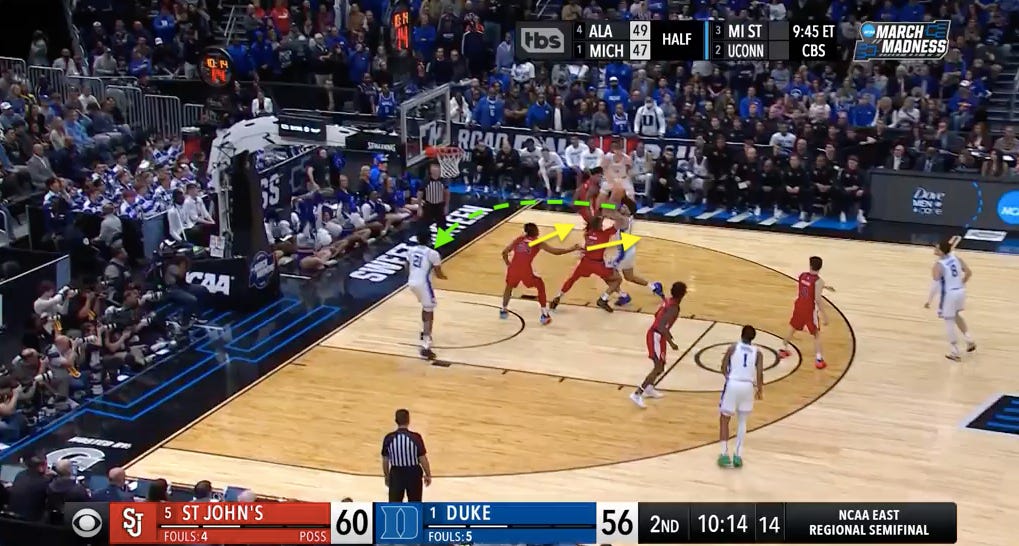
Boozer’s pass to Ngongba is off the mark, though, which pulls Duke’s center away from the rim to collect it. For a moment, the defense is able to reset. But that moment vanishes, thanks to Khamenia. As Mitchell ball-watches in the right corner, his attention is focused on Ngongba, not Khamenia. The freshman forward takes advantage, cutting into the lane.
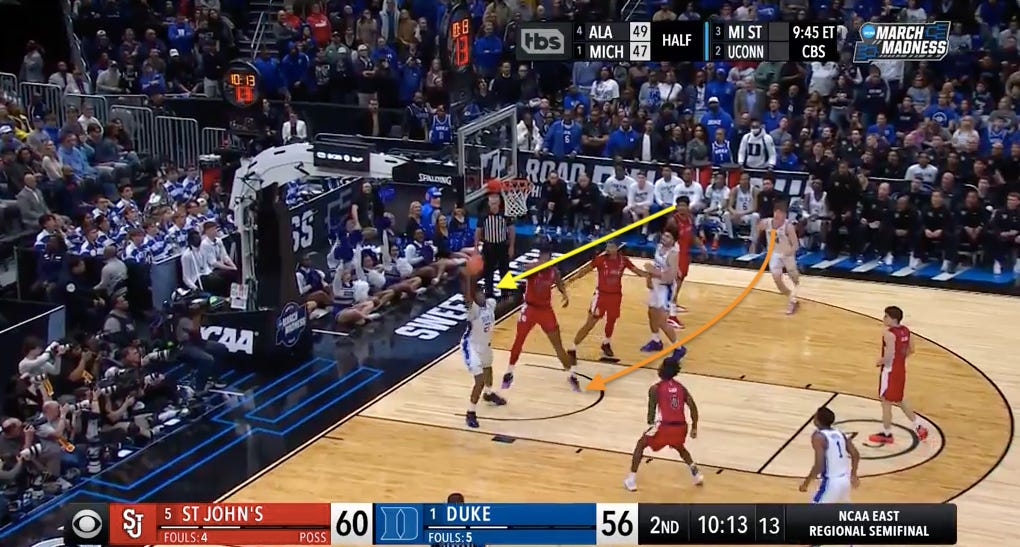
This is a heady off-ball read from Khamenia. It takes Ngongba a half-second to recognize the cut, but he spots Khamenia and hits him for a finish in the lane, with Mitchell unable to get back into the play.
With about three minutes to play, Duke’s defense is back in its man-to-man scheme. The Blue Devils get one of the their biggest stops of the game: Brown helps contest a 3-point attempt from Sellers as he comes off a screen from Ejiofor. Foster reads the missed shot off the rim and wins a race to the corner to collect the long rebound.
This is the kind of “heart of a champion” performance you expect from Foster. His 11 points and two assists off the bench were legendary, but it was his effort and courage in securing those two long rebounds that really stood out. Those defensive plays set the stage for Foster to hit one of the biggest shots of his career.
Horns Ghost Ricky
With just over 90 seconds left, Duke reset its half-court offense, and Scheyer signaled a play out of the Horns series. I call this action “Horns Ghost Ricky,” a go-to design for Evans. The play begins with Foster initiating the offense up top, Duke in a Horns set and Evans stationed at the right elbow. Evans fakes a ball screen for Foster, then “ghosts” out to the left wing, slips the screen and runs off a flare screen from Brown.
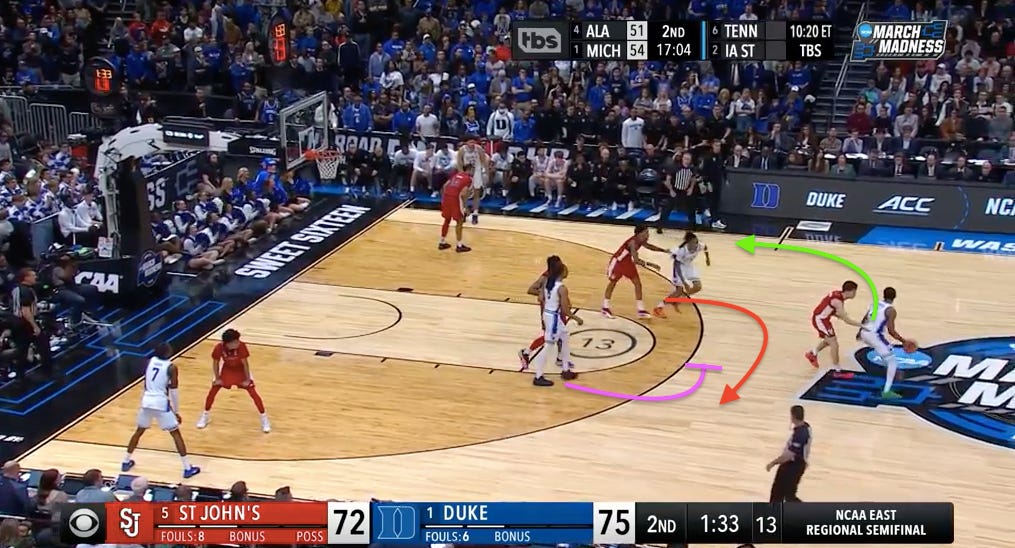
Evans doesn’t continue toward the sideline off Brown’s flare screen. He stops abruptly along the left wing and cuts back toward the middle of the floor off a re-screen (“Ricky”) pindown from Brown. St. John’s may have even scouted the play: Sellers, guarding Sarr in the left corner, points out the action to his teammates.
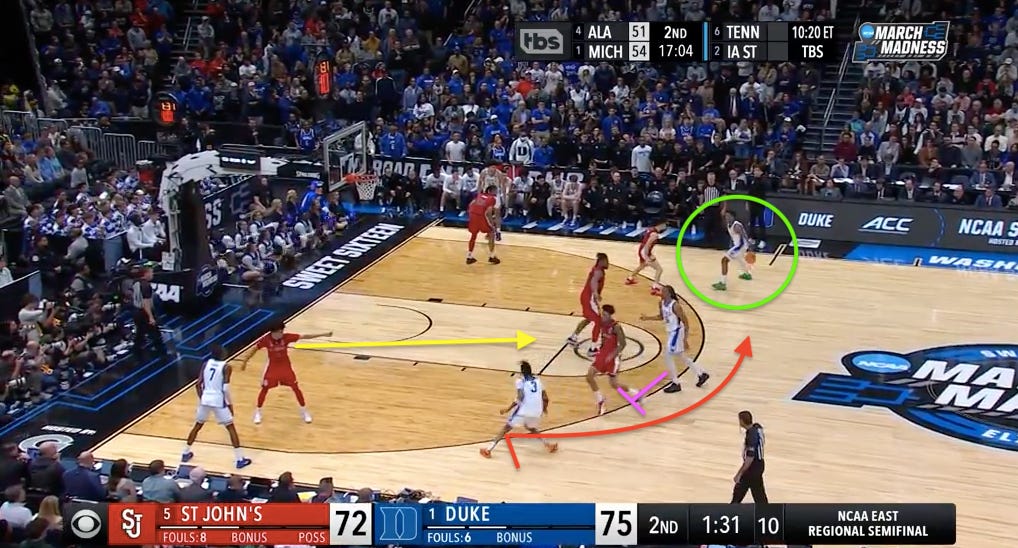
Concerned with Evans, who was red-hot at this point, coming off the screen into space, Mitchell and Ejiofor communicate a switch. Mitchell takes Brown while Ejiofor slides over to guard Evans. The exchange works perfectly as a decoy for Duke. With Mitchell and Ejiofor focused on Evans’ off-ball movement, they leave Darling isolated against Foster.
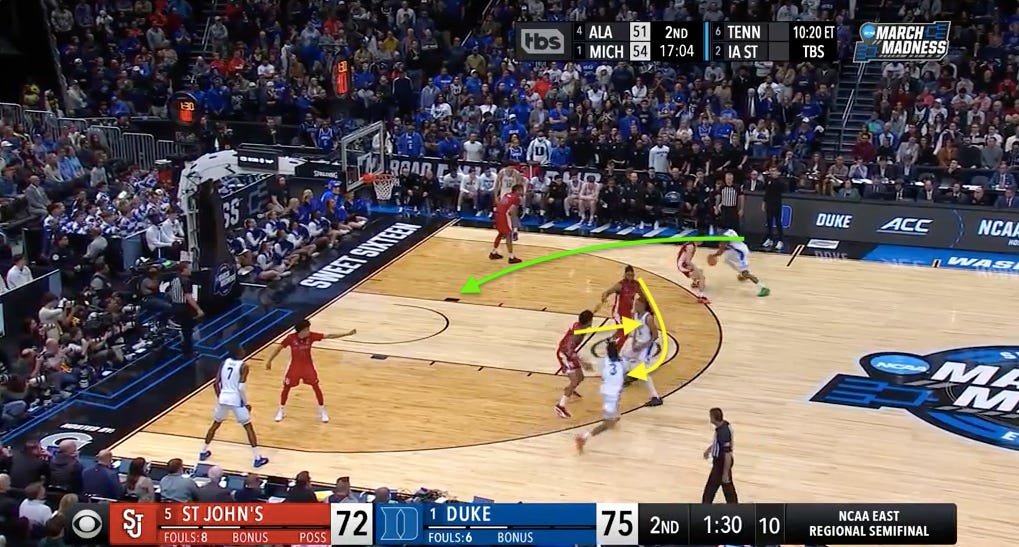
You know what happens next. Foster blows past Darling with a nasty crossover dribble. Hopkins hesitates to help off Boozer in the strong-side corner, which would’ve opened up an easy kick-out pass, and with Mitchell and Ejiofor occupied, there’s no weak-side rim protection. Despite not having two fully healthy wheels, Foster explodes downhill and finishes through contact for a huge bucket.
Here’s the same Horns Ghost Ricky set in another tight, late-game scenario against Florida. The Gators defend it well, so Duke flows into its 5-out offense mid-possession, and Boozer ends up with an open pick-and-pop 3 after setting a back screen for Evans.
Foster was the spark plug for Duke’s win over St. John’s, but he wasn’t the only Blue Devil who came alive as a second-half pick-and-roll scorer or creator. Once again, the inverted pick-and-roll game with Cam Boozer and Isaiah Evans proved to be a crucial source of clutch offense. Given the circumstance, Evans put together one of the most shot-making games of his career, which is saying something: 25 points on 15 attempts, including four 3-pointers.
When Foster was subbed out at the 9:24 mark of the second half, Boozer got the keys to the car. On the very first offensive possession sans Foster, Duke went to inverted pick-and-roll with Cam Boozer-Evans on the right side of the floor — with an empty corner. As Boozer drove into the paint, the St. John’s defense converged, doubling him in the lane with Joson Sanon, which created a kick-out to Cayden Boozer on the left wing. The defense rotated toward Cayden, who made the extra pass and quickly redirected the ball to Evans. Sanon had ground to coverage on his closeout back to Evans, who took advantage by shot-faking and getting to the midrange for a pull-up 2.
On the next trip up the floor, Duke’s offense quickly flows from its “L” series into more inverted pick-and-roll with Boozer and Evans: another go-to action. St. John’s switches, but Hopkins drifts too far from Evans, leaving an open pick-and-pop 3 from the left slot.
This shot (temporarily) gave Duke the lead and highlighted a notable breakdown from Hopkins. The whole point of switching this action is to keep the ball in front, stay in rotation, and deny Evans an easy catch-and-shoot opportunity on the pop.
3 Across Inverted: Fist 4
The Blue Devils will use the inverted screening action between Boozer and Evans in their 3 Across setup, too.
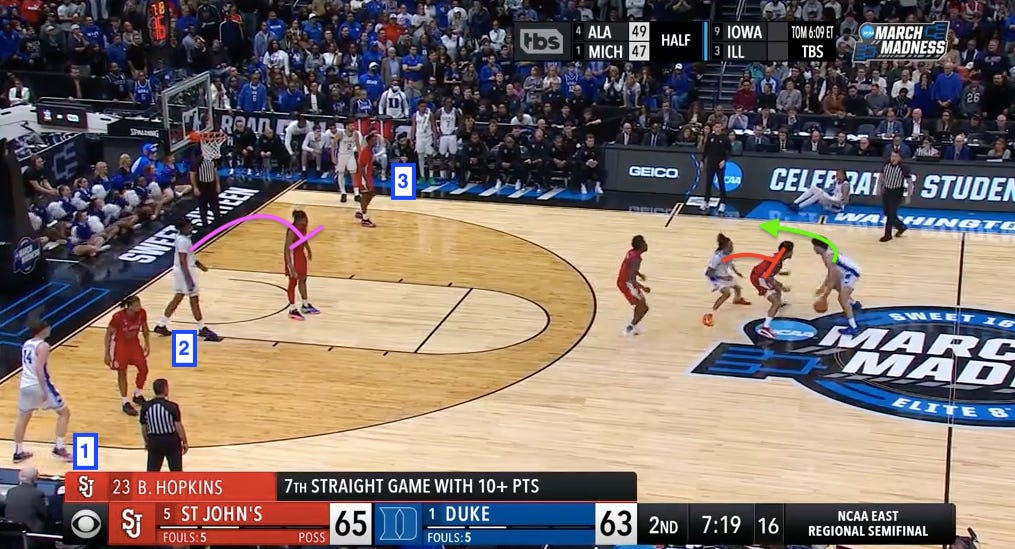
This has been the case all season: no defense has found a reliable answer for the Boozer-Evans ball screen. If the defense switches, Duke can attack the mismatch; if it shows and recovers, Duke can attack the open space. The action is built to produce quality looks.
On this possession, Mitchell starts on Boozer. As Evans sets the screen, Mitchell fights over and stays with Boozer for a dribble — until it’s called out that he’s supposed to switch, with Sanon stepping out on Boozer.
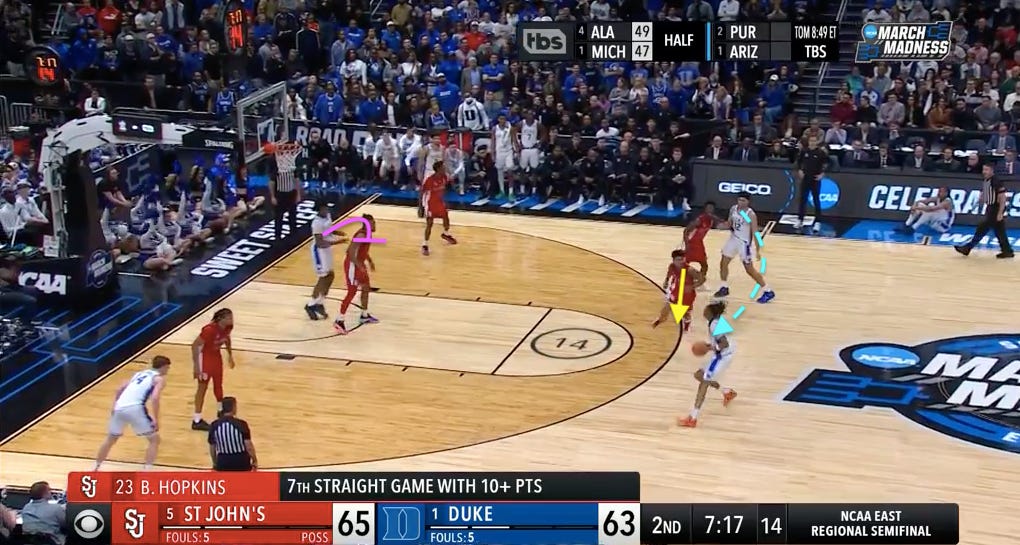
If the coverage is programmed to switch, it’s trouble for the defense when the switch defender’s first step goes the wrong way. Mitchell now has to cover ground to get back to Evans, who has made big strides as a slasher this season. He knows a hard closeout will create catch-and-go opportunities. Evans shot-fakes, blows by Mitchell and uses another seal from Ngongba to get space near the rim, with Ejiofor once again unable to provide weak-side rim protection.
Ngongba really was an unsung hero in this game with his ability to clear space around the basket.
Less than two minutes later, Duke flows back into more inverted ball screen action with Evans and Boozer in 3 Across. The Red Storm defend much better on this possession, but Boozer is just a load to deal with: he still gets downhill against Hopkins and scores in the paint.
At the 4-minute mark, Duke runs more of the same with Boozer and Evans. St. John’s does an excellent job of bottling up the initial action. No matter: Evans and Boozer flow back into middle-third screening action, with Brown in the dunker spot and Evans now handling the ball. Evans rejects the re-screen and creates space from Jackson with a massive step-back 3-pointer.
Evans has now hit 10 unassisted 3-pointers this season, second most on Duke’s roster. Cam Boozer leads with 12.
At the risk of beating a dead horse, Duke runs the same play on the next possession. Instead of fighting through, St. John’s opts to switch the screen. Boozer lines up Jackson on the switch and overpowers the former UNC guard en route to the rim for an and-one finish.
Boozer has 32 and-one finishes this season, per CBB Analytics, which is 20 more than any other player on Duke’s roster.
Given their combined effort in generating second-half offense, it was only fitting that Boozer helped set up one of Foster’s field goals.
On this baseline-under possession, the Blue Devils run staggered ball-screen action for Boozer: Brown and Evans lift up the right side, while Foster and Sarr space out to the left corner.
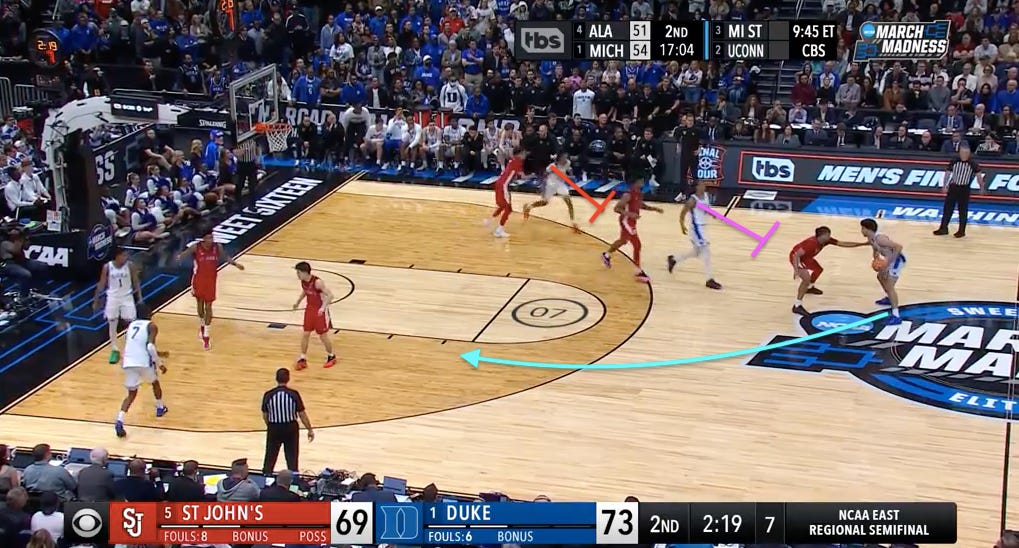
Boozer rejects the staggered ball screens and attacks the left-side gap. His drive forces the two weak-side defenders to slide over, opening a kick-out to Foster in the corner. Mitchell flies by on the closeout, but Foster fakes him out and settles into a smooth midrange pull-up jumper.
Perhaps I’m connecting two unrelated dots, but the timing of Foster’s performance feels significant. In a week when the biggest story in men’s college basketball centered on a now-former ACC coach abandoning ship and running from a challenge while crying poor, it’s a reminder of Foster’s fortitude. The juxtaposition is profound.
Life in the fishbowl of playing point guard for Duke basketball isn’t for everyone. It can be hard. Over his three college seasons, Foster has battled injuries and endured a high-profile benching. I was in Cameron Indoor Stadium last season when — in the final home game — Foster was the only player, including walk-ons, who didn’t see the floor in Duke’s 33-point demolition of Wake Forest. That night, with his role in the rotation having dwindled for months, it seemed like his time in Durham was all but over.
Foster worked his way back into the lineup and proved to be an integral piece down the stretch last season — mostly as an energy guy off the bench. He stepped into a larger role this year and delivered the best basketball of his life.
Now, one year later, he’s a hero: the guy who stuck with it, playing through who knows how much pain to try and will Duke — his dream school — back to another Final Four. It’s an incredible story, a testament to his work ethic and Duke’s culture.
I’ll spare you the pearl-clutching over player and coach movement in major college sports. With some exceptions, I just don’t care that much. Players — the ones who make this billion-dollar industry what it is with their labor — should be compensated and have the right to move freely. The game is the game: even acknowledging its own absurdities, I’m willing to tolerate the disjointedness of college athletics if it means athletes have compensation and agency. I’m far less generous to those who leach off the sport.
Still, Foster’s growth as a player, his commitment to Duke’s program, and his willingness to believe in and sacrifice for the collective are commendable. There’s a lesson here. It’s a reminder that he has more courage, integrity and emotional maturity than many of the men and women — more than twice his age — who lord over these sports with impunity.
So, a big salute is in order for Caleb Foster. He earned this moment. Let’s see if he has another one up his scooter — I mean, sleeve.
No posts
Comments
Nothing yet. Say the first thing.
Sign in to join the conversation.