
March has been madness…in more ways than one. The basketball, though, has been especially fun. Under first-year head coaches, Virginia and Miami finished second and third, respectively, in the ACC this season, with both ranking inside the Top 30 nationally in KenPom’s adjusted efficiency metric.
After finishing with losing records in the 2024-25 season, it was a remarkable turnaround for both programs. Unfortunately, all good things must come to an end. Both teams saw their 2025-26 seasons come to a close on Sunday. Virginia rallied against Tennessee — and even briefly led late — before falling to the Vols, while Miami came up just short against a Purdue team that appears to be peaking at the right time.
Let’s take a look at the key hinge points from those two second-round matchups, including the play of two of the ACC’s top freshmen — Chance Mallory and Shelton Henderson — and why the future looks bright for both programs.
In Ryan Odom’s first season as head coach in Charlottesville, Virginia’s Top 20 defense held opponents to just 1.04 points per possession, according to CBB Analytics. There were only five games this season in which the Cavaliers allowed more than 1.2 points per possession. Unfortunately for Odom, one of those games came in the finale: Tennessee scored 1.21 points per possession and knocked UVA out of the tournament.
When facing Tennessee and Rick Barnes, a defense must be prepared for secondary breaks, off-ball motion, Floppy action and the team’s go-to pick-and-roll look: 3 Across.
3 Across is a ball-screen action that takes place in the middle third of the floor, with one of the bigs screening for a guard. Instead of spacing the three off-ball players around the arc, the opposite big sets up near the basket while the two off-ball guards space to the corners.
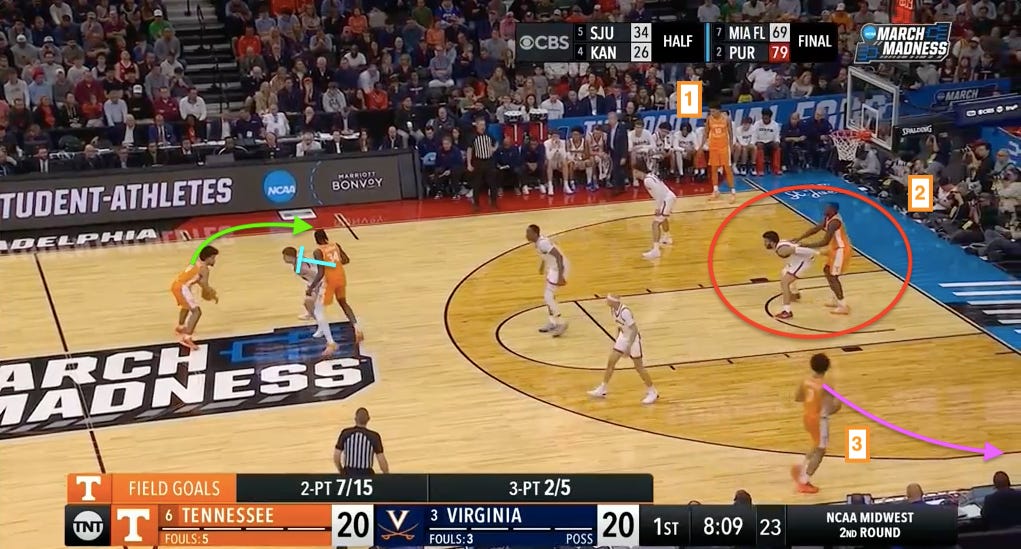
Tennessee ran some version of 3 Across 12 times against Virginia, according to my charting — far more than any other pick-and-roll action. The Vols also found success with the play, largely thanks to the playmaking and pull-up shooting of Ja’Kobi Gillespie: 21 points and six assists in 38 minutes of action.
Ja’Kobi Gillespie’s 3-point percentage (34.5 3P%) is slightly down from his previous two seasons at Belmont and Maryland, but he remains a powerful high-volume shooter. He currently ranks fifth among high-major players with 281 3-point attempts and has made 20 more unassisted threes than the next-closest player on Tennessee’s roster, per CBB Analytics. With Nate Ament struggling this season, if any Tennessee player is going to beat a defense off the dribble, it’s Gillespie.
The Cavaliers primarily play drop coverage, deploying their centers several feet below the level of the screen. Often, Virginia has its bigs hang back and sit in the paint — even against strong pull-up shooters like Jordan Pope of Texas.
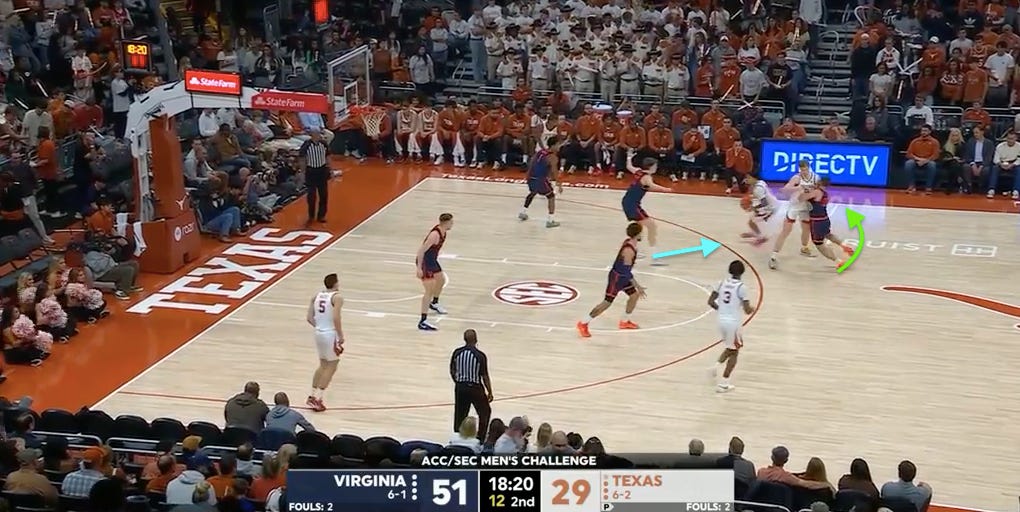
Normally, Odom prefers to maintain his defensive shell and rely on the guard defender to fight over the screen and contest the 3-point attempt from behind. However, Gillespie’s pull-up shooting clearly had Virginia a little geeked out.
For example, as Gillespie dribbles off Felix Okpara’s screen in 3 Across, Dallin Hall fights over the pick while Ugonna Onyenso takes a big step toward the 3-point line to apply a contest on Gillespie.
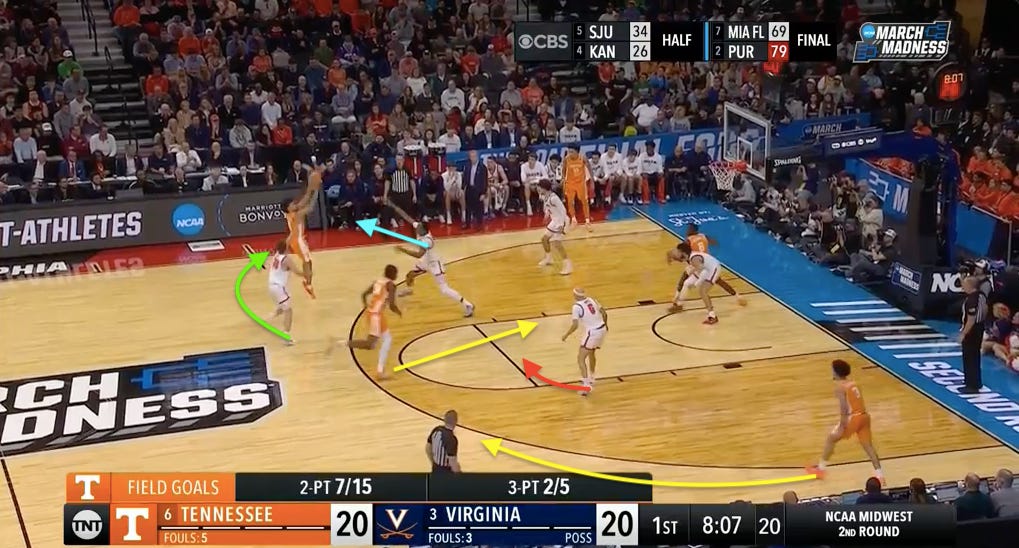
That extension from Onyenso may seem small, but it speaks volumes for UVA. When the defense bends like this toward the gravity of a pull-up shooter, it can soften the shell and create openings for other offensive players all over the floor.
On Tennessee’s next trip down the court, it’s more 3 Across for Gillespie. With DeWayne Brown setting the pick, Onyenso takes another big step out of the lane, while Hall shows early help at the nail, coming off Bishop Boswell on the right wing. Jacari White fights over the screen, leaving three UVA defenders focused squarely on Gillespie.
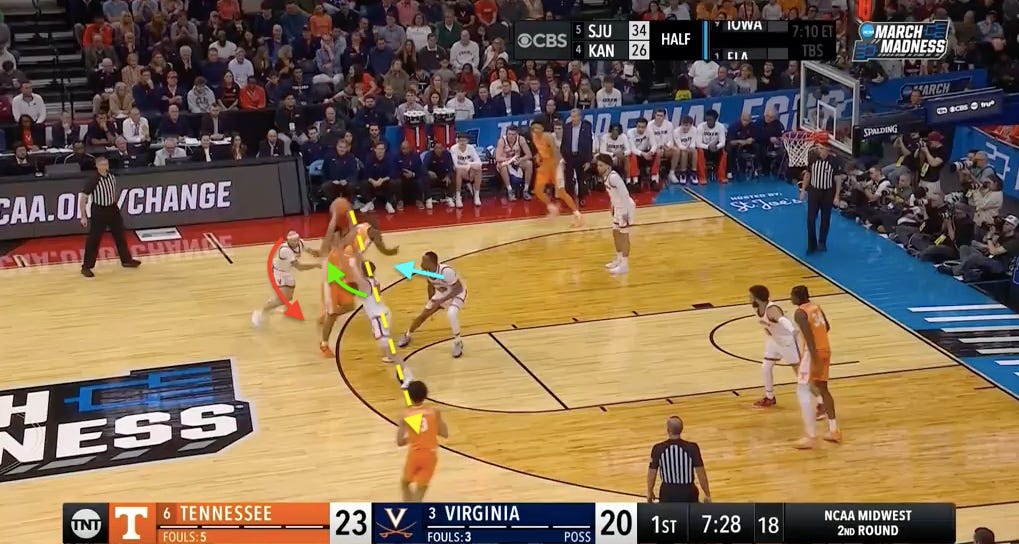
Virginia has really sold out on Gillespie, and there’s a cost to such an aggressive approach: Boswell (39.4 3P%) is left wide open on the wing. Gillespie makes the simple read and kicks it out to Boswell for an uncontested triple.
Down the stretch of the game, Odom chose to adjust his pick-and-roll coverage, shifting from drop to bringing the big up to the level of the ball screen and hedging on Gillespie. Here, Onyenso hedges Okpara’s screen for Gillespie well above the arc — a notable departure from his usual drop approach.
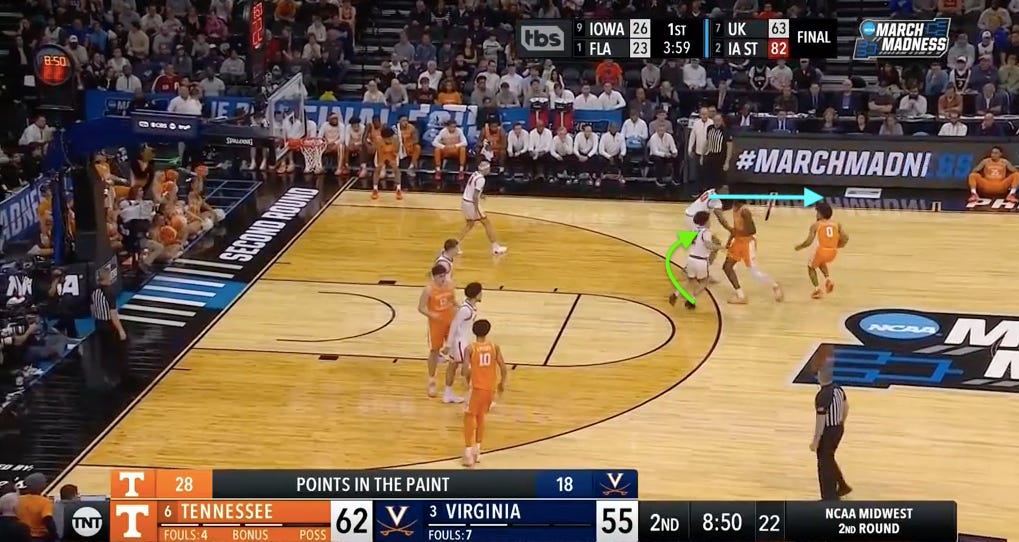
Virginia has used this coverage at times this season when more pressure on the ball is needed. As UVA desperately tried to snatch a victory from Tennessee and prolong its season, the defense fully committed to forcing the ball out of Gillespie’s hands. It was no longer enough to simply apply more attention to his off-dribble jumper.
Tennessee’s offense has limited secondary creation, but Gillespie is highly skilled and still managed to generate quality looks for his teammates.
Unconcerned with a pull-up jumper, Johann Grunloh begins this possession in drop coverage as Ament dribbles right off an empty-corner ball screen, while White goes under the screen.
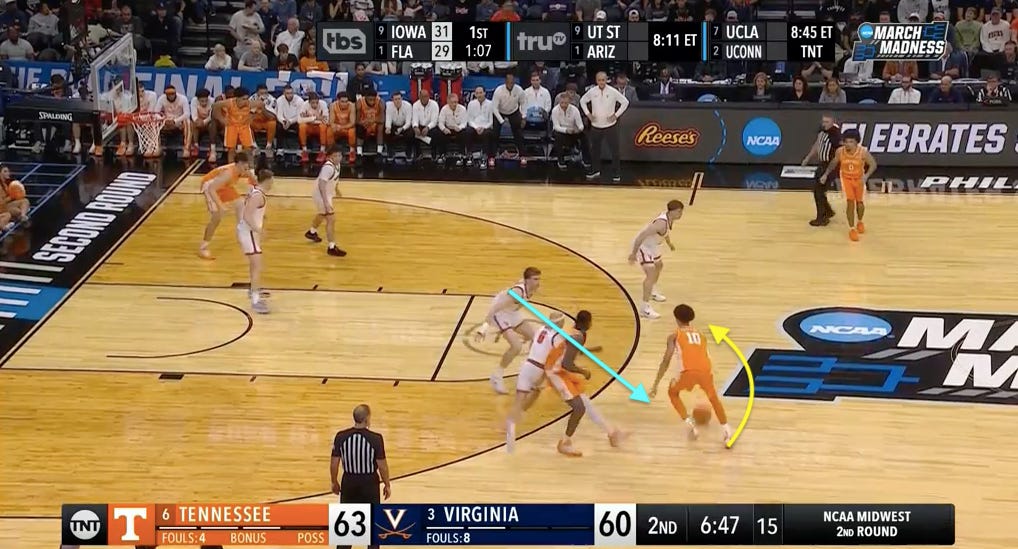
Tennessee re-screens for Ament, but the possession remains rudderless — going nowhere until the ball is reset to Gillespie at the top of the key. This time, Grunloh hard hedges the 3 Across action between Gillespie and Okpara, putting two defenders on the ball and opening a lane for Okpara to roll to the rim. Chance Mallory rotates off Boswell on the weak-side wing to tag Okpara and prevent a clean pass to the rolling big.
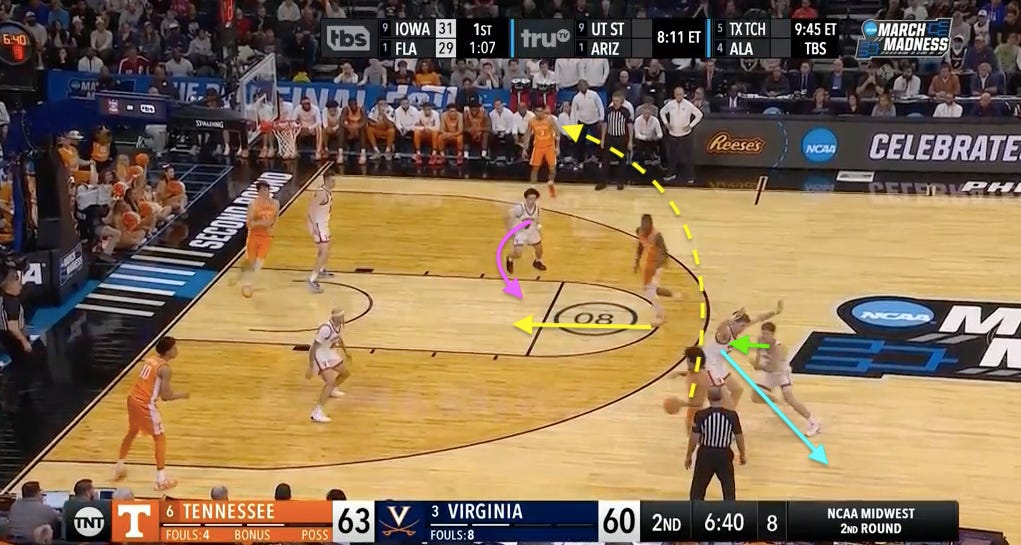
Virginia seemingly has this thing bottled up, but with the shot clock winding down, Gillespie is able to navigate his way around the hedge from Grunloh, who is a pretty smooth lateral mover for a 5-man but more accustomed to dropping below the screen. This buys time and space for Gillespie who can now see the floor; he spots an open Boswell, shaking up the floor. Gillespie flings a perfect skip pass and Boswell drills the 3 before Mallory can scamper back out and contest.
In the late stages of the game, as UVA ramped up its pressure, the hard hedge against Gillespie began to pay off.
With under three minutes to play, Gillespie and Okpara run a re-screen action out of Tennessee’s 3 Across look. As the dynamic point guard drives around Okpara’s second screen, he steps on his teammate’s foot, slips and loses control of the ball. Unsurprisingly, Mallory is first to the floor, diving to secure the loose ball and create a transition opportunity for UVA.
After a timeout, with Virginia up one, Grunloh hard hedged another ball screen against Gillespie, forcing the ball into the hands of Ament. For a moment, that’s a win for UVA. But as Tennessee’s motion offense cycled the ball back to Ament, working off a down screen near the right elbow, Virginia caught a tough break. Ament jabbed and drove past White, where Grunloh was waiting in the paint. The freshman wing then took one of the most exaggerated pro hops you’ll see in this year’s NCAA Tournament, somehow avoided a travel and even drew a foul, earning a trip to the free throw line.
This call played a big role in the outcome of this contest. It’s tough, but that’s the breaks of the game.
During the ACC Tournament in Charlotte, Mallory put together an outstanding stretch, recording 11 assists and zero turnovers across 69 minutes, though UVA came up just short against Duke in the title game.
Mallory’s two-game NCAA Tournament showing was less efficient and productive. He finished with just two points (1-of-4 FGA), one turnover and no assists in the first-round matchup against Wright State. However, in the final game of his freshman season, Mallory reaffirmed why he’s one of the top rookie guards in the country.
Facing the size and experience of Tennessee, Mallory didn’t deliver his most efficient performance, but he competed and flashed his upside with four or five “wow” plays that showcased his handle, strength as a downhill driver and decision-making.
Late in the shot clock during this first-half possession against the Vols, Ugonna Onyenso initiates 5-out Zoom action. Mallory comes off a down screen from White and into a handoff from the 7-footer. Recognizing Tennessee’s coverage, he’s prepared when JP Estrella hedges on the ball screen, countering with a smooth split to get downhill. With the clock winding down, Mallory gets into the paint with ease and kicks it out to Sam Lewis for an open 3-point attempt.
Lewis misses the shot, but this is Mallory creating something out of nothing — manufacturing an open corner look for a 40-percent 3-point shooter.
As a freshman, Mallory assisted on 63 3-pointers (2.9per 40 minutes), including 43 above-the-break 3s and 20 from the corners — both totals ranking second on the roster behind Hall.
Mallory projects as an outstanding piece for Odom to build around. He’s already very good, and his shooting should continue to improve. With increased playing time and usage next season, he’s in line for a significant jump in raw production.
Moreover, playing alongside Mallory should be a key selling point for UVA as Odom enters a critical phase of roster construction. With Virginia looking to add shooting and scoring to its guard/wing rotation this offseason, clips and numbers like this strengthen the pitch: come to Virginia, Mallory will get you easy shots.
Of course, Mallory can use his full toolbox to create his own offense as well. He averaged 9.9 unassisted points per 40 minutes this season, ranking third on the roster behind Malik Thomas and Thijs De Ridder. Moreover, just 18.6 percent of his two-point field goals were assisted — the lowest rate on the team.
Out of a timeout later in the first half, Virginia runs its “Iverson Spain” action. Malik Thomas cuts across Iverson screens from Devin Tillis and Onyenso, while White lifts from the right corner to serve as the back screener in the set’s next phase: a Spain pick-and-roll.
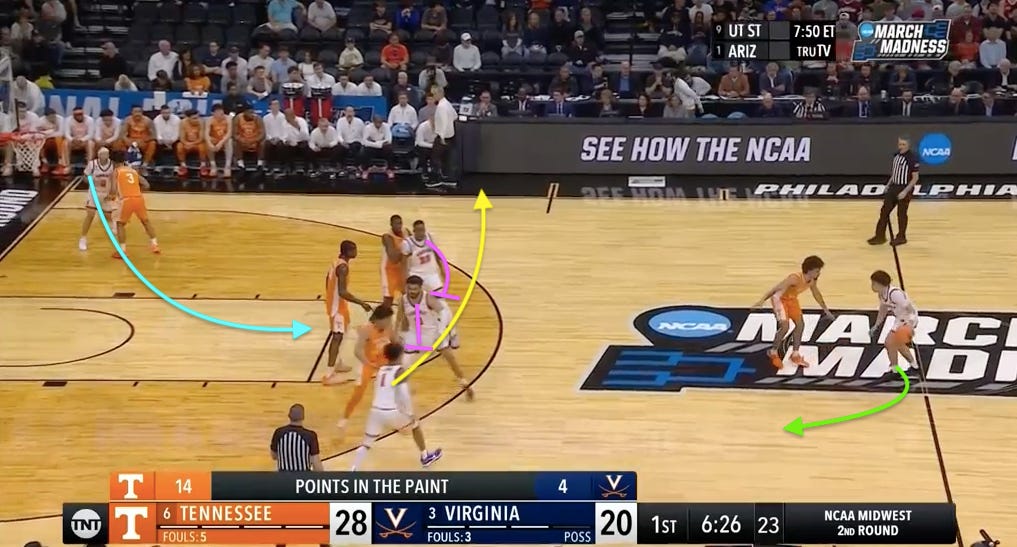
Tennessee defends Onyenso’s ball screen by having Brown hedge, routing Mallory back up the floor and toward the sideline. It’s hard to speed him up, though. Mallory patiently waits for Brown to recover, then attacks Gillespie in space, using a subtle left-handed hesitation move to turn the corner. As Mallory gets into the paint, Onyenso does a terrific job sealing Brown, who also has to navigate White’s back screen. With separation from both Brown and Gillespie, Mallory finishes with a reverse layup, getting the ball off the glass before Okpara can rotate down for the block.
What he lacks in size, the 5-foot-10 Mallory makes up for with craft. He also flashed the ability to utilize a “Nash dribble” this season. Named after NBA legend Steve Nash, it’s a controlled tactic in which a player keeps the dribble alive, goes under the basket and emerges on the other side of the lane — rather than picking it up or forcing a finish over size.
It’s an especially effective tool for smaller ball handlers like Mallory, allowing them to avoid low-percentage attempts against rim protectors. Keeping the dribble alive can also stretch the defense and create new angles for cuts or kick-out passes.
After a Bruce Thornton field goal, Virginia runs an empty-corner drag pick-and-roll with Mallory and Grunloh against Ohio State. The Buckeyes “down” the action, with guard Gabe Cupps funneling Mallory toward the right sideline and center Christoph Tilly dropping below the level of the screen.
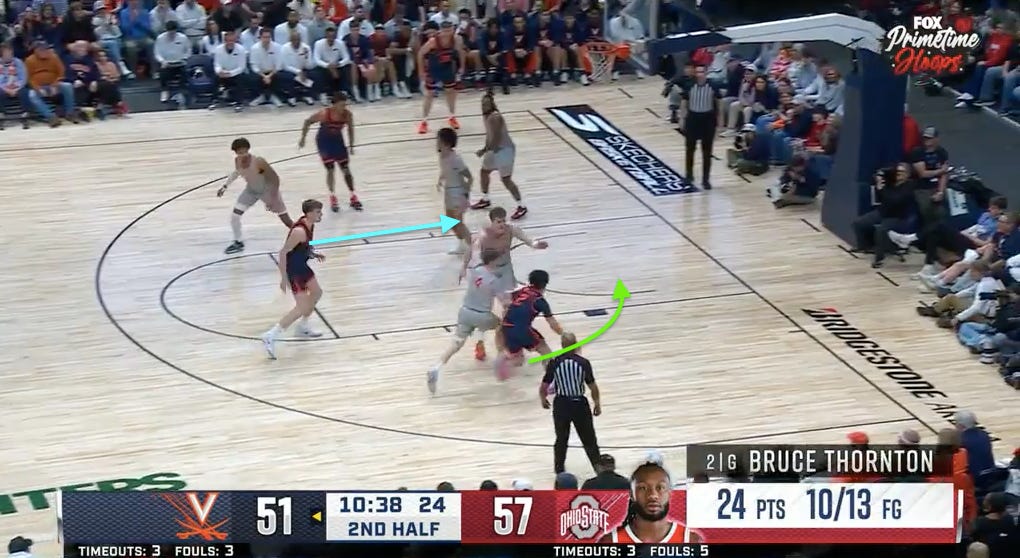
As Mallory approaches the rim, he doesn’t appear to have many quality passing options, despite having two defenders on the ball: Cupps and Tilly. Ohio State’s weak-side defenders stay home as well, eliminating the chance for a kick-out to a spot-up 3. With the 7-foot Tilly on him, Mallory also has little chance of finishing on the right side of the hoop.
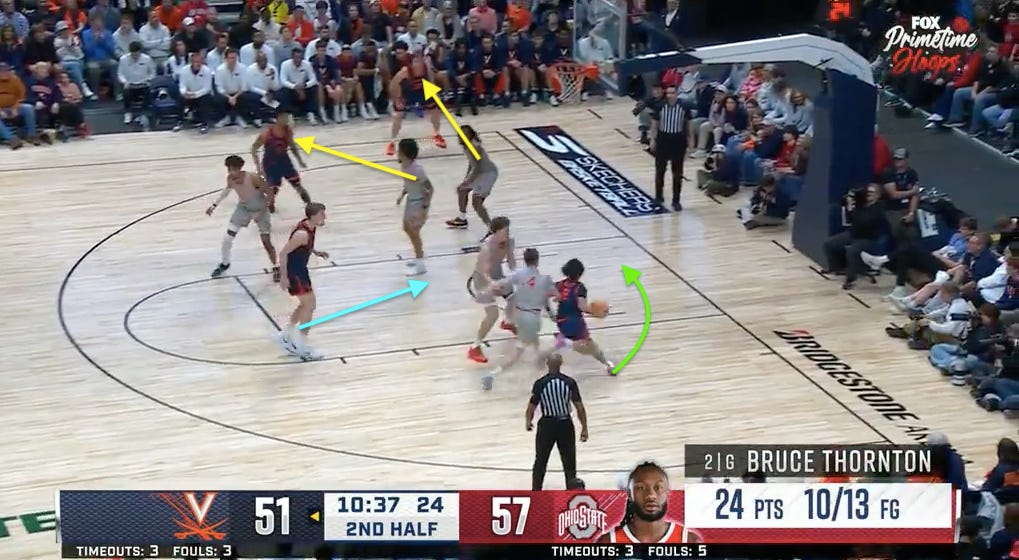
Mallory could have tried a drop-off pass to Grunloh. Instead, he keeps his dribble alive, drives under the basket and pulls both Cupps and Tilly with him. More importantly, this “Nash” maneuver resets the floor and opens a kick-out to the trailing De Ridder in the right slot.
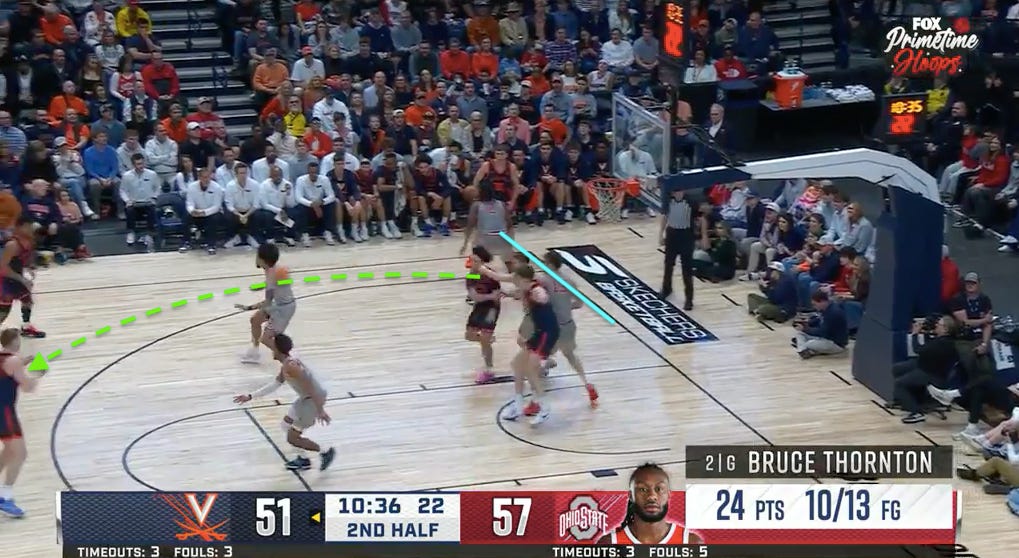
De Ridder could easily step into a catch-and-shoot 3 off Mallory’s kick-out. That’s not the play here, though, for one of the best connective passing teams in the country this season. De Ridder opts to quickly initiate hi-lo action with Grunloh, who seals Tilly — positioned deep in the paint after chasing Mallory under the basket. The result is an uncontested dunk for Grunloh.
There’s no assist for Mallory on this play, but his live-ball dribble, patience and feel set everything up.
In the second half against Tennessee, Mallory initiates early offense with a high handoff from Tillis. Initially, the 6-foot-11 Okpara hedges on the screen, but Mallory forces him to adjust, using his strength to chisel around the defender. Okpara is then forced to switch onto Mallory, who now has a step on the bigger defender. Though Okpara — a good athlete for a big man with a 7 percent block rate — has the speed and length to neutralize Mallory’s slight advantage, Mallory summons every ounce of guile, toughness, body control and touch, launching himself horizontally for a diving and-one finish just out of reach of Okpara’s contest.
It’s not easy for a sub-6-foot guard to finish and playmake among the trees in high-major college basketball, especially as a freshman. Yet Mallory displayed an advanced game right away as these counters and tricks allowed him to seamlessly adapt to life in the ACC.
To that end, Mallory was one of only seven high-major freshmen to finish the 2025-26 season with an assist rate above 20 percent and a turnover rate under 15 percent. The other six players on that list are all projected lottery picks in the 2026 NBA Draft: Cam Boozer, AJ Dybantsa, Darius Acuff, Kingston Flemings, Keaton Wagler and Ebuka Okorie (should he enter the draft).
In his debut season with Miami, first-year head coach Jai Lucas built a winner (26-9) that was efficient on both ends of the floor. The Hurricanes were an elite two-way rebounding team, ranking in the Top 20 nationally in both offensive and defensive rebound rate.
Defensively, Miami was a shapeshifting unit, frequently blending man-to-man and zone concepts. With a defensive rebound rate of 74.1 percent and a free-throw attempt rate of 29.5 percent, the Hurricanes excelled at two fundamental principles: securing the glass and avoiding fouls. Put those two items together and you have the foundation for a rock-solid defense.
On offense, Miami lacked top-tier shooting talent, but the Hurricanes operated effectively through the Tre Donaldson–Malik Reneau pick-and-roll, enhanced by the emerging playmaking of freshman wing Shelton Henderson.
Ultimately, due to their rebounding, foul avoidance and defensive turnover creation, the Hurricanes won the possession battle. Miami averaged nearly three more field goal attempts and over five more free throw attempts per 40 minutes than their opponents this season. That’s winning on the margins.
Donaldson finished the year with 201 assists, ranking third in the ACC behind only Quadir Copeland (211) and Boopie Miller (211). Reneau and Donaldson developed quick chemistry this season, too, with the veteran point guard assisting the First Team All-ACC power forward 67 times — the most of any duo on Miami’s roster, according to CBB Analytics. The next closest combination was Donaldson and center Ernest Udeh Jr., who connected on 36 assisted buckets.
The pair was particularly effective in the pick-and-roll, with Reneau serving as an excellent target in space for Donaldson — both on short rolls and pick-and-pop actions. As a southpaw, Reneau becomes especially dangerous when he can get downhill, attack the rim and make passing reads from the left side of the floor.
According to CBB Analytics, 48.5 percent of Reneau’s field-goal attempts this season came from the left side of the floor (92nd percentile), where he shot 49.5 percent. By contrast, just 24.3 percent of his attempts came from the right side (11th percentile), where he made only 44.3 percent. The remaining 27.2 percent of his attempts came from the center of the floor, where he excelled, shooting 70.6 percent.
On this empty-corner ball screen against Virginia, Donaldson forces a switch with De Ridder as Reneau gains inside leverage on point guard Mallory and curls to the short roll. Onyenso rotates to contest at the rim, typically a strong defensive position for UVA. However, the 6-foot-9, 238-pound Reneau is downhill with momentum, finishing through contact for a layup and drawing the foul.
A 14-point win over Missouri propelled Miami into the Round of 32. To pull off a second-round upset over Big Ten champions Purdue — boasting the most efficient offense in the country — the Canes would likely need a huge performance from their best player: Reneau.
While Reneau filled the stat sheet with 16 points, four offensive rebounds, four steals, three assists and a block, he struggled in other areas. After drawing 3.6 shooting fouls per 40 minutes this season (96th percentile nationally), he drew just two against Purdue and attempted only four free throws. The Boilermakers are good at limiting these items, but also of note: Reneau committed seven turnovers, tying his career high for a single game.
One way head coach Matt Painter and Purdue limited Reneau’s impact was by sending extra attention when he short rolled into space. Whenever Reneau tried to short roll to the left side of the floor, the Boilermakers would flood him with an additional defender, disrupting his opportunities.
For example, Miami runs middle pick-and-roll with Donaldson and Reneau. Braden Smith pushes Donaldson right — away with from middle of the floor — as Trey Kaufman-Renn sets up just below the level of the screen. The three Purdue help defenders outside of the action stick close to their assignments.
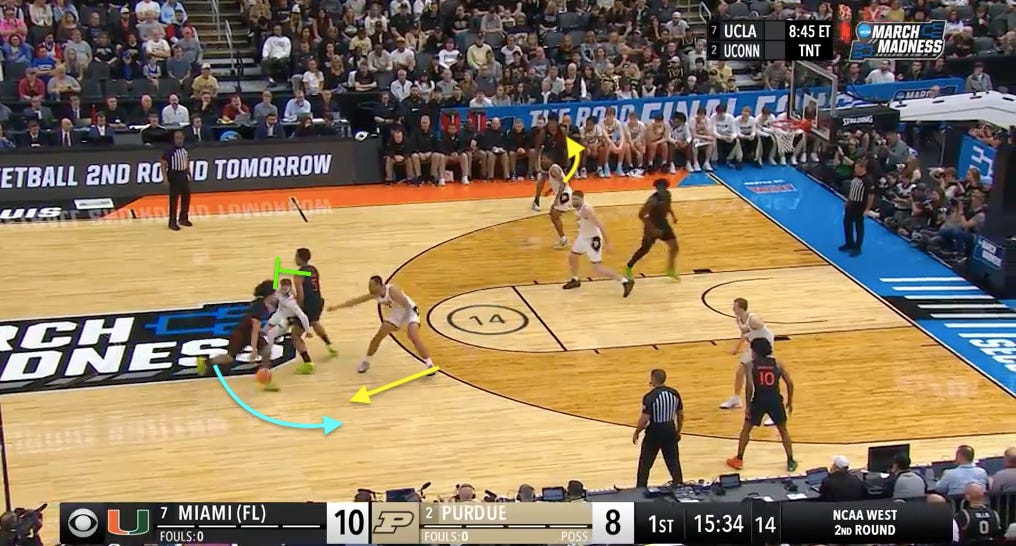
In theory, with two defenders on the ball, Reneau should be open as an outlet man on the short roll. This makes for an easy decision for Donaldson: take the low-hanging fruit, hit Reneau in space, and let him attack a 4-on-3 advantage on the back side. As Donaldson prepares to thread a pocket pass, however, CJ Cox lunges over off Henderson in the left corner, moving toward Reneau.
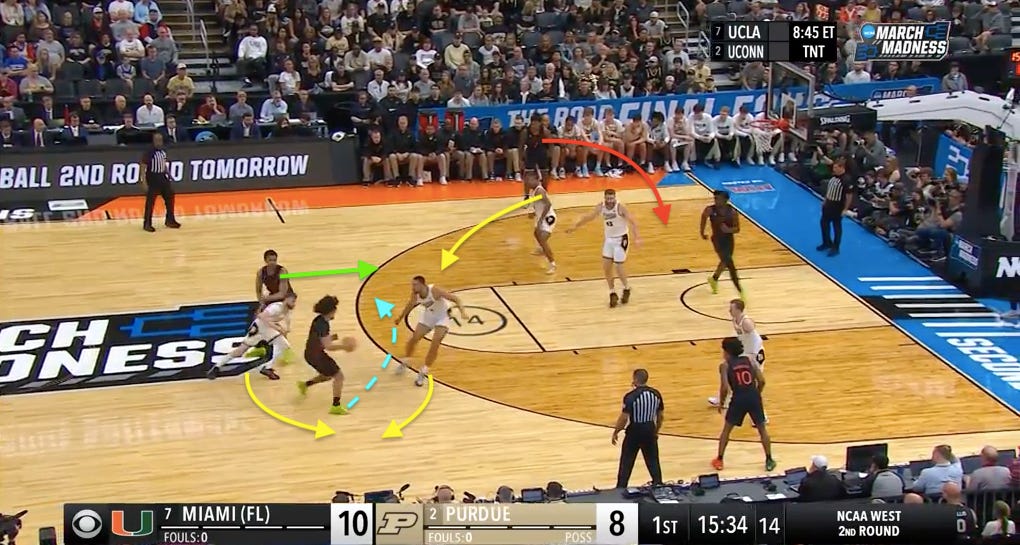
Stunting toward the ball on the catch, Cox positions himself in the space between Reneau and the basket. As Reneau faces the rim, he sees a congested half-court: all five Purdue help defenders are inside the arc, with heavy traffic in the lane. If Henderson (25.5 3P%) were a more reliable spot-up shooter, Reneau might have kicked it out to him for a catch-and-shoot 3. Instead, Henderson cuts along the baseline as Cox scrambles back toward him, adding even more congestion to the lane.
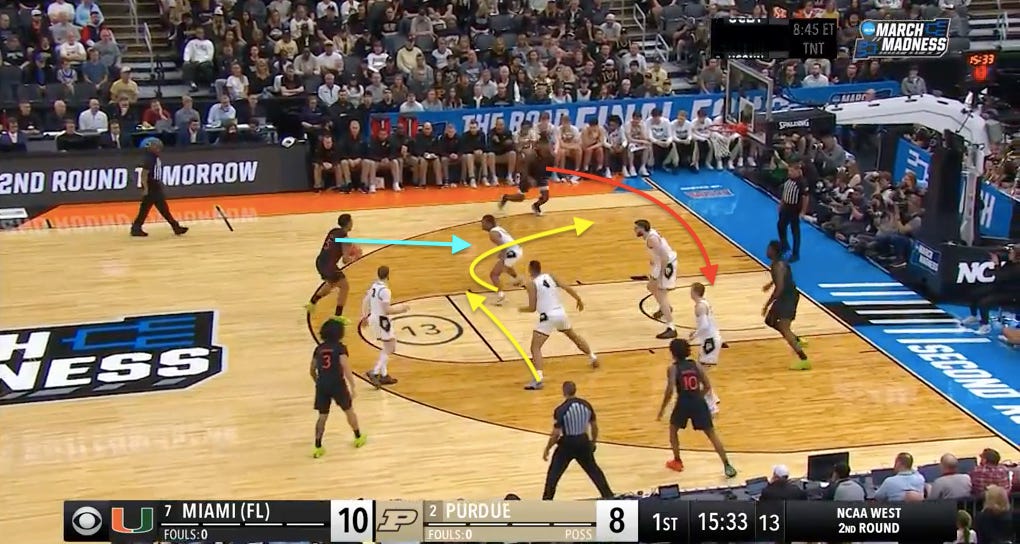
This willingness to sag off Henderson, who missed his only 3-point attempt in the game, allows Kaufman-Renn to get back in front of Reneau and contest the shot, forcing a miss right at the rim.
A defense can’t take everything off the table; it has to make choices: what is it willing to live with? In Miami’s case, Purdue was committed to making life difficult for Reneau, even if it opened opportunities for secondary targets. Henderson wasn’t the only wing or guard the Boilermakers were willing to leave to funnel Reneau into traffic and disrupt the short roll.
Here’s a similar pick-and-roll look for Miami early in the second half: in the middle third of the floor with Donaldson and Reneau, Udeh is positioned near the hoop in the right dunker spot — opposite the side Reneau will roll into. Miami’s spacing is cleaner here; however, Purdue wing Fletcher Loyer is still willing to leave Dante Allen (32.1 3P%) hanging in the corner to step up and meet Reneau on the touch near the left elbow.
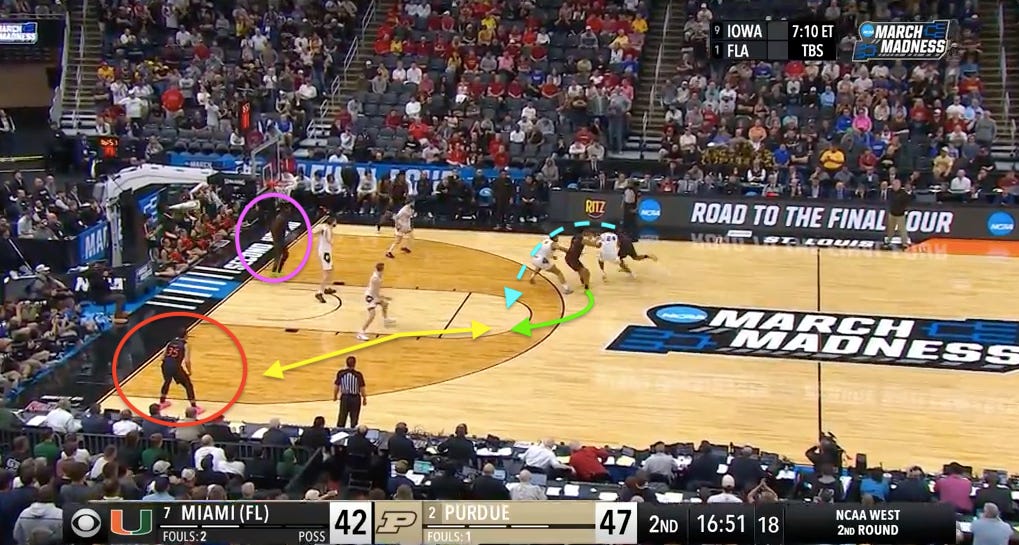
Reneau is disrupted by Loyer’s presence. In a rare moment of indecision — whether to kick out to Allen or drive downhill — Reneau takes an extra step and travles, resulting in a turnover.
Overall, it was a strong season for Lucas and Miami, regardless of last weekend’s result. With several key players set to depart, the coaching staff faces a busy offseason as they work to rebuild the roster and raise the bar for 2026-27. The cupboard isn’t bare, though.
Henderson, the first major recruit Lucas landed in South Beach after flipping from Duke to Miami, had an outstanding freshman season. At 6-foot-6 and 240 pounds, he is a bulldog defender and driver, playing with impressive strength and a relentless motor while toggling between the 3 and 4 positions in different lineups.
There were moments this season when Miami would use him as a defensive stopper on top-tier perimeter creators, including smaller guards like Purdue’s Smith. Henderson can navigate screens and handle his business at the point of attack.
Miami’s defense generated a solid number of turnovers this season, ranking 42nd nationally in steal rate at 11.4 percent. Yet Henderson’s individual block and steal numbers are somewhat modest: 1.3 percent block rate and 2.1 percent steal rate. This is a bit surprising given how much zone defense Miami ran, combined with his athletic profile and anticipatory skills.
That said, Henderson wins plenty of battles for contested rebounds and 50-50 balls. He has good hands and his ability to absorb contact while making basketball plays is pretty special. Plus, when he takes over in these situations, it can result in easy transition offense on the other end.
It’ll be interesting to see how Henderson’s defensive box score stats develop next season. With two excellent defensive rebounders, Reneau and Udeh, now gone, he’ll likely need to carry a larger load on the boards as well.
On offense, he excels as a cutter, timing his movements along the baseline or from the slot with precision and purpose, and finishing effectively around the basket. According to CBB Analytics, Henderson shot 70.4 percent at the rim this season. He also finished second on Miami’s roster with 42 dunks.
Henderson is already an impressive slasher. He can explode as a driver, powering into gaps or barreling through would-be defenders. Along with Cam Boozer and Caleb Wilson, Henderson was one of only three high-major freshmen this season to finish with 60 percent shooting on 2-point attempts, an assist rate above 10 percent and 40 or more dunks.
Let’s watch him in action. As Donaldson comes off a slot ball screen from Udeh, he draws multiple help defenders toward the nail, including Smith, who drifts away from him on the right wing. By the time Donaldson kicks out, Henderson is already in motion on a “stampede cut,” ready to attack as the ball swings his way.
The stampede cut is an excellent way to generate pace and momentum when attacking downhill off the catch. It allows an offensive player to dart into gaps ahead of the defensive rotation or blow past a poorly timed closeout. Henderson used this move frequently this season, adding yet another weapon to amplify his rim pressure.
In the open floor against UNC, Henderson receives a pass from Donaldson, uses a spin move to shake off Derek Dixon and attacks the rim, powering through with his chest to create separation and finish against a vertical contest from Jarin Stevenson (6-10, 215).
Currently, his jump shot remains inconsistent at best. He made just 13 3-pointers all season and shot only 57.6 percent from the foul line — an indicator of shaky touch. Obviously, critiquing his shot is an easy point to make: every evaluation of Henderson highlights this aspect of his game as a clear area for growth.
While the stampede cut and Henderson’s activity level make him a moving target of sorts for defenses when he’s off the ball, he remains a player defenders can sag off or close out short against when he’s spotted up, which can create issues in half-court offense.
In fact, Miami’s offense was slightly more efficient with Henderson off the floor this season. According to CBB Analytics, the team scored 1.23 points per possession with him on the bench, compared with 1.19 points per possession when he was in the game — a still very strong number.
It’s no surprise that Donaldson and Reneau were the bigger swing pieces in terms of offensive efficiency; the Hurricanes struggled whenever one of them sat. In minutes without Donaldson — the team’s floor general and best perimeter shooter — Henderson took on a larger playmaking role, stepping in to run pick-and-roll action. It was valuable experience, as Henderson showed potential future on-ball equity. Still, sustaining high-level offense without Donaldson proved difficult.
Miami scored just 1.07 points per possession in 209 minutes with Donaldson on the bench this season. Henderson played 145 of those minutes (69.4 percent), during which Miami’s offensive efficiency dropped to 0.99 points per possession against all competition. In 49 minutes of Quad 1 games with those lineups, Miami scored just 0.97 points per possession.
Some of these point differentials are a bit marginal, and small sample sizes likely introduce some variance, but the data underscores Henderson’s limitations. This, in turn, can affect how teams defend him in pick-and-roll situations.
If the defense brings the screen defender up to the level of the ball screen, Henderson can turn the corner and attack downhill for finishes at the rim. Lucas also put him in advantageous situations this season by letting him flow into ball screens on the move, rather than relying on more static looks.
When Henderson sees the screen defender leaning to one side of the pick, he’s comfortable using his handle to reject the screen, crossover and attack the basket. He’s also very effective at finishing through contact.
Other defenses used drop coverage against Henderson, and knowing he lacks a reliable pull-up jumper, went under ball screens. Henderson can hit an elbow jumper and made an impressive 62.3 percent of his 2-point field goals, but he shot just 23.8 percent on 2-point attempts from outside the paint this season.
It’s a huge win for the defense to get him to settle for these inefficient looks.
Furthermore, Henderson’s handle isn’t yet advanced enough to break down high-level defenses that load up on his dribble or funnel him in specific directions.
Take this sequence against Purdue: the Boilermakers “weak” Udeh’s ball screen for Henderson. Gicarri Harris positions his body between Henderson and Udeh as center Oscar Cluff drops below the level of the pick. Purdue effectively boxes Henderson in, forcing him to drive with his weaker left hand. The result is a sloppy turnover and a fast-break run-out for Purdue in the other direction.
Henderson has NBA upside and potential, though he seems more likely to make that jump after 2026 due to his current offensive limitations. There’s already a lot to like, but with development in his handle and strides as a shooter — first off the catch, then off the dribble — he could evolve into a two-way force for Miami and beyond.
No posts
Comments
Nothing yet. Say the first thing.
Sign in to join the conversation.