
With the read-and-react nature of Duke’s flowing five-out offense, the Blue Devils can flow seamlessly into countless actions and counters within a single possession.
Every second of the 30-second shot clock is precious. A finite resource. But each second also offers another opportunity, another moment to screen, cut and press the advantage. The more the players share the floor, the more instinctive their reads become and the more naturally one action flows into the next.
Thanks for reading Split The Action! Subscribe for free to receive new posts and support my work.
For the second straight season, Duke’s offense is on pace to assist on more than 58 percent of its field goals. The Blue Devils currently rank 55th nationally in assist rate, setting up 58.3 percent of their made shots. The 2024-25 team assisted on 58.5 percent of its buckets — a Top 50 mark in Division I.
Powered by downhill creators Cooper Flagg and Kon Knueppel and anchored by the rim-running presence of center Khaman Maluach (81 dunks, 75.4 percent on 2PA), Duke finished Top 10 nationally last season in 2-point percentage at a scorching 57.9 percent. Through 26 games this season, the Blue Devils are shooting 62 percent inside the arc, ranking in the Top 5 nationally alongside other elite offenses: Miami (Ohio), Utah State and Michigan.
The Blue Devils may not have the above-the-rim pyrotechnics of Flagg and Maluach, but Jon Scheyer’s team is also averaging slightly more dunks per game this season — well above where the offense was two or three seasons ago.
2025-26: 125 dunks in 26 games, 4.8 dunks per game
2024-25: 172 dunks in 39 games, 4.4 dunks per game
2023-24: 101 dunks in 36 games, 2.8 dunks per game
2022-23: 113 dunks in 36 games, 3.1 dunks per game
Dunks per game isn’t the perfect measure of dominance or efficiency at the rim, but it does underscore this team’s tempo on that end of the floor — how consistently it pushes in the secondary break and off turnovers (with the defense’s turnover rate up to 19 percent this season) — and the premium it places on attacking the basket.
Every team in the country wants to get downhill, touch the paint and generate quality shots: finishes at the rim and kick-outs for open 3-pointers. But wanting to do it and actually doing it are two different things. Success in the paint requires a blend of talent, size, scheme and ball movement to consistently create those high-value looks.
The Blue Devils have that formula, starting with the dynamic frontcourt tandem of Cameron Boozer (6-9, 250) and Patrick Ngongba (6-11, 250), with Maliq Brown (6-9, 225) — one of the top bench players in the country — providing additional impact and versatility. According to CBB Analytics, all three are shooting better than 71 percent at the rim and have thrown down at least 27 dunks apiece.
Boozer: 65.1 2P%, 74.1 2P% at rim, 35 dunks
Ngongba: 66.9 2P%, 71.8 2P% at rim, 33 dunks
Brown: 76.1 2P%, 77.6 2P% at rim, 27 dunks
Duke’s core advantage this season isn’t just the finishing power of its top three big men. It goes deeper. The real strength lies in the unselfishness and passing vision of three high-feel players who happen to be big men, combined with how Duke’s 5-out scheme maximizes those talents.
With its mix of talent and scheme, the Blue Devils initiate much of their offense from the high post, working through the 4 and 5, who often space out to the slot or wing — extending from the elbow. This approach not only puts the ball in the hands of Duke’s best playmakers but also pulls opposing big men away from the rim.
By starting possessions in a 5-out alignment, Duke positions all five offensive players outside the paint, opening up the floor and creating room for cuts to the basket.
Now, let’s take a look at one of Duke’s primary high-post actions. It features Cameron Boozer as the cutter, the 5 (Ngongba or Brown) as the facilitator and one of the guards or wings — often Isaiah Evans — as the screener.
This is Duke’s “Elbow” series.
Elbow Room
The action begins with Boozer stationed in the middle of the floor, well beyond the arc. He enters the possession by receiving a pass and reversing it to the 5 positioned on the opposite wing or slot. As soon as Boozer swings the ball to the 5 — Ngongba on this possession against Clemson — he sprints into a basket cut while Evans lifts from the weak-side corner.
Evans then sets a back (“rip”) screen on Boozer’s defender (Nick Davidson), and Ngongba immediately looks to reward Boozer on the cut to the rim.
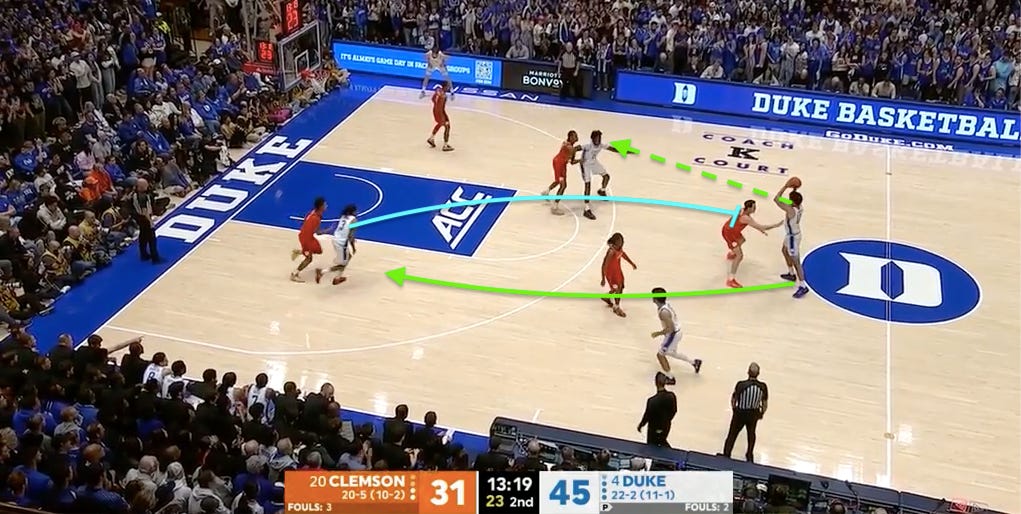
Coming off a well-timed rip screen from Evans, Boozer slices into open space. Only two Clemson defenders are below the free-throw line — Jestin Porter (1) and Dillon Hunter (2) — and both are smaller guards. Neither is in position to provide meaningful help as Boozer streaks to the rim.
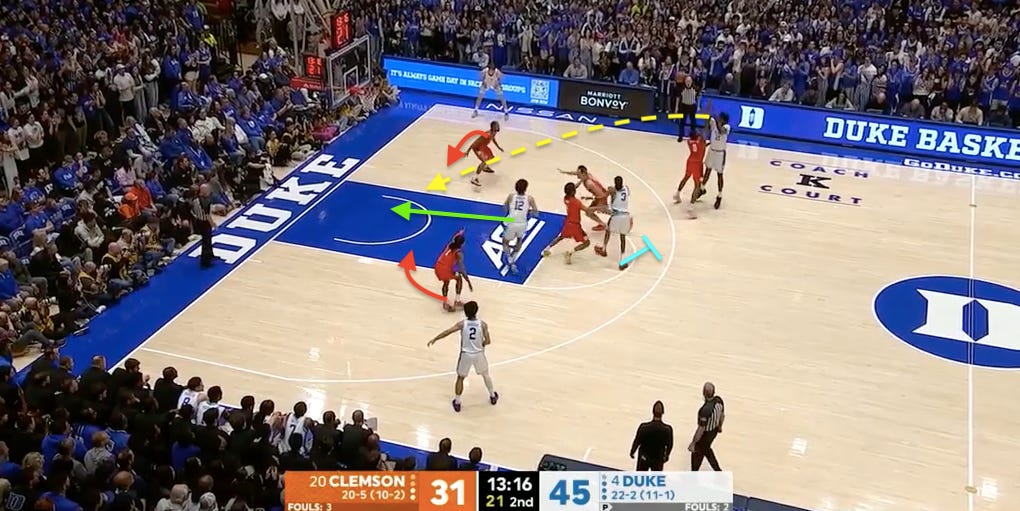
Trailing the play, Davidson (11) has a heavy burden. He must navigate the screen and recover in time to contest Boozer at the rim. With Ngongba delivering a perfectly timed pass, Davidson has no chance to disrupt the finish.
Out of a timeout, Duke goes to the same Elbow action against Boston College — this time with Brown at the 5. Boozer initiates from the middle of the floor, reverses the ball to Brown and then dives to the rim off another back screen from Evans.
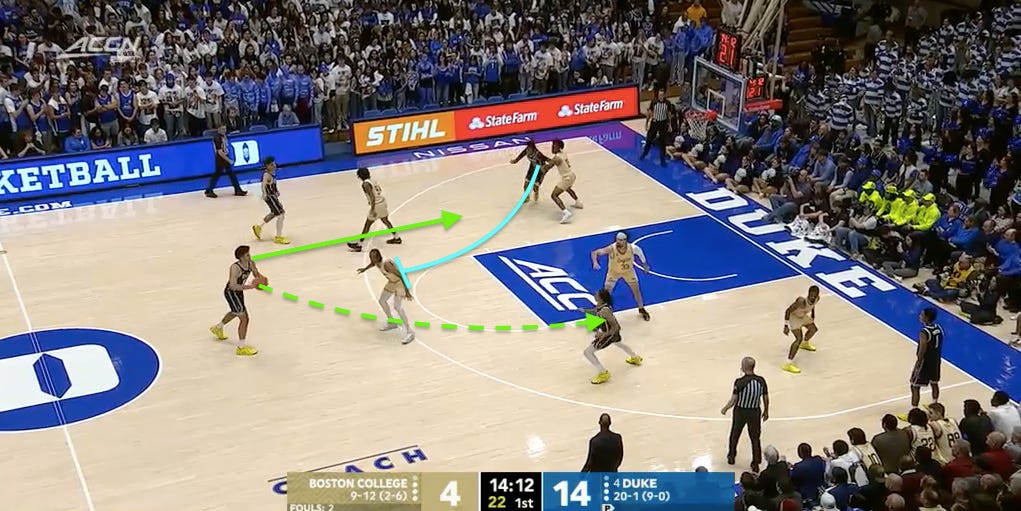
Donald Hand Jr. (13) briefly leaves Evans to track Boozer, but he’s quickly pulled back out to the perimeter when Evans pops to the top of the key. Meanwhile, Aidan Shaw (23) gets hung up on the back screen, allowing Boozer to slip free. Brown recognizes the opening and threads a bounce pass inside for a layup.
Evans provides significant value as an off-ball mover. Defenses must respect his 3-point shooting (14.7 3PA per 100 possessions, 36.1 3P%), and Duke capitalizes on this gravity by using him as an impactful screener. His screens can create confusion, as defenders are reluctant to leave him open for more than a split second to help on a cutter. Opponents may attempt to switch these actions, but that requires precise communication and quick decision-making, too. Even when switches occur, Duke still generates favorable mismatches: Boozer in the post against a smaller defender, while the opposing big is forced to chase Evans around the perimeter.
This action is reminiscent of the “Shuffle” series the San Antonio Spurs once ran through Tim Duncan. It’s simple in structure, but its effectiveness has become a key component of Duke’s offense.
I refer to this as Duke’s “Elbow” action because, well, when the Blue Devils want to run it, coaches and players signal it by tapping their elbow.
As Scheyer taps his right elbow on the sideline at Cal, Boozer passes to Brown on the right wing, and Evans lifts from the left corner to set the rip screen.
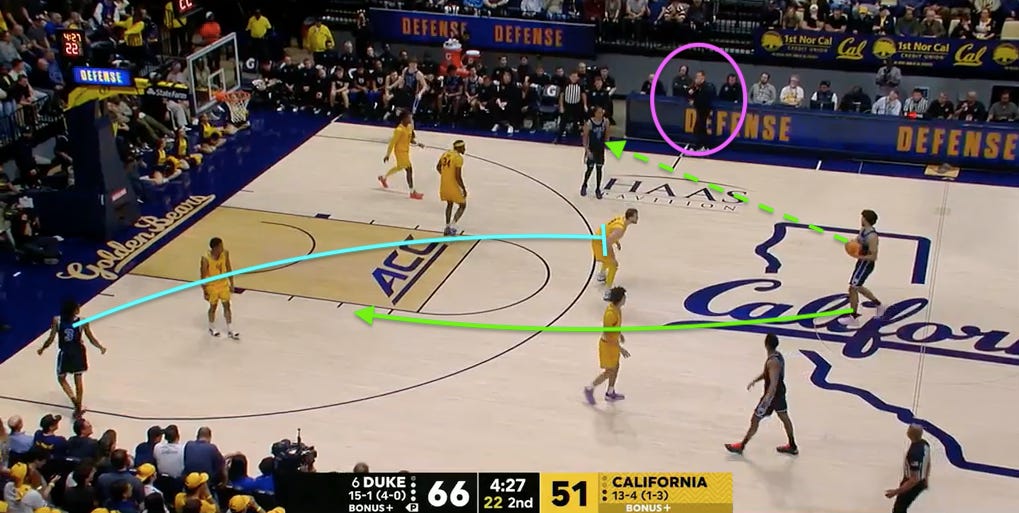
Cal has Boozer momentarily covered on the back cut, but as Evans pops and lifts into a potential handoff with Brown, two defenders hesitate, unsure of how to react: Milos Ilic (8) and Dai Dai Ames (7). Ames abandons Boozer in the paint, while Ilic drifts into no-man’s land. Brown reads it perfectly and delivers a pass to Boozer for the uncontested dunk.
Once again, Brown and Boozer will connect on this same action in Chapel Hill. To start, Boozer signals the play by tapping his right elbow as Caleb Foster brings the ball up the floor.
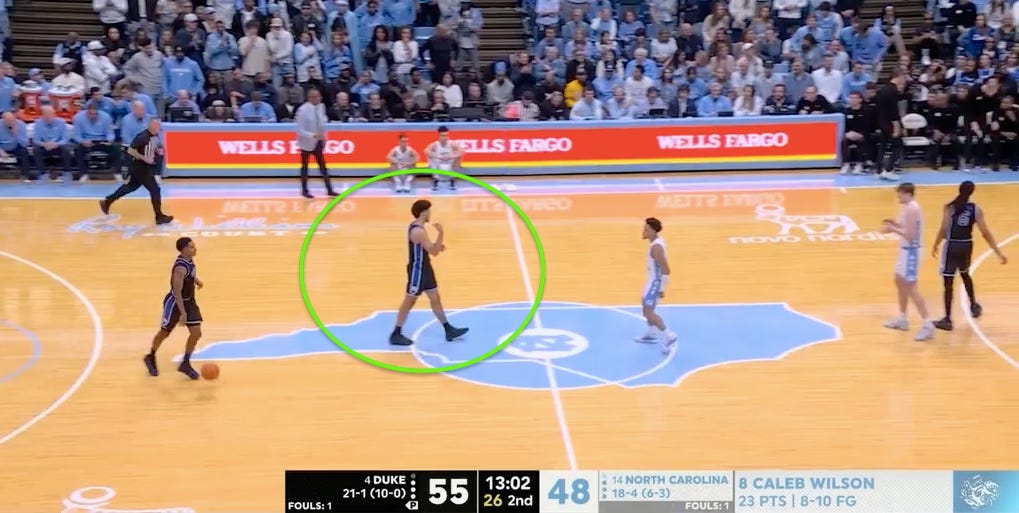
With the larger Jarin Stevenson (15) guarding Evans, Duke opts to have Dame Sarr, defended by point guard Derek Dixon (3), set the rip screen this time. Sarr doesn’t carry the same gravity as Evans, obviously, but with no backside help and Henri Veesaar’s (13) body turned toward the ball, Brown has space to lob a pass over the top, which Boozer finishes with an uncontested layup.
Following elbow-tap signals from Cayden and Cam Boozer, Duke runs the same action in the first half at North Carolina. Caleb Wilson (8) — arguably the top defensive prospect for the 2026 NBA Draft — slips around Sarr’s screen as Dixon stays low. Rather than cutting into traffic, Boozer stays above the screen, where Brown finds him in the middle of the floor. From there: Boozer, Sarr, and Brown execute a quick tic-tac-toe passing sequence around the paint, resulting in a layup for Brown.
In Blacksburg, the Blue Devils run Elbow against Virginia Tech, with Foster signaling the play as he brings the ball up the floor.
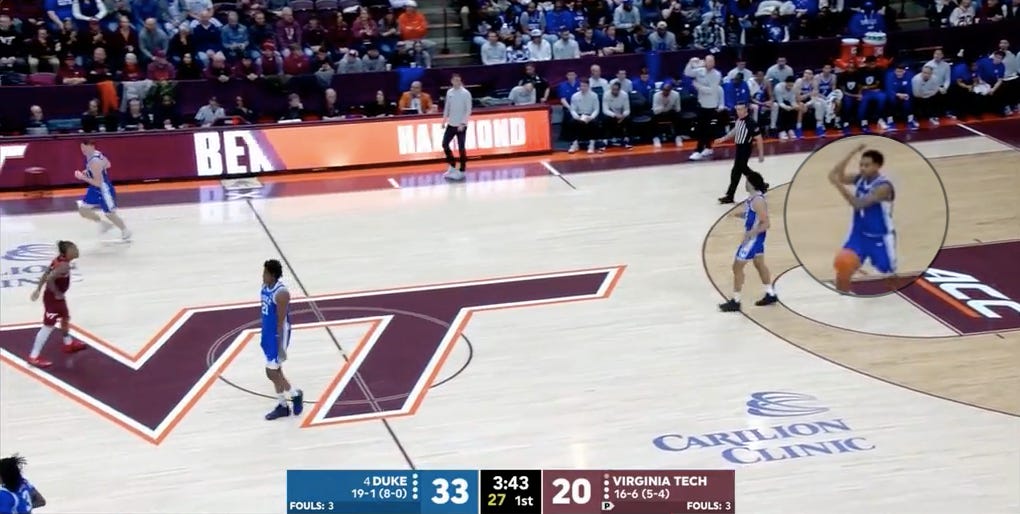
With assistant coach Evan Bradds also signaling in from the bench, Boozer quickly follows by tapping his right elbow as well.
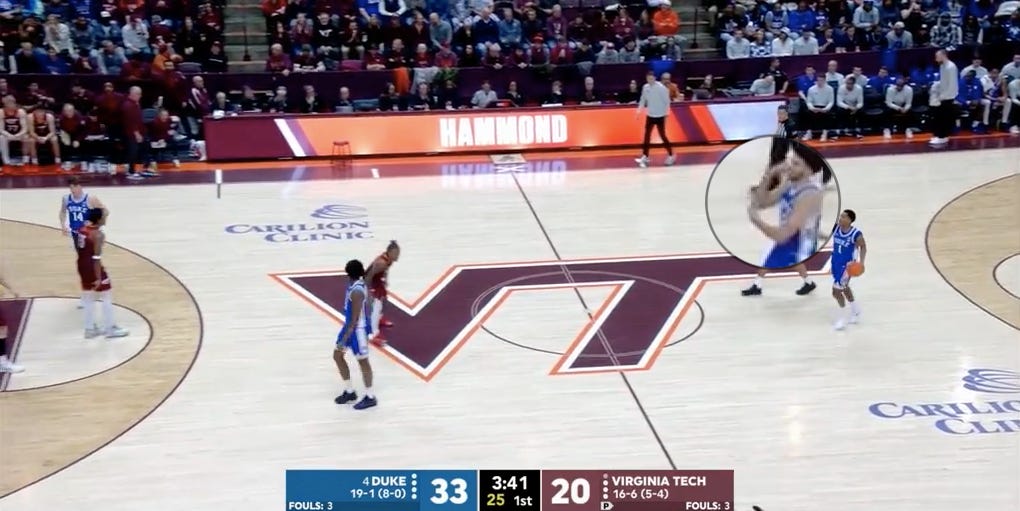
Virginia Tech, however, defends this possession differently than in previous examples. Throughout the game, Mike Young and the Hokies aggressively sagged off Ngongba and Brown: two centers capable of hitting 3-pointers, but not exactly high-volume perimeter threats.
Boozer passes to Ngongba on the right wing as freshman center Christian Gurdak (32) lingers near the restricted area.
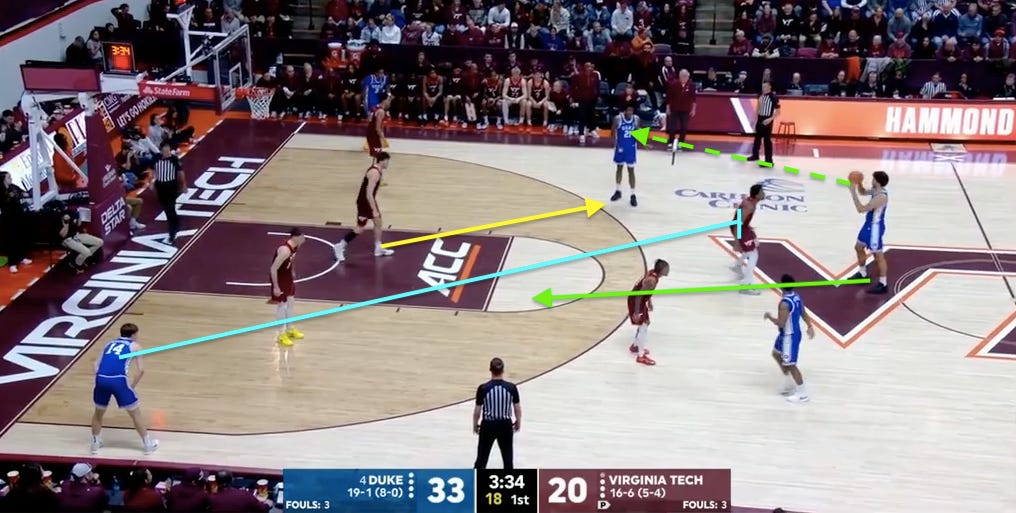
Nik Khamenia lifts to set the back pick for Boozer, but with Gurdak lingering in the paint, the cut’s opening is significantly reduced.
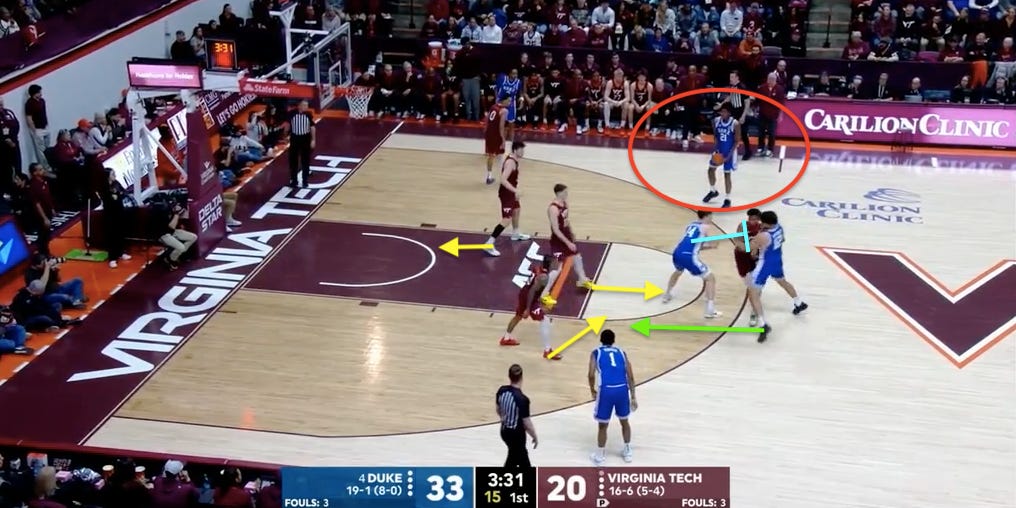
Ngongba’s 3-point shot is still very much a work in progress (7-of-26 3PA this season, 26.9 3P%), but there’s literally no one contesting him on the perimeter. It’s a calculated gamble by Virginia Tech; the Hokies are willing to take on extra risk to contain Duke’s interior offense. Still, Ngongba is skilled and confident. He embraces the space and lets it fly, draining the wide-open 3.
Thanks for reading Split The Action! Subscribe for free to receive new posts and support my work.
Counters
While the first read off this action is Boozer on the back cut, that option isn’t always available. If defenses take away the primary look, Duke has counters it can flow into from Elbow.
Razor or “Peja” Action
This comes from Duke’s first half-court play of the 2025-26 season. The Blue Devils run Elbow against Texas, and the Longhorns do a good job covering Boozer after the back screen: Dailyn Swain (3) lingers in the paint long enough to deny the direct-line pass, while Nic Codie (10) fights over the screen and recovers back to Boozer.
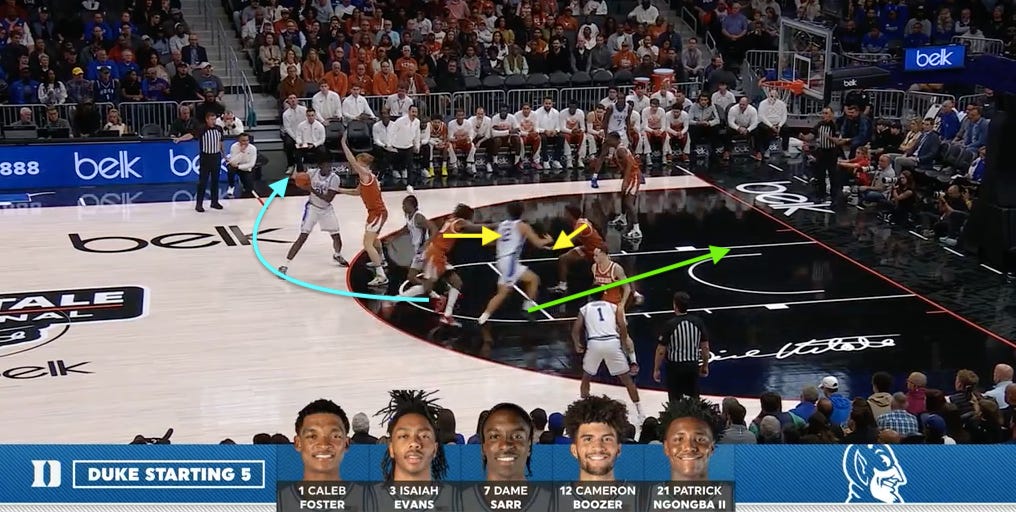
Texas has two defenders on Boozer, freeing up Evans and allowing Duke to flow into one of its customary 2-on-1 handoff actions. After setting the back screen, Evans sprints into a handoff with Ngongba. I refer to this as “Razor” action, though it’s also called “Peja” action in basketball circles — a back screen leading into a handoff. Texas center Matas Vokietaitis (8) is left to corral the Ngongba-Evans handoff as Swain tries to recover, and with Vokietaitis in drop coverage, Evans slips off the screen into space and launches a 3-pointer.
Here’s the same action against Texas Tech: JT Toppin (15) stays with Boozer on the back screen, but as Evans clears Ngongba’s handoff, he emerges into open space with LeJuan Watts (3) in drop coverage.
Evans misses this shot as well, but it’s good process by the Blue Devils and a reminder of the chemistry he shares with Ngongba. That connection becomes a key element of Duke’s 5-out offense when the initial action doesn’t produce a score.
On the first play of the second half at Michigan State, Duke kicks off another Elbow series. Evans, once again, sets the back screen for Boozer before curling toward Ngongba for a potential handoff. Ngongba could flip the ball to Evans, but as Boozer cuts, Jeremy Fears (1) digs in from the right wing to help in the paint, leaving Foster open.
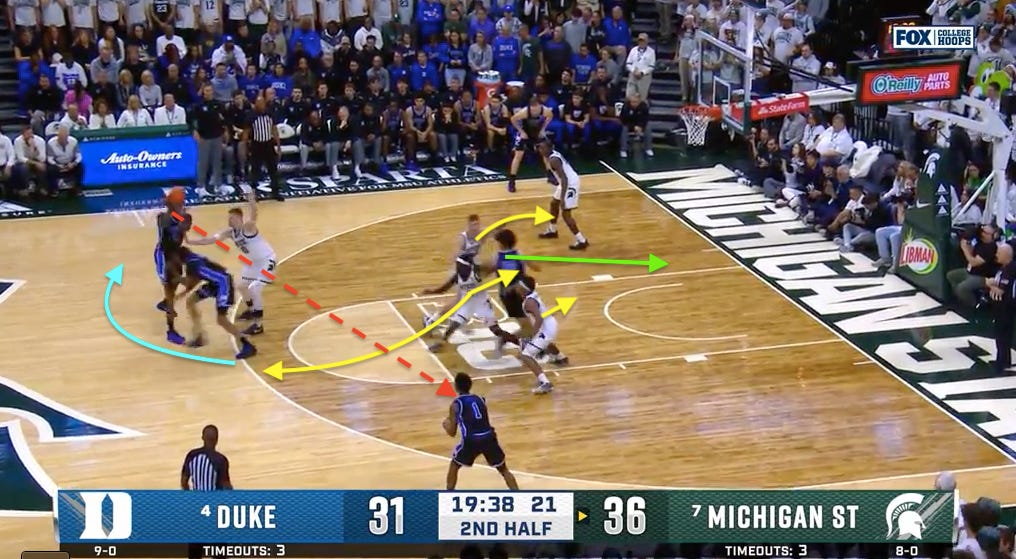
Ngongba’s pass to Foster is a little off the money, preventing Duke’s point guard from stepping into a catch-and-shoot 3 as Fears closes back out. However, Foster is now perfectly positioned to feed a post-entry pass to Boozer, which Ngongba signals him to do. Boozer goes to work 1-on-1 and blows past Carson Cooper (15) on the face-up drive for a layup.
Boozer’s downhill gravity can be a wrecking ball for Duke’s offense. When he cuts, the defense bends, and riskier defensive approaches can open up all kinds of opportunities.
For example: Duke runs Elbow on an after-timeout (ATO) play against Texas Tech. Evans sets a solid back screen on Toppin, and as Toppin struggles to fight through, Tyeree Bryan (1) crashes from the strong-side corner to cover Boozer. That leaves Khamenia (3.7 corner 3PA per 40 minutes) completely unoccupied. Ngongba finds him, and the freshman wing drains a wide-open 3.
Late in the first half against Arkansas, Ngongba has to add a bit more arc on his pass to the cutting Boozer (Malique Ewing may even get a hand on it), which gives Trevon Brazile (7) time to recover to the play. Darius Acuff (5) leaves Foster in the left corner to help on Boozer, opening up a kick-out sequence: Boozer swings to Evans, who finds Foster — around Billy Richmond (24) — for an open corner 3-point look.
One of the things that makes the Ngongba-Boozer connection so potent is how smoothly both players process the game. They read the floor, make quick decisions with the ball, stay ahead of the defense and look to set up teammates for easy scoring opportunities.
Spread Screen-Roll
If Boozer is covered coming off the back screen, Duke doesn’t have to flow into the Razor/handoff to run 1-5 action. The Blue Devils can instead dial up a 1-5 spread pick-and-roll.
As Cayden Boozer brings the ball up the floor, he signals the Elbow action multiple times. Cam Boozer is well defended off Foster’s back screen. Rather than sprinting toward Brown, Foster pops to the top of the key, which Brown uses to trigger a quick pitch-and-chase pick-and-roll — throwing over to Foster and immediately lifting to set a screen. The sequence eventually results in a post-up, with Boozer ducking in and finishing an and-one off his own miss.
According to CBB Analytics, Boozer is shooting 75.6 percent on put-back attempts this season (81st percentile) and he leads Duke with 23 and-ones — 13 more than Evans, the next closest Blue Devil.
Flex Post-up
Another progression from Elbow is for Duke to flow into a Boozer post-up, often off a small Flex action.
On an ATO play at Virginia Tech, after cutting down the lane without receiving Ngongba’s pass, Boozer continues and sets a Flex screen for Khamenia, who cuts over the top and clears out to the weak-side corner.
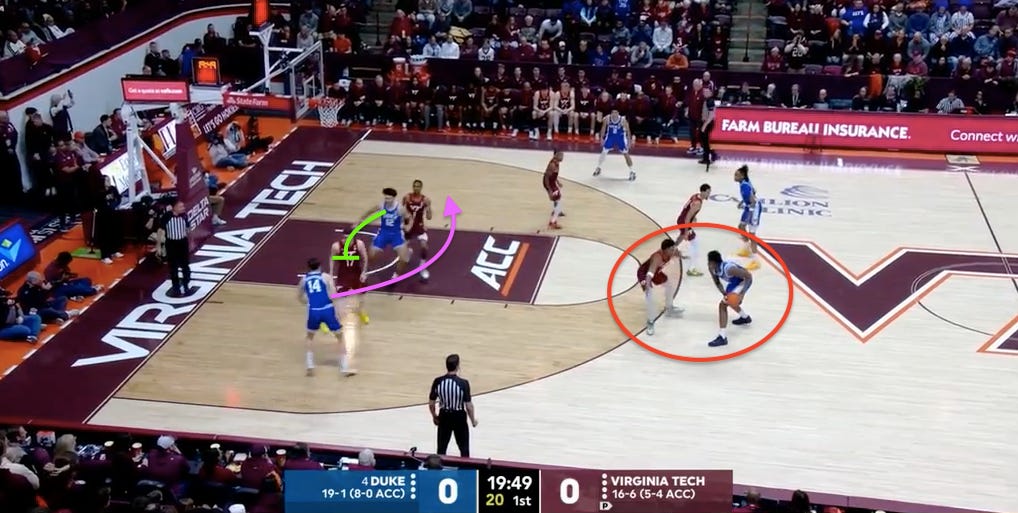
Ngongba could look for Khamenia on the Flex cut, but the angle is difficult. More importantly, this action is designed to clear out that side of the floor for a Boozer post-up. After the post-entry pass, Boozer goes to work; when the double team arrives, he kicks it out to his twin in the right corner for an open 3-point attempt.
Against UNC on the road, Duke runs the same Elbow Flex sequence into a post-up for Boozer, who sets a screen for Sarr before receiving the post entry. The Tar Heels bring a big-to-big double team, with Veesaar dropping in from one pass away. Boozer reverse dribbles away from the pressure and, once again, skips the ball to the weak-side corner for an open spot-up 3 — this time for Sarr.
Pinch Post Flow
If Boozer is blanketed on the cut and Evans doesn’t have an immediate catch-and-shoot opportunity, the Blue Devils can recycle the offense: throwing the ball back to Ngongba in the pinch post and working into the blender, cutting and moving off his high-post facilitation.
With the initial actions taken off the table at Stanford, Duke flows into its half-court flash game. Ngongba lifts back to the elbow, followed by a pass back from Evans. Now, it’s just two players with strong chemistry playing off one another. This isn’t scripted, but Evans threatens to sprint back toward Ngongba for a handoff, which causes Benny Gealer (5) to swing his hips and open up the top side. Evans and Ngongba read it perfectly: back cut.
Boozer occupies the weak-side low-man defender, and every other Cardinal is nowhere near the paint. Evans strolls down the proverbial red carpet and finishes with authority as Ngongba dimes him for two. This is how an offense plays out of the play. This is read-react basketball.
Following a Boogie Fland (0) deflection, Duke finds itself in a scramble against Florida off the initial Elbow action. The Blue Devils settle things with a Boozer post-up and a reset to Ngongba in the right slot. Ngongba’s touch triggers a “Spurs” cut from Evans, who arcs around and off Ngongba — Tony Parker around Tim Duncan style.
The cut from Evans pulls Florida center Alex Condon (21) a step closer to the paint, opening up Ngongba for the late-clock 3. Without touching the ball, Evans uses movement to help open up his teammates.
Covert Connections
Duke can also shift its pieces around the floor to show defenses different looks before running various versions of the back screen/Shuffle series off the 5 in the high post.
Here’s the first play of the game against Kansas. Duke spaces Boozer to the right side of the floor instead of the middle, with Ngongba near the left slot. As Foster initiates the offense, Evans curls toward the middle off a brush screen from Ngongba.
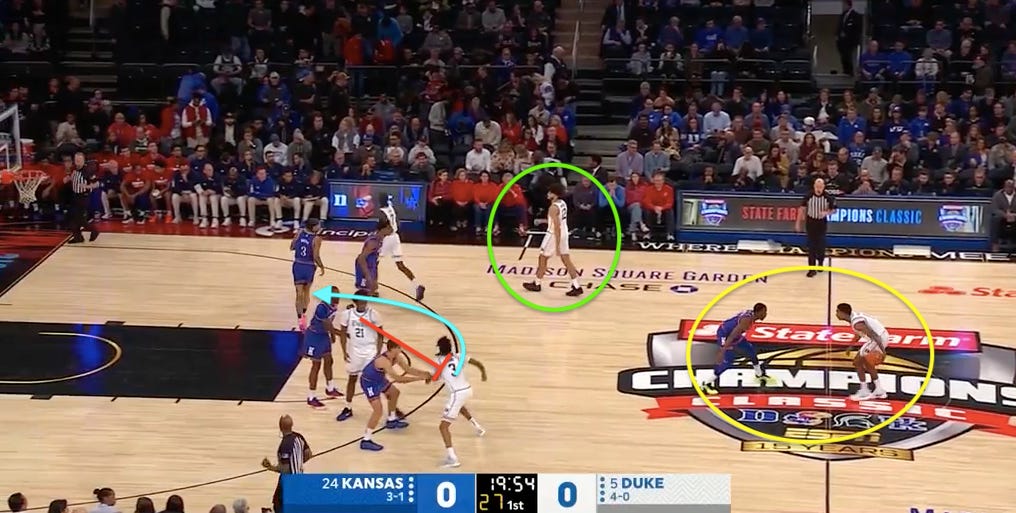
Foster passes to Ngongba on the left wing and cuts through to the left corner. Evans continues his curl, guiding his defender into the lane. This is where his showmanship shines: Evans sells his downward cut, pivots and wheels back up to set the back screen for Boozer.
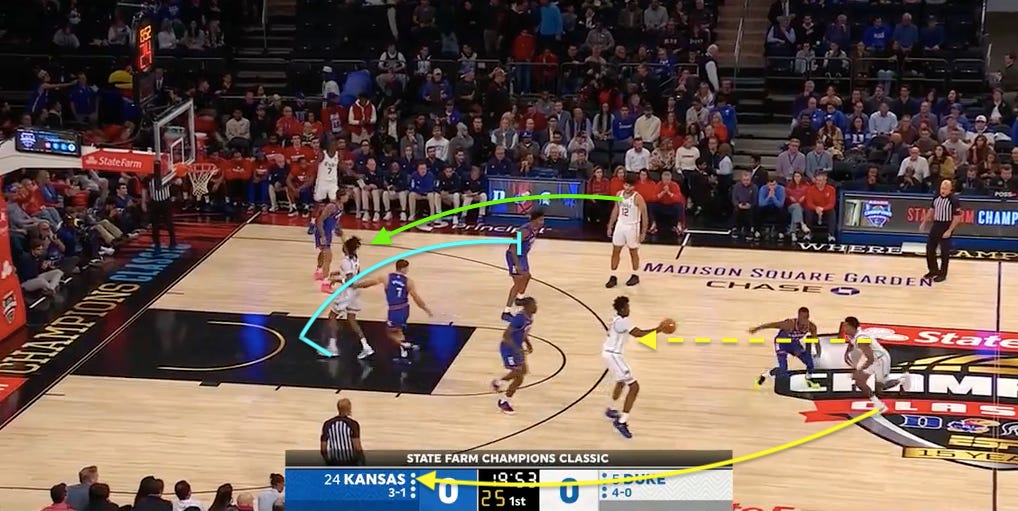
Flory Bidunga (40) plays off Ngongba, which clutters the passing lane but applies no pressure on the ball. Boozer cuts into space, and Ngongba times his pass perfectly, threading it around the rangy Bidunga and finding Cam for an easy finish.
Late in the game, as Duke looks to close things out, the Blue Devils run the same set following another timeout. Boozer gets behind the defense, and Ngongba finds him once again. Although the initial attempt is blocked, Boozer stays aggressive and finishes on the put-back.
Coming Up: Mighty Michigan
Duke’s process will be put to the test this Saturday: No. 1 Michigan, boasting the most efficient defense in the country, awaits in Washington, D.C.
Dusty May’s team ranks second nationally in block rate at 16.2 percent. Overall, opponents are converting just 42.8 percent of their 2-point attempts against Michigan. According to InStat, opponents have made only 47 percent of cut field goal attempts around the basket against the Wolverines, all of which are elite numbers.
The defense is anchored by a star-studded frontcourt: Yaxel Lendeborg (6-9, 240), Morez Johnson (6-9, 250), and Aday Mara (7‑3, 255), each with a block rate above 4.5 percent.
Mara ranks fifth nationally with a block rate of 12.9 percent. His size and activity make him an imposing backbone for Michigan’s defense.
Johnson is remarkably nimble and athletic for his size. He can switch onto guards along the perimeter while also serving as a formidable rim protector and providing excellent rebounding presence on the glass.
I was impressed with Johnson’s game last summer, playing with Team USA at the U-19 FIBA World Cup, where he won gold alongside Khamenia. Before that, he had an impressive freshman season at Illinois, though he unfortunately missed the Duke game after suffering an injury following this spectacular block against Michigan State.
Lendeborg is older, but he’s one of the top players in the country and a leading prospect for the 2026 NBA Draft. While he’s better known for his offensive playmaking, he’s exceptionally strong and can be highly disruptive on defense, aided by a 7-foot-3 wingspan.
When those three are on the floor together, they blot out the sun: Michigan is +104 in 211 minutes while allowing just 89.9 points per 100 possessions (100th percentile). During that time, the Wolverines boast an incredible block rate of 23.2 percent, and opponents are shooting under 57 percent from within 4.5 feet of the rim, according to CBB Analytics.
Even if Duke can pull some size away from the rim by going 5-out, Michigan has the size and versatility to adjust quickly. The Wolverines will be locked in on these 5-out cut actions, so the Blue Devils must be precise and execute perfectly. There’s very little margin for error.
Duke will almost certainly look to run its inverted pick-and-roll concepts with Cam Boozer and either Evans or Foster, depending on how the defense aligns. While Michigan is tough and physical defensively, the Wolverines do play some smaller guards, like former UNC point guard Elliot Cadeau (6‑0, 180). Cadeau could be a focal point for Duke to attack, though that’s easier said than done for many reasons. In fact, May will likely manage his primary assignment carefully. Michigan’s wings are a tougher matchup: Trey McKenney (6‑4, 225), Roddy Gayle (6‑5, 210), and Nimari Burnett (6‑5, 195).
Bottom line: Duke has shot below 50 percent on 2-point attempts just three times (2-1 record) this season: Texas, Michigan State, and UNC. Projection models have this game close, making it an excellent matchup. Duke will need Boozer, Ngongba and Brown to stay out of foul trouble and deliver a monster effort in finishing, passing, and screening.
Immovable object vs. unstoppable force: something’s gotta give.
Thanks for reading Split The Action! Subscribe for free to receive new posts and support my work.
Comments
Nothing yet. Say the first thing.
Sign in to join the conversation.