
Flory Bidunga is one of the biggest names and best players in this offseason’s insanely crowded transfer portal. After a dominant sophomore season — during which he earned multiple year-end honors, including Big 12 Defensive Player of the Year — Bidunga has emerged as a priority transfer target, with several prominent programs in the mix: Duke, Louisville, St. John’s and Michigan, the current champs of men’s college hoops.
Without further ado, let’s dive into a full scouting report on Bidunga, covering both ends of the floor: schematic versatility defending the pick-and-roll, weak-side rim protection, generating hustle points, interior finishing and a burgeoning low-post game.
Despite logging fewer than 700 minutes this season, Darryn Peterson was clearly the headliner for the 2025-26 campaign in Lawrence. Stepping into the starting center role, however, Bidunga put together a monster season, emerging as an elite rim protector and two-way rebounder. In doing so, he became the team’s most reliable player on a night-to-night basis.
With Bidunga on the court this season, the Kansas offense scored at a pretty healthy clip: 114.7 points per 100 possessions. The team’s offensive efficiency stayed high even when Bidunga played without Peterson. In fact, Kansas was even more efficient offensively in those minutes: +151 over 533 minutes, with an offensive rating of 117.8 points per 100 possessions.
One major reason Kansas struggled offensively without Bidunga — a play-finisher who provides little stretch in the frontcourt room due to limited 3-point range — was a lack of rim pressure. According to CBB Analytics, the Jayhawks averaged just 15.7 field goal attempts at the rim per 40 minutes with Bidunga on the bench, compared to 20.1 per 40 minutes when he was on the floor.
While the Kansas offense never fully found its stride this season, Bill Self’s squad could always rely on its defense. The Jayhawks finished the year ranked in the Top 10 nationally in adjusted defensive efficiency, according to KenPom. Kansas also placed among the nation’s best in several key metrics, all of which are related: effective field goal percentage (45 eFG%), 2-point percentage (44.4 2P%) and block rate (15.6%).
Make no mistake: Bidunga was the driving force behind these defensive numbers. With him off the floor, Kansas’s block rate dropped to 13.8 percent, and opponents shot a much higher percentage at the rim, per CBB Analytics: 59.7 percent, up from 52.9 percent when Bidunga was on the court. Overall, Kansas allowed nearly 16 more points per 100 possessions with him on the bench.
Given his elite on-off numbers, strong rim protection and rebounding metrics — 8.9 percent block rate and 18.4 percent defensive rebound rate — combined with disciplined foul avoidance (3.0 fouls committed per 40 minutes), it’s no surprise that Bidunga ranks highly across a variety of catch-all defensive metrics. According to CBB Analytics, he sits in the 99th percentile among centers in DRAPM (Defensive Regularized Adjusted Plus/Minus), while also placing in the Top 5 nationally in Evan Miyakawa’s DBPR metric — alongside other standout defenders such as Yaxel Lendeborg, Rueben Chinyelu, Aday Mara and Jojo Tugler.
Listed at 6-foot-10 and 235 pounds, Bidunga is somewhat undersized and lighter than a typical full-time center. At the 2024 Hoops Summit, he measured 6-foot-7—a noteworthy mark, especially in terms of his NBA stock. Currently, he projects as a one-position player (center), and these measurements are below average for an NBA 5.
The size concern matters in college as well, though less dramatically. Bidunga still brings length, run-and-jump athleticism, lateral mobility and a high-end motor. What he lacks in elite size is mitigated by his physical tools (7-foot-2 wingspan) and his willingness to leave it all on the floor.
In the second half against Duke, Kansas runs a middle ball-screen action with Tre White and Bidunga, which Maliq Brown blitzes — hedging out and pushing White back toward midcourt. The Blue Devils have the backside well-covered, but White chooses to loft the ball to his big man anyway. Bidunga snags a tough catch in traffic, high-points it over Brown, quickly reloads and rises again for a thunderous dunk over Cameron Boozer.
On this ball screen against Baylor, Bidunga gets low into a defensive stance as Cameron Carr dribbles left off the pick. Using his reach and quick hands, Bidunga deflects the ball when Carr leaves it exposed. The turnover sparks a fast break the other way, with Bidunga sprinting the floor for a put-back finish.
Bidunga’s combination of straight-line speed and effortless vertical lift (very little load time) makes him a threat both on the break and on the offensive glass, where he can finish over defenders thanks to a quick second jump.
After grabbing a contested rebound against Baylor, Bidunga pushes the ball ahead and then trails the action, sprinting into an angled ball screen with Melvin Council. Without missing a beat, he create contact on the screen and rolls downhill for a lob finish.
Here’s another transition opportunity for KU, this time against Arizona. After sprinting the floor, Bidunga secures a contested rebound over the burly Tobe Awaka (6-8, 250) and Brayden Burries, spins and pogo-sticks back up for the finish, while Koa Peat wisely opts not to challenge.
Bidunga is a dream defensive anchor for coaches who value scheme versatility on ball screens, especially those who want their centers to be able to switch and credibly defend positions 1-5. He allows the defense to be multiple, whether hedging hard at the top, dropping below the level of the screen or switching. Not yet 21, the southpaw already has two years of college experience and nearly 1,700 minutes under his belt, providing high-level impact in a variety of situations for two Top 10 defenses.
Kansas switched screens 1-5 frequently this season, particularly early in the schedule when it served as the base coverage in some matchups. While Bidunga can struggle in space against some of the quicker guards, he remains solid on switches. He demonstrates an ability to corral drives without fouling, funnel the ball away from the rim and force kick-out passes.
NC State gets a decent look for Darrion Williams off the catch on this possession, but Bidunga does a good job containing point guard Quadir Copeland, one of the ACC’s best live-ball drivers this season.
Carr tries to attack downhill against this Bidunga switch, but Baylor’s star wing can’t gain leverage to turn the corner. As the 6-foot-5 Carr extends for the finish, Bidunga swats the shot, keeps the ball in play and even saves it from going out — sparking a Kansas transition in the opposite direction.
In a game-sealing moment against then-undefeated Arizona, Bidunga switches onto Burries, a likely Top 10 pick in this summer’s NBA Draft. Burries attacks Bidunga’s feet and opens a lane to the hoop, but this is where Bidunga’s athleticism and timing shine: though Burries gets off the floor first, Bidunga recovers and explodes upward to reject the driving attempt.
Once again, Bidunga keeps the ball in play, forcing Arizona to foul and helping Kansas secure the victory.
Bidunga can hold his ground on switches against elite college guards, but his primary pick-and-roll coverage should be hedge-and-recover. He has the activity and wingspan to challenge the point of attack, along with the speed to get back to the rolling big man.
St. John’s flows from a 5-out set into middle ball-screen action on this possession, with Bidunga hedging out and containing Ian Jackson. As STJ resets and the ball returns to Zuby Ejiofor, Bidunga stays disciplined on the fake handoff back to Jackson and finishes the sequence with another block off the backboard.
Against Duke, Bidunga shows smooth defensive work, helping corral the two-man action between Brown and Isaiah Evans around the elbow. He’s ready to challenge Evans if he looks to pull up from midrange and is also able to get back in front of Brown on the dive.
While Bidunga lacks the high-end size some coaches may prefer in drop coverage, especially at the next level, some of those same limitations can affect his post defense as well. He is, of course, an active and physical interior defender who can use his length to alter or block post-up attempts, including this contest on Ejiofor, St. John’s star center.
Bidunga is always on the prowl for shots to block or alter, but he isn’t reckless. Offensive players try to get him off his feet with pump fakes, yet Bidunga trusts his length and vertical athleticism, staying grounded until the moment to explode for a rejection — as he does here against Notre Dame’s Jalen Haralson.
This also helps keep Bidunga out of foul trouble and on the floor. He committed just 2.7 defensive fouls per 40 minutes this season (86th percentile) and played 78.4 percent of the team’s minutes. Bidunga was the only high-major player in the country this season to appear in at least 75 percent of his team’s available minutes and post a block rate above 7.0 percent.
That said, bulkier offensive players can find success against him in the post. Bidunga will battle, but he sometimes gives up too much mass. Some opponents use early seals or shoulder contact to push him deeper into the paint and create separation.
The 7-foot-2, 260-pound Montiejus Krivas is a load for any defender, and he did damage in 1-on-1 post situations against Bidunga when Kansas hosted Arizona, including this hi-lo bucket.
Later in the matchup with St. John’s, Ejiofor sizes up Bidunga with a face-up in the right mid-post. Ejiofor goes left, spins back to the right and uses his left shoulder to displace Bidunga and get the ball up on the glass.
Very few young post defenders are perfect in isolated post-up situations. Ultimately, Bidunga can be trusted to defend effectively in the post, though some matchups may put him in more precarious positions in terms of finishing and foul avoidance.
According to Bart Torvik’s database, Bidunga was one of 11 high-major players this season to finish with an 18 percent defensive rebound rate and an 8% block rate. This group, which also includes Tarris Reed Jr. (UConn) and Ugonna Onyenso (Virginia), lists Bidunga as the second-shortest player — behind only Keba Keita of BYU.
Bidunga racks up blocks defending ball screens and post-ups, but his best rim protection comes when he can showcase his motor, ground coverage, and anticipation as a back-line helper: chasing down shots and rejecting attempts from the weak side.
After a long rebound by Arizona guard Jaden Bradley, Bidunga tracks the ball as it races back up the floor. Around mid-court, he begins to slow his steps to properly time out and position himself for Bradley’s rim attempt. Council does just enough to hold up the ball, and Bidunga flies into the picture — punching Bradley’s layup away with a vicious chasedown block.
Thanks to his wingspan and explosive leaping ability, Bidunga has an exceptional deterrence radius; he can block, alter or effectively contest shots that initially appear out of his reach.
On the first play of the second half against Baylor, Carr comes off a ball screen and drives past Bryson Tiller and Peterson. With Baylor center Caden Powell sealed in the post, it appears Carr has a straight-line path to the hoop.
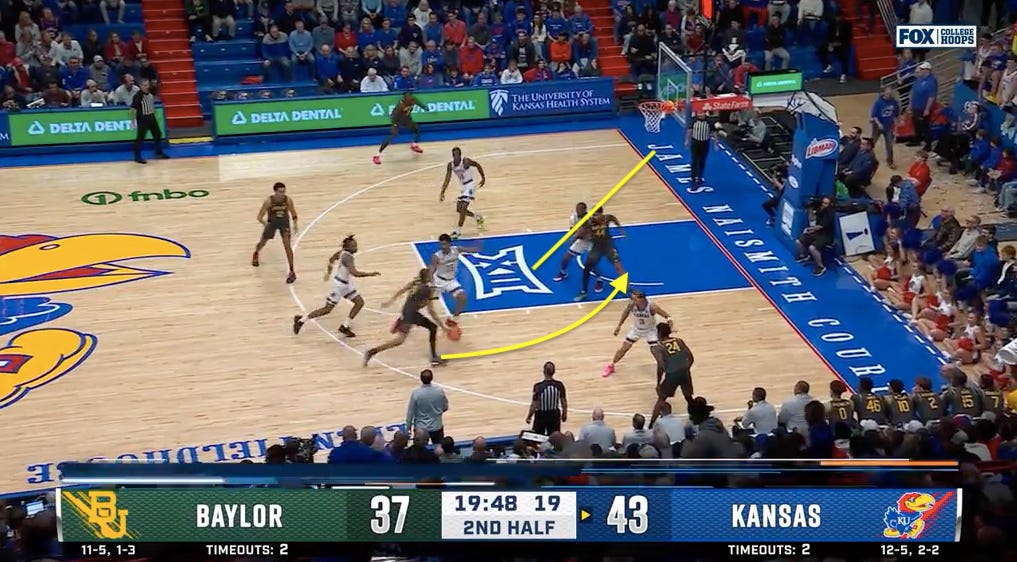
Bidunga is known for his multi-sport skills that translate to the soccer pitch, but he taps into some American football techniques for this maneuver. Like a defensive end, he swim moves around Powell, shedding the would-be screener, and emerges on the other side to erase Carr’s rim attempt.
Later in the Baylor game, it looks as though Powell again as Bidunga sealed in the paint as Obi Agbim drives. Once again, though, Bidunga is able to shake Powell and get up for a major rejection — swatting Agbim’s attempt with so much force that it leads to a run-out layup down on the other end.
The key to Bidunga’s offensive efficiency is simple: he’s a powerful interior finisher who doesn’t turn the ball over that much. He’s a career 66 percent shooter on 2-point attempts, including 64.4 percent in the 2025-26 season despite a larger workload: 19.5 percent usage rate, up from 15.9 percent as a freshman.
According to CBB Analytics, 74.2 percent of Bidunga’s career field-goal attempts have come within 4.5 feet of the rim, and he’s converted an impressive 74.5 percent of those looks.
Many of these opportunities come from hustle and doing conventional center duties at a high level: screen-rolls, cuts and crashing the offensive glass.
During the 2025-26 season, Bidunga the average distance on Bidunga’s 2-ponts attempts was 3.2 feet and he averaged 7.9 rim field goal attempts per 40 minutes, ranking in the 94th percentile for centers.
The high volume of rim attempts turns into a lot of dunks for Bidunga, unsurprisingly. Bidunga averaged 3.0 dunks per 40 minutes this season, and he was one of only three high-major players to record 80 or more dunks, per Bart Torvik’s database.
Somto Cyril, Georgia: 83 dunks
Flory Bidunga, Kansas: 82 dunks
Aday Mara, Michigan, 81 dunks
While Bidunga gets plenty of dunks around the basket on the pick-and-roll, he’s not just a dunk-bot. His touch isn’t always there, but Bidunga has moments where he shows a little more feel on touch or lob finishes.
On this possession, Bidunga sprints the floor and sets a solid screen in KU’s “Drag” pick-and-roll, helping create space for Council. When the lob comes his way, Nnaji backpedals and nearly undercuts him in midair. Bidunga, however, adjusts his body, catches the pass and finishes softly off the glass.
Bidunga remains heavily reliant on his left hand for non-dunk finishes around the basket. Developing his right hand — even for jus the occasional paint attempt — would be a real asset.
With more opportunities and greater maturity, Bidunga became a more productive and efficient post-up scorer. According to InStat, he averaged 0.9 post-up chances per game as a freshman, accounting for 20.7 percent of his total possessions, and scored 0.73 points per opportunity.
As a sophomore, Bidunga increased to 3.2 used post-ups per game (shots or turnovers), representing 30.4 percent of his possessions, and scored 0.83 points per chance.
He doesn’t project as a low-post brute who commands double teams or anchors an offense, but when he plays with poise and pace in the post — and leverages his quickness, long arms and frame — he can be a productive finisher in the paint. Bidunga’s ability to extend for finishes, even in a congested low-post area, really pops.
Here against UNC, Bidunga switches onto Caleb Wilson. He quickly ducks in, sealing off Wilson in the paint and positioning himself for the post-entry feed. Bidunga may get away with a slight “chicken wing,” using his left elbow to create separation, but it results in a strong finish at the rim. It’s good to see him play with this type of force.
It’s an effective move, but Bidunga is guilty at times of using his elbows to hook and displace defenders. There’s some risk associated with that; however, it’s effective if the refs swallow their whistles.
While Bidunga can usually rely on his quickness advantage against college centers, he isn’t afraid to play physical, too. He uses angles and a solid lower-body base to carve out space for duck-ins and hi-lo feeds.
This is excellent work against Krivas, one of the country’s top interior defenders. Bidunga creates space in the restricted area with Krivas fronting the post. After Tiller’s lob entry, he keeps his pivot foot grounded, spins like a top and uses a shot fake to get Krivas (7.5 percent block rate) off his feet before rising for the finish.
To open the second half against Duke, Kansas dumps the ball into Bidunga in the post, working against Patrick Ngongba, another excellent post defender. Bidunga gets momentarily pinned on the basket, with his dribbled expired and Ngongba applying serious pressure. However, Bidunga manages to maintain his balance and pivot as he shakes out of Ngongba’s defense to extend for a monster reverse dunk.
While Bidunga often uses his speed to slip screens — cutting downhill toward the rim before the screen fully develops — he’s just as willing to use his body to help teammates get open. He holds his ground and sets solid screens.
This, in turn, impacts his ability to roll effectively into space.
For example, Bidunga extends a handoff to Council on an empty-corner ball-screen action. Arizona’s defensive anchor, Krivas, drops a few feet below the level of the screen. Bidunga doesn’t allow Burries to float over the top; he sets a hard screen, giving Council room to dribble into space near the nail.
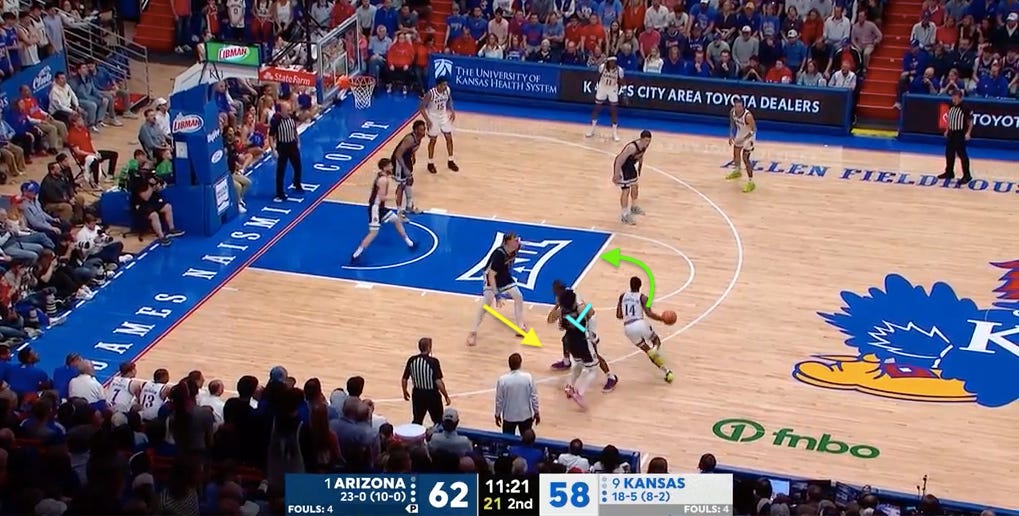
With Burries stuck on the screen and now behind the play, Krivas must come off his line in the drop as he takes a step toward Council.
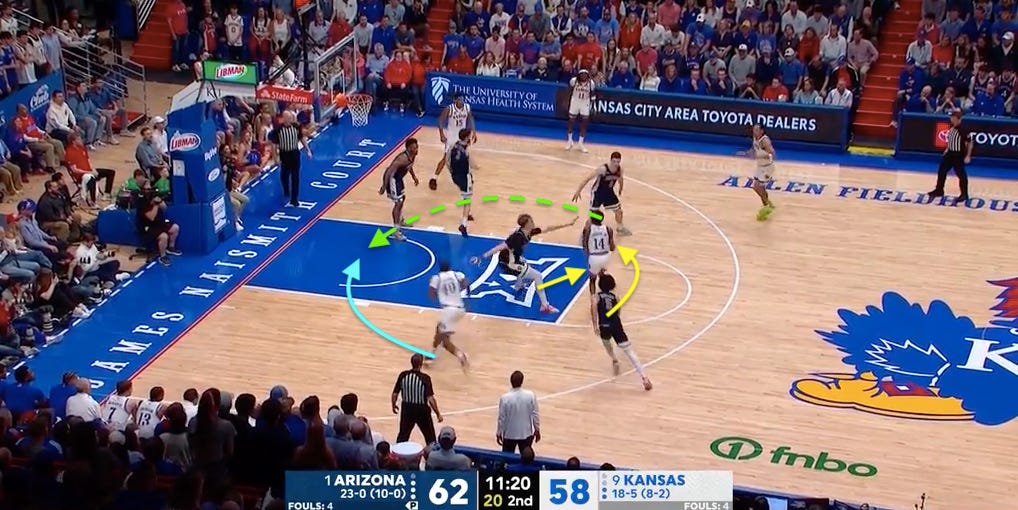
This slight nudge from Krivas leaves Bidunga wide open, as the left corner is vacated and no help defender is in position to tag the roll. Council recognizes it and lobs the ball over the top to Bidunga, who finishes over a retreating Krivas with both grace and authority.
After recording just 11 assists in 34 games as a freshman, Bidunga took on a larger playmaking role this season for KU. He posted a respectable 9.7 percent assist rate, along with an assist-to-turnover ratio of 0.96-to-1, which isn’t too shabby for a rim-running 5.
Bidunga won’t dissect a defense for 40 minutes from the elbows or high post. That’s not how his game is built. But he can keep the offense humming, linking teammates through 5-out handoffs, face-up feeds and kick-outs from the post.
There have also been encouraging flashes on the short roll, when the defense double-teams the ball and allows Bidunga to slip into pockets of space.
Peterson and Bidunga run an empty-corner pick-and-roll on the left side against NC State. When Williams hedges the screen, Bidunga short rolls into space along the left baseline. His catch triggers a rotation from NC State: Ven-Allen Lubin slides over to stop the ball, while Matt Able and Tre Holloman rotate down to cover the cutters. Bidunga reads it perfectly, avoids forcing a pass and instead kicks the ball out to Council for an open look in the right slot.
According to CBB Analytics, nearly 85 percnet of Bidunga’s assists this past season led to rim finishes or 3-pointers.
The Jayhawks run their “Angle Pop Zoom” action here against Baylor, which flows into a screen-roll with White and Bidunga. Baylor’s defense is all over the place, and White hits an open Bidunga on the roll. Bidunga could probably finish at the rim, but he catches the ball a little under the basket and instead kicks it out to Elmarko Jackson for an open corner 3.
Bidunga won’t break down a defense on the short roll, but he can make the next play, including moments when he needs to put the ball on the floor for a dribble or two. He still relies on his left hand to finish, which can complicate things, but this is a smooth, tasty finish off a short roll spin move against former Charlotte Hornets draft pick James Nnaji.
If those weak-side rotations aren’t present — or if the defense fails to get back in front of him — Bidunga can also do damage in space, driving the ball straight to the basket.
These are growth areas for Bidunga. He doesn’t need to become a primary offensive hub, but the more he can help organize or facilitate offense in 5-out sets or on the short roll, the more effective he becomes as an offensive 5 who doesn’t stretch the floor.
Flory Bidunga’s 2025-26 season firmly established him as one of the country’s most impactful two-way bigs.
While there are areas for growth — such as expanding his post-up repertoire against bulkier opponents and continuing to refine his short-roll decision-making — Bidunga’s combination of athleticism, motor and defensive feel sets him apart as a rare, multi-dimensional portal target.
No posts
Comments
Nothing yet. Say the first thing.
Sign in to join the conversation.