
WELCOME to #TheatreClique — my emphatically intermittent newsletter dedicated to encouraging you to click out to some of the most interesting, intriguing & noteworthy writing about drama, theatre & performance (at least, so says me)…
This installment of #TheatreClique clicks out to pieces that consider why professional critics still matter, the origin story of downtown performance icon Carmelita Tropicana , and 250 years of Black theatre in America. There’s also a quick burst of self-celebration and, of course, some commentary about my experience of recent productions, including Every Brilliant Thing, A Walk on the Moon, Poor Judge, and You’re a Good Man, Charlie Brown. And for this week’s opener, I lift a song that I just can’t stop singing to myself: “Bugs” from contemporary folk/Americana artist Jesse Welles (which I actually discovered via this collaboration with The Wiggles) .…and if clicking the embedded image below routes to an error message, try clicking here.
EDITOR’S NOTE: whenever possible, whenever linking to paywalled pieces, I try to “gift” the article to #TheatreClique readers. In other words, clicking out to articles in the New York Times, Washington Post, Philadelphia Inquirer, Atlantic, and Wall Street Journal should neither present hassle nor burn through your current allotment of free views. Here’s hoping more outlets — hello LATimes! hi NewYorkMagazine! yo NewYorker!— adopt similar technologies for subscribers soon... I likewise try to flag when a sign-in/registration is required for access, with the exception of general access sites like MuckRack, TikTok or Instagram. If any obstacles to access to linked materials are particular persistent, perplexing or annoying, please do alert me by replying to this message so that I can adjust accordingly.
Wherein I highlight a handful of the most click-worthy links I’ve encountered in the last few…
at Hyperallergic, arts writer/historian Natalie Haddad talks to Alina Troyano — aka Carmelita — about how she began “writing and performing in New York’s 1980s club culture, her collaborators and inspirations, and her queer community” (pdf);
at The Independent, independent writer/editor Caitlin Hornik reflects on her experience of the National Critics Institute and why professional critics still matter in an era defined by hot takes, influencers, and platform journalism;
at Middle East Eye, researcher/scholar Alaa Tartir contemplates the legacy of his father Adel Tarir — a foundational figure in Palestinian theatre — and his belief in theatre as “a space for confession, provocation and liberation”;
at Another Eye Opens, veteran arts critic/writer Don Shewey reflects on his deep ambivalences about Death of a Salesman as he digs deep into archives for a piece he wrote about the film adaptation of the 1984 stage version of Death of Salesman starring Dustin Hoffman (which, as it happens, was also my first real introduction to the play in performance);
and THIS WEEK’S MUST-READ…
at Ebony Magazine, culture writer/editor Delaina Dixon and author/producer Patrick L. Riley offer a three part rendering of “Our Stage, Our Stories: 250 Years of Black Theater in America”…
Part 1: The Beginning by Delaina Dixon
Part 2: Notable Black Playwrights by Patrick L. Riley
Part 3: The African American Musical by Delaina Dixon
Wherein I highlight noteworthy current or soon upcoming opportunities for remote theatregoing.
Hadestown: The Musical via Bleecker Street Films
“The live capture of the Tony Award winning musical Hadestown, featuring five original principals of the Broadway company. The genre-defying new musical blends modern American folk music with New Orleans-inspired jazz to reimagine a sweeping ancient tale that invites audiences on a hell-raising journey to the underworld and back.”
screens at cinemas across the US for “five nights only” : 7/23-7/27• $
Wherein I briefly highlight noteworthy current or soon upcoming things happening in my life, world, or work…
It is a profound honor to be nominated but… WE WON! The volume I co-edited with Anne García-Romero — María Irene Fornés in Context (Cambridge, 2025 — is one of three titles honored with this year’s Edited Works Award by the Association for Theatre in Higher Education. Attentive readers might recall that, upon news of the volume being shortlisted for this award, I hoped that such recognition might expedite the publication of a (slightly more affordable) paper edition of the volume? Well… That is happening too! The good folks at Cambridge tell us that the PAPERBACK EDITION IS COMING THIS FALL! (The paperback purchase link will likely go live by the end of September at a probable price-point of about 1/3 of the hardcover price. See image below for discount code!)
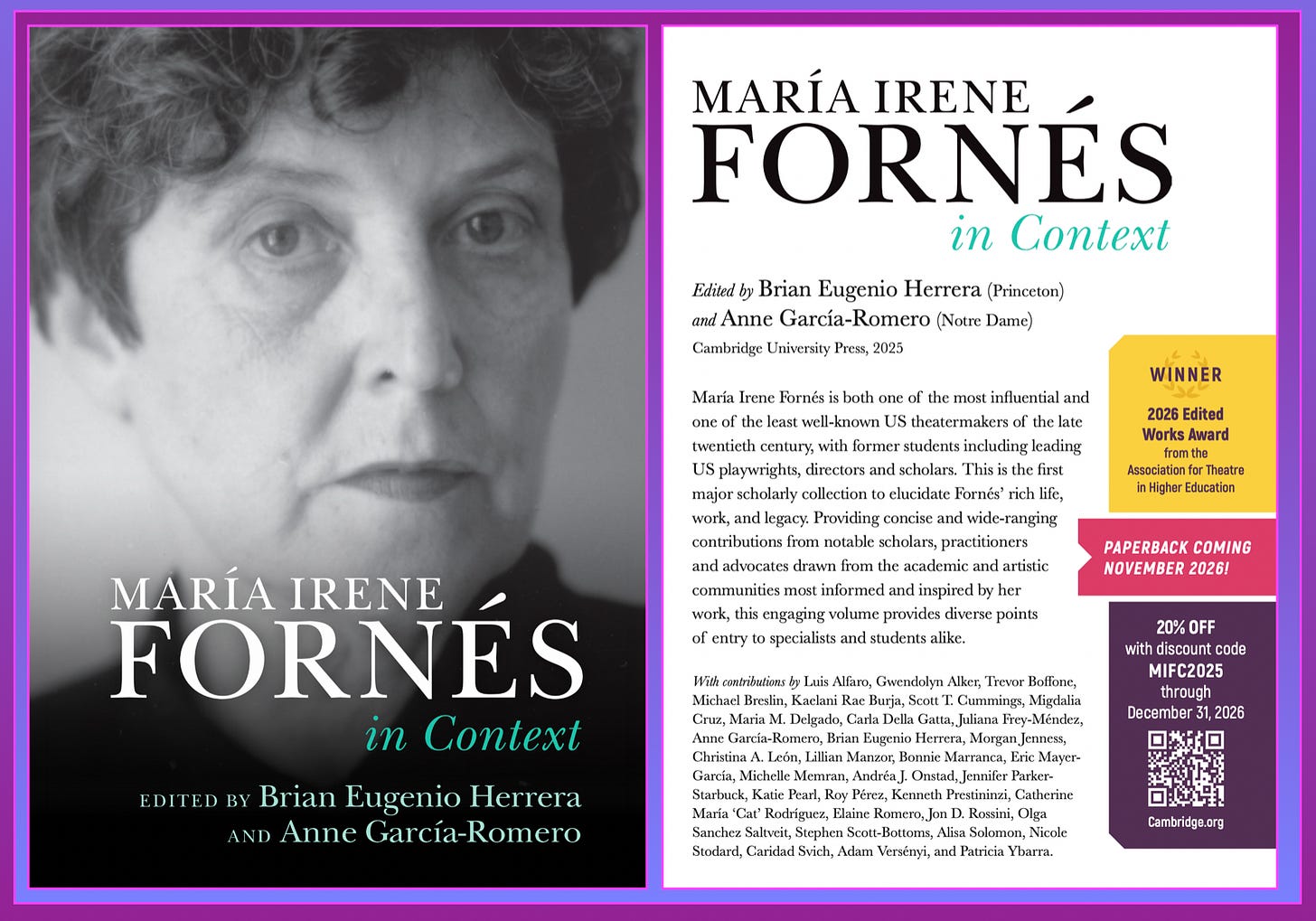
For those attending ATHE’s 2026 Conference in Baltimore this week, Anne and I will be speaking about the volume at two panels — first, at Thursday’s Spotlight on New Works panel and, next, at Friday’s Awards Roundtable. On Friday’s roundtable, we will be alongside this year’s other awardees in the Excellence in Playwriting, Outstanding Book, and Outstanding Article categories, as well as those recognized for their Leadership in Community-Based Theatre and Civic Engagement and Sustained Achievement in Teaching and Mentoring. Yay!
Wherein I offer capsule commentaries on what I liked best (or found most compelling) about the shows I’ve recently engaged... A full accounting of my 2026 theatregoing can be found HERE.
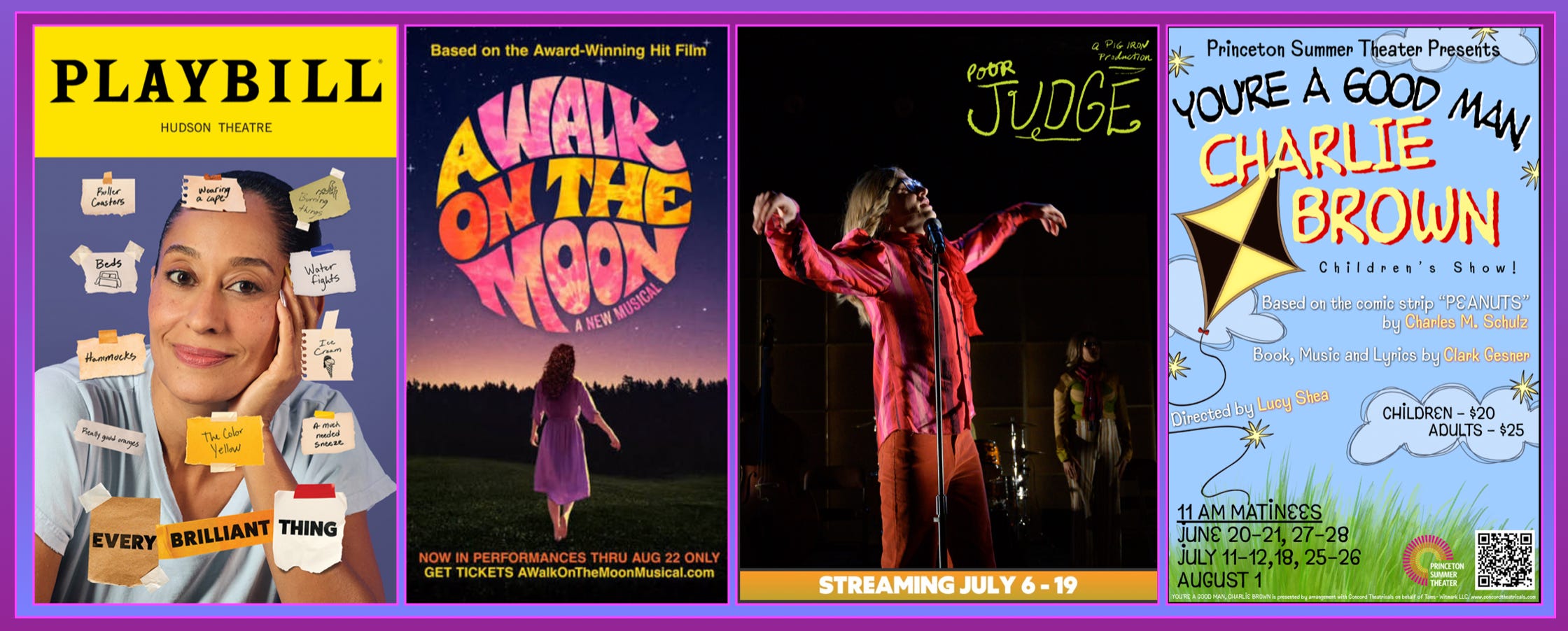
Written by Duncan Macmillan with Jonny Donahoe • Directed by Jeremy Herrin and Duncan Macmillan • NYC : Broadway • Hudson Theatre • July 2026.
Every Brilliant Thing was kinda great. As a play, it’s a sturdy contraption: emotionally accessible, deftly constructed, lightly dotted with precisely placed moments of audience participation, always smartly toggling between forthright naturalism and lightly abstracted theatricality, with just a touch of a Brecht-ish exposure of the theatrical apparatus. And, in this iteration, at center — as the affective axis upon which the whole piece spins — stands Tracy Ellis Ross, who holds the stage, the role, and the audience with astonishing clarity, tenderness, warmth, and poise. Throughout my first encounter with this play and this production), I couldn’t help but marvel at how effectively this script activates the potent pleasures of celebrity-watching on Broadway. Unlike recent experiments like, say, All Out or Celebrity Autobiography — where the semi/famous people “appear” as they might on a tv talk show or award show or whatever — this production of Every Brilliant Thing activates the interest stirred by celebrity in a more compelling way. First, it invites the audience to sit in the same room as a major celebrity, prompts us to stare at the celebrity, and allows us to hold in our mind whatever we know or feel about that celebrity as a famous person. Indeed, as the audience enters, said celebrity is already onstage, consulting visibly with the crew and certain members of the audience, all as part of the show. Should we choose to watch the aforementioned celebrity during this preshow prologue, we become rehearsed in seeing her as both a casually-dressed celebrity and as a working person who, as the show begins, incrementally becomes additionally legible as a distinct character. At the same time, because of the many ways the piece deploys “audience participation” — whether having certain folks call out words or phrases when prompted or inviting others to join the celebrity onstage as a scene partner — Every Little Thing also invites the audience to witness and appreciate the other people who also just happen to be in the room with this celebrity/person/character. This invitation — to relish and to luxuriate in this experience of co-presence — is remarkable to experience in any theatre, let alone a Broadway how. The legible apparatus of the production lets us know that we are in good, safe hands, which allows us to feel somehow closer with our fellow audience members and the celebrity/actor/person at the center. This intentionality also inflected how Tracy Ellis Ross — as the first Black celebrity to take on the role in this production — and her team identified Black audience members to take on particular roles (the veterinarian, her father, her librarian/counselor) which allowed this ostensibly race-neutral piece to amplify a loving call to creating space for conversations about mental health in Black families and Black communities. Ross’s evident intentionality also informed my response to the moment when she sang a snippet of “Endless Love” (a song made famous by Ross’s mega-famous mother Diana) and, for one glistening moment, Tracy Ellis Ross sounded so much like her mother. (I can attest that the two GenXers sitting to my immediate right were as moved and exhilarated as I in this sequence.)s This moment — when an actor playing a character reflecting on their dis/connections with their mother is also a famous person singing a song made famous by their celebrity mother — distilled for me the ways this play is always asking, encouraging, even requiring its audience to think/feel within the dramatic moment and beyond it… simultaneously, consistently, generatively. This stealth sophistication makes Every Brilliant Thing a surprisingly striking piece, really — in its theatrical effectiveness, in its emotional nuance, in its stirring activation of a palpable sense of co-presence. A warm and welcome surprise of a show.
See also:
People’s Dave Quinn distills the conversation between Tracy Ellis Ross and Keke Palmer (part of Ross’s appearance on Baby, This Is Keke Palmer) in which Ross reflected on how making her Broadway debut in a one-person play is something she’s dreamed about for years.
at Vogue, independent theatre writer/critic/historian Carey Purcell talks to Ross about how she understands her “job” in Every Brilliant Thing “is really to be a conductor of sorts, and to fill the space with wonder and connection—really to set the tone that we are all there to flourish. There’s no doing it wrong, and there’s no mistakes” (PDF).
Written by Pamela Gray • Music and Lyrics by AnnMarie Milazzo, with Additional Lyrics by Pamela Gray • Directed by Sheryl Kaller • NYC : Off-Broadway • Laura Pels Theatre • July 2026.
The pleasures of A Walk on the Moon are simple, even as the story itself is emotionally, historically, and culturally quite complex. Set in one of the many “communal bungalow colonies that made summer leisure accessible to the urban Jewish working class” throughout the Catskills, A Walk on the Moon tells the story of Pearl Kantrowitz (a luminous and vibrant Talia Suskauer), a dedicated and hardworking housewife who finds herself at an unexpected crossroads (and identity crisis) in the summer of 1969. For not only is Pearl’s bungalow community immediately adjacent the farm that would host Woodstock, and not only is everyone abuzz with the anticipation for American astronauts to walk on the moon, but Pearl’s teen daughter is about the same age as Pearl was when she became a mother. Enter hunky dress peddler (Sam Gravitte, serving charisma and physique in equal measure) to stir the excitement of the ladies and to forever change Pearl’s life. With a narrative that is roughly equal parts Dirty Dancing and The Bridges of Madison County, this musical adaptation of Pamela Gray’s autobiographically-inspired film taps into rich wells of culturally-specific nostalgia while also opening resonant questions about all that changed in women’s lives as the 1960s became the 1970s. AnnMarie Milazzo’s tuneful songs are fortified by lushly exhilarating vocal arrangements and sung by a powerhouse cast that includes veterans like the always electric Andréa Burns (so warm, wise, and witty as Pearl’s allegedly psychic but definitely discerning mother-in-law Lillian) and rising newcomers like Sophie Pollono (who, as Pearl’s daughter Alison, delivers on the forceful promise I first saw showcased by her performance at the 2022 Jimmys). But at the center Suskauer’s performance opposite both Gravitte and Max Chernin (as Pearl’s hardworking husband Marty) once again confirms that Suskauer is among the most noteworthy and compelling among Broadway’s “Leading Ladies in Waiting.” Attentive readers might recall my appreciation of Suskauer’s take on Dot in Eamon Foley’s staging of Sunday in the Park with George a couple years back. But in A Walk in the Woods, I was particularly taken by the searing chemistry between Suskauer and Chernin, who starred opposite each other on the recent national tour of Parade. I’d say it’s worth seeing A Walk on the Moon for Suskauer alone but, then again, you’ll also get to see Gravitte, Chernin, Burns, Pollono, and the totes adorbs Oscar Williams (as young Alison’s love interest), not to mention an ensemble packed with genuinely interesting and compelling performers. Plus, I do love the sounds of Mah Jongg being played. All told, an unexpectedly tender and engaging show.
See also:
at TimeOut New York, independent theatre writer/critic Raven Snook appreciates A Walk on the Moon as “a summer beach read of a musical [that] delivers Jewish nostalgia with a smattering of schmaltz”;
at New York Theatre Guide, independent theatre writer/critic Joe Dziemianowicz highlights how its wonderful cast gives A Walk on the Moon its liftoff.
Created by Pig Iron, from an original idea by Dito van Reigersberg • Directed by Eva Steinmetz • Music Direction by Alex Bechtel • Philadelphia • Wilma Theatre (via The Digital Theater Lab) • July 2026.
My recent encounter with Girl, Interrupted — Martyna Majok’s play with (Aimee Mann’s) music — stirred my reflection on (and my continuing curiosity about) my not-quite-as-recent experience with the video-capture of Pig Iron’s Poor Judge at the Wilma, which I characterized as follows:
Billed as an “original work of dance-theater cabaret born from the music of alt-rock iconoclast Aimee Mann,” Pig Iron’s Poor Judge ponders the deeply interior experience of dissociative loneliness that might be triggered by a traumatic breakup, or by a major move, or by an artistic/professional crisis of faith, or — as in Poor Judge — all three at the same time.
Re-viewing the video capture of the 2026 production both fortified and deepened the appreciation I detailed in my reflections on my prior encounter with the piece, even as this experience reverberated with different poignancy in light of the passing of PigIron’s co-founder Dito van Reigersberg (1972-2026), whose life and sensibility so imbue this piece. Poor Judge remains a truly remarkable piece of innovative, intermedial music theatre that I sincerely hope I might be able to catch “live” someday.
See also:
at Broad Street Review, freelance theatre writer/critic Cameron Kelsall reviews Poor Judge as “a testament to the power of performance as a collective act and healing ritual”;
at Philadelphia Magazine, veteran arts/culture journalist Christine Speer Lejeune remembers the “indescribable blessing that was the brilliant, joy-making, mold-breaking Dito van Reigersberg.”
Book, Music and Lyrics by Clark Gesner • Directed by Lucy Shea • Princeton, NJ : Princeton Summer Theater ( • Hamilton Murray) • July 2026.
You’re a Good Man, Charlie Brown might just be the first musical I ever saw live. I was in the sixth grade, sitting in the front row of the bleachers in the gym at Roosevelt Middle School in Tijeras, New Mexico. My childhood best friend played Charlie Brown, the cool girl from my first grade bus stop played Snoopy, and and a girl I barely knew but who would ultimately become a lifelong friend played Frieda or Violet or someone. I have a mental block on who played Linus, possibly because I fervently believed that Linus should have been my part. (You see, I had played Linus, to great acclaim, the prior year in a stealth — and illegal in so many ways — production of A Charlie Brown Christmas staged at a rec center in Riyadh, Saudi Arabia.) I had only just returned to the US shortly before this production of You’re a Good Man, Charlie Brown — RATS! — had thus missed auditions — AAUGH! — and could only watch from the sidelines/audience — GOOD GRIEF! I think I saw both performances of the show, one before the whole school at an afternoon assembly and the other for parents that same evening. I mostly remember being just over the moon with excitement about how amazing the show was. I was reminded of that early dramaturgical assessment of the show’s merits as I experienced Princeton Summer Theatre’s staging of You’re a Good Man, Charlie Brown as their kid’s show this season. Lucy Shea’s forthright, emotionally-grounded production — animated by a charming cast and delightful set — evinced the show’s simplest, silliest, and profoundest strengths. I’m not sure the largely pre-K audience I saw it with fully grooved with the show’s existential ruminations as much as I did but, whenever the company danced, with each char/actor doing their own riff on the iconic animated dance stylings of the Charlie Brown crew, my all-ages audiences was all in.1
See also:
at Town Topics, theatre writer/critic Douglas Sanborn III celebrates this “exuberant and heartfelt production that highlights the appeal of the show, and that of its classic source material, for audiences of all ages” — while also reminding us that Clark Gesner was a Princeton alum (who wrote his thesis on “The History of the American Musical Comedy”…
TRANSPARENCY DISCLOSURES for #260721: I am friendly with Alina Troyano as professional colleagues. Sam Gravitte and I have stayed in connection and conversation ever since his name appeared on my roster of first-year advisees at Princeton. I attended A Walk on the Moon as a guest of the production and at no direct expense to myself..
With only the very occasional exception, I do not include in this newsletter extended commentary on works presented on the Princeton campus by current (or even recently graduated) Princeton students. Even so, I do want to embrace the opportunity to highlight the work being done by this rising cohort of theatremakers and also to document, even if only briefly, the relevance of their work to my general theatregoing flow.
Comments
Nothing yet. Say the first thing.
Sign in to join the conversation.