
WELCOME to #TheatreClique — my emphatically intermittent newsletter dedicated to encouraging you to click out to some of the most interesting, intriguing & noteworthy writing about drama, theatre & performance (at least, so says me)…
This installment of #TheatreClique clicks out to pieces that evince the connections between August Wilson and Romare Bearden, that survey the impact of federal funding cuts on the public media landscape, and that unearth Andrew Holleran’s remembrance of Charles Ludlam circa 1987. I also highlight some of my soon upcoming theatre-related endeavors and, as always, I share my reflections on some recent productions, including Birthright, Object Permanence, Doll Parts… A One [Trans] Woman Show, and How to Put Down the Weight of Your Past. And for this week’s opener, I lift the sweet, silly, and strange music video for one of my favorite tracks from Bury Deep My Heart the latest album from my favorite indie/high-concept/electro-country band: Owen Lake and the Tragic Loves. .…and if clicking the embedded image below routes to an error message, try clicking here.
EDITOR’S NOTE: whenever possible, whenever linking to paywalled pieces, I try to “gift” the article to #TheatreClique readers. In other words, clicking out to articles in the New York Times, Washington Post, Philadelphia Inquirer, Atlantic, and Wall Street Journal should neither present hassle nor burn through your current allotment of free views. Here’s hoping more outlets — hello LATimes! hi NewYorkMagazine! yo NewYorker!— adopt similar technologies for subscribers soon... I likewise try to flag when a sign-in/registration is required for access, with the exception of general access sites like MuckRack, TikTok or Instagram. If any obstacles to access to linked materials are particular persistent, perplexing or annoying, please do alert me by replying to this message so that I can adjust accordingly.
Wherein I highlight a handful of the most click-worthy links I’ve encountered in the last few…
The New York Times’s Maya Phillips evinces how the works of playwright August Wilson and collagist Romare Bearden are intimately intertwined;
NPR’s David Folkenflik surveys the public media landscape (and the role of “rage giving”) one year after the end of nearly six decades of bipartisan federal funding;
at The Brooklyn Rail, theatre writer/critic Joey Sims profiles Adult Film, the emerging company that has rapidly “grown into a teeming laboratory of productions, training, acting investigation, and new work development”;
the good judys at Christopher Street unearth Andrew Holleran’s 1987 remembrance of Charles Ludlam;
and THIS WEEK’S MUST-READ…
at Jacques, theatre reporter/writer Gordon Cox reports on the eight things that he learned during his time with leading scholars of musical theatre at Song, Stage & Screen 26, the conference of the International Society for the Study of Musicals.
Wherein I highlight noteworthy current or soon upcoming opportunities for remote theatregoing.
Suffs • Purlie Victorious • Irving Berlin’s Top Hat • Hamlet - PBS.org
Four shows — currently available to stream at no-cost/subscription — scheduled to be removed from the PBS website on Friday, 73/1.
Hamlet (2023) : Kenny Leon directs Ato Blankson-Wood as Hamlet at the Delacorte Theater in NYC.
Irving Berlin’s Top Hat (2026) : Kathleen Marshal directs & choreographs Phillip Attmore and Amara Okereke in this stage adaptation of the the iconic 1935 movie musical, filmed at the Southbank Centre in London.
Purlie Victorious: A Non-Confederate Romp Through the Cotton Patch (2024) : Leslie Odom, Jr. and Kara Young star in Ossie Davis’ play about a traveling preacher who returns to his Georgia hometown, filmed at the Music Box Theatre on Broadway.
Suffs (2024) : Shaina Taub writes and stars in musical about the American suffragist movement, filmed at the Music Box Theatre on Broadway.
ONLY available until Friday July 31 at 11:59pm ET : streams freely
Wherein I briefly highlight noteworthy current or soon upcoming things happening in my life, world, or work…
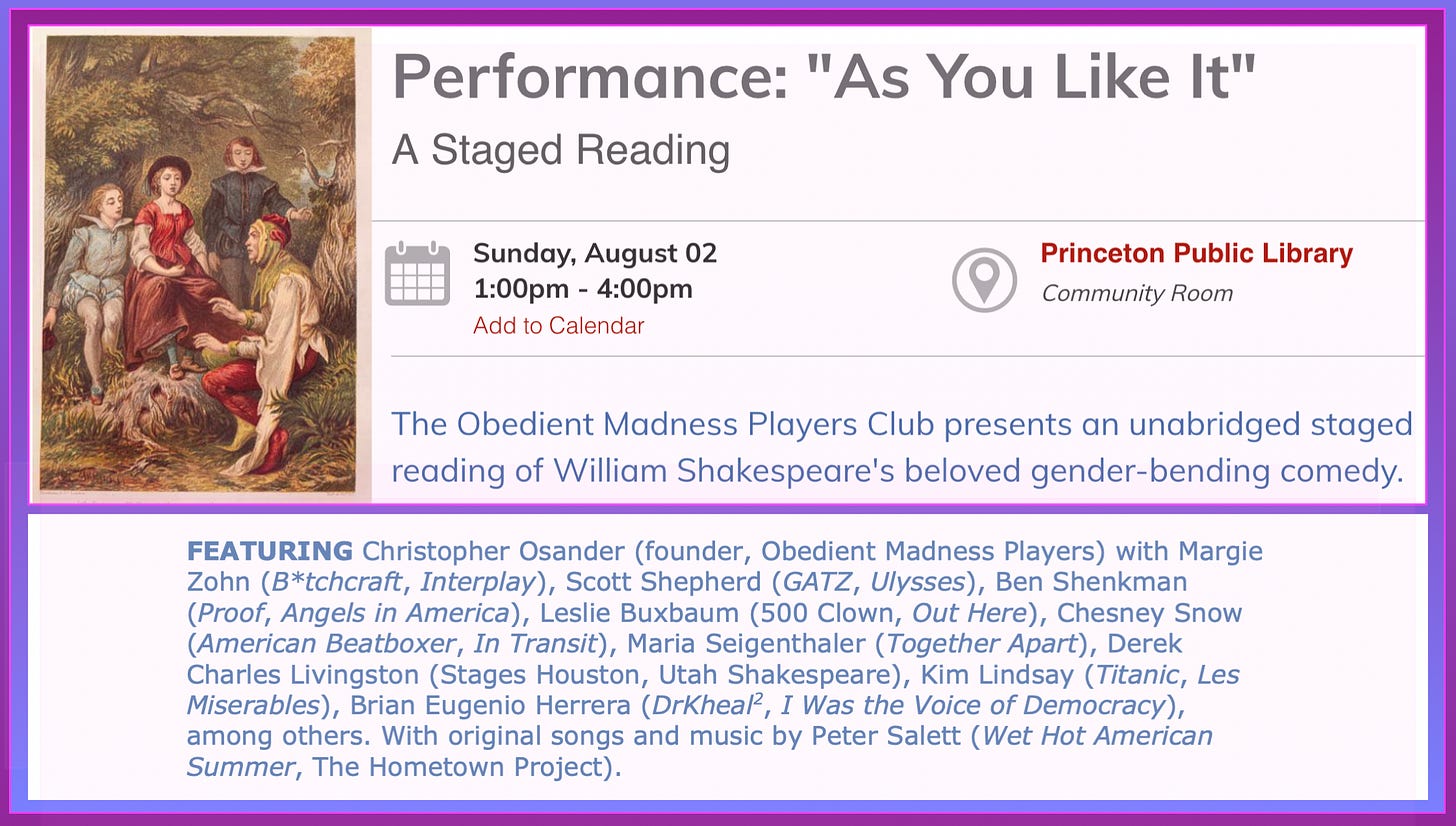
It’s become an annual tradition. As the summer starts to wane, Princeton’s Obedient Madness Players — a motley crew of “players” comprised of professional actors and arts educators and corporate trainers and community organizers and MFA-trained-actors-cum-attorneys — assemble for a richly engaging afternoon reading of the full-text of one of Shakespeare’s most beloved plays. Last year, I was the voice of god (ie the stage directions) for Macbeth; this year, I will be both a duke who thinks he’s a god and an actual god in As You Like It at 1pm on Sunday, August 2. See you there?
Wherein I offer capsule commentaries on what I liked best (or found most compelling) about the shows I’ve recently engaged... A full accounting of my 2026 theatregoing can be found HERE.
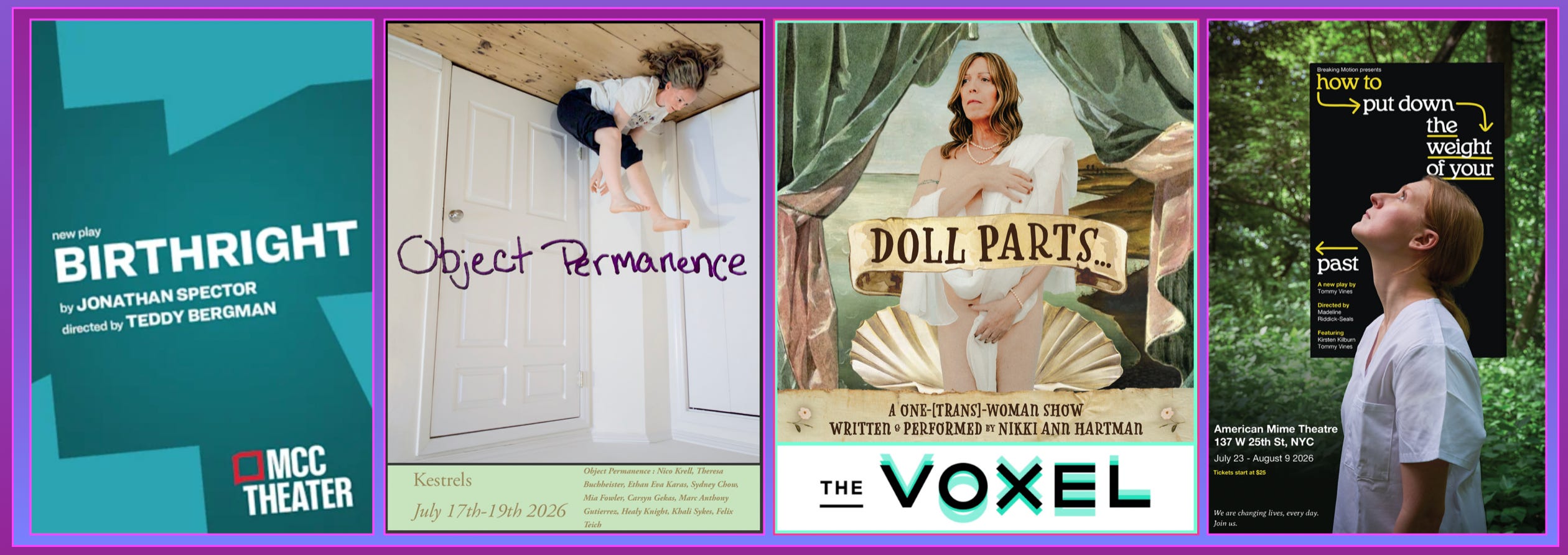
Written by Jonathan Spector • Directed by Eddy Bergman • NYC : Off-Broadway • MCC Theater • July 2026.
Birthright is the third Jonathan Spector play that I’ve experienced. I marveled at both the prescience and the deft dramaturgy of Eureka Day when it appeared on Broadway a year or so ago. Eureka Day stoked my curiosity about Spector as an “idea play” playwright, which I define as a dramatist capable of dramatizing complex social, cultural, political, and/or intellectual ideas through the crafting of complex, nuanced, and engaging characters interacting within and through compelling circumstances. Of course, nearly every playwright works through ideas in their plays but very few — George Bernard Shaw, Lynne Nottage, Stephen Sondheim, and Branden Jacobs-Jenkins all come to mind — are reliably capable of activating (and illuminating) big ideas and big gratifying drama in equal measure. My experience of Spector’s This Much We Know tempered my curiosity a touch but then Spector followed up with Birthright, a play that secures him in my theatregoing heartmind as one of the playwrights to always attend to for the foreseeable future. I won’t go too much into the details of Teddy Bergman’s expert production — for more comprehensive reviews, see the many pieces linked to in my See Also section below — but I will try to parse why Spector’s play so moved me. First, the play’s activating narrative scenario: we catch decadal glimpses of a group of young people, sutured into a forever form of friendship by a galvanizing experience in early adulthood, as they grow and mature through their twenties and thirties, a period that just happens to coincide with the first twenty five years of the 21st century. This kind of narrative structure is like catnip for me and Spector — abetted by a uniformly extraordinary ensemble of actors — crafts six (or seven, depending on how you count this cohort) variously interesting (and annoying) characters worth listening to. Next, building on Eureka Day’s much-commented-on social media conceit (in which the hilariously unhinged comment section of a zoom meeting derails a well-intentioned conversation), Spector — with the expert support of projections designer David Bengali — somehow finds a way to deploy text chains, video calls, and smartphone reliance in ways that are both “realistic” and dramaturgically dynamic. (There is a smart scholarly essay to be written about how the dramatic rhythms of each of Birthright’s three acts are themselves inflected by the shifting modes of technological engagement in the first three decades of the 21st century.) And finally? Spector’s Birthright deploys “the drama” not only as a space for attentive, critical listening to and through disagreement, but also as a space for encountering moments of ineffable wonder at the major and minor miracles of human experience. For me, encountering such moments of wonder is the essence of theatrical catharsis and Birthright offers (and earns) its moments of wonderment with grace and generosity. Is Birthright a perfect play? Of course not. A necessary play? Perhaps. Do I “agree” with Birthright’s representation of one of the most painfully fractious intracultural schisms of our contemporary moment? Yes and no… and yet I do affirm that there is an abundance to celebrate in Jonathan Spector’s Birthright. Here’s hoping its many generous provocations may continue to be shared far beyond the constraints of this necessarily limited initial run.
See also:
Vulture’s Sara Holdren admires Spector’s deployment of “writing as character, not as megaphone” in this “humane and capacious new play [that is] more deeply interested in its characters than its issues [and that] remains, in spite of everything, doggedly hopeful for them”;
at Theatermatters, scholar/writer/dramaturg Jonathan Kalb praises Birthright’s “emphasis on heterodox flexibility, on the essential importance of drawing the widest possible circle around types of American Jewishness [which] lands like a fortifying breeze right now”;
at Engaging with Melodrama, dramaturg Susana Kuhn reflects on how Birthright is “not a play that changed my world view [but one that] did create space to think deeper about issues that usually skim the surface of my mind”;
at his eponymous substack, theatre scholar/writer Derek Miller shares what “began as a critique of Birthright, but turned into a meditation on the play and its exploration of Jewish identity.”
Created & Directed by Nico Krell • NYC : Off-Off-Broadway • Kestrels BK • July 2026.
In Nico Krell’s original dance theatre piece Object Permanence (“a half-silent play based on true events”), an ensemble of seven dancers manifest a world defined as much by silence and alienation as by intimacy and interconnection. The description of the show gives some cue to the dramatic scenario — in a household where every sneeze is dangerous… seven siblings turn silence into an art form; their captors want perfect stillness but the siblings master the choreography of silent communication — but Krell’s production offers little exposition for the panicked-yet-lethargic world that unfolds, on a sharp angle, among these seven bodies in the Kestrels BK space. Limbs flop. Heads droop. Elbows jut. Some backs bend to become reverse somersaults. Others lengthen to a headstand. Some bodies intertwine. Others assert the boundaries of self-isolation. Everyone tenses when the door opens or closes. Everyone tenses when that one girl keeps trying to peak from behind that windowshade. Everyone tenses. Every one tenses. Every one senses everyone at all times. The experience of Object Permanence is one of woozy acuity — a distillation of the experience being on alert at all times to all things even as the thickness of fatigue, of sleep, of dream threatens to pull you…somewhere. Put another way: it’s a wildly unsettling sixty or so minutes. And what tweaks the experience toward unreality even more is the deceptively simple device Krell uses to mark scene transitions. Instead of flicking a light switch to effect a conventional “blackout” to allow the onstage performers to reposition themselves, Krell’s preshow intro asks that the audience participate in approximating a blackout. Krell explains that a series of two handclaps will, first, cue the audience to close their eyes, while the second will prompt them to open them. And as the piece began, I dutifully performed that task — doing my damnedest to close my eyes on the first clap, opening them only when I heard the second. But almost immediately, in what I suspect was not an entirely atypical experience, I completely lost track of which clap was the first and which was the second. (I tried to clock the eyelids of my fellow audience members to see whether I was in or out of synch, but that was no help whatsoever.) But then I also found my eyes reflexively opening, even when I knew they were supposed to be closed, anytime I was startled by a sound or a palpable shift in energetic movement. And, yeah, sometimes I just felt like keeping my eyes closed, or open, just because. But even though I violated the rules of this handclap-blackout-audience-contract (or perhaps precisely because I did so), I soon found myself tuning even more into the woozy acuity of it all. Perhaps because like these characters (?) on stage, I never fully knew what was going on, nor did I have a clear sense whether what I was doing was correct or incorrect in terms of the rules of this particular game. So I just started tracking my intuitive response to the personae of each member of the onstage ensemble. Who was I inclined to trust? Who made me feel happy? Who did I just enjoy watching? Who made me nervous? Who did I worry for? I’m not sure I completely understood Object Permanence. (That’s a lie. I most emphatically did not.) But I did have a visceral, brain-bend of a response to the artistry, emotion, and ambition at play within and through the piece. In short, Object Permanence proved a fascinating, gratifying, and perspective-altering experience served by the remarkable mind of one the most reliably compelling director/devisers working today.
See also:
on TikTok, theatre influencer/advocate Grace Walker offers a thorough and nuanced reflection on the complexity and impact of Object Permanence;
[from 2018] at The Arthur Miller Review, theatre writer/scholar Lincoln Konkle reviews Nico Krell’s staging of The Crucible, which stands out as one of the most surprising, illuminating and memorable productions I’ve encountered in the past decade [pdf].
Written & Performed by Nikki Ann Hartman • Directed by Grace Shepperd • Baltimore : The Voxel • July 2026.
Immediately after experiencing Nikki Ann Hartman’s autobiographical solo show, and as my theatregoing companion and I awaited our rideshare back to the conference hotel, I reflected aloud on how Doll Parts… felt, simultaneously, like a throwback to the pathbreaking language and story-driven LGBTQ autobiographical shows of the early 1990s but also as a show that — both technically and topically — could only happen in the now of the later 2020s. As I’ve thought about the piece over the last few days, I’m realizing that this duality might explain why Hartman’s Doll Parts… — even in this early, somewhat unruly, and slightly overstuffed production —continues to reverberate so for me. Summarized simply: in Doll Parts…, veteran theatremaker Nikki Ann Hartman reflects forthrightly on the many absurdities attending her experience of gender transition later in life. The piece is comprised of (I think) six semi-distinct monologues, overlain as loosely connected passages in a captivating ruminative mosaic. Hartman’s lilting voice — feathery when reflective, spikier when “bratty” — loops us through the elliptical swerves of her experience of becoming. Some of the passages edge toward the conceptual, as in the final section where Hartman utilizes The Voxel’s extraordinary capacity for dynamic, immersive projection to invite us to reconsider “our” place in the solar system. Other sections are more pointed — as in one very funny early passage where Hartman giddily demonstrates the delicious perversity of knitting, or as in a later section in which Hartman jarringly enacts the anxiety of displacement (cognitively, emotionally, politically, medically) infusing her experience as a trans person in the U.S. right now. I was perhaps most taken by the piece’s second passage, in which Hartman ponders the vicissitudes of embodied memory in her aging and transitioning body. Hartman’s remembrance of an early encounter with Georg Osterman (performing in Charles Ludlam’s Camille) vividly distilled the polymorphous pleasures of 1970s genderf*ckery while also opening the layers of self that brought Hartman to this moment in her being. One breathtaking line — it went something like “appeared at the edge of my vision, like the memory of something that hadn’t happened yet” — suggested Hartman’s capacity for truly captivating language. Likewise, Hartman’s tendency to toy with multiple meanings of a word or phrase in a quick series of lines and sentences kept my ears on happy alert (and made me wonder if having Hartman on mic might amplify the linguistic nuance of much of the writing). Indeed, my interest in Hartman’s writing made me wonder whether I wanted this piece to be a work of audio theatre but that’s for Hartman — a distinguished multi-disciplinary theatremaker with decades of experience — to decide, not me. But Doll Parts… stands as an enthralling work of autobiographical performance, as poignant as it is provocative, as personal as it is political — and one that I hope and trust will continue to grow into itself as Nikki Ann Hartman’s own journey of becoming continues.
See also:
TheatreBloom’s Amanda N. Gunther talks at some length with Nikki Ann Gunther about developing her “one-[trans]-woman show about memory, becoming, and transitioning gender in later life”;
at Bmore Art, playwright Tim Paggi appreciates how Doll Parts… “succeeds due to Hartman’s nuanced performance, and keeps its audience on its toes by throwing tonal curveballs.”
Written & Performed by Tommy Vines • Directed by Madeline Riddick-Seals • NYC : Off-Off-Broadway • Breaking Motion @ American Mime Theatre • July 2026.
As you enter the performance/studio space at American Mime Theatre (a lovely intimate venue I had no prior experience with) and take your seat for How to Put Down the Weight of Your Past, you are asked to do four things: 1) write your name on a “Hello My Name Is” sticker with a sharpie marker; 2) write on a tiny piece of paper a brief description something heavy that you’re carrying that you’d like to put down1; 3) put that piece of paper in a clearly labeled box at the center of what appears to be the stage; and 4) select your seat from one of three angled rows, separated by a center aisle. While you are assured that whatever you write on that piece of paper will not be used in the performance that follows, it remains unclear as which — if any — of these decisions (name, paper, seat) might become part of the proceedings. Indeed, as I sat at the far house-left edge of the front row (so I could have the option of resting against the side wall), I had no idea that my seat choice would prove consequential. I did, however, notice the warning projected along the top edge of the playing space: You really shouldn’t go to an “experimental” “immersive” “show” in New York City. I was amused by the fact that, whether by accident or design, these three words — experimental, immersive, show — each had their own set of scare quotes. Which, inevitably, stirred me to wonder: what do each of those words mean anyway? do they mean anything anymore? do they mean anything in the context of NYC performance right now? and why not “New York City”? But then actor/writer/producer Tommy Vines took the stage and began the show. Billed somewhat incongruously as “an experimental new self-help class,” How to Put Down the Weight of Your Past read to me more as a terrifying excavation of the existential horrors of one (every)woman’s quarterlife crisis. Perhaps because Tommy Vines is such a compelling physical enactor of wordless fear, I kept thinking of how excellent she would be in a horror movie, ideally one directed by one of the rising cohort of feminist horror directors. But How to Put Down the Weight of Your Past is not a genre film. It is an intimate “experimental” performance piece with no shortage of “immersive” and interactive moments central to the “show.” And, perhaps unfortunately, I was tapped to be a scene partner for a particularly discomfiting scene that began with Vines saying to me “I’ll never forgive you for what you did” and my being scripted to reply with a line accusing her of being some kind of — maybe heartless? — “b*tch”… Perhaps because I had been thinking of the projection’s particular use of “quotation marks,” perhaps to register my resistance to being so interpolated in the performance, perhaps to disidentify from the lines I was nonconsensually tasked to speak, I noted the presence of quotation marks in “my” scripted line and so included “quote/end-quote” as as I spoke it. (Here, I’m reminded of the much more welcoming and friendly strategies for audience dialogue-participation modeled in my experience of Every Brilliant Thing and Heated Rivalry: The Unauthorized Parody Musical.) To be sure, other audience members were so drafted, in various ways, throughout the performance. Though from my audience of mostly GenZ men and elderGenX/earlyBoomer women), the older folks were more likely to be so impressed into service. But once I was so unceremoniously yanked “in” to the performance, I checked all the way “out” of what remained. Such are the “experimental” risks of nonconsensually “immersive” techniques when a generally-friendly theatregoer like me attends your “show.” Maybe I should have filled out my name tag a little differently: Hello My Name is NO!”
See also:
TheatreMania’s Zachary Stewart underscores how Tommy Vines is “an undeniably gifted physical performer, with a ballet dancer’s control over her body and a clown’s ability to contort her face”;
FrontRowCenter’s David Walters considers How to Put Down the Weight of Your Past is “worth seeing for the nerve of it, even if you leave still carrying some of the weight yourself.”
TRANSPARENCY DISCLOSURES for #260728: I am friendly with Derek Miller and Jonathan Kalb as professional colleagues, just as I enjoy a more neighborly friendship with Jeff Snyder and Anica Mrose Rissi of Owen Lake and the Tragic Loves. Nico Krell and I have stayed in connection and conversation ever since his undergraduate years at Princeton. I attended How to Put Down the Weight of Your Past as a guest of the production and at no direct expense to myself.
I wrote something about not wanting to feel bad about myself for the lack of manuscript morale/momentum I’ve been feeling this summer.
Comments
Nothing yet. Say the first thing.
Sign in to join the conversation.