
WELCOME to #TheatreClique — my emphatically intermittent newsletter dedicated to encouraging you to click out to some of the most interesting, intriguing & noteworthy writing about drama, theatre & performance (at least, so says me)…
This Week's #TheatreCliquery:
This installment of #TheatreClique clicks out to pieces that chart what can happen when local audiences alert producers to the perhaps unanticipated reverberations of their onstage choices, how “pay what you can” ticket initiatives do and don’t play out, and the peculiar quirks of “Broadway math.” Plus commentary about my experience of recent productions, including Giulia: The Poison Queen of Palermo, Heated Rivalry: The Unauthorized Musical Parody, The Potluck, and Music City: The Musical. And for this week’s opener, I lift the video for one of my favorite songs from the first half of 2026 — Willow Avalon’s “Hypothetically Speaking” (with Kaitlin Butts) — if for no other reason than I love it and mention it in my comments about one of this week’s shows.…and if clicking the embedded image below routes to an error message, try clicking here.
EDITOR’S NOTE: whenever possible, whenever linking to paywalled pieces, I try to “gift” the article to #TheatreClique readers. In other words, clicking out to articles in the New York Times, Washington Post, Philadelphia Inquirer, Atlantic, and Wall Street Journal should neither present hassle nor burn through your current allotment of free views. Here’s hoping more outlets — hello LATimes! hi NewYorkMagazine! yo NewYorker!— adopt similar technologies for subscribers soon... I likewise try to flag when a sign-in/registration is required for access, with the exception of general access sites like MuckRack, TikTok or Instagram. If any obstacles to access to linked materials are particular persistent, perplexing or annoying, please do alert me by replying to this message so that I can adjust accordingly.
#NowClickThis…
Wherein I highlight a handful of the most click-worthy links I’ve encountered in the last few…
The Albuquerque Journal’s Logan Royce Beitmen reflects on how his frank conversation with a director actually led to the removal of a “racially charged prop” — aka a noose — from the current Santa Fe Opera production of The Magic Flute [pdf]1;
at Broad Street Review, theatre writer/producer Gauri Mangala explores what a recent boom in Pay-What-You-Can theater tickets means for Philadelphia for artists and audiences;
at The Next Audience, theatre commentator/strategist Katharine Quinn insists that Cats: The Jellicle Ball “didn’t fail” even though “the [Broadway] math failed the show”;
at TDF, theatre writer/editor Raven Snook talks to mother-son performers — Debbie Gravitte and Sam Gravitte — about their summer starring in two musicals just blocks apart;
at Fourth Wall, actor/producer Matt Rodin reflects on the process of developing and launching their new Theater Games app (my handle? @stinkylulu of course! enter code 7D8-RCT if you want to connect on the app);
and THIS WEEK’S MUST-READ…
at American Theatre’s Rob Weinert-Kendt, with reporting support from independent theatre journalist/critic Nathan Pugh, interrogates what Hana Sharif’s departure from the Arena Stage might “mean, not only for the D.C. theatre scene, but for the national theatre field at a moment of precarity and contraction” and how this turn of events “has ignited a debate about the American theatre’s systemic challenges.”
Continued Adventures in Remote Theatregoing:
Wherein I highlight noteworthy current or soon upcoming opportunities for remote theatregoing.
Pacific Resident Theatre’s The Price via League of Lives Stream Theatre
“Pacific Resident Theatre’s sold-out production of Arthur Miller’s The Price will be available to audiences everywhere through a scheduled captured-live stream. Directed by Elina de Santos and starring Richard Fancy, Scott G. Jackson, Jason Huber, and Dana Dewes, this critically acclaimed production extends access to audiences everywhere during its final weekend on stage.”
matinees stream live 6/18-19 • $35
Thoughts from That One Theatregoer Who Likes Pretty Much Everything:
Wherein I offer capsule commentaries on what I liked best (or found most compelling) about the shows I’ve recently engaged... A full accounting of my 2026 theatregoing can be found HERE.
#101: Giula: The Poison Queen of Palermo
Book, Music, & Lyrics by Jennifer Nettles • Directed by Mary Zimmerman • NYC : Off-Broadway • Perelman Performing Arts Center • July 2026.
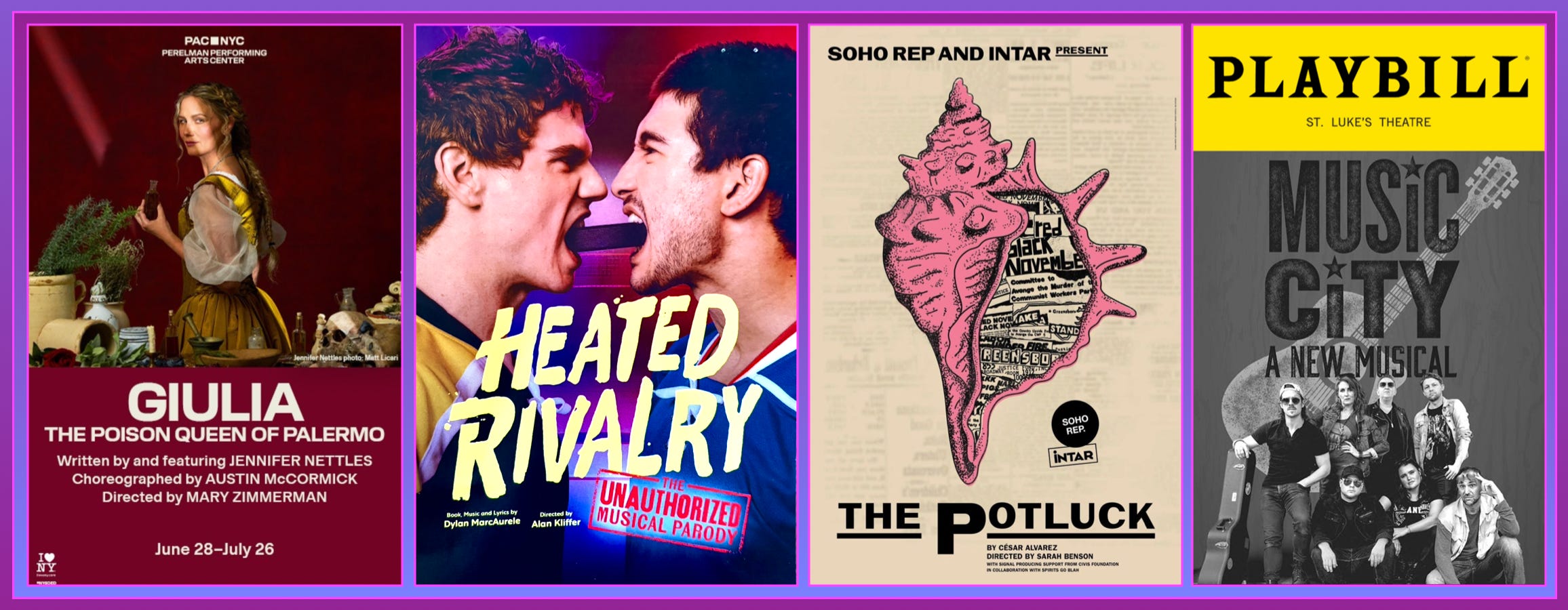
If asked, I typically say that my two favorite genres of music are “Broadway” and “Country.” I sometimes also add “both genres lean into clever lyrics and distinctive powerhouse women vocalists.” So when I learned that country star Jennifer Nettles — who has dipped her toe into musical theatre waters once or twice before — would be writing the music, lyrics, and book for a musical she would also be starring in? I was definitely intrigued. I knew I liked her voice. I had also stumbled across a PBS show that highlighted the artful humanity of her songwriting. But when I finally clocked the title/premise of the show? A musicalization of the legend of Giulia Tofana, — aka “The Beloved Serial Poisoner of Bad Husbands”— a 17th century apothecary reputed to have created an undetectable poison that she sold to scores women who wanted to escape abusive husbands? I was in. (I love a good country gal murder ballad. See above for my current favorite is “Hypothetically Speaking” by Willow Avalon with Kaitlin Butts; or you can listen to my ever-evolving playlist of other faves here.) Under the guidance of esteemed director Mary Zimmerman, Nettles’s first musical is remarkably solid, with a score that balances the heartfelt and the sly with confidence and clarity. Like most of the country murder ballads I love so, Giulia is a proto-feminist parable of women resisting the everyday brutalities of patriarchal violence, treachery, and villainy. The broad narrative strokes of the musical’s storytelling also mirror the genre of country murder ballad, veering between the soaringly sincere (ala Martina McBride’s “Independence Day”) and the archly irreverent (think “Goodbye Earl” by The Chicks). I found this tonal toggle delightful, and even occasionally thrilling. In particular, Zimmerman smartly presents the two male villains in starkly contrasting tonal registers — the Quentin Earl Darrington’s Cardinale elegantly embodies the sublime villainy of the self-serving cleric while Christopher M. Ramirez’s Governatore is downright dastardly in his giddily craven pursuit of political power. Both Darrington and Ramirez deliver delicious performances that aptly counterbalance Nettles’s formidable starpower. (Darrington, in particular, raises the roof in a stunning second act solo.) Thus caught between the powers-that-be of Church and State, Nettles’s Giulia becomes the unlikely leader of what becomes a chorale of resistance, featuring often startling harmonic thrills from the majority-femme ensemble of actor-singers. Giulia: The Poison Queen of Palermo is a thoroughly wild ride — narratively, musically, and even visually. Daniel Ostling’s dynamic scenic design evokes the grand perspectival play of Piranesi’s impossible scenography on one side of the stage, while a series of large doors function as cabinets of continuous curiosity, opening toward an array of often surprising wonder. Like those cabinets, I found Giulia: The Poison Queen of Palermo to be a giddy, stirring, surprising delight but even my fascinated enjoyment of the show did not prepare me to be moved to tears by the show’s anthemic curtain song, “Higher.” And while Giulia: The Poison Queen of Palermo might not be a perfect musical — I mean, really, is Sweeney Todd a perfect musical? — it is an exciting one and — goldarnit — I do love witnessing a smart proto-feminist country murder ballad fervently seize the musical theatre stage the way with Jennifer Nettles made it happen with Giulia.
See also:
at Exeunt, arts writer/editor Loren Noveck affirms that “there is much to love, and much to cheer for, in Giulia: The Poison Queen of Palermo, down to its fantastic “encore” song”;
at The New York Times, veteran culture writer Alan Light talks to Jennifer Nettles about the process of developing a personal, political and provocative pop-eretta about the likes of Giulia of Tofana.
#102: Heated Rivalry: The Unauthorized Musical Parody
Book, Music & Lyrics by Dylan MarcAurele • Directed by Alan Kliffer • NYC : Off-Broadway • The Culture Club • July 2026.
Some while ago a college pal asked me to save the date for a theatregoing venture with her and her now-adult daughter, the idea was that I would pick the show. Then, as the date approached, my friend — somewhat sheepishly asked — “Would it be okay if we went to this new Heated Rivalry musical? My daughter and I both love the show.” And — my dear #TheatreClique reader — as you know better than most, I’m always up for a theatregoing adventure. Even so, my friend’s request forced a confession: I had not yet seen the gay-hockey-players-with-big butts-in-big-secret-gay-sex-love show that had somehow become this year’s breakout streaming sensation. And yet. I had swooned for star Connor Storrie’s (now Emmy-nominated) turn as SNL host, and one of my oldest friends has become a dramaturgical expert on the show, so the time had clearly arrived for me to venture into the world of Heated Rivalry. So I did my homework — bingewatching the series (which I quite adored) the night before — and took the stairs and then the elevator up to the sixth floor of the former home of Sleep No More to see how all that hockey buttplay would play as a musical. At this point, with a nearly sold-out NYC run and with productions soon to open in both London and Montreal, it might come as no surprise that Dylan MarcAurele’s smart, silly, sexy, and strikingly tuneful musical riff is good. Because it is good… quite good, actually… and far better than it needed to be. Indeed, Heated Rivalry: The Unauthorized Musical Parody might just be my new personal exemplar of the “unauthorized musical parody” form at its very best. For MarcAurele embraces the source material with the kind of love that only camp can give: a deep dedication to both the profound integrity of the work and to its utter ridiculousness. And it is such sincerity that is at the root of camp — a sincere adoration (I love this!) counterbalanced by an often giddy, sometimes perverse, but also sincere alertness to the absurdity of the situation (I can’t believe I love this!). Such sincerity anchors both Jacob Tierney’s adaptation of Rachel Reid’s novels for television and MarcAurele’s lovingly parodic elaboration of that world on the musical stage — which is why, to my mind, Heated Rivaly: The Unauthorized Parody Musical works so well as both a parody musical and as a standalone musical comedy entertainment. But it is Alex Kliffer’s nimble direction and the formidable cast of five that truly makes it work. As the dreamy down-low doofuses, singer/actors Jay Armstrong Johnson and Jimin Moon put their Broadway-hewn belts and bods into thrilling service. (This adaptation has a bit of a crush on Moon’s Shane, who makes the character even more awkwardly adorable than the series.) As “Main Susan,” a bewigged Ryann Redmond hilariously anchors the show’s primary conceit, the midwestern wine moms who are the core fan base for this hockey buttboy lovestory; Cherry Torres sings her face off in my favorite bit from the show as “Maria the Character who Only Says ‘Girl’”; and Ryan Duncan ably activates a whole b-plot love story with someone from the audience. And though I tend to find some laughs in a well-conceived parody musical — see, as example, my appreciation of Don’t Vape! and Exorcistic! — I don’t think I’ve ever smiled all the way through one, let alone swoon the way I did for Heated Rivalry: The Unauthorized Parody Musical. Just call me Susan, I guess. (Oh! I should mention that my college friend — who created an apparently quite successful workshop at her church for parents wanting to talk to their kids about sex in which she showed the first episode of the Heated Rivalry series in the church parlor — also loved the musical. She’s also game to offer said workshop for your church, your parent organization, or your community. Contact me for her details if interested!)
See also:
TimeOut’s Christina Izzo talks to Dylan MarcAurele about the high-speed process of adapting the horny hockey romance for the musical (parody) stage;
TeenVogue’s P. Claire Dodson considers how Heated Rivalry: The Unauthorized Musical Parody “didn’t need to be as funny or as well-acted as it is” but, by being so, “cements the power of the TV series and sets the stage for whatever comes next”;
and at BoyCulture, independent culture writer Matt Rettemund reports on how he “went from being a guy with zero expectations to one with zero reservations” about Heated Rivalry: The Unauthorized Musical Parody.
#103: The Potluck
Book, Music, & Lyrics by César Alvarez • Directed by Sarah Benson • NYC : Off-Broadway • Soho Rep @ Playwrights Horizons (Peter Jay Sharp) • July 2026.
I’ve encountered a number of tut-tutting responses to César Alvarez’s new musical The Potluck that compare it to the same handful of recent-ish musicals — A Strange Loop, Tick, Tick… Boom!, [title of show]— all of which use the process of writing a musical as a narrative frame, as if this device has been somehow worn out from overuse. (One critic even called for “a moratorium on meta musicals about the act of writing a musical.”) At first, I couldn’t at first put my finger why these dismissals so frustrated me. I mean, The Potluck is a para-biographical meta-musical that confronts the im/possibility of discerning knowable truths in an age of alternative facts. Yet I wondered why other musicals about making musicals (A Chorus Line, Smash, Curtains, Gutenberg! The Musical, The Producers, 42nd Street, etcetera) weren’t the part of the purported problem, and why musicals about making music (Dreamgirls, Once, School of Rock, Bandstand, Harmony, Buena Vista Social Club, etcetera) were somehow exempt. But as I built this list of contradictory comparands, I realized that my appreciation of The Potluck operated from a different premise. Yes, The Potluck is a “first person musical” but it’s not so much a musical “about” writing a musical as it is a portrait of one artist’s reckoning with how their artistry connects them to their ancestry. For me, then, The Potluck lands somewhere smack between Heather Christian’s Animal Wisdom and Act 2 of Sunday in the Park with George. Put another way, The Potluck is a deeply personal and ruminative musical ritual/seance that interrogates the knowability of history, even (or especially) when that history is one’s own ancestry. Rooted in an historical event — the 1979 Greensboro Massacre — that has not only overdetermined César Alvarez’s life but also, arguably, stands as an inceptive event in the activation of the contemporary US alt-right movement, The Potluck offers a resonant reckoning — politically, musically, historically, theatrically, spiritually — with the potential, power, and purpose of art-making in times of crisis. And the musical’s title cues its structure: what will César — who is named for two of the murdered — bring to the annual potluck honoring these lives, their legacy, and the anti-capitalist, anti-fascist work still left to do? How can a musical be an adequate offering? But as the musical unfurls, in a swath of varied sonic and theatrical modalities, The Potluck manifests the necessarily unpredictable synergies that infuse nourishing collaborative co-creation. As GenX César (the brilliant vocal alchemist Anthony Alfaro) works with their GenZ “intern” Moss (played with prickly precision by Jasmine Rafael) the imperative of intergenerational conversation (and mutual mentorship) becomes clear. Likewise, César’s consultations with their activist-organizer parents emphasize the distinct yet essential skills of community organizing. (Mom — as played with acerbic tenderness by Barbara Walsh — always attending to the particulars of what to bring, what to do, and who will be where, while Dad — the attentively curious Rubén Flores — is inclined to focus on the one-to-one connections. Each of these Broadway vets offer a stirring second act solo that distill their parallel wisdoms.) With a saxophonist and a percussionist and the inimitable El Beh interceding at crucial sonic and emotional junctures, a central quintet of actor-musicians provide The Potluck’s musical infrastructure before stepping forward as the conjured presences of the Greensboro Five: Sandi Smith, Mike Nathan, Bill Simpson, Jim Waller, and Cesar Cauce (played respectively, and with forthright acuity, by Dionne McClain-Freeley, Zack Segal, Andrew R. Butler, Jacob Brandt, and Gían Pérez). Sarah Benson’s direction and Emily Orling’s design deftly meld The Potluck’s striking melange of styles — scenes that edge toward microrealism abut fantastical rave-like dance breaks; a live-film performance lecture and an old school protest march each encircle the theatre — with César’s constant internal excavation of the peculiar corporate, capitalist machinery of “a musical.” So, yeah. Don’t be dissuaded: The Potluck stands as a stunning work of experimental music theatre, as poignant as it is pointed, that invites us into the necessarily ongoing work of understanding our history as we embark together on imagining and making a better world.
See also:
TheWrap’s Robert Hofler celebrates how, in The Potluck, “Cesar Alvarez takes a bloody episode from the past and turns it into the best new musical of the year” (dodge the paywall by reading via Yahoo);
New York Theater’s Jonathan Mandell reflects on the “extraordinary and devastating... journey César Alvarez takes us on [in The Potluck] from intellectual ambivalence to visceral understanding.”
#104: Music City: The Musical
Book by Peter Zinn • Music & Lyrics by JT Harding • Directed by Eric Tucker • NYC : Off-Broadway • St. Luke’s Theatre • July 2026.
If Giulia: The Poison Queen of Palermo tapped into my abiding affection for the pleasures of country music’s distinctive vocals and storytelling potency, Music City: The Musical taps into another of country music’s superpowers: its use of simple, raw musicality to access emotion aka “three chords and the truth.” Music City: The Musical also joins a roster of recent semi-immersive musicals like Beau: The Musical and The Lonely Few featuring actor-musicians set in an off-the-main-strip bar as they try to “make it” even as life keeps complicating and confusing what “making it” actually means. These backroads barrooms tap into the narrative crucible of creative collaboration, stirring stories of unexpected love, familial trauma, the risks of dreaming big, and the capriciousness of success. And Music City: The Musical is precisely, unapologetically, just this kind of musical. Built mostly around songs from the catalogue of songwriter J.T. Harding (who has written or co-written a sizable handful of chart-topping hits for the likes of Keith Urban, Kenny Chesney, Darius Rucker, and Blake Shelton), Music City tells the story of TJ (the adorably charismatic Stephen Michael Spencer) a singer-songwriter working as a barback at The Wicked Tickle, an East Nashville bar. When he can, TJ grabs the bar’s open-mic to sing his own songs, often with his brother Drew (an emotionally vivid Jonathan Judge-Russo). One such night, a scout takes note of TJ’s songwriting and promises to share TJ’s demo with country star Stuckey Stiles (a wily Andrew Rothenberg). To quickly gather the cash needed to make the demo, Drew and TJ decide to run drugs for a local dealer. Bookwriter Peter Zinn uses the brother’s canonically bad idea to kickstart a twisting narrative turnstile that includes guns, drug mules, intergenerational trauma, intellectual property theft, incarceration, quick costume changes, sexual exploitation, twelve step programs, one intermission, military deployment, and the Grand Old Opry. It’s a lot. But it mostly works — thanks to a uniformly charismatic cast, a kicking band, and some consistently ear-catching songs. And central to Music City’s success is the presence and performance of Lauren Lolo Pritchard as 23 (a nickname/cover for her actual given name) who crosses TJ’s path as both a captivating open-mic singer and the daugher of one of the addicts he delivers to. (Like I said, it’s a lot.) As 23, Pritchard’s rich voice and electrifying presence as a singer-actor evinces a different potency from TJ, enabling Stephen Michael Spencer’s own gifts to shine more fully. (Leenya Rideout’s searing vocals as 23’s addicted mom Tammy add haunting poignancy to the story of talents lost, especially in contrast to Rothenberg’s Stuckey, who perfectly distills the glib ease of the “hat acts” so favored by country radio.) Under Eric Tucker’s clarifying direction, the balance of Zinn’s readily accessible storybeats, TJ Hunter’s solidly engaging songwriting, Jane Shaw’s herculean achievement of a sound design, and a kickass cast/band all come together to make Music City: The Musical a undeniably diverting musical theatrical entertainment.
See also:
Theatremania’s Zachary Stewart hails Music City: The Musical’s “radiant charm and ample heart”;
The Knockturnal’s Karen Snyder praises “how naturally Harding’s songs flow through the story…their joy and heartbreak mov[ing] the plot forward while leaving space for the characters’ histories and struggles to unfold.”
TRANSPARENCY DISCLOSURES for #260717: César Alvarez is a friend/colleague/collaborator with whom I first crossed paths at Princeton. Sam Gravitte and I have stayed in connection and conversation ever since his name appeared on my roster of first-year advisees at Princeton. I attended The Potluck and Music City: The Musical as a guest of each production and at no direct expense to myself.
Big thanks to scenic designer Hannah Tarr for bringing this story to my attention.
Comments
Nothing yet. Say the first thing.
Sign in to join the conversation.