

*Please read the disclaimers at the base of this report. The author may maintain a short position in the company (or companies) mentioned below. Does not constitute a recommendation to buy or sell the securities mentioned herein. Do your own due diligence. This report constitutes opinion journalism and commentary and should not be read as investment advice. For Permitted Recipients only (UK - see disclaimers).
Summary
The Iran War has partially damaged and shut-in ~90mtpa of liquefied natural gas exports, or approx. 10x the UK’s annual imports of LNG.
Total UK energy demand remains dominated by fossil fuel consumption
Notably, UK reliance on gas has actually increased since 1990 as a percentage of total UK energy sources
A high and volatile North Sea tax rate, along with misguided climate change legislation has gradually choked off investment in new and existing fields and accelerated decline
The absence of strategic storage or swing gas supply in winter makes us more vulnerable than our European neighbours.
Renewables displacement of gas in electricity generation is modest in the context of overall energy needs
A rethink may be required of how we price and incentivise wholesale gas and electricity
A look at potential winners and losers from an energy price shock going into winter 2026
Since the start of the US & Israel launched Iran war over a month ago much has been written about the UK’s energy costs, and most notably a debate over whether the UK should continue to licence new fields and projects (eg Rosebank and Jackdaw fields in the UK North Sea). Strident voices on the right have called for an immediate return to North Sea drilling (including the ubiquitous Donald Trump!) while equally strident voices on the left (though not the unions) have raised objections. The energy secretary, Ed Miliband believes it is pointless to licence new UK gas fields as gas prices are determined by “international markets”. There are many falsehoods in this debate, however this one is the most egregious.
Lets begin with UK demand and supply of Natural gas:
Source: DUKES report, UK government
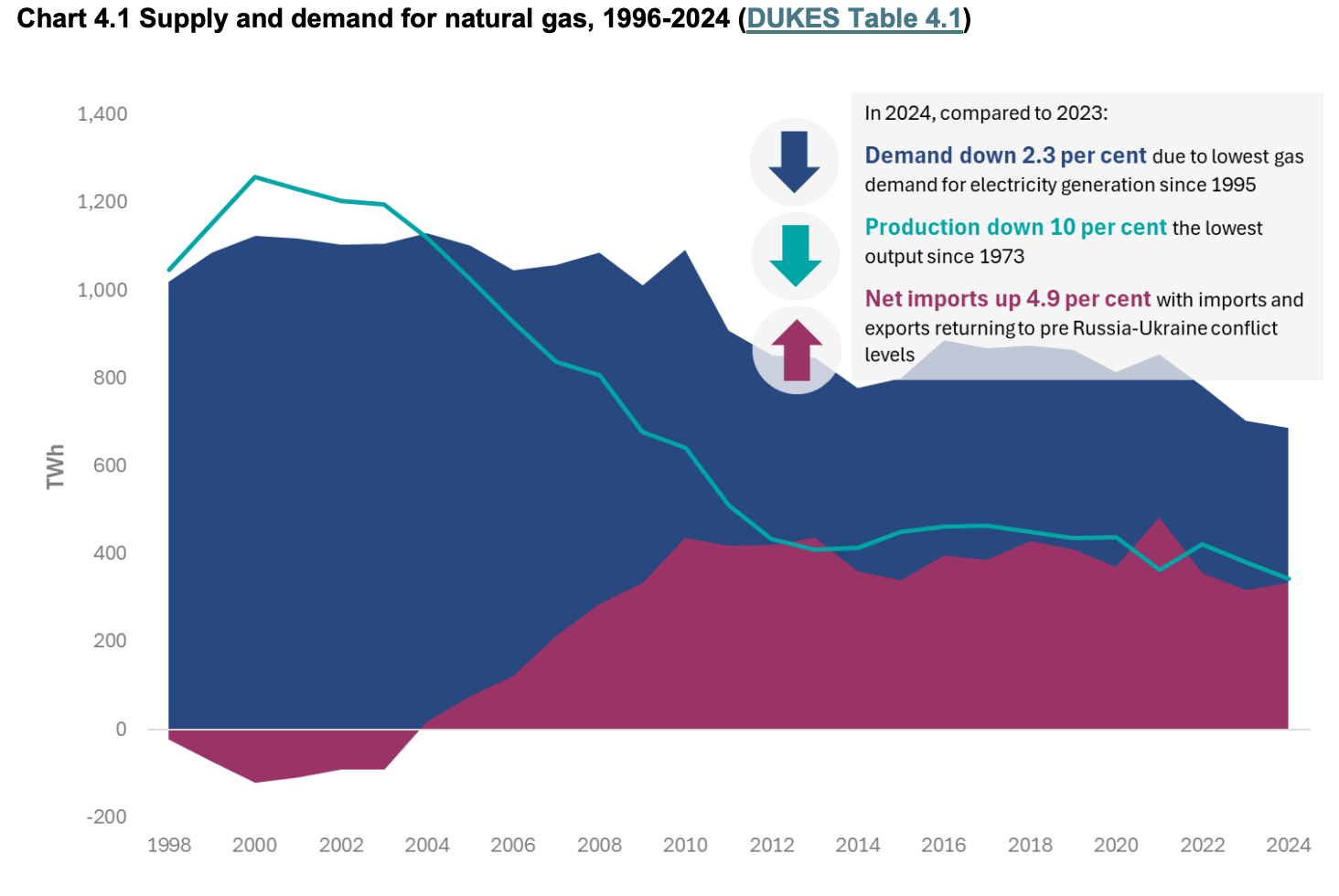
The above graph is from the DUKES report from the government. As we can see, from a position in the early 2000s when we produced more gas than we consumed, we are now in a considerable net import situation, with approx half of our gas needs met by foreign imports. Our own gas production continues to fall by a material amount annually (10% in 2024).
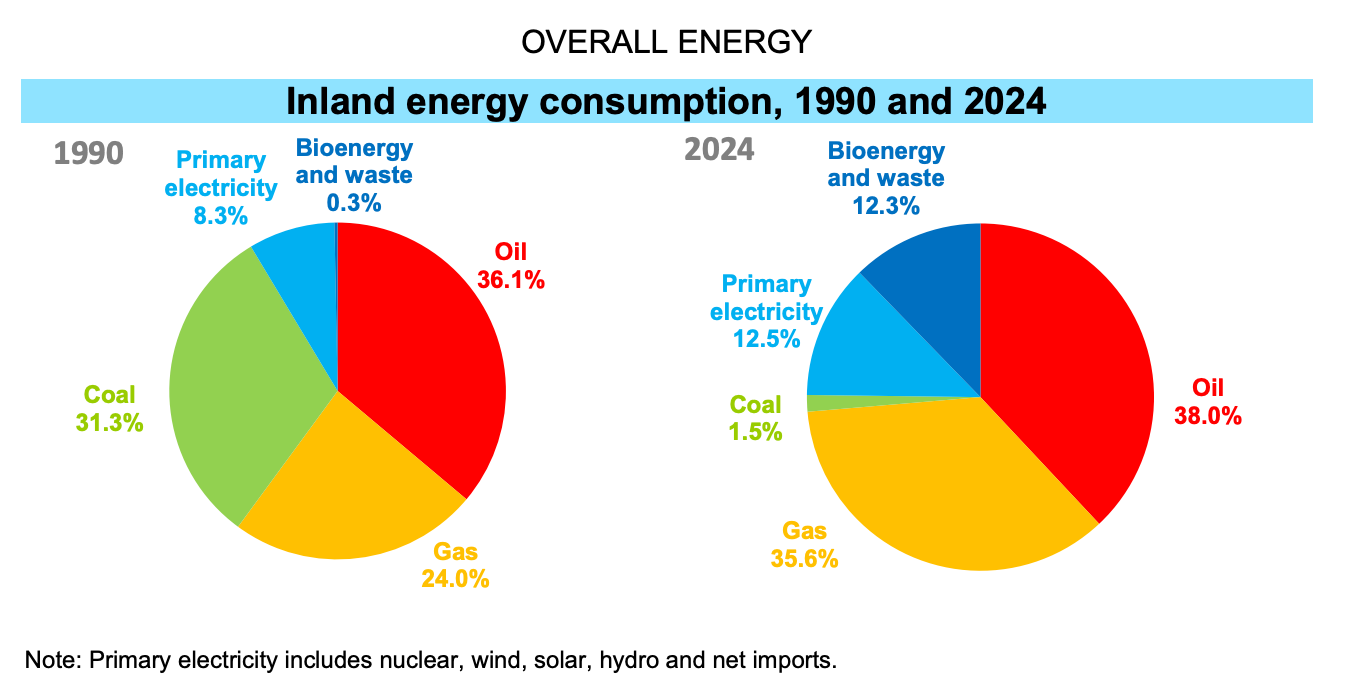
Meanwhile gas as a percentage of total energy consumed (including gas used in electricity generation, and gas to heat homes etc) remains at a high percentage of our overall energy consumption:
Source: UK government statistics
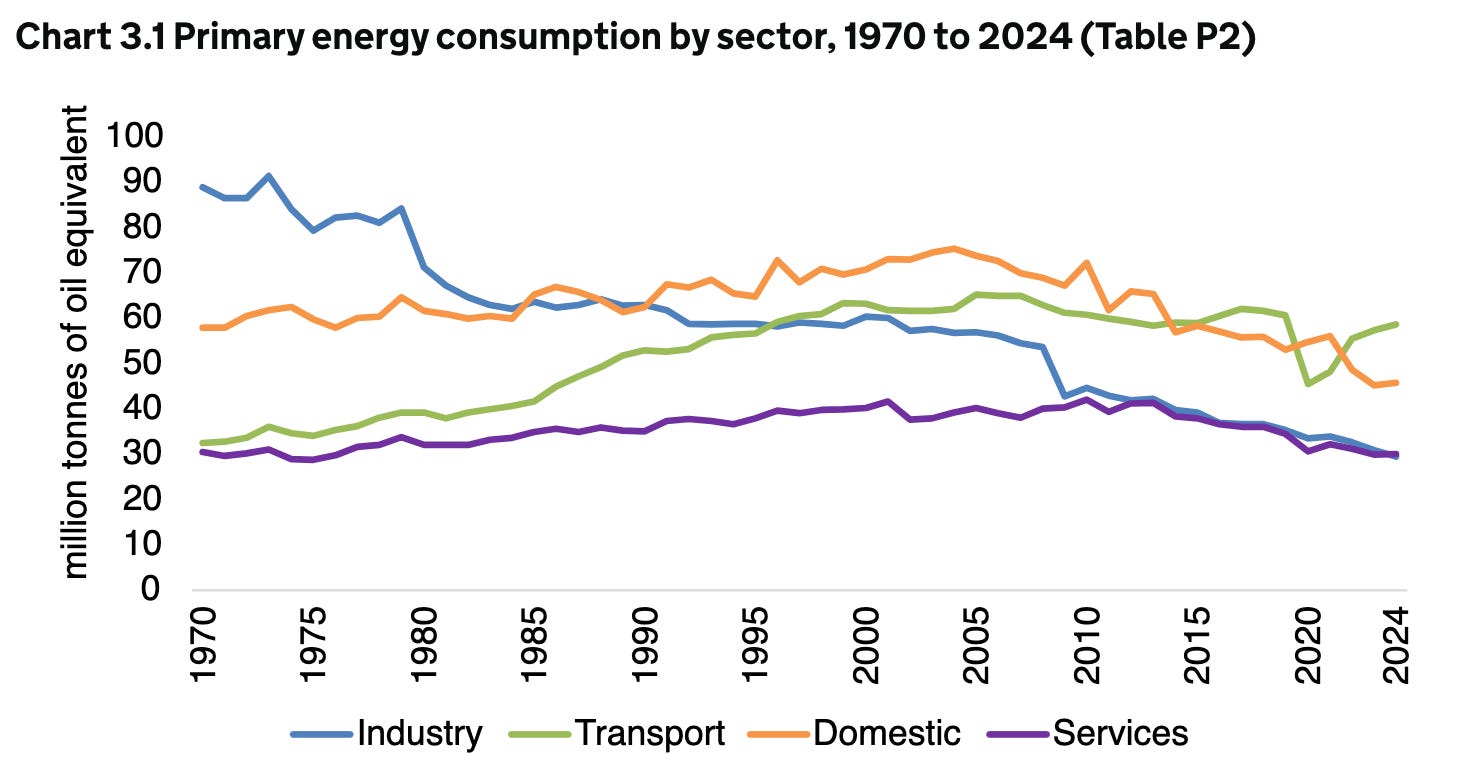
In 2024 gas represented 35.6% of our consumed energy versus oil at 38%. Renewables such as wind and solar represent a tiny fraction of our total energy consumption - perhaps 7%, despite their more meaningful percentage of electricity generation. Approx. 75% of the nations energy requirements are met by fossil fuels. These are not figures you will find mentioned often in speeches by government ministers. In fact the primary reason for reduced fossil fuel consumption in the UK is from overall reduced energy consumption:
Source: OIES
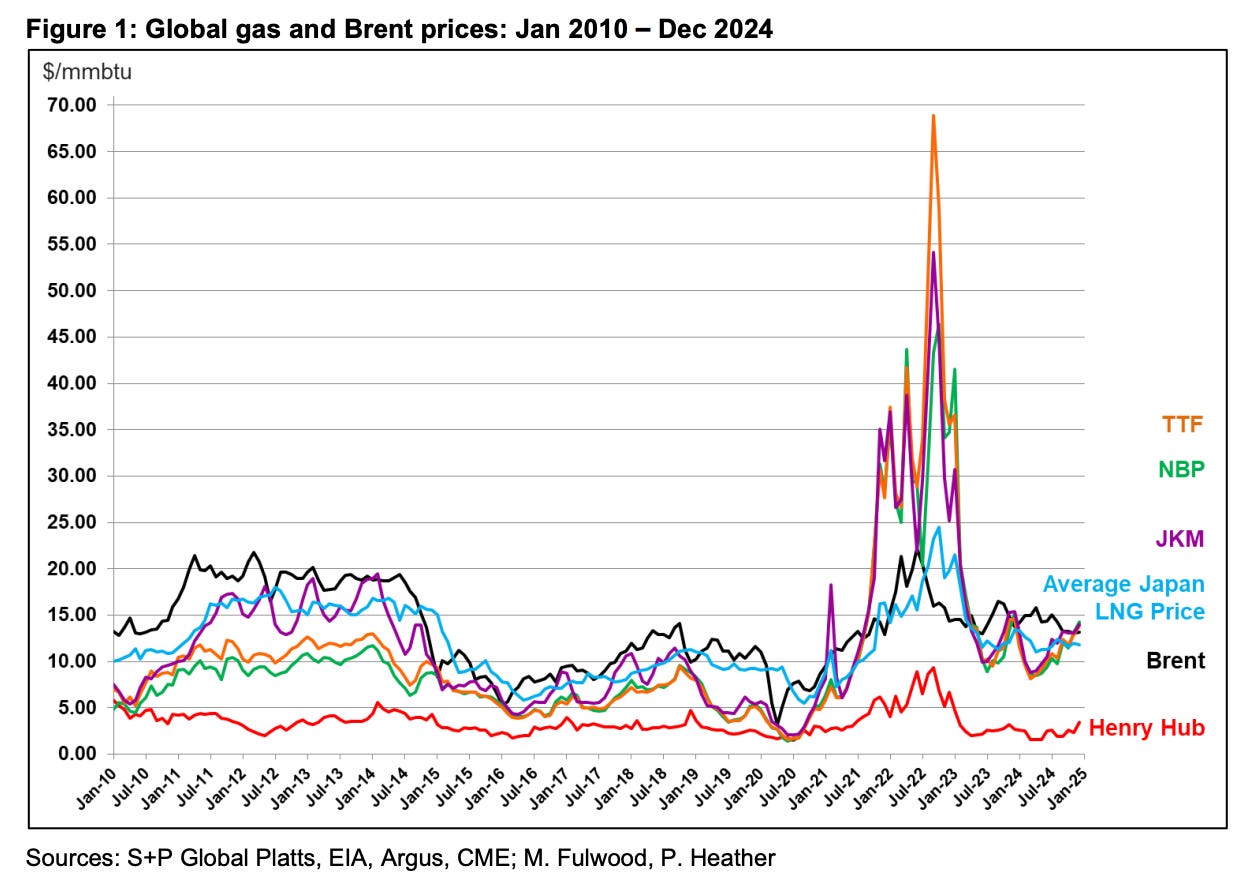
Whilst more efficient homes, vehicles and businesses undoubtedly contribute to a reduction in overall energy demand over the years the move in industry in particular may well be more a function of deindustrialisation, most notable in the late 1970s and early 1980s but also from the financial crisis and onwards. High energy costs (which were notable at the time of the GFC) have continued to plague industry and correlate with deindustrialisation since the GFC. Those high energy costs (especially driven by gas) are divergent with energy costs elsewhere in the world, most notably the US:
Source: OIES report
Note the green of NBP and mustard line of TTF, the two European hub benchmarks and compare even with the price of Japan LNG or JKM in Asia. Historically NBP was much closer to US Henry Hub and at a significant discount to Brent oil (energy equivalent price), whereas now it trades at a significant premium to Henry Hub and at either a modest discount or marked premium to Brent oil. That is a profoundly destructive trend for industrial competitiveness in the UK and Europe. The above chart gives the lie to the idea that there is one “international gas price”, when the reality is that there are regional hubs for gas prices internationally and even within Europe. LNG, which has only in the last 10 to 15 years matured as a tradeable market acts as a marginal supplier in many markets when the local market is gas-short.
In the 1990s the UK deliberately moved away from long term fixed price contracts for gas following privatisation of utilities and British Gas into BG and Centrica. The pipeline subsidiary of BG group became Transco, and ultimately now belongs to a consortium which is now called Cadent Gas. Centrica became a shrinking distributor faced with market competition in distribution while dabbling and then gradually withdrawing from upstream gas, and increasing its infrastructure footprint with the acquisition of the Isle of Grain LNG import terminal. As a result of this evolution, the UK gas supply is essentially linked to spot prices which are in turn linked to the balancing import requirement for LNG, with Gazprom no longer supplying material gas volumes into Europe after its invasion of Ukraine (a 90% share reduction).
In the early 2000s UK gas production was split between associated gas from oil fields and “swing gas” from dry gas fields in the UK North Sea. The swing gas would “swing in” during the colder months of the year as heating demand rose from gas boilers etc. There were no LNG imports and the market was essentially domestic with some gas from Norway and from Groningen in the Netherlands from 2006 (the BBL pipeline).
Below the paywall we cover the history and evolution of UK gas supply, “swing gas”, storage, and the UK’s relatively recent dependence on LNG (liquefied natural gas imports), along with the debate about “international gas prices”, and the winners and losers from a supply impaired UK gas market this winter.
Comments
Nothing yet. Say the first thing.
Sign in to join the conversation.