
You’ve probably lived this moment:
You ship fast. You trim the fat. You make hard calls to deliver something lean.
And then…
Weeks later, you're still explaining to users why it's broken.
Your team is cleaning up rushed architecture.
And the execs? They’re already asking where v2 is.
You didn’t build a Minimum Viable Product.
You built a Minimum Forgettable Patchwork.
The original idea was brilliant.
Eric Ries, The Lean Startup:
“A Minimum Viable Product is that version of a new product which allows a team to collect the maximum amount of validated learning about customers with the least effort.”
Learning.
Validation.
Least effort — not least care.
It was never meant to be a shortcut.
It was a test. A probe. A signal.
But over time, MVP became something else entirely.
At some point, MVP stopped being a smart way to test ideas — and started being the default excuse for shipping incomplete, incoherent, and uninspired work.
What once stood for intentional learning now gets thrown around to justify technical debt, design compromises, and half-hearted roadmaps.
It’s the product world’s get-out-of-jail-free card.
“We’ll fix it later.”
“It’s just the MVP.”
But later rarely comes.
And what we call an MVP is often just the first draft of a future failure.
We broke the MVP.
Not on purpose.
But slowly, collectively — we stripped it of its meaning.
A broken MVP doesn’t just waste a sprint — it quietly erodes trust and compounds risk across the entire product ecosystem. It fails to deliver the one thing MVPs are supposed to offer confidence.
When users interact with a rushed or incoherent MVP, they don’t see a "test" — they see a reflection of your product quality. That first impression sets the tone, even if you had every intention to improve it later.
You teach them to expect mediocrity
They don’t know if what you shipped was “beta,” “final,” or “oops”
You lose the opportunity to make a strong first impression
Broken MVPs take a toll on morale. Your team knows what good looks like — and when they’re forced to ship less, it chips away at pride, ownership, and clarity of purpose.
You burn out developers who know it’s duct tape
You frustrate designers whose work gets gutted for the “first pass”
You teach PMs to optimize for speed, not clarity
When MVPs don’t deliver learning or value, they create waste — and worse, they hide it under the illusion of progress.
You delay learning instead of accelerating it
You make it harder to justify iteration
You confuse activity for progress
MVPs are supposed to be the cheapest way to learn.
Not the fastest way to disappoint.
Checkout the Product Hierarchy of Needs post where I broke down the various phases of a product and the compound impact of products on failing trajectory
It starts by returning to the intent.
Not the buzzword. Not the deadline.
The reason we build MVPs in the first place:
To learn. To validate. To test the waters before we dive in.
That means asking hard but essential questions:
What are we actually trying to learn?
What’s the minimum that still delivers meaningful value?
Who needs to be aligned — and are they?
But even that’s not enough.
Because clarity at the start means nothing
if it gets diluted by the time you ship.
You also need:
A shared definition of success
The discipline to say no when scope starts creeping
The courage to kill the MVP if the learning is already clear
Fixing MVPs isn’t just about better delivery.
It’s about better decisions.
Because if your MVP doesn’t lead to insight or impact,
it’s not an MVP — it’s noise.
Done right, MVPs are powerful.
They give teams confidence.
They help you learn before you burn.
They create momentum — not just motion.
But that only happens when we ship with clarity, not compromise.
If this post struck a chord, checkout my latest eBook about MVPs
📘 Broken by Design: MVP’s Became the Killer of Good Products
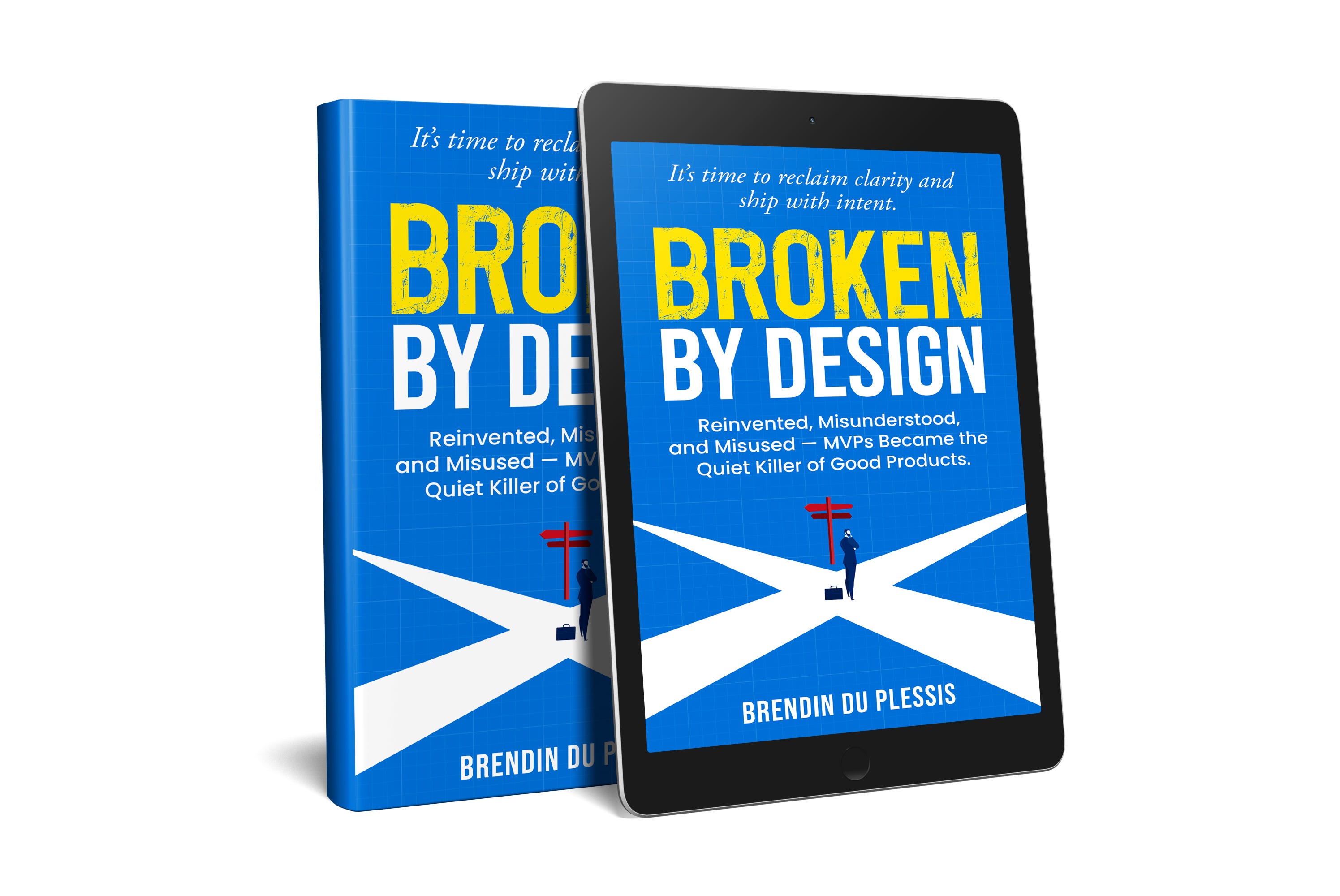
In this eBook I cover:
The two MVP archetypes most teams confuse
The trap of building an “MVP of an MVP” — and how to escape it
Real-world MVP examples across industries
Audit frameworks to fix broken strategies before launch
It’s not a product manual. It’s a mindset shift — one I think we badly need.
The MVP isn’t dead.
But it’s time we brought it back to life — the right way.
👉 Grab your copy here: https://doapm.gumroad.com/l/brokenbydesign/FIXMYMVP
Comments
Nothing yet. Say the first thing.
Sign in to join the conversation.