
In the wise words of Master Oogway:
“One often meets his destiny on the road he takes to avoid it.”
And this couldn’t be more true in product.
You think you’re being careful. Strategic. Making sure everything’s “just right” before sharing it with the team.
But here’s the hard truth: The longer you delay feedback, the higher your risk.
And not just risk of failure — risk of wasted time, lost alignment, emotional over-investment, and stakeholder backlash.
The Hidden Cost of Delay
We’ve all been there.
You start a new idea — maybe it’s a feature, maybe a whole flow.
You want it to be solid before anyone sees it.
So you tinker. You polish. You explore edge cases, perfect your components, finesse your flows…
“I just need to work on this a little more before I show it.”
Another day passes.
Another sprint.
You’re deep in it now.
What started as a lean hypothesis is now a fully fleshed-out solution — and you still haven’t validated whether anyone needed it in the first place.
Here’s the reality check:
~80% of product features are rarely or never used
Only 20% of the features in most apps drive 80% of the value
The average product team spends 50% of their time building features that will be deprecated or ignored within 18 months
So yes, that thing you’re perfecting might never even matter.
Feedback isn’t a formality — it’s a survival mechanism.
Time vs Investment = Risk
Let’s break this down.
There’s a direct relationship between how long you wait to share and how much you invest — mentally, emotionally, and even politically.
More Time → More Investment → More Risk
You start defending your design instead of discussing it.
You internalise feedback as personal critique.
You resist pivoting because so much has already been done.
Worse? If you’re off track, you’re now deeply off track — and changing course comes with friction, frustration, and rework.
Why Fast Feedback Loops Work
The goal isn’t to get it perfect. The goal is to get it directionally correct — fast.
When you show early:
You calibrate quickly.
You reduce emotional attachment.
You bring others into the problem-solving process, not just the output review.
Design isn’t meant to be a solo reveal. It’s a conversation. And conversations don’t work if you show up late with a finished speech.
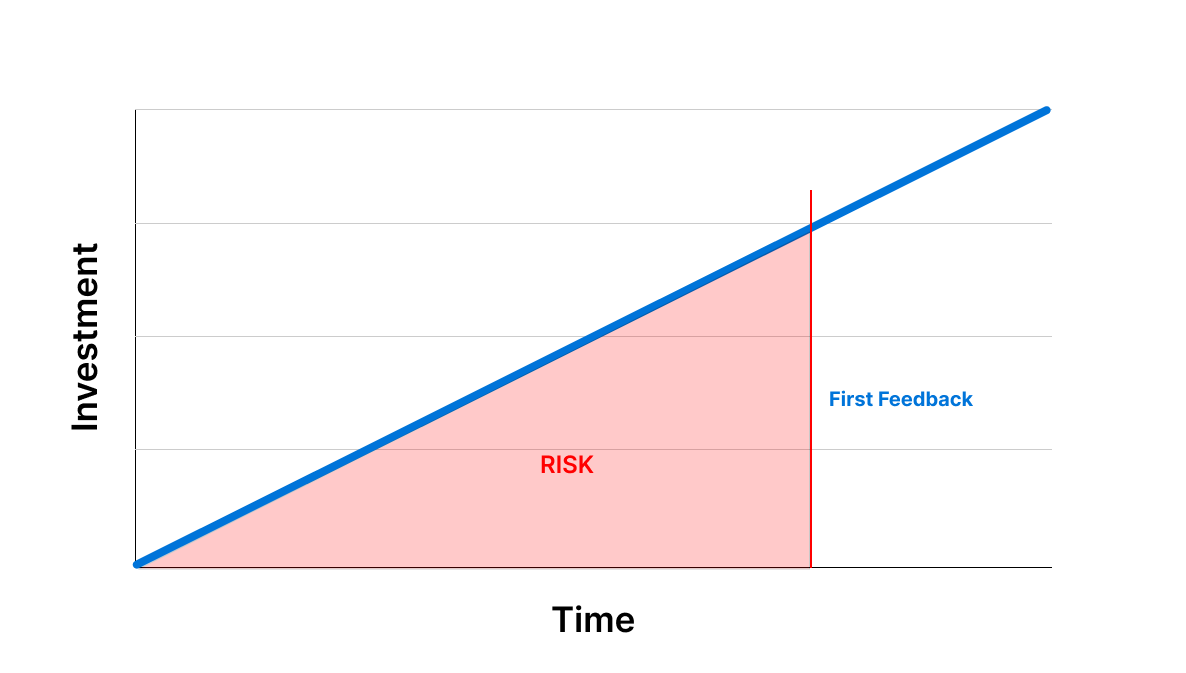
The longer you wait to show something, the more costly feedback becomes.
This isn’t just theoretical.
It’s the reason products get delayed.
It’s why entire teams feel blindsided.
It’s how silos get built — unintentionally.
The Myth of Readiness
Many designers (and PMs, and devs) fall into the “readiness trap.”
“I’ll show it when it’s ready.”
“Just need to clean this up a bit.”
“They’ll take it more seriously if it looks final.”
But here’s the thing:
“Ready” is subjective. Feedback isn’t.
Every day you delay, you’re choosing aesthetics over alignment.
Would you rather:
Spend 4 weeks perfecting the wrong thing?
Or 4 days roughing out the right thing?
What Early Feedback Actually Looks Like
Some people worry that showing too early will trigger surface-level feedback:
“Why is this so rough?”
“Can you make it cleaner first?”
And yes — this happens if you don’t set the frame.
So set it:
“Hey, this is early. I want to check if we’re solving the right thing before going deeper.”
“Not worried about polish right now — just want to pressure test the concept.”
“This is version 0.3 — help me break it before we invest more.”
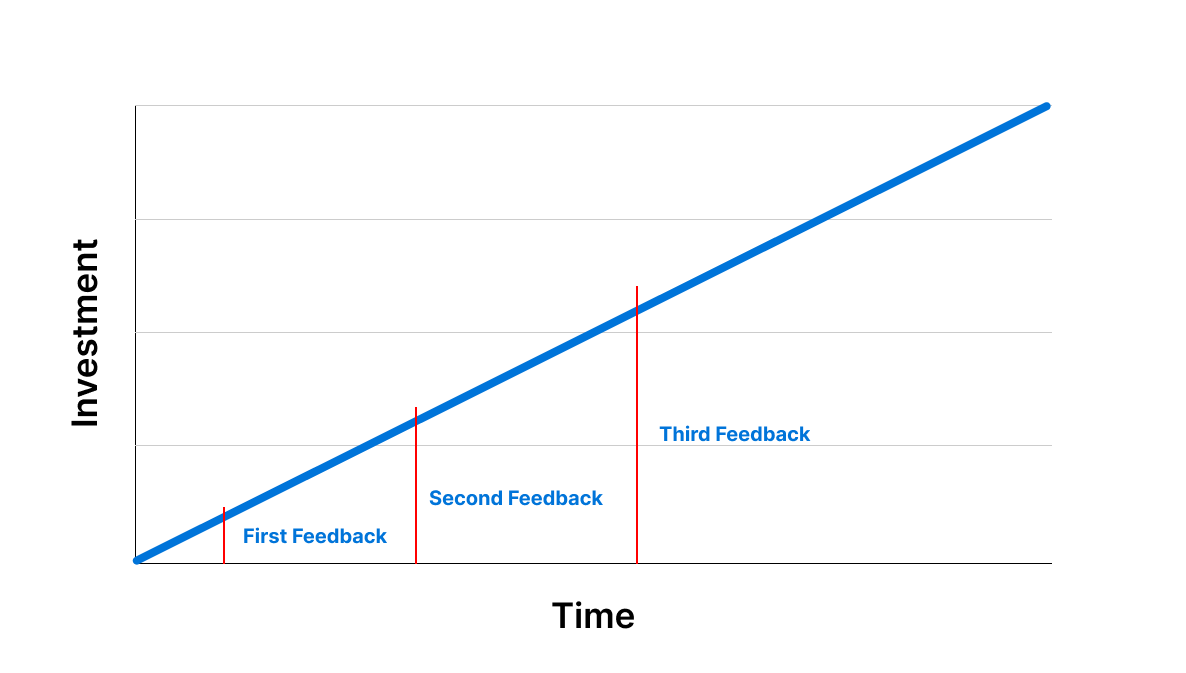
Frame it like that, and you shift the expectations. You’re not presenting a finished product. You’re inviting them into the process. This also significantly reduces the risk of straying down the wrong path and wasting unnecessary time.
The Pivot Gets Pricier With Every Hour
Assume a typical product/design/dev team costs $10,000 per week (conservative estimate for even a mid-size SaaS org).
Now imagine two paths:
❌ Path A: No Feedback Until It’s Too Late
6 weeks building the wrong solution
Followed by 6 weeks to pivot, rework, and realign
$120,000 spent
✅ Path B: Early Feedback at Week 2
2 weeks in: kill direction based on feedback
4 weeks to iterate and build the right thing
$60,000 spent
That’s a $60K difference — just by calibrating earlier.
And that’s not even counting the opportunity cost of the delay to launch, revenue impact, or demoralised teams.
Every week you delay feedback, you increase the cost of being wrong
The truth is, pivots are a normal part of product.
But they get exponentially harder the longer you wait to course-correct.
Your team has spent more hours.
You’ve attached more reasoning and explanation to the current direction.
Your stakeholders have already started picturing the solution as you’ve described it.
And now… any change feels like failure.
But it’s not failure. It’s just feedback that came too late.
Don’t Be Afraid of Scrappy
One of the most powerful things you can do as a designer or PM is to become comfortable with showing rough work.
Your job isn’t to impress — it’s to progress.
Scrappy doesn’t mean sloppy. It means fast. Flexible. Lightweight. It means you’re confident enough to validate thinking before validating polish.
Stakeholders respect that.
Teams move faster because of it. Products get better because of it.
So What’s the Move?
Here’s how to operate with intentional urgency:
👉 Default to early share mode
If you’re more than 2–3 days in, and you haven’t sanity-checked your direction — it’s time.
👉 Own the framing
Set expectations upfront: “This is rough and early. I’m looking for signal, not sign-off.”
👉 Keep looping
Don’t wait to “finish” something before you validate. Build your work like a living doc — not a statue.
Design your own calibration loop
Decide upfront:
What’s the first version I can share?
Who needs to see it?
What am I hoping to learn?
Final Thought: Feedback Is Fuel — But Only If You Use It Early
You’re not a better designer or product person because you went off and built something perfect in a vacuum.
You’re better when you loop in the right people early, often, and with just enough fidelity to learn.
So stop waiting. You’re not buying time. You’re compounding risk.
Every delay you justify in the name of polish is a bet against alignment.
And alignment is what actually gets great products shipped.
If this hit home,
my new eBook “Broken by Design” goes even deeper.
It breaks down the costly traps product teams fall into — like long feedback loops, polishing ideas without validation, and shipping MVPs no one needed. Real examples, practical tools, and tough love for PMs, designers, and founders who are tired of wasting time.
🎯 Grab your discounted copy here
Diary of a Product Manager is a reader-supported publication. To receive new posts and support my work, consider becoming a free or paid subscriber.
Comments
Nothing yet. Say the first thing.
Sign in to join the conversation.