
The at-risk cohort is made up of customers showing clear warning signs of churn—they have low engagement, reduced feature usage, and minimal recent activity. Unlike the concerning cohort, these users are no longer in decline; they are at the final stage before full disengagement.
Understanding and acting on this cohort is crucial because:
Reactivating at-risk customers is cheaper than acquiring new ones – Once a customer churns, winning them back takes significantly more effort than keeping them engaged in the first place.
Identifying their pain points can prevent further losses – Many at-risk customers face similar blockers, and addressing these issues can improve retention for future users.
They may still have interest but need a compelling reason to return – Sometimes, at-risk customers are on the fence, waiting for the right opportunity, feature, or outreach to bring them back.
This cohort requires an urgent and tailored approach. Time is of the essence, and applying the right re-engagement tactics can mean the difference between saving a customer or losing them forever.
When at-risk customers are ignored, churn is inevitable. Many businesses focus heavily on acquisition, but retention should be just as important—if not more so—because losing customers means losing potential lifetime value, word-of-mouth referrals, and upsell opportunities.
A lack of action often results in:
Lost revenue – A churning customer represents money already spent on acquisition that will never yield long-term returns.
Damaged brand perception – Unhappy customers are more likely to share negative experiences than satisfied ones.
Higher costs to replace lost users – Retention efforts are far more cost-effective than acquiring brand-new customers.
The good news? There’s still a chance to save these customers—but only if you take immediate, proactive measures.
To understand the full engagement journey, here’s how at-risk customers compare to other segments:
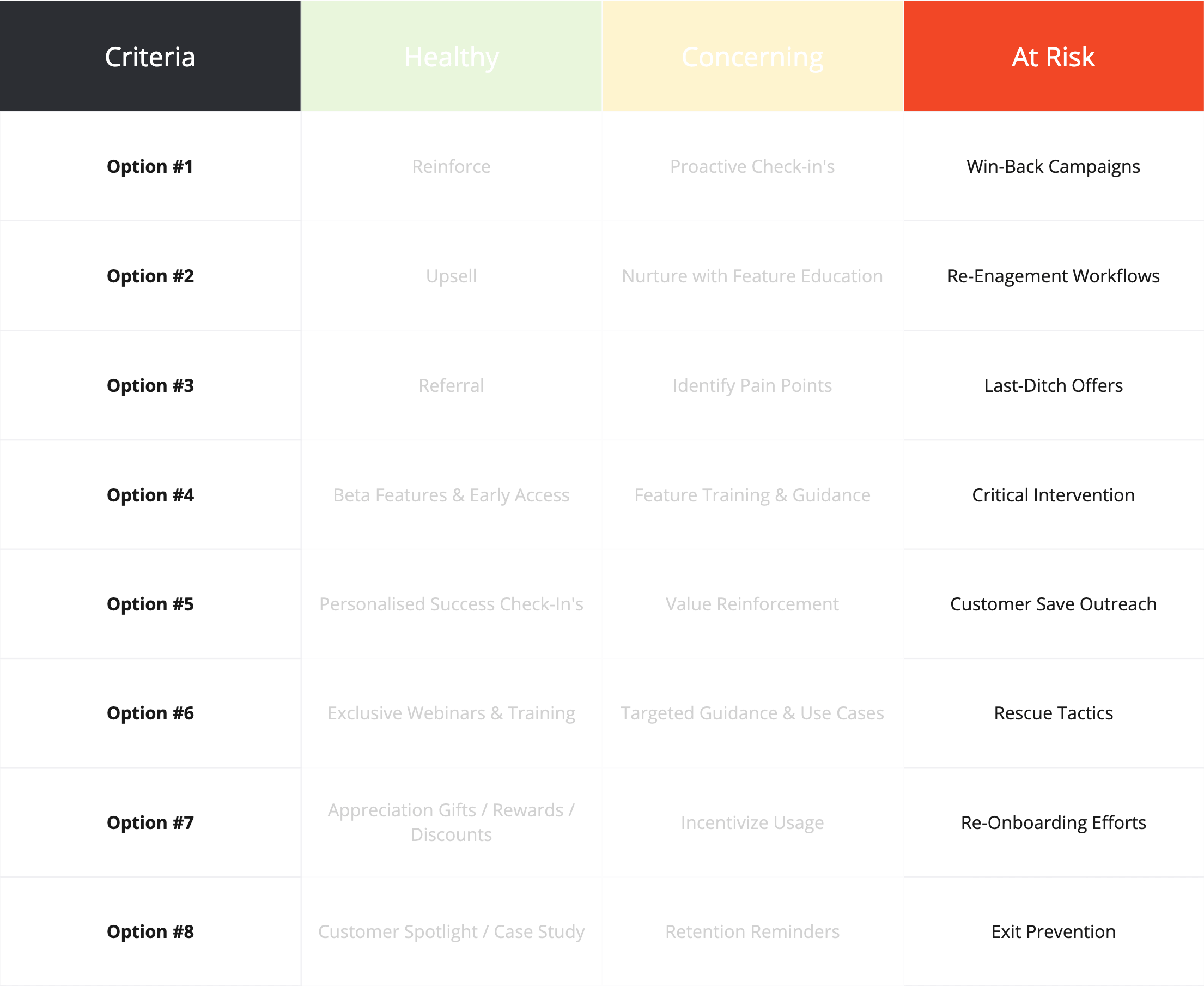
In this post, we’ll focus exclusively on the at-risk column, outlining actionable strategies to rescue customers before they churn.
At-risk customers require immediate, high-touch engagement. Unlike concerning customers, subtle nudges won’t work here. This group needs urgent intervention—strong incentives, personal outreach, and last-ditch efforts to reignite interest before it’s too late. These customers often have specific frustrations or unmet expectations, and without a compelling reason to stay, they will likely leave for a competitor or abandon the product altogether.
To successfully re-engage these users, businesses must leverage hyper-personalized messaging, special offers, and targeted outreach that acknowledges their declining activity and provides a direct path back to value. Every touchpoint should be intentional, urgent, and backed by clear solutions to their potential concerns.
The strategies below are designed to help you re-engage and retain these customers before they become lost for good.
Re-engagement campaigns using personalized messaging, incentives, and time-sensitive offers can spark renewed interest.
Example Message:
Text within this block will maintain its original spacing when published
"Hey [Customer Name], we miss having you around! For a limited time, enjoy [Exclusive Discount/Bonus Feature] to help you get back on track. Redeem here: [Link]"
Automated email and in-app sequences designed to guide customers back into key workflows or feature usage.
Example Message:
Text within this block will maintain its original spacing when published
"Your account has been inactive, but there’s so much more to explore! Here’s a quick-start guide to help you get back up to speed: [Resource Link]"
A strong financial or feature-driven incentive (e.g., extended free trial, price discount, premium feature unlock) to encourage users to stay.
Example Message:
Text within this block will maintain its original spacing when published
"We’d hate to see you go! Renew today and enjoy [X% discount/bonus feature] on your next billing cycle. Don’t miss out: [Special Offer Link]"
For high-value accounts, personal outreach from a customer success manager (CSM) or executive can provide a final opportunity to address issues.
Example Message:
Text within this block will maintain its original spacing when published
"Hi [Customer Name], we noticed you haven’t been active. We'd love to understand how we can better support you. Let’s set up a quick call to discuss your needs: [Schedule Link]"
Identify specific reasons for disengagement and provide tailored solutions to win back the customer.
Example Message:
Text within this block will maintain its original spacing when published
"We understand that [pain point] may have impacted your experience. We’d love to help you resolve this and get more value from [Product Name]. Let’s chat: [Support Link]"
For customers nearing cancellation, provide proactive assistance, such as live chat support or guided onboarding sessions.
Example Message:
Text within this block will maintain its original spacing when published
"Considering leaving? Let’s fix this together! Our support team is ready to help with any concerns. Chat with us now: [Live Chat Link]"
A structured program to help at-risk customers regain confidence in the product, including walkthroughs, tutorials, or dedicated onboarding calls.
Example Message:
Text within this block will maintain its original spacing when published
"We’d love to give you a fresh start! Join our next live walkthrough session and discover new ways to get the most out of [Product Name]. Register here: [Onboarding Link]"
For customers who initiate cancellation, present tailored alternatives such as downgraded plans, feature adjustments, or alternative solutions.
Example Message:
Text within this block will maintain its original spacing when published
"We noticed you’re thinking about leaving. Before you go, let’s explore options to better suit your needs. Let’s chat: [Retention Call Link]"
The at-risk cohort represents the final opportunity to salvage customer relationships before churn becomes irreversible. With the right mix of urgent outreach, compelling incentives, and proactive support, businesses can recover lost value and rebuild engagement.
Next, we’ll explore long-term strategies to ensure customers never reach this stage again.
Want to access the full retention framework? Subscribe now for exclusive insights on customer success and churn prevention!
💚 Missed the Healthy Cohort Playbook? Check it out here!
💛 Missed the Concerning Cohort Playbook? Check it out here!
Comments
Nothing yet. Say the first thing.
Sign in to join the conversation.