
Hello, and welcome back to the BREAK–DOWN’s weekly newsletter. This week we have two brand new pieces for you, plus an extended preview of a fascinating essay by Natasha Heenan from our third print issue.
First up: a sharp set of reflections from Wim Carton and Joel Wainwright on the Santa Marta conference—a sort-of counter-COP, and the world’s first-ever international conference on transitioning away from fossil fuels. As they note, the conference has the potential to be a decisive turning point for global climate politics, moving fossil fuel production, rather than consumption, squarely into the spotlight. But its radical potential is already threatened, and “the moment must be seized”.
Next we have a preview of Natasha Heenan’s stunning essay from our third issue on geoengineering, a planet in ruin, and the politics of climate repair. It’s both a personal and incredibly thought-provoking exploration of the extent to which we have already transformed the planet, and how a different future, one of climate repair, might be defined.
And finally, from earlier this week, an evocative piece from Robert Newton recounting the story of a remote religious community and chapel in Essex long shadowed by a dormant nuclear plant, and how a battle over a new reactor is revitalizing old conflicts between environmental conservation, community, and state power.
Scroll down, or visit our website, to read.
But, before that, a huge thank you to everyone who came to our Issue #3 launch last week. We’ll be posting the recording of the conversation between Geoff Mann, Daniela Gabor and Oliver Eagleton shortly for those of you who couldn’t make it down. Copies of the issue are available to buy now.
And, if you missed that, our editors, Adrienne Buller and John Merrick, will be at the How The Light Gets In Festival in Hay-on-Wye later this month. Tickets for that are still just about available.
by Wim Carton and Joel Wainwright
For as long as the UN climate negotiations have existed, any discussion of phasing out fossil fuels has been blocked by the world’s main polluters. The most recent Conference of the Parties (COP)—the thirtieth, held in the Brazilian city of Belém—repeated a now familiar pattern: a group of countries tried to insert a fossil fuel phase-out into the final text to be agreed, but vehement opposition by Saudi Arabia, Russia and others ultimately prevented it.
So, in September of last year, Colombia used its intervention at the UN General Assembly in New York to announce that it would host a separate meeting: the world’s first-ever international conference on transitioning away from fossil fuels. This, Colombia reasoned, could bypass this blockade and allow some countries to move forward. It was a radical proposition. And on April 28–29 this year, it was realized.
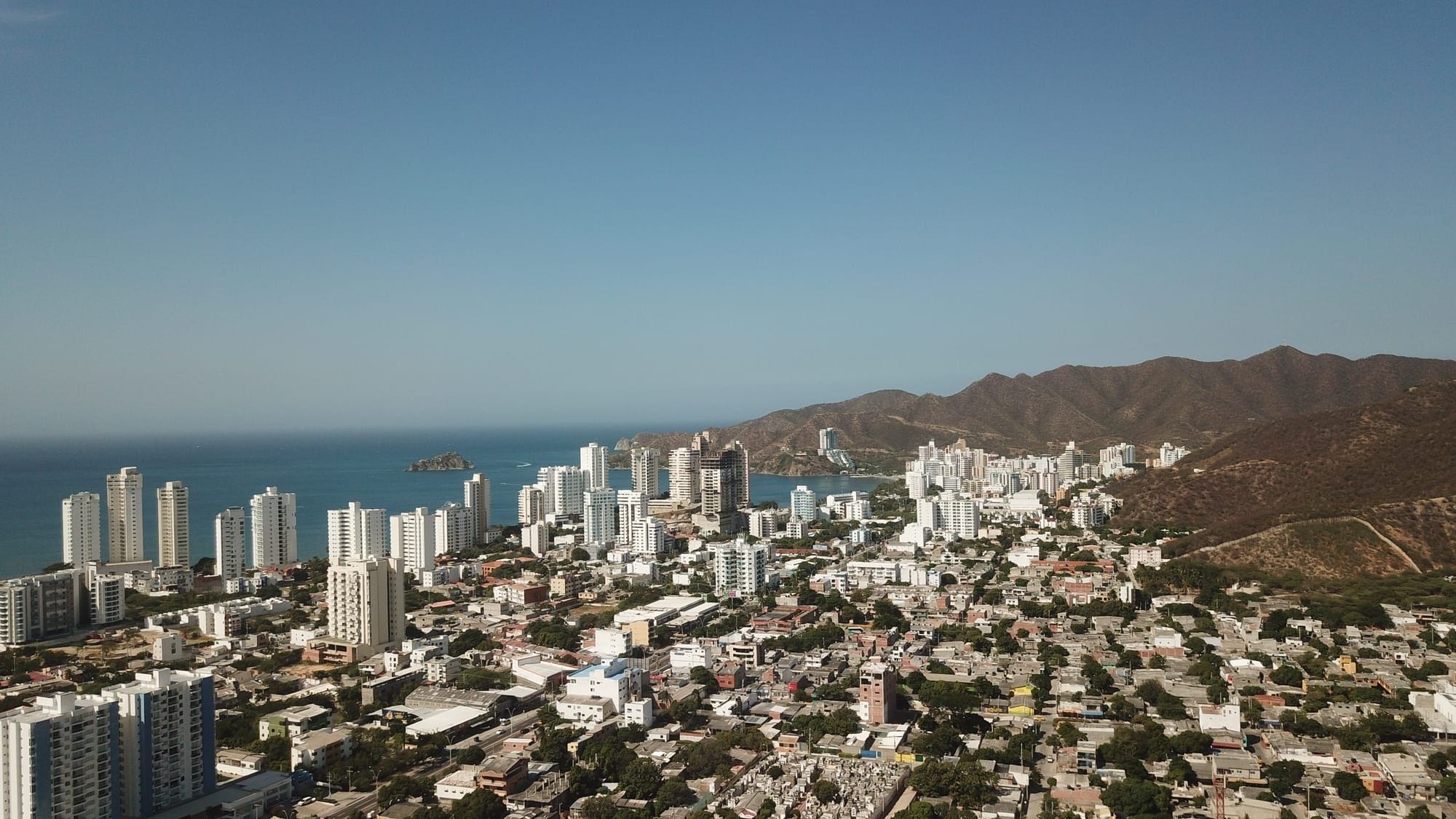
With the “First Conference on Transitioning Away from Fossil Fuels” now concluded in the Caribbean coal port of Santa Marta, we have much to celebrate. Santa Marta changed the fundamental question under negotiation: from a technocratic “By what percentage should countries x, y, z reduce carbon emissions?” (broadly, the terms of COPs 1 through 30) to a pointed “How shall we end fossil fuels?”. It initiated a shift away from a singular focus on managing consumption (or demand) and generated a groundswell of energy and support. This was the change in perspective that the climate movement needed, and which it has been demanding for years. From the first days of the event, it was obvious that this shift in perspective, and the momentum generated by it, would be its greatest achievement.
That momentum, however, could easily be lost. A key relevation at Santa Marta was that the idea of phasing out fossil fuels can mean very different things to different actors. Many European states flocked to Colombia despite their continued failure to realize meaningful climate action at home. While ambitious when compared with the likes of Saudi Arabia, Russia or the United States, these countries’ positions fall far short of what justice demands. Indeed, they seemed to have come to Santa Marta to reiterate the same agenda they continue to pursue at the COPs.
The Netherlands, which co-hosted the event, is a case-in-point. The Dutch are no leaders in decarbonization: the country has long been one of Europe’s leading gas producers. The government closed its largest gas field in Groningen a few years ago only because recurring earthquakes posed a risk to public safety. Meanwhile, the state continues to expand gas production elsewhere (both onshore and offshore) with no phase-out date in sight. The Netherlands also remains one of the staunchest supporters of the widely rejected Investor-State Dispute Settlement (ISDS) mechanism in treaties, which enables foreign investors to sue states for exorbitant sums when they perceive their assets to be at risk; ironically, Shell and ExxonMobil did just that when the Netherlands closed the Groningen field. The present Dutch government, a three-party centrist coalition, has adopted a techno-optimist climate position that combines trust in “blue” hydrogen, “green” gas, small modular reactors and carbon capture and store (CCS) with a commitment to continue extracting fossil gas from below the North Sea.
This tepid ambition also pervades one of the most concrete outcomes of the Santa Marta conference: the call for countries to create “voluntary national roadmaps” for phasing out fossil fuels. Setting aside their voluntary nature, what matters most about these roadmaps is the timeline they set out, and particularly: when will countries arrive at their end goals? The first country to publish such a roadmap, even before the conference concluded, was France, which has promised to end the consumption of coal by 2030, the consumption of oil by 2045, and the consumption of fossil gas by 2050 (though only for energy purposes).
To put this in context: a new study by James Hansen and colleagues shows that, if the pace of temperature rise we have seen in recent years continues, the world will reach 2°C mean warming as early as the 2030s. Letting oil and gas combustion continue for another quarter century, in other words, would push our world well into dangerous overshoot territory. We cannot afford roadmaps that stretch that far. If anyone is allowed some leeway against the brutal timeline now imposed on us, it should not be the world’s wealthiest countries or the largest historical emitters.
This toothless take on phase-out stands in stark contrast to how much of the climate movement defines the term. For the two of us, and for many others, it means the defeat of fossil fuel-based capitalism and its imperialist manifestations: no more wars for oil. What made Santa Marta unique is that this radical perspective was given voice by the leader of the host country. When Colombia’s left-wing President Gustavo Petro took to the stage, he characterized the phase-out agenda as an existential battle against “suicidal” fossil capital.
To read the rest of the essay, visit our website.
by Natasha Heenan
“You are in danger and need to act immediately to survive. The safest option is to take shelter indoors immediately.
It is too late to leave.”
—New South Wales Rural Fire Service Emergency Warning
In the early months of the pandemic, while many of us wearily logged onto Zoom or donned protective gear, a group of scientists and engineers were on a boat stationed off the coast of Queensland, conducting a world-first experiment. Using a prototype constructed from a repurposed snow machine, the team sprayed ultra-fine particles of sea salt into the air from their research vessel. Their goal was to brighten the clouds over the Great Barrier Reef.
The experiment, part of a larger Australian government-funded programme called the Reef Restoration and Adaptation Program (RRAP), was designed to help the Great Barrier Reef survive the rapidly warming ocean temperatures. As the largest coral reef system in the world and the Earth’s largest living structure, the Reef is a dazzling archipelago made up of 2,500 individual reefs: a sprawling turquoise lacework constructed from trillions of tiny coral polyps on top of a series of older reef systems that formed and died off the north-east coast of Australia over hundreds of thousands of years. It is visible from space against the deep blue of the Coral Sea.
In the late 1990s, an escalating pattern of mass bleaching events, with further extensive bleaching in 2016 and 2017, threatened the future survival of the reef, prompting public outcry about the impacts of climate change. In response, both the federal government and industry promoted adaptation measures (even if much of their effort was concentrated on lobbying UNESCO to not list the world heritage site as “in danger”). As part of the RRAP, hundreds of scientists were tasked with finding novel ways to help the reef adapt to the impacts of climate change, including coral spawning, cryopreservation and Marine Cloud Brightening. The latter technique, first trialled in 2020, aims to increase the reflectiveness of marine stratocumulus clouds which, in theory at least, would temporarily cool the waters during summer heatwaves when the risk of coral bleaching is at its highest.
During the second year of my PhD, I told my supervisors I wanted to change the direction of my research to interview the people working on RRAP. My plan was to try to understand how they viewed their work in relation to climate mitigation, and what, if anything, was novel about humans willingly filling the atmosphere with pollutants or changing the reflectivity of clouds. I found the common critique of “geoengineering” (an umbrella term, covering a range of practices) as a mere “technofix” to be unsatisfying, and thought it required further elaboration. Technologies are always artefacts of labour; the working conditions of the people tasked with creating these solutions interested me more than the machines themselves. The scientists I spoke to were clear that cloud brightening, if successful, could only ever buy time for the reef. It would not replace the urgent need to cut emissions. Rather than being driven by a hubristic desire to control the weather or dominate nature with technology, the cloud brightening being tested by RRAP is something else: a multi-disciplinary research programme designed to defend an ecosystem uniquely favoured by legislation, regulation and funding due to the cultural and economic significance of the Reef.
Nine months before the RRAP trials began, the federal government approved the long-disputed Carmichael coal mine in Queensland’s Galilee Basin, a project that would substantially increase the country’s already record-high per capita emissions. That same year, in what is now referred to as the Black Summer, a catastrophic bushfire season burned through an area of the Australian continent roughly the size of the United Kingdom, including ancient Gondwanan rainforest normally considered too wet to burn.
That the Australian government can provide funding to a programme like RRAP while approving new fossil fuel infrastructure reveals something crucial about climate politics today. We find ourselves in what many have called an “overshoot conjuncture”, in which ongoing deferral of or refusal to pursue adequate mitigation is creating a new rationale for an array of strategies to stabilize the conditions of capitalist production. Not all of these proposals come from well-meaning scientists attempting to shepherd a critical ecosystem through the worst impacts of climate change, of course. Venture capitalists promising to “undo” carbon and “fix” the climate also proliferate, touting technologies spanning everything from covering the Earth in mirrors to dumping seaweed in the ocean as a form of carbon sequestration. Many of these are spurious technofixes—attempts to divert the crisis and delay the politically difficult work of cutting carbon. But while the hype machine of Silicon Valley has little grounding in reality, start-ups with deep pockets—brimming with Promethean hubris—are ready and willing to solve the problem of climate change, for a fee.
Take Luke Iseman and Andrew Song, the duo behind Make Sunsets, a solar geoengineering start-up that began launching balloons containing sulphate aerosols from Iseman’s backyard in 2022. Neither Iseman nor Song have a background in atmospheric science, as both hail from the tech sector. They describe coming up with the tagline for their stunt, “sunscreen for the Earth”, by asking ChatGPT to explain solar geoengineering to a five-year-old. Despite their launches being unauthorized, Make Sunsets managed to raise USD$750,000 in venture capital by promising to help “cool the Earth”.
The existence of this and other VC-backed projects appears to confirm what opponents of solar geoengineering have long cautioned against: that relatively cheap and easily deployed technologies could become fodder for rogue, do-it-yourself geoengineers, in this case putting a highly risky and uncertain climate engineering technique in the hands of people who appear to have little interest in even tracking the impact of their experiments. But a reckless desire to disrupt the climate and capitalize on the painfully slow progress of climate mitigation is not inherent to the technologies that sit under the broad umbrella of “geoengineering”. Iseman and Song’s actions were enabled not by decades-old developments in atmospheric science so much as by the ideology of planet-saving innovation espoused by “cleantech” entrepreneurs—an ideology perfectly suited to the steadfast refusal of major emitters to scale down highly profitable activities, even if it means risking the stability of Earth’s systems and the security of its inhabitants.
In early December I received a phone call from my partner’s Mum. Don’t panic, she said, but there’s a big fire near your place. We had been inside all morning, sheltering from the scorching 41-degree heat and high winds. Immediately, we divided up the tasks in our fire safety plan. Buckets were filled with water and the roof sprayed down, anything irreplaceable gathered in a bag (including 70 rolls of unprocessed film). Neighbours were called and the radio turned on. We live in a cedar-clad pole home that sits high on the wall of a narrow valley. The house is flanked by a national park, perched among a canopy of red gum, spotted silky oak and lilly pilly. It has the highest fire vulnerability rating a dwelling can have, aptly called the “Flame Zone”. That day, a fire had started about 2km south of us, and soon our phones were flooded with alerts and anxious messages from friends. By nightfall it had consumed 16 homes, spreading across 120 hectares of suburbia and bushland. It is hard to comprehend how quickly fire can move uphill until you see it.
The fire burned for days, through bouts of rain and the best efforts of the New South Wales Rural Fire Service volunteers. We slept in shifts, keeping watch over the house, while our every waking hour was spent glued to our phones waiting for updates and replying to our neighbours on the community Facebook group. One night, at 3 am, I climbed up the steep, heavily wooded slope behind our house, slipping on dried gum leaves the brush turkeys had diligently swept into piles. The heat was suffocating, even at this hour, and I stopped to scour the darkness for the tiny flickers that reveal themselves as falling embers. From the top of the ridgeline the fire was breathtaking. In the dark it looked like a strip of molten lava pouring out of a gash in the hillside; like the Earth was breaking apart. I watched it trickle down toward the containment line for a while, where half a dozen fire trucks were idling. No smoke reached me, the wind carrying it south toward Sydney.
The next night I attended a community meeting organized by the state government. The first question from the crowd echoed the comments on every social media post: Was it intentionally lit? What was the source of ignition? Was it intentional? Nothing like this has ever happened here, someone said. What changed?
The climate changed. A decade ago, this was still somewhat abstract to me; it is now our daily reality. On a really hot day I no longer consider going to the beach. Instead, I worry my brother will die of heat stroke while he’s working as a contractor planting trees. At work I choose to turn on the giant portable air conditioners in the older classrooms even though we can’t continue the lesson over the roaring sound they make. Students can’t make it to class because there’s been another landslip on the Blue Mountains train line, caused by unusually heavy rains. They email me to ask what they missed.
I recall an interview with Anna Kornbluh where she quotes from Laura Heffernan and Rachel Sagner Buurma’s book The Teaching Archive, and think to myself, “you missed everything and you missed it forever”. More terrifying than the magnitude and velocity of these changes is how quickly a new normal is established following each disaster, each record-breaking summer.
The search for an arsonist, for someone to blame for the devastation of the fires, was a way of avoiding the more difficult and complex question: who produced the social, political and ecological conditions that made these fires so catastrophic? The source of ignition ultimately doesn’t matter as much as the increasingly frequent heatwaves and changed patterns of rainfall that provide the perfect conditions for such intense burning.
Behind it all lies another question, one no one wants to say out loud: how much longer can we live here?
Read the rest here (full piece for subscribers only).
by Robert Newton
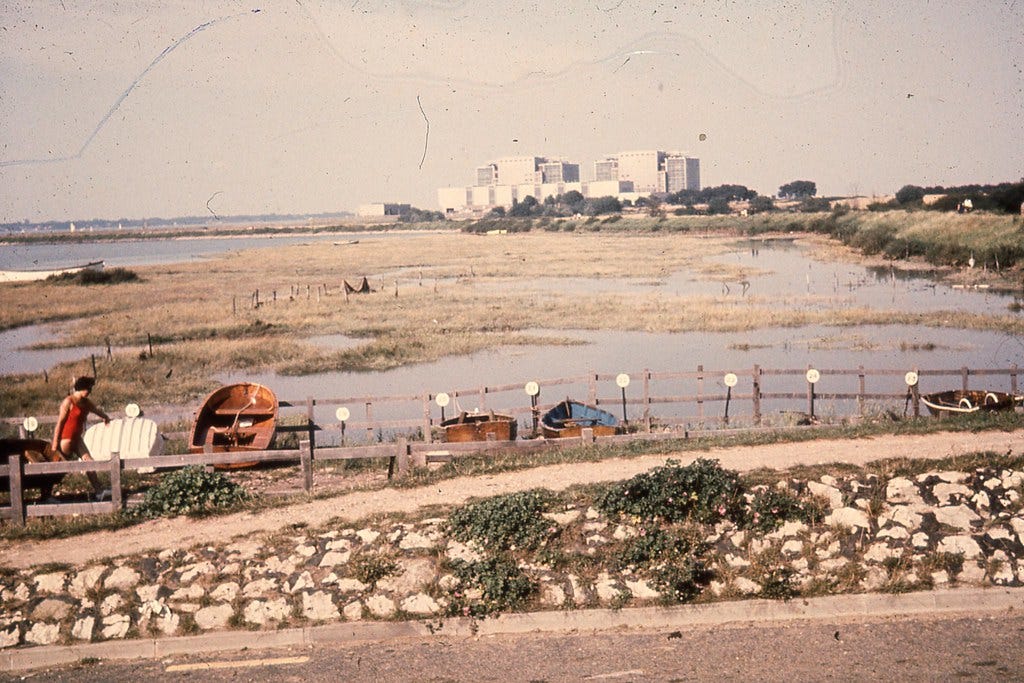
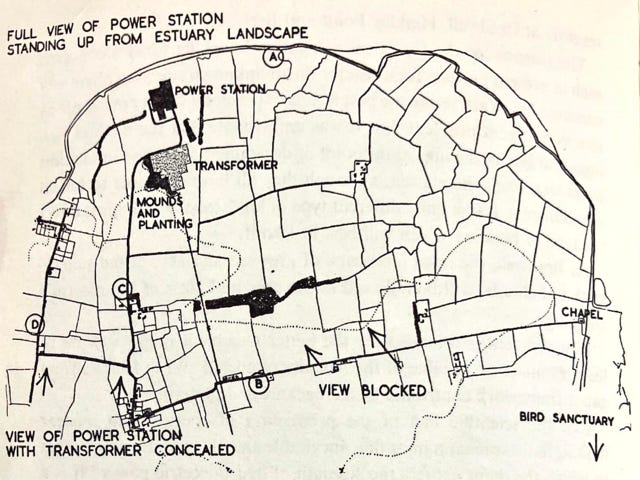
For eighty years, a small religious collective called the Othona Community has worshipped by the chapel of St Peter-on-the-Wall, at the edge of a marsh on Essex’s Dengie Peninsula. It’s a simple structure, more like a barn than a church, its sandstone walls patched with brickwork. In the seventh century, Saxon monks built it from the ruins of a Roman fort. Ever since, this compact form has stood in counterpoint to the broadening span of the mudflats, to the expansive sky.
In recent decades, this ancient place has stood in tension with a more recent force, one that arrived on the Essex coast in the mid-twentieth century: nuclear energy. Two miles to the chapel’s east, at the mouth of the River Blackwater, is a dormant atomic power plant called Bradwell A. In the 1950s, when plans for the power station were announced, local people and conservation organizations made the chapel a symbol of their opposition. For these campaigners, the contrast between the chapel and the power plant expressed a wider conflict in post-war Britain, in which centrally planned motorways, towns, and reservoirs intruded into quiet, hidden places. Decades later, those struggles seemed to have faded into history, while Bradwell A, retired in 2002, was encased in a metal sarcophagus to seal up its four thousand cubic metres of irradiated graphite.
Life by the marshes went on. Then, rumours of a new nuclear project reached the estuary, and the chapel once more became a focal point for debates about nature, history, and power.
In 2015, EDF (the French state-owned energy group) and CGN (a Chinese state-owned energy corporation) proposed the construction of a new atomic plant in Essex. Five years later, their joint enterprise BRB was claiming that nuclear energy was critical to the UK’s recently announced target of net zero emissions by 2050. Bradwell B, as it would be known, ‘would make a vital contribution to meeting the UK’s future need for low carbon, secure and affordable energy’, they declared, and would offer a stable source of electricity ‘when limited wind and solar power is produced’.1
Locals baulked at the new project, which would be several times larger than Bradwell A. The Othona Community, in particular, voiced fears that the plant would devastate a sacred site, and questioned the need for nuclear power in the energy transition. Once again, the chapel and the nuclear plant became emblems of competing visions of this place: one channelled its distinct historical, ecological and spiritual qualities; while the other subordinated them to a grand industrial scheme. But now, a new tension was at play—a tension between a local form of environmentalism, and an emerging argument for nuclear power as a solution for the energy transition.
Since the Chernobyl disaster in 1986, atomic energy has in the popular imagination been associated with abandoned cities, toxic clouds and cancer. Despite its continued prominence in electricity systems, this association persists. Two decades into the twenty-first century, as activist movements drove the climate crisis up the political agenda, lobbyists spotted an opportunity to refresh their industry’s image, developing a potent new narrative: there can be no decarbonization without nuclear power. Protestors against Essex’s first nuclear plant saw themselves as protectors of the natural world, defending what they called “this half-land of mud and ooze and salted winds” from an “industrial invasion.” This time, though, to resist development was to find oneself an adversary of state climate policy. Local opposition to a nuclear plant was revealing a new faultline in British environmentalist culture, pitting conservation against an increasingly mainstream vision of decarbonisation.
***
By the time I arrive at the Othona Community, I am quietly asking myself whether it is wise to have come here. It is spring 2021, and under the oak rafters of a spacious modern hall, I am drinking tea with Pete, who has been with Othona for twenty-two years, and Richard, the new warden. Pete is telling me how he joined the group. “It’s great being part of a cult,” he declares with a grin.
“My friend knew about Bradwell, and he knew about the chapel. And he says, ‘Would you like to go and see the oldest chapel in the country’. We came down, had lunch in the village, seen the chapel. And then we started walking along the sea wall.” He leans in conspiratorially. “We saw the sign for the Othona community, and thought, ‘Oh, what’s that?’ We walked in here, and it was kind of like…a strange place. There was nobody here, and I thought we were going to get chased away by some kind of mad cult thing. Which I soon found out it was.” I laugh nervously. “And I’m still here!”
“Which way did you come in, by the way?”, he asks. Images flit through my mind: the blank sandstone front of the chapel; an opening in a hawthorn hedge like a tunnel; yurts covered in algae, laminated images of medieval saints at their doors. I describe the route to Pete. “Ah yes,” he says. “Generally when you come in that way, you don’t leave. I will get the next pit ready!” I force a strangled laugh and look down at the teapot, which sports a crochet tea cosy in the form of a chicken.
I can only think to ask how the pair feel about the nuclear plant. Pete’s expression darkens. “I hope this thing doesn’t go ahead,” he mutters. “The destruction to this area is just going to be immense.”
***
Norman Motley, the founder of the Othona Community, first came to the Blackwater Estuary in 1946 in search of a home for his new religious collective. Motley had investigated the island of Lindisfarne, which he found too remote, and a ruined mansion in Gloucestershire, which he found too expensive. Then, he found the chapel of St Peter-on-the-Wall and ‘came under the spell of that ancient building’:
There, one can breathe. The land on which we stood is almost a peninsula, with the mile wide estuary to the north and Bradwell Bay behind – and all round and curving to the south, the North Sea. The cry of the curlew was heard, and a variety of maritime flora and many sea birds were visible on the saltings; and withal, a great silence.
During the war, Motley had worked as a chaplain at an RAF training centre in Blackpool. Assigned to give religious lectures to trainees, he became frustrated by their didactic format. In response, he set up what he called “answer back meetings,” in which men and women of all military ranks, religions and political persuasions were encouraged to talk across social barriers about collective wartime suffering. The result, Motley wrote, was “a sense of belonging, of solidarity, and of caring.” When the war ended, some participants in these meetings, dispersed but still communicating, decided to regather and resume their discussions, this time alongside released German and Italian prisoners of war. In doing so, they hoped, Motley later said, to “meet the post-war world with some idea of a framework which would make a contribution to the inevitable uncertainties of the time.”
The Essex coast near Bradwell is a place of contradictions. In its offshore world of saltings, creeks and islands, religious dissidents and writers have long sought to escape from convention and surveillance. Planners, meanwhile, have found here a blank space on the map, a surface onto which to project large-scale infrastructural fantasies.
In the 1850s, speculative investors observed hungrily that Essex contained “waste lands of considerable extent,” resolving to claim its marshes from the sea. In their place, they envisaged tens of thousands of acres of prime farmland, or pools of London’s sewage pumped away from the capital in new pipelines. Their schemes failed, but not before excavators had uncovered some remnants of the Roman fort of Othona, along with a few spearheads, brooches and bones among the ruins. While the reclamation projects came to nothing, the power dynamics they expressed lived on, to re-emerge in a distinctive twentieth century form.
First came the power plant. In the 1950s, the Central Electricity Generating Board (CEGB) was looking for “isolated and undeveloped” places to build a new generation of nuclear power plants. They chose to build the first of these at Bradwell, despite considerable local protest.
Then, the 1960s brought plans for a new airport on the mudflats of Foulness Island. Foulness was preferred to a location in Buckinghamshire, which, unlike the Essex marshes, had rolling hills, hedgerows and little woods, and was thus deemed “of interest” to the “open background of London.” One campaign slogan exclaimed: “Don’t foul Bucks, Foulness.” This doubled character of the Essex coast—in location, close to London and the urban zones of the southeast, and in landscape aesthetics, readily categorised as a foul, undeveloped waste—has for two centuries made it a convenient, peripheral place to put ugly but necessary things.
Read the rest of the essay here.
Comments
Nothing yet. Say the first thing.
Sign in to join the conversation.