
Hello readers,
Adrienne here. This week we’re bringing you an excerpt from the feature interview in our third issue: an expansive conversation with journalist and author of The Uninhabitable Earth, David Wallace-Wells. I spoke to David back in February about the state of global climate politics, the paralysis of the Democratic party and what it means when catastrophes that should shock us out of complacency—like the Palisades fire that tore through Los Angeles last year, or the astonishing ten million lives lost each year to air pollution—fail to galvanize action, moving quickly from devastating to ordinary. You can read an excerpt of that conversation below, or in full on our website.
But first, we want to say thanks again to everyone who came out to the London launch of AIRBORNE on 6 May. We loved meeting you. The full conversation with Daniela Gabor, Oliver Eagleton and Geoff Mann will be launching Monday May 26, so be sure to check out Youtube, Spotify or whever you usually find our podcast.


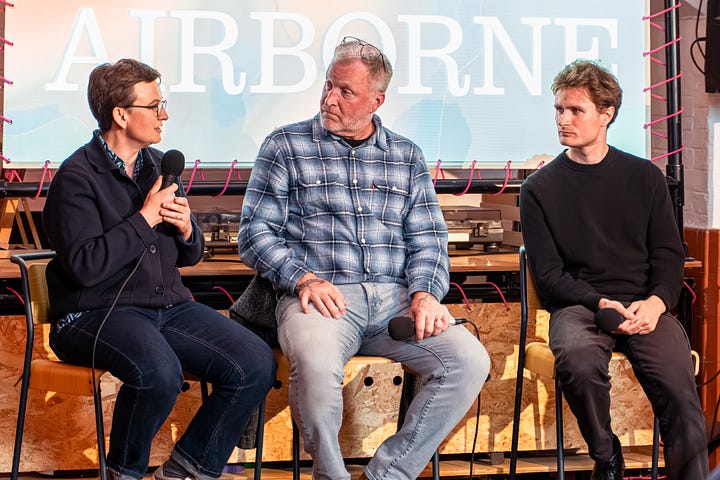
Last but not least, we’ll be at the How the Light Gets In Festival this weekend in Hay-on-Wye, so if you’re planning to attend, say hello—we’ll be thinking about geoengineering, eco-fascism, and Raymond Williams and Marx as ecological thinkers with some lovely panelists.
More soon,
Adrienne
This interview was recorded remotely on 11 February 2026 between Vancouver, Canada and New York City.
DAVID WALLACE-WELLS: I want to underscore that we are now living in a time when the leadership class of the Global North has decided that the climate crisis is not going to be all that problematic. And that seems to me to be a sort of self-interested calculation that has to do with the pace at which we are currently moving and how difficult it would be to accelerate that pace. So rather than trying to push the ball forward faster, leadership have come to terms with the chaos that we’re unleashing, by defining it as acceptable.
Now, that doesn’t mean the world will be an everywhere burned-over wreck as a result. When we tell stories about the distant climate future, I do think we tend to underappreciate how much adaptation and resilience can be built in to make those futures more liveable—I’ve certainly underappreciated it myself. But there’s nevertheless something at the cognitive and ideological level that is quite disturbing about how quickly we are normalizing climate futures that just five or eight years ago we were defining as completely unacceptable. I find myself shouting again and again lately, you know: “there is still a climate crisis going on!” The future that terrified Greta Thunberg into action and mobilized Sunrise and Extinction Rebellion, that moved so many Americans to push for the Green New Deal, the climate future we were promised by the most alarming IPCC reports—we are on track to meet that future. We are not avoiding it. It is still coming. We’ve just decided that it’s all OK, after all. Or decided to pretend, at least.
This is one of the sadder and stranger features of the period in which we’re living: we are seeing in front of us the kinds of disasters that freaked us out to no end when we considered them as hypothetical possibilities, mobilizing us and focusing our attention considerably less when they arrive in reality than when they were mere predictions. Here I would just emphasize the story of the LA fires last January. Coming out of Hurricane Katrina in the US, many climate people would say: “okay, this was a climate disaster that woke some people up.” But it also played into these cultural and national stereotypes and allowed people to define the problem in part as, you know, “this is an impoverished Black city that’s being hollowed out.” The degree of empathy and sympathy that many Americans extended to those victims was insufficient by any objective measure.
Yet you could also find yourself hoping in some backwards way that future disasters hitting more well-off, more prominent, whiter, people, would generate a much larger political response. We had exactly that in Los Angeles: one of the wealthiest neighbourhoods in the world’s global cultural capital, full of many famous people with careers in film and television and music and on social media, whose entire community burned down overnight. Again, five or eight years ago that would have seemed to many of us almost too perfect a climate nightmare to write into a script. And yet it happened. Dozens of people lost their lives. Thousands of homes were destroyed. And it didn’t motivate or mobilize any large-scale protest action. It didn’t reinvigorate the climate movement in the United States at the grassroots level, at the policy level or at the level of culture. To some degree, people in Los Angeles treated the story as a case study in the failure of local government. Others saw it as merely an extreme version of the fire disasters the city told themselves were familiar from its history, though this disaster was much larger and much more destructive and much deadlier. And most Americans living outside the city seem to have responded to it and processed it almost immediately as background noise—news we already know, rather than something full of portent for what might follow.
AB You’ve written about the growing divide between the US, which is increasingly turning inwards and rolling back public green energy investments, environmental regulations and institutions, and China, which is increasingly oriented outward and almost singlehandedly driving the world’s energy transition. How are you thinking about what that divide means for the future of global climate politics?
DWW One way of putting it is that the landscape of climate geopolitics can look quite a bit bleaker from within the US than it does from elsewhere. It is easy to see America engaged in an atavistic embrace of a fossil fuel-dependent economy that the rest of the world is already moving past. This is not just a story of Donald Trump, or one that starts with the election in 2024. It’s really a decade-long story, even though that decade includes a lot of good news about American climate politics as well. When the Paris Agreement was signed, it was essentially illegal for the US to export natural gas, and it was doing no oil exporting. Yet today, ten years later, we are the world’s largest exporter of both. We are also the world’s largest producer of both. In some basic way, then, the United States is the world’s leading petrostate. We of course have a more complex economy than that, and I tend to think American policy over the last couple of years is better understood not as an embrace of fossil fuels per se, but as a big bet on AI. But nevertheless, to the extent that we measure contributions to the climate crisis in fossil fuels, the US is doing more to produce and export those contributions every year than anyone in the world.
At the same level of superficiality, you can tell a story about China’s Great Green Awakening—responsible for two thirds of all renewable installations anywhere in the world, rapidly increasing that production and enjoying such a commanding share of that technology that it’s almost impossible to imagine the world keeping pace with the transition timelines that we’re on now without China.
But on both sides, the story is messier than that. In the US last year, 92.5 per cent of all new energy installed was renewable. That was a slight drop from 2024 when it was 94 per cent. But if this is a race for the future, renewables are still running away it. Even in the United States, despite all the energy that Donald Trump has put into stopping that from happening, renewables are winning. Meanwhile in China, you’re still seeing more coal plants being built than ever before. They’re running at lower capacity, and the ultimate emissions impact is unclear. But it’s still the case that China is producing by far the most emissions of any country in the world. And it’s the case that the gap between China and the United States, which is in second place, has been growing rather than shrinking. Because, while China is now perhaps at or approaching a peak, the US’s emissions have been dropping for almost 20 years now.
At the geopolitical level, the United States under Donald Trump has embraced a much more combative, destructive posture towards all the systems of global hegemony (which the United States created for its own benefit and then benefited from). It’s now trying to pull the planet back towards some half-remembered version of nineteenth-century imperial history in which the great powers get around a table and divvy up the map.
AB Effectively, “Let’s bring back the mandate system! The good old days!”
DWW Yeah! And China’s opportunistic response has been telling and, I think, on some level useful, particularly on green energy but really across infrastructure investment and other forms of power.
Now, a year ago, when Trump came into office, I would have described this as a conflict that was building towards a crescendo. I would have said we had seen a decade or more of intensifying rivalry, which had begun late in the Obama administration and continued through Trump 1.0, through Biden, and which seemed to give a much larger share of at least the American foreign policy establishment, a sense that we were in a zero-sum competition with the world’s other great power.
China was never, in my mind, operating nearly as combatively on those fronts as the US was. They obviously have some designs on greater influence, but I think were playing their hand a little more carefully. I do think that we’ve now moved into a new phase in which the China hawks in the Trump administration have been somewhat marginalized. Trump has dropped his trade war with China. He’s loosened up the restrictions against AI chips. He’s had a few climb-downs in what were supposed to be showdowns at summits with China. And it feels to me as though his foreign policy focus is elsewhere—that the foreign policy focus of the United States is elsewhere. What that means beyond the Trump horizon is a big and important question.
This is really true of American politics more generally. The truth is that the Democratic Party has been so preoccupied with Trump for more than a decade now that it seems to have no clear path forward on any front beyond excising the cancer of MAGA and instituting some modified version of what I think many liberals understand is their “natural” right to rule in a technocratic fashion. That loss of purpose is really quite profound.
Comments
Nothing yet. Say the first thing.
Sign in to join the conversation.