
Hello from The BREAK—DOWN’s weekly newsletter. This week we have an essay from Jeremy Wallace, one of the most perceptive analysts of China’s economy and its energy transition. Here, Wallace compares American capitalism (in which returns to capital are king, but shortages rein) and Chinese capitalism (in which returns to capital matter less, but overcapacity and involution are a real drag). It’s a superb piece of comparative political economy in its own right, but it’s even more interesting for what it says about decarbonization.
You can read an extract of the essay below. The full piece is subscribers only for now—the good news is you can access that via our website by becoming a digital subscriber for just over £1 a month (£15/year) which, if you really think about it, is a steal.
The essay is also a good introduction to the themes we’ll be pursuing in our autumn print issue, which will focus on China in the climate crisis and its many glorious contradictions. Thanks to everyone who has sent us pitches for that. We’ll be responding to those over the coming weeks.
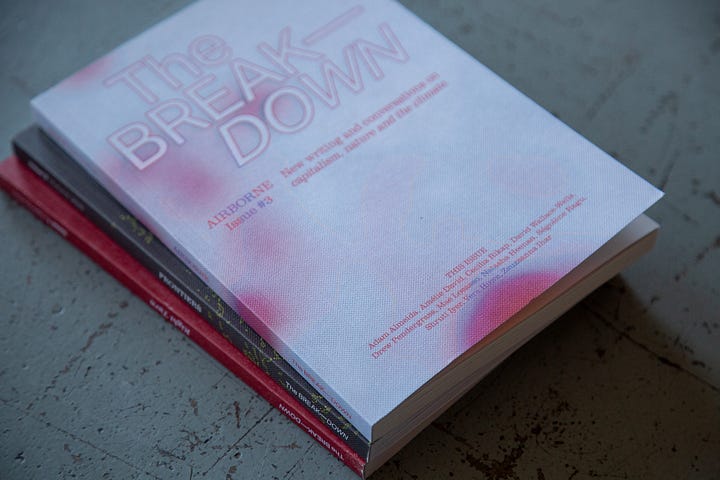
Thanks as well to everyone who has bought a copy of our third issue, Airborne, which is out next week. If you haven’t yet, you can grab a print subscription or single copies on our website. Plus, if you do so before May 6th, we’ll send you a copy of our very first issue, RIGHT TURN, as a thank you, featuring essays from thinkers like Ilias Alami and Brett Christophers.

Last but not least, we’ve got just a couple of tickets left for our Issue #3 launch and live podcast recording in London on Wednesday 6 May. If you haven’t bought yours, you can get one here—but move fast.

Sun Spots
The idea of solar radiation management is controversial to say the least, but is quietly picking up steam in certain policy circles and even the private sector (watch this space for a major new podcast series on this from Adrienne and friend of The BREAK—DOWN, Geoff Mann). But a new paper argues that we’re missing a serious trick in research into this technology. As the prospects of using it move out of the fringes, Ina Moller and Danielle Young raise concerns that the “balance of risks” arguments that we tend to have about it focus almost exclusively geophysical and not geopolitical risks. They make the case that many actors might want the ability to block out the sun first and foremost for security, not climate, reasons. See what you make of the argument and, if this is your thing, become a digital subscriber to read Sofia Menemenlis’s excellent piece from our last issue.A Troubled Blue Sky
We’ve just released a sneak peek into our third issue: a stirring photoessay documenting the struggle for clean air and energy independence in a Beirut under renewed US-Israeli assault. Journalists Amelie David and Ségolène Ragu provide insight into the politics of energy and air in the city, and speak to residents who are taking a clean energy future into their own hands.China Drum
China is, of course, now the undisputed leader in green technologies, dominating in batteries, electric vehicles and solar. But, as James Jackson and Mathias Larsen argue in a new paper in Review of International Political Economy, much of the discussion in political economy circles has a China blackspot. It’s a fascinating essay, sure to be much debated.Bad for the world; worse for America
There is currently about a one-in-four chance that the world is on for a “super” El Niño this year. This is bad news for much of the world, which will experience hotter, drier weather (for more on El Niño-Southern Oscillation then I can’t recommend Mike Davis’s classic and excoriating book, Late Victorian Holocausts, enough). It could, however, be even worse for climate politics in the global North where, as Jeva Lange notes in Heatmap, “the phenomenon has the potential to alleviate some of the extreme weather we’ve seen recently in the United States”. The trouble is, when the more visible effects of climate change are softened, people become less concerned. As Lange writes, “a lower average state temperature is about as reliable a predictor of climate change skepticism as being a Republican, even when controlling for income, party affiliation, education, and age.”Slouching Towards Electro-utopia
It’s become common in the past year or two to see commentators divide the world into electrostates (the US being the major one, along with Russia and the Gulf states) and petrostates (China). In a recent Chartbook, Adam Tooze clarifies the stakes of the distinction, offering a bit of much-needed nuance. The US, he writes, and against much recent talk, is “not not an electrostate”, it’s just one “slouching rather than racing towards the new era of ultra-low cost electric power”.


Images taken from Amelie David and Ségolène Ragu photoessay, A Troubled Blue Sky, from Issue #3: Airborne.
Returns to capital are the cornerstone of the American economy. Money flows to projects, companies and ideas where it can be most profitable and where it can generate the greatest financial return to the investors; areas that lack strong expected returns struggle to raise money and remain unbuilt.
The Chinese economy is very different. There, capital is not so beholden to profit expectations. Six months ago, western media reports were agog at the scale of expansion at the Chinese EV giant BYD’s “gigafactory” in Zhengzhou, which would they claimed be “bigger than San Francisco”, even though the firm’s financials were on flimsy footing with their sales slowing and profits collapsing. By February 2026, BYD’s factories in China were only operating half the time.
In China, unlike America, capital is comparatively undisciplined. It flows even without high expectations on returns. In mainstream economics this lack of capital discipline is seen as a problem. Without discipline, the thinking goes, capital is allocated inefficiently; money travels toward purposes that produce smaller returns than it theoretically could get if it were allocated more efficiently. The Chinese state-owned enterprise (SOE) is a classic example of this: for decades, firms like the automaker First Auto Works (FAW) and Angang Steel received preferential treatment from state-controlled banks and capital markets despite—in the polite language of the World Bank and the UN—their mediocre returns. This, to put it more bluntly, was the equivalent of setting money on fire, with their huge workforces making products that the market simply did not demand. From 2010 to 2015, FAW threw over thirty billion RMB (£3.25 billion) at R&D for just two models for the iconic Red Flag brand (Hongqi), only to see miniscule sales.
It was precisely this kind of waste that was, until recently, the standard economic complaint about Chinese investment decisions. In the past few years, however, something has changed. While capital going to places where it fails to produce returns for investors and lenders is still seen as the primary issue, now, both inside and outside the country, the stress has shifted from inefficient state-owned sectors to those plagued by “overcapacity” or involution (内卷). No longer is flabby state-owned indiscipline the scourge, but destructive hypercompetition. Chinese real estate, steel, EVs, polysilicon, solar panels and more all operate in worlds where, amid massive supply capacity, profits have evaporated from intense competition.
At the same time, firms in these sectors have grown to world-changing proportions. Chinese investments may generate minimal returns to capital, but they still produce substantial benefits. Workers get jobs, consumers get cheap products and competition helps push technologies forward—the glut of cheap solar, batteries and EVs might even help save the world. While a Nero-like would-be-king sits atop a faltering if still dominant global hegemon determined to burn the global order to the ground, and with an increasingly chaotic climate system fuelled by carbon emissions pushing towards its own entropy, excess capacity can even start to smell like resilience.
Is it time, therefore, that we expand our perspective on returns? Investment necessarily involves trading expenses today for production and returns tomorrow. But whose returns should we consider? Should it be only the funders of investment—the returns to capital—or should we consider the benefits of additional supply for a broader population of consumers and citizens, what we could call “returns to capacity”? And, if we take this more expanded view of returns seriously, what are the implications?
If China needs to reform its financial sector, then it is often the US that serves as the model capitalist economy against which it is held. Over the past twenty-five-odd years, however we have seen in blatant terms where this story of American capital discipline against Chinese profligacy fails: innumerable in that time have been the charismatic white guys given billions of dollars of Silicon Valley VC money to squander. California’s start-ups may do the squandering with a little more flair than a Chinese SOE (their being capital-light software as opposed to capital-intensive heavy industry also distinguishes them), but in both cases the result is much the same: ashes, and little else.
The American fracking boom of the 2000s and 2010s exhibited a similar trend, driving a rapid increase in drilling for oil and gas, though conspicuously not profits for its operators. As Yakov Feygin and Advait Arun have noted, in the decade to 2020 US oil and gas companies recorded around $342 billion in losses while “North American shale oil and gas developers had over $189 billion in negative free cash flow (the difference between their cash flow from operations and their total capital expenditure).” If the boom did not drive profits, what it did do was keep supplies of US oil and gas in surplus and prices low for consumers, while also becoming a kind of Rube Goldberg machine transferring capital from investors and banks to American households and energy consumers while sticking a knife into the American coal industry. The fracking boom, seen this way, was a kind of “productive bubble”, in which investments reshape the economy even if they do not generate returns to capital.
More broadly, we can say that the American returns-to-capital model excels in capital-light, high-margin sectors, but that it fails to adequately invest in capital-intensive manufacturing and infrastructure—sectors where profits may be thin but broad benefits are significant. An interesting counterexample in this respect is the current AI investment cycle, where hyperprofitable tech firms have been placing bets by the billion on data centres and, in doing so, shedding their prior capital-light status and making huge decisions about the economy’s future. But this is an exception, however large, for American capitalism.
In the typical story, American industrial operators of varying stripes put short-term profits first. Established players keep their eyes out for any threats to their dominant market position in order to maintain pricing power, effectively printing money by keeping prices and thus profits high. Capital is pleased with its high returns, while these cash-rich firms take their profits and offer dividends or buy back their own stocks rather than invest in additional capacity.
One of the clearest examples of this has been the auto industry. Protected from European competition in the light truck market because of historic disputes over chickens, American automakers have systematically reconfigured their production lines, and the nation’s collective unconscious, toward profitable trucks and sport utility vehicles. These are high margin units, and by focusing on them, automakers have given less attention and investment to other parts of the market. The best engineers and sales staff, wanting to be where the action is and not in the remainders bin, followed, and firms made fewer and worse small cars, while even less attention still went to cheap econoboxes for global markets. The low-end thus cleared, the Big Three US automakers (GM, Ford and Stellantis) retreated to higher ground behind tariff walls.
More common than shrinking markets is the tactical acceptance of shortages to generate high prices and profits. A formative example can be found in the PPE shortage during the early COVID-19 pandemic, when American firms failed to radically expand production despite the obvious market demand and social need. The US electricity sector is also rife with these dynamics, having become accustomed to flat total demand for two decades. Whether it is gas turbine manufacturers or transformers or polysilicon, the electricity industrial machine in America has been resting on its laurels for so long that they’ve all but turned to dust: are you building a data centre and want a best-in-class gas turbine to power it? GE Vernova will be happy to supply you with one—in 2031. Do you need to replace transformers to change voltage in your electricity system because of age, wear and tear, climate-fuelled disasters or a new data centre? Good luck finding one available before the start of Trump’s third term.
And, as journalist David Fickling has shown with the polysilicon sector, even individually rational business decisions can ultimately lead to failure. The global market for polysilicon in the early 2000s was dominated by a small number of European, Japanese and American firms, with their businesses geared toward the high-end needs of chip makers who could pay a premium for an impossibly pure product to keep Pentiums chugging along. However, when a new sector—solar power—emerged that wanted comparatively vast quantities of lower-end polysilicon to make their panels, the American producer Hemlock and other producers offered them only scraps at high prices. Eventually, they were upended by new competitors willing to accept lower profits.[4] Those competitors were, of course, Chinese.
You can read the rest of Jeremy Wallace’s essay on our website.
Comments
Nothing yet. Say the first thing.
Sign in to join the conversation.