
Hello, and welcome back to the latest newsletter from The BREAK–DOWN. This week we have a newly published interview with the great Laleh Khalili looking at the Iran-US/Israel war and the profound effects that it along with the closure of the strait of Hormuz has had on the global economy. You can watch that below, or in all the usual places.
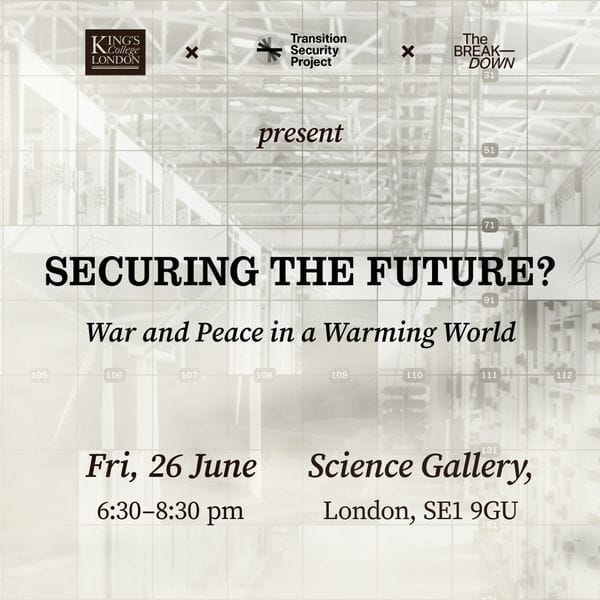
Plus, a reminder: next Friday in London we have a FREE event, organised in conjunction with King’s College London and the Transition Security Project. The event will see Adrienne Buller, Samar al-Bulushi, Adam Hanieh, Guillaume Long and Lorah Steichen unpack the relationship between fossil fuels and war, the impact of warfare on environmental devastation and the potential of an energy transition. If you want to come along, please RSVP.
“At the ’86 World Cup,” wrote the Uruguayan novelist Eduardo Galeano in Football in Sun and Shadow, perhaps the greatest book about this now omnipresent sporting event, “Valdano, Maradona and other players protested because the big matches were played at noon under a sun that fried everything it touched.” The enemy that year was the TV broadcasters, who insisted games be played under blazing Mexican skies to increase European audiences. As Germany’s goalkeeper, Harald Schumacher, said: “I sweat. My throat is dry. The grass is like dried shit: hard, strange, hostile. The sun shines straight down on the stadium and strikes us right on the head. We cast no shadows. They say this is good for television.” To which João Havelange, then president of FIFA, replied: “They should play and shut their traps.”
Today, of course, the already scorching Central and North American summer is further compounded by a changing climate. The US National Weather Service predicts that, for the duration of the tournament, every region in America will experience above average temperatures. The England team’s arrival at their training base in Kansas City has already been disrupted by tornado warnings and heavy storms.
So far, the weather hasn’t caused too many headaches. But temperatures across the continent are expected to rise in the coming days. The most visible sign of disruption so far has been the FIFA-instituted hydration breaks that come midway through the first and second halves: three minutes of momentum-sucking dead air, in which players gather on the touchline to drink water while being fed instructions by their coach. Poor Curaçao, tournament debutants, who after falling behind early to Germany drew level shortly before the mandatory break. They would lose the game 7-1.
This, however, is a small price to pay. According to the Pitches in Peril report, 14 of the 16 host cities are likely to exceed the Wet Bulb Globe Temperature threshold of 28C (82.4F) during the tournament, making them dangerous to play in. Nearly half of the tournament’s games, meanwhile, will kick off at 3pm or earlier local time. Expect the ice jackets and cooling towels to be an ever more visible presence in the next few weeks.
Three host cities—Dallas, Houston and Atlanta—have stadiums fitted with futuristic domed roofs and air conditioning. The former hosted last night’s game between England and Croatia and produced the bizarre spectacle of players being forced off the pitch to rehydrate even though they were playing under artificially cooled conditions. In this context, there’s probably no need to point out that FIFA have allowed broadcasters to fill the time with even more adverts. If this is the last thing the World Cup needs, at least it will provide some distraction from the flashing green and blue LED boards proudly announcing the Saudi oil and gas firm ARAMCO as the tournament’s “global energy partner” that float over the pitch.
Is this, then, the future of the World Cup: Games played in stifling and dangerous heat, sold to yet another petro-state so that a few FIFA officials can buy themselves a second yacht? Or, as with the 2022 tournament in Qatar, will the Cup perhaps be moved out of the usual summer slot to accommodate a new climate reality? If so, it’d be a shame. It’s always best to avoid the call of nostalgia on these matters, but so many of the memories of my childhood are punctuated by long hazy summers of sport that losing them would be a wrench: 1994, with its garish kits and Americanised spectacle; the Ronaldo v Zidane final of 1998; 2002 and Ronaldinho’s chipped freekick over the head of David Seaman; Zidane, again, four years later, headbutting the Italian centre half Marco Materazzi.
As the FIFA™ era kicked in, I must admit that this youthful passion began to ebb, to the extent that I barely registered what happened in Qatar four years ago. Was that also because it was the first not held over the summer? Perhaps. If I’m honest, it’s probably a more likely explanation than whatever ethical concerns I may have held (sorry).
If there’s a core to the modern World Cup, then it’s almost definitely orbiting somewhere in the vicinity of Gianni Infantino, FIFA’s strange control-freak of a president. In Qatar, directors were told to show him in the crowd once per match, and it doesn’t appear to be any different this time around. According to a revealing profile in the New Yorker, for Infantino, football is as much an ethical—even political—force as it is a sport. “He talks about soccer the way that other people talk about clean water or universal basic income,” writes the profile’s author, Sam Knight.
This has led to some of the more bizarre, even sinister, aspects of recent competitions. The sight of Infantino repeatedly prostrating himself in front of Donald Trump, for instance, as his regime refuses entry to Omar Artan, who was supposed to be the first Somali referee to officiate a World Cup game, is surely only the most egregious. To this, Infantino gave the astoundly glib response: “Chill, relax”, he said, “we are not kings of the world”.
Being able to “chill” is a luxury that will not be afforded to the players. Particularly not to those from Iraq and Iran, who were made to wait for hours at immigration control before they even arrived at the tournament. Eleven of the participating countries, meanwhile, all from the Global South, have faced travel restrictions or unusually high rates of visa rejections; the mother of Cape Verde’s goalkeeper, and hero of their first ever World Cup match, Vozinha, was unable to travel to watch the game due to the cost of visas. More bizarrely, Infantino seems to believe that football is the one thing that can end the conflict in Palestine, a sure sign of the planetary vastness of his ego.
World Cups are, if nothing else, a mirror held up to the world: modern life reflected in the spectacle of 22 men chasing a ball around a field every four years adorned in national flags. Infantino, the egoist in chief, solidifying his position as head of football’s governing body by ingratiating himself with despots and petro-dictators is only the most obvious symptom of this. Less on the nose, this year’s event will also be the most diasporic: a clear sign of the increasing salience of immigration in a world shaped by the global movement of people. As Rory Smith recently noted in the Observer, nearly a quarter of the players will be representing nation’s other than the one they were born in.
That the climate crisis will have a profound effect on the tournament in years to come should not then be a surprise, even if the shape this will take is still uncertain. Could the ever more visible and inescapable effects of the climate crisis, reflected back to billions of eager spectators, turn the World Cup into a vehicle for building a new consensus on the need for rapid action? To do that would mean breaking FIFA’s grip on the tournament, with their determination to remove politics from football in all but its most anodyne forms. That will be hard, but not impossible. After all, as Galeano reminds us, football, whatever its form, has always been political.
Til soon,
John
Up this week on the BREAK–DOWN website, we have an interview with Laleh Khalili, Professor of Gulf Studies at the University of Exeter and author Sinews of War and Trade. In it, Khalili uses the outbreak of the war in Iran at end of February, to show us the reality of the global economy. The closures of the Strait of Hormuz have had profound effects, on food and oil prices, and on the supply of goods like ammonia and aluminium, among others.
The destructiveness of this war is clear. Less clear is what it could mean for the future of an industry at the heart of the region and the conflict: oil.
Listen below, or wherever you get your podcasts.
Red Card, Green Card
Perhaps the best guide so far to the climate effects of the World Cup has come from the former professional footballer, and perennial spectacle sceptic, Jules Boykoff. Writing for the Guardian, Boykoff cuts through FIFA’s propaganda about the games aiming to a “to raise [a] green card for the planet” with ease.
Jaw-dropping absurdities abound. At the 2022 World Cup, stadiums were located relatively close together, linked by metro and buses. At the 2026 World Cup, the Bosnia and Herzegovina squad – and their fans and families – will have to travel more than 5,000km (3,144mi) from Toronto to Los Angeles to Seattle. Their training camp is in Salt Lake City, meaning they’ll tack on additional carbon miles. Algeria will rack up about 4,800 km (2,972 mi) journeying from Kansas City to San Francisco and back. Czechia start in Guadalajara before heading to Atlanta and then Mexico City, notching more than 4,500km (2,811mi).
Contours and Contradictions
For Phenomenal World, friends of the BREAK–DOWN, Thea Riofrancos and Ilias Alami, take us on a tour of the world Trump is making in his image as he embraces a rampant form of “state capitalism”.
Rather than “deglobalization,” whatever that would mean, this new era of state capitalism is defined by the reconfiguration of the border-spanning movement of capital and minerals, the sprawling geographies of supply chains and industrial clusters, and the multi-actor alliances of trade and diplomacy. These developments are especially relevant to the governments and societies of the global South, as they attempt to navigate an increasingly fractured world order to achieve longstanding goals of development, regional integration, and sovereignty. The new US state capitalism carries three significant global implications: neocolonialism, subordinate integration, and asymmetric competition.
The Origins of Red Tape
Arthur Dowling, a specialist in energy systems and the author of a forthcoming history of British energy, has a superb essay up on his Substack (well worth a follow) about the increasingly stifling effects of red tape on the British economy.
Thatcherism may have killed off some ‘distributional coalitions’, but it led to something of a ‘roided up’ arms race among new ones. Privatisation was not synonymous with ‘de-regulation’. It created new regulators, new industry bodies to interface with those regulators, new think tanks to provide ideological cover, and new consultancies to navigate the resulting complexity.
Fracked Futures
Ed Conway has a brilliant short essay on his Substack about fracking, “one of the most extraordinary, and underappreciated, phenomena of the modern age.”
In fact, something rather extraordinary happened last year, though it passed mostly below the radar. For the first time in many decades, America pumped more oil and crude products (which also includes other hydrocarbon-related liquids) out of the ground than it consumes for its own economy. This watershed moment is part of the reason why an assault on Iran is plausible for America, in a way it never was before.
Comments
Nothing yet. Say the first thing.
Sign in to join the conversation.