

I remember, from my days of being more active in the foreign exchange markets, riding a major yen rally. In June 2007, the Japanese currency stood at ¥124; by 2011, it had reached a low of ¥75—an appreciation of 40%. (It is worth noting for readers less familiar with currencies that this quote indicates how many yen are needed to buy one dollar; in other words, the lower the number, the stronger the yen.) I didn’t catch the entire move, but I did capture a significant portion of it. Back then, everyone wanted yen; it was considered the ultimate safe-haven asset.
Japan had been grappling with decades of deflation and responded with an extremely loose monetary policy—featuring zero percent interest rates and long-term bonds that offered savers meager returns. Weary of these paltry yields, the Japanese began seeking higher returns abroad, while global investors grew increasingly wary of the mountain of debt the country had accumulated. Since then, the yen has been on a downward trajectory, albeit with intermittent periods of stability.
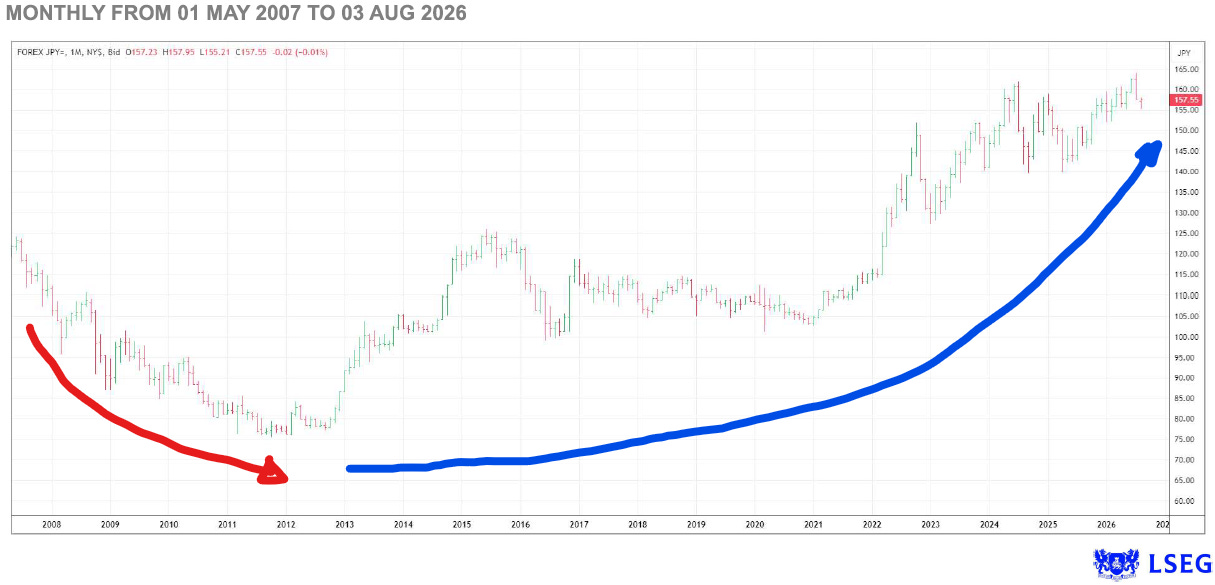
This sustained currency depreciation, combined with the inflation emerging everywhere—including Japan, following the pandemic—has placed the Japanese government in an uncomfortable dilemma. It must either raise interest rates to correct the imbalance (and it is worth noting that analysts like Robin Brooks point out that such a hike would need to be substantial to be effective) or attempt to somehow halt the yen’s slide. The problem is that while a weak currency benefits exporters, it also fuels inflation, which in turn increases the pressure to raise interest rates. It is an uncomfortable cycle.
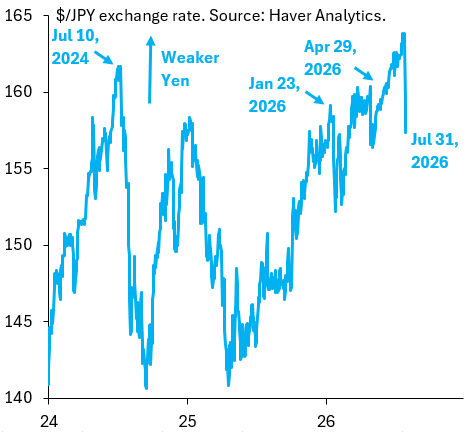
Evolution of the dollar/yen exchange rate since 2024, showing episodes of intervention. Source: article “What to Make of the Latest Yen Intervention”, Robin J. Brooks, Shadow Price Macro]
To prevent a disorderly depreciation, the Bank of Japan (BOJ) has engaged in recurring interventions, yet the practical effect has been increasingly short-lived; Robin Brooks emphasizes that the efficacy of these interventions is diminishing, with the exchange rate deteriorating more rapidly after each round. Faced with this, Tokyo sought assistance from the US Treasury. Secretary Scott Bessent bought yen and sold euros held in his portfolio—notably, he chose not to sell dollars, preferring instead to utilize his holdings of another currency. It was a decision lacking an obvious economic rationale—one for which Trump will almost certainly exact a price from the Japanese down the line.
According to Brooks, the intervention is short-lived because Japan fails to address the root of the problem: significantly raising interest rates or reducing its portfolio of foreign financial assets—which, it is worth noting, amounts to around 82% of its GDP. In the past, this very lack of structural action caused previous interventions to quickly lose momentum.
Bessent, for his part, signaled that further action might be taken, arguing that the yen’s weakness heightens the risk of broader depreciation across Asia—and that the United States would, in some way, derive “financial benefit” from the intervention. It is intriguing to see a former hedge fund manager—who once bet against the yen while working with Soros—now sitting on the other side of the table, championing the very currency he helped drive down.
As this tug-of-war between intervention and market forces plays out, the day-to-day reality of the Japanese economy clearly reflects this imbalance. Banks are profiting from a steeper yield curve, export-oriented industries are benefiting from the weak yen, and the technology sector is riding the wave of the artificial intelligence boom. On the other hand, the low-income consumer foots the bill—facing higher import costs and steeper energy prices, while suffering the effects of relentless inflation. A stronger yen would help redistribute some of these gains to consumers and to sectors that have lagged behind, such as energy and sanitation, healthcare, and basic consumer goods.
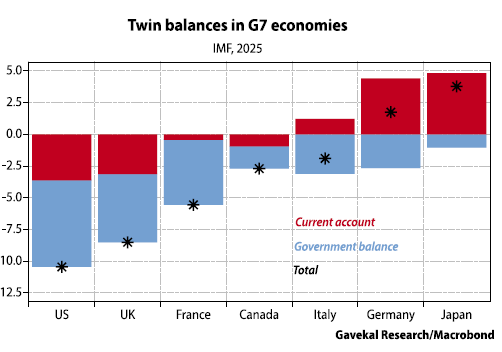
It is worth noting here that the market is divided on a crucial point: is the yen cheap or expensive? Gavekal, analyzing the currency through the four lenses it applies to any asset—fundamentals, positioning, momentum, and valuation—concludes that the yen is like a compressed spring: solid fundamentals (Japan boasts the largest current account surplus and the smallest fiscal deficit in the G7), still-light positioning, negative momentum since the April 2025 tariffs, and valuations stretched to the downside. Bessent appears to subscribe to this thesis.
Brooks strongly disagrees, and this disagreement is the most interesting point of the entire debate. In his view, the yen isn’t cheap; it’s expensive. The logic is as follows: the BOJ keeps long-term interest rates artificially suppressed by ceaselessly buying government bonds; consequently, the so-called “shadow yield”—where the 30-year rate would stand without BOJ interference—is at least 300 basis points above current levels. This suppression shifts fiscal stress from the bond market to the currency market. In other words, the yen isn’t cheap by accident; it is being prevented from pricing in Japanese fiscal risk, which is precisely why it remains weak.
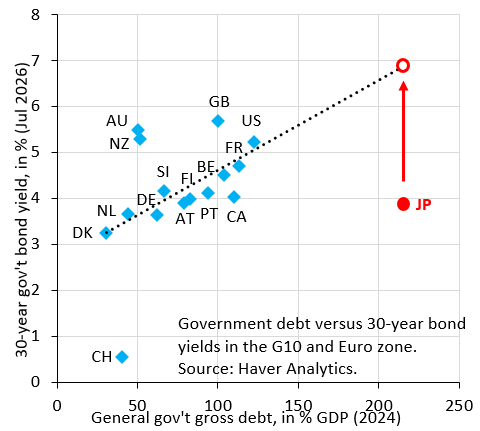
The truth is that, in recent years, the yen has ceased to be the safe haven that once yielded me good returns and has instead become the “bad boy” of the currency market—no one wants to hold a long position in it, and each intervention seems to have a shorter-lived impact than the last.
Technical Analysis
In the post “The Eclipse of the Magnificent Seven,” I made the following comments regarding the Ibovespa:
“I am increasingly confident that a red ‘wave B’ is underway; in the short term, this suggests a triangle—highlighted by the red ellipse—where the final leg is currently forming. An upward move should follow soon, pushing prices toward the levels indicated by the orange rectangle.”
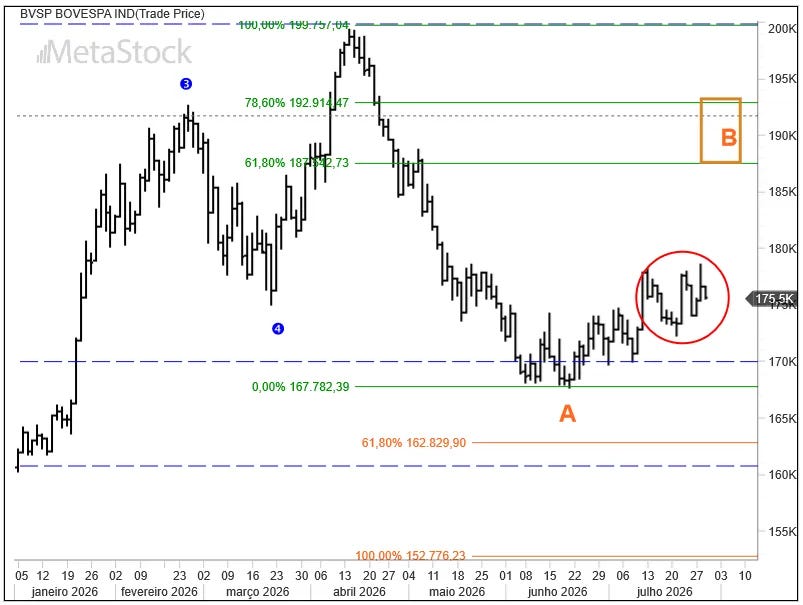
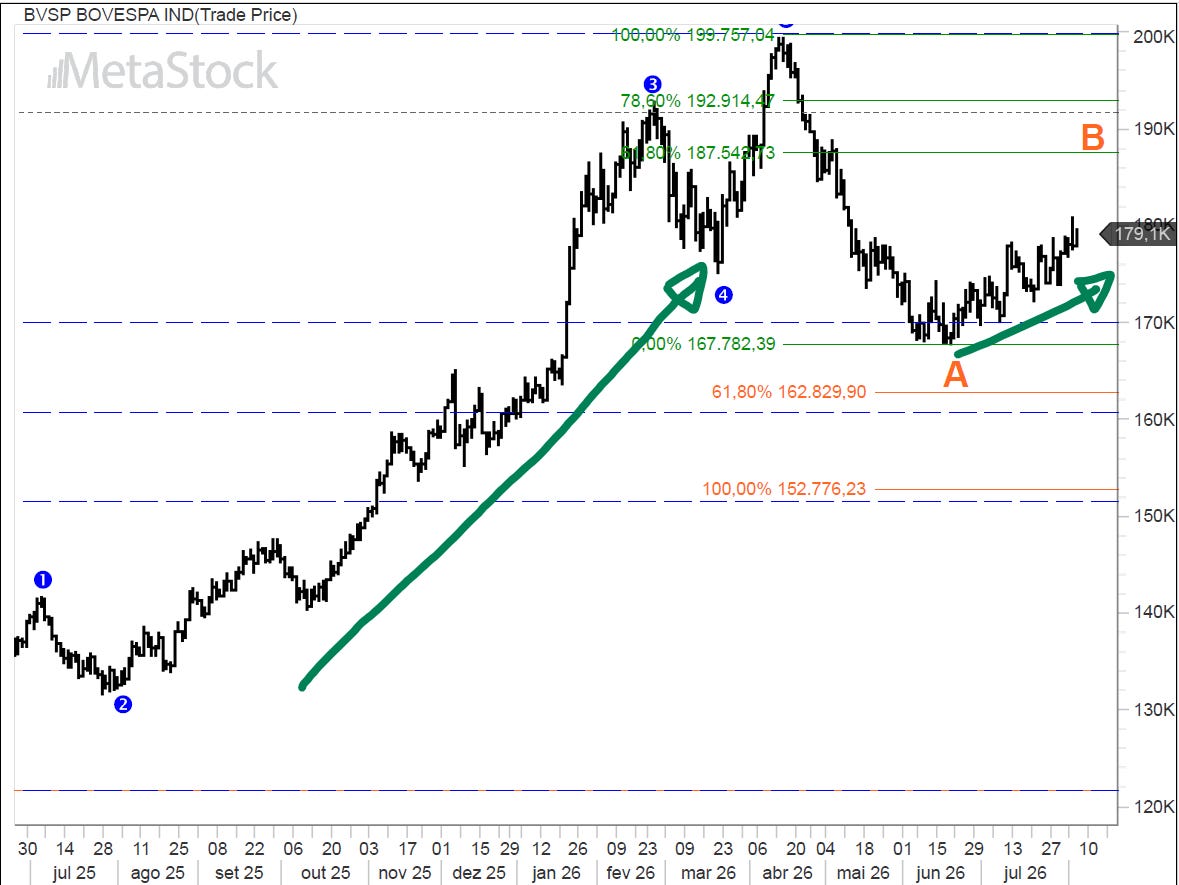
The triangle did eventually break, but without any real momentum—reflecting the same lethargic pace the stock market has shown since June; the difference is clearly visible in the slope of the green line. While international markets continue the rally that began earlier this year, the Ibovespa has lost its luster. Have investors become discouraged by the prospect of a “Lula 4” term? A scenario that, were it to happen, would be too late to matter. Acting Finance Minister Dario Durigan—whose tenure is uncertain—has been trying to convince the financial market (Faria Lima) that the government will make a fiscal effort to prevent an uncontrolled surge in public debt. However, he is viewed with deep skepticism; one need only look at the government’s track record.
It would also be wise for them to get on the same page, as Sérgio Gabrielli—the government’s campaign coordinator—expresses a different view regarding government spending and has even floated the idea of capital flow controls. That is a topic akin to stirring up a hornet’s nest.
In case the reader doesn’t quite recall who Gabrielli is: he was the president of Petrobras during the *Lava Jato* (Car Wash) scandal—which makes it baffling that he can still hold a position of trust within the PT!
Well, ultimately, it comes down to the bottom line; and, as happens from time to time, the Brazilian stock market currently offers no appealing opportunities for investors.
The S&P 500 closed at 7,723, down 0.17%; the USD/BRL exchange rate stood at R$ 5.1431, unchanged; the EUR/USD rate was € 1.1552, up 0.17%; and gold traded at US$ 4,249, up 4.21%.
Stay tuned!
Original Post: Click Here
This is not an investment recommendation.
About the Author of this Post: David Gotlib has 45 years of experience in investment management. An engineer from Polytechnic School of the University of São Paulo, he was one of the founders of the first Brazilian hedge fund in 1993 (AUM US$ 1 billion). Later, he was Managing Director of Deutsche Bank Asset Management (AUM R$ 2.2 billion) until the company was sold to Bradesco. He is currently the manager of his own investment portfolio and the author of the blog Acertar na Mosca, where, since 2011, he has shared his thoughts on the global economy and the financial market on a daily basis.
Comments
Nothing yet. Say the first thing.
Sign in to join the conversation.