
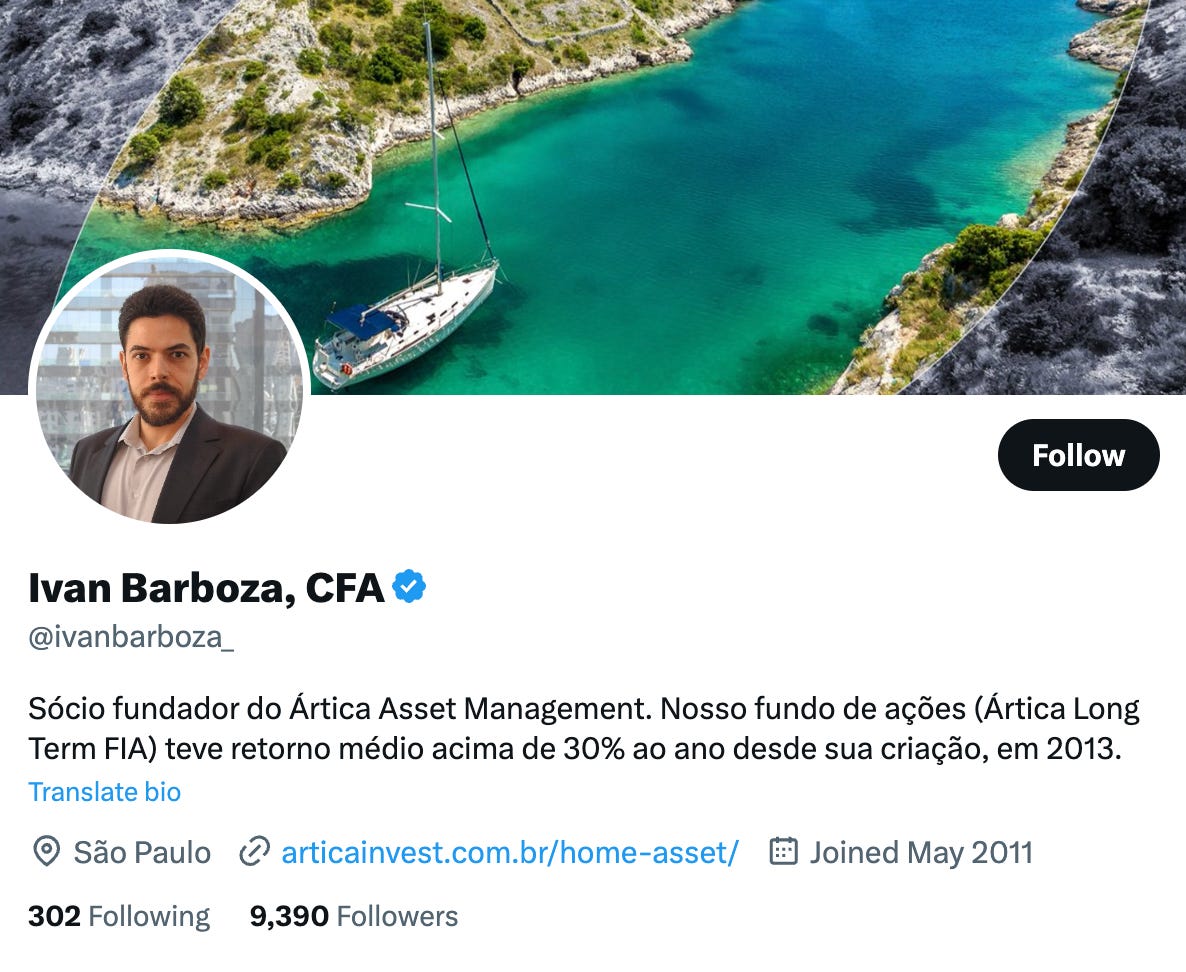
Today I have the pleasure of interviewing Brazilian investor Ivan Barboza, CFA.
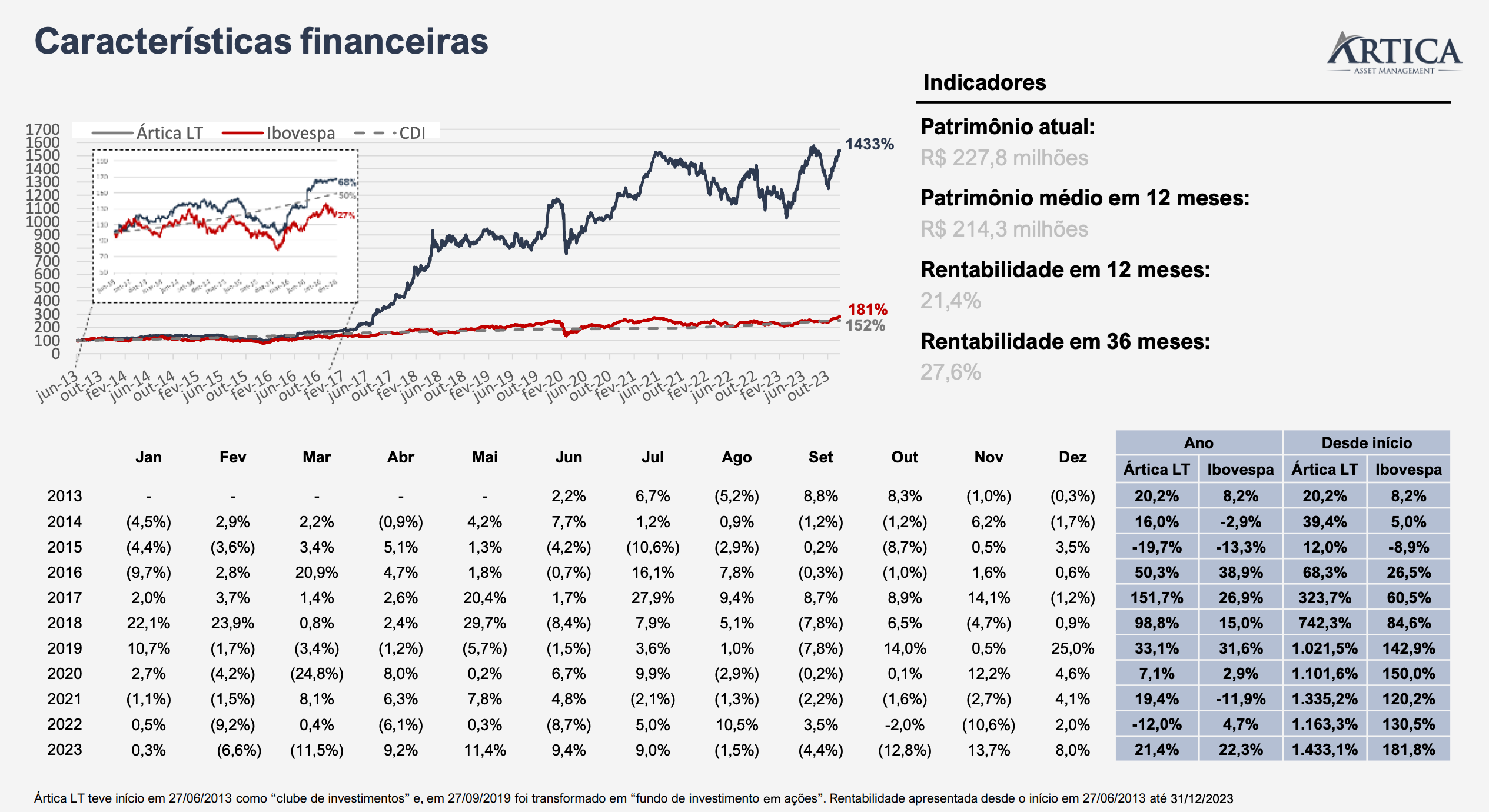
From June 2013 to December 2023 his historic performance will be the envy of anyone.
His portfolio returned 1433.1% in the period, versus 181.8% for Ibovespa.
This guy knows how to generate real value.
Shall we meet him?
BZ: Ivan, could you tell us a little about yourself?
IB: I started investing in the stock market in 2008, right in the middle of the subprime crisis. At the time, I was still in college and had very little money or knowledge. I lost part of my investment, but it turned out to be a lesson on why one shouldn’t invest recklessly. It was after that event that I began studying economics, finance, and investments in general more seriously.
I hold a degree in Engineering Physics, but I never worked in a technical role. I had a brief stint in strategic consulting right after graduating; I didn’t enjoy the field and quickly switched to investment banking. I worked in that sector for several years—mostly at Ártica, the firm I co-founded. Later, I left that line of work to dedicate myself entirely to investment management, which is what I intend to do for the rest of my life.
I manage the Ártica Long Term equity fund, which began in June 2013 as an investment club. We started very small, using only our own capital (mine and my partners’), and grew gradually using earnings from investment banking, the fund’s own returns, and investments from acquaintances who were interested due to the strong returns we had achieved over time. In 2019, we converted the club into the current equity fund.
BZ: How did your experience in Investment Banking/M&A help you with the investment and company valuation process? (Special question from Clara Sodré)
IB: Investment banking is a career that offers a privileged vantage point for learning about business. I worked on dozens of successful company acquisitions and sales; for every deal that closed, there were numerous alternatives explored beforehand. Each transaction provided the opportunity to closely follow a company’s development and get to know the key partners, executives, private equity investors, and lawyers from major firms—all top-tier professionals. Meeting hundreds of people of this caliber taught me invaluable lessons about business.
I also witnessed various companies fail completely or see their ambitious business plans thwarted. Understanding these failures is arguably even more important than understanding the successes. Grasping what leads intelligent, sophisticated people to make mistakes on major investment decisions is a vital part of becoming a skilled investor.
BZ: What is your process for finding a new buy opportunity? What filters do you use?
IB: It is a filtering process. We always start by looking for flaws in investment opportunities. The sooner we identify a problem that invalidates the thesis, the less time we spend on a poor opportunity. In this way, the approved theses are the ones that ultimately survive the analysis process.
There are two main questions we seek to answer. The first is whether the business we are evaluating is a good one—featuring high profitability and competitive advantages that appear sustainable enough to maintain that high profitability over several years. The second is whether its current share price is significantly below what we believe the business is worth.
What we are looking for is what every buyer wants: opportunities to buy something good at a low price.
BZ: What is the secret behind your portfolio’s explosive 30% annual return over the last 10 years?
IB: There is no secret—in the sense of a trick that boosts returns quickly and easily. As with almost any profession, investment success depends on time, hard work, and discipline. The rest of the team and I have dedicated our lives to becoming as skilled as possible at analyzing businesses and investment opportunities.
Our day-to-day work involves educating ourselves as thoroughly as possible on topics relevant to the investment theses we are analyzing, and then waiting patiently for good opportunities to arise. These usually appear during periods of market extremes. At such times, we remain rational and are comfortable trading against the majority of other investors for a few years.
Perhaps the greatest challenge for the individual investor is trading against the crowd. When every newspaper predicts a disastrous economic future, the confidence needed to disagree and buy stocks comes from a solid foundation of technical knowledge, rigorous analysis, and the experience of having seen such cycles play out before.
BZ: How do you value a share: DCF, Multiples, implied IRR, a mix of the previous ones, …?
IB: Valuation based on multiples is a rather simplistic technique. We use it only to gauge whether something appears expensive or cheap during the initial screening of stocks we select for analysis; multiples do not provide the level of reliability needed to make an investment decision.
We build DCF models for all investment theses. Both the fair value and the implied IRR are derived from this method. Once the model is built, we run a series of simulations—varying the assumptions that most significantly impact the valuation—to gain a better understanding of the range of possible future values for the business. It is important to highlight this point: while valuation is often discussed as a fixed figure, this is done merely for the sake of convenience. In reality, the analysis does not conclude that a business is worth exactly 100; rather, it might indicate a 90% probability that its future value will fall between 80 and 120, for example. The width of this range varies from business to business. For some companies, the probable value might be between 90 and 110, while for others, the range might span from 50 to 150.
BZ: Some investors dislike investing in commodity companies, arguing that they require more complex analysis. Do you like investing in them? How do you typically conduct your valuation analysis?
IB: We face no restrictions on investing in any specific sector, yet we do not invest heavily in commodities due to the difficulty of forecasting future commodity prices over the long term. The way we address this unpredictability—which significantly impacts the valuation of companies in these sectors—is simply by demanding a much larger margin of safety in the purchase price; this practice makes it very difficult to meet our target entry price and almost always keeps us out of commodity stocks.
BZ: Do you believe that technical analysis, combined with fundamental analysis, can help determine buy and sell points for stocks?
IB: I don’t believe in technical analysis. Especially nowadays, given the level of technology used by quantitative funds—if there were money to be made by purely analyzing a stock’s historical price series, that opportunity would be snapped up by quant funds within minutes. An individual investor analyzing charts “by eye” wouldn’t stand a chance.
I believe the best approach is to assume that price movements are random in the short term but converge toward a business’s fair value in the long term. That is the traditional premise held by fundamental investors.
BZ: What are the main analytical errors you see when applying U.S. investment literature to stock investing in Brazil?
IB: Investment principles are the same regardless of geography. What I notice about American literature is that it doesn’t pay much attention to certain issues that are rare there but significant in the Brazilian context. Examples include legal uncertainty—particularly regarding tax laws—political instability, which makes government economic policy less predictable, and interest rate volatility, which is much higher here than in the United States.
Even so, I believe it is the best source for study. Unfortunately, Brazilian literature on investment and business still leaves much to be desired compared to the American material.
BZ: Do you believe the pattern of the Ibovespa cycle chart (in USD) will hold?
IB: Economic cycles will continue to occur, and therefore the IBOV will continue to show a chart of ups and downs; however, I do not think it is possible to predict the timing of how these cycles unfold based on chart analysis of past cycles. In other words, even with a reasonable idea of which phase of the cycle we are currently in, the moment the current trend reverses will always be highly unpredictable.
BZ: What additional margin of safety is required to justify swapping a stock currently in the portfolio for another? In other words, how much greater must the potential return of a stock under analysis be to warrant selling a current position? (Musashi’s Special Question)
IB: We don’t have a hard-and-fast rule for this, but it is generally somewhere between 10% and 20%. One must take into account the imprecision inherent in valuation. If the difference in margins of safety is 5%, it falls within the margin of error. It is not attractive to incur transaction costs and the burden of switching to a less familiar investment thesis based on a very small price difference.
BZ: How do you rebalance the portfolio based on market volatility, and what is the best way to do this given liquidity constraints? How can you continue to significantly outperform the benchmark if the fund’s assets under management grow? (Special question from Pedro Perin)
IB: We consider three aspects when determining the weight of each stock in our portfolio: the risk-return profile of each asset, the degree of uncertainty surrounding each investment thesis, and the correlation of each business with the other companies already in our portfolio. However, there is no formula that dictates the ideal allocation for each thesis; it is a blend of quantitative analysis and subjective judgment.
Regarding performance as the fund grows, I do not believe it is possible to avoid a drop in returns once assets reach a certain level—provided we continue to operate solely in the local market. Investing exclusively in Brazil, it seems to me that we would begin to see diminishing returns once assets exceed R$ 1 billion (the fund currently holds R$ 230 million, so we have plenty of room). Our plan to address this issue is to look at other geographies as well. Brazil accounts for about 3% of the global stock market; expanding into new markets significantly increases the scale we can achieve while maintaining the same return targets.
BZ: Which incentive for the management of a publicly traded company is most aligned with the interests of shareholders? (Special question from João Marcos)
IB: Variable compensation paid through the granting of shares subject to vesting (a minimum period during which the executive must retain ownership of the shares). This structure ensures that executives become long-term shareholders of the very company they manage, sharing in the downside when the stock price falls and benefiting when it rises.
BZ: What is the cheapest company on the stock market today?
Comments
Nothing yet. Say the first thing.
Sign in to join the conversation.