
Today I have the pleasure of interviewing Brazilian investor Jayme Simão.

From January 2024 to June 2026 his historic performance will be the envy of anyone.
His portfolio returned 54.32% in the period, versus 28.20% for Ibovespa.
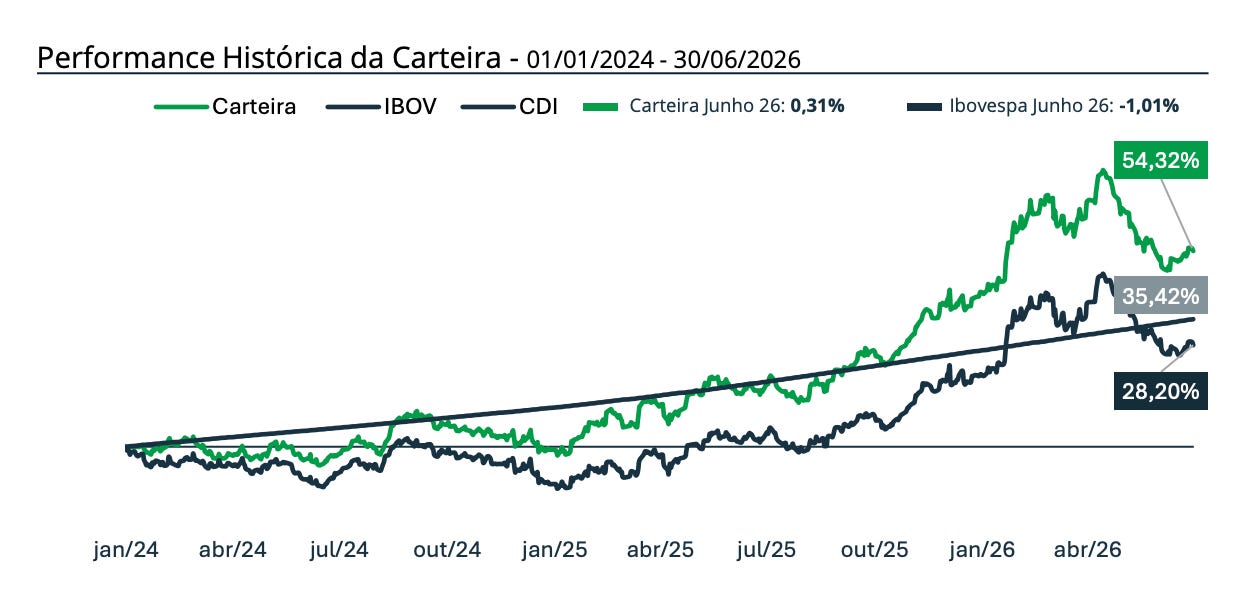
This guy knows how to generate real value.
Shall we meet him?
BZ: Jayme, could you tell us a little about yourself?
JS: I am a production engineer by training, with an MBA from Insper. I built a corporate career in operations at Ambev until I was thirty. That experience gave me a valuable perspective on how companies actually function—far removed from the “Faria Lima” valuation bubble.
After that, together with my partner Ricardo, I founded Hub do Investidor, which has now been operating for six years. Today, we are one of the country’s leading research firms, focused entirely on serving institutional clients: investment advisory firms, brokerages, banks, and asset managers.
BZ: What is your strategy for making money on the stock market?
JS: Our methodology revolves largely around the margin of safety. Whether in our reports or during committee discussions on allocating a stock to a portfolio, we prefer to stress-test the variables that drive the company’s revenue and cash generation. And when testing these variables, we tend to avoid optimism. In other words, we look for a scenario where things don’t go particularly well for the company, yet the stock remains cheap. That is the kind of situation we like.
We are not a firm that speculates on a company’s success; instead, we focus on finding a margin of safety in the price under adverse conditions.
BZ: What is your process for finding a new buy opportunity? What filters do you use?
JS: We do use some quantitative filters—mainly regarding liquidity, since we manage some large portfolios. We also look for companies with a track record of cash generation, though this isn’t a hard-and-fast rule, as a company might be going through a rough patch.
Beyond that, the process is largely qualitative. It’s about understanding whether the business is sound and capable of weathering various economic cycles. We also pay close attention to the people running the business—the family behind it. We aren’t big fans of widely held corporations; we prefer owner-led companies.
BZ: How do you value a share: DCF, Multiples, implied IRR, a mix of the previous ones, …?
JS: We use a bit of everything. The DCF ends up being the primary method for arriving at a valuation. We look at multiples occasionally—usually at the end of the fiscal year—to compare against peers. We also work backward to calculate the implied IRR to see if the price makes sense.
But, again, what matters most is how we handle the variables that make up the key components of the DCF: we stress-test those variables to understand the margin of safety.
BZ: How do you like to build your stock portfolio, considering the number of companies, sectors and concentration?
JS: We aren’t big fans of excessive diversification. That is precisely why we like using ETFs—including within our strategies—following a “core-satellite” approach: the ETF forms the portfolio’s indexed core, and we then seek to generate alpha by adding specific individual stocks.
In practice, we typically work with a single ETF making up the core, complemented by investment theses involving six to twelve individual names.
BZ: How often do you like to rebalance your portfolio?
JS: It really depends. If a stock’s price has dropped and we believe the investment thesis remains unchanged, we might rebalance as often as every month. But generally, our average rebalancing cycle is around every three months. Sometimes it’s more frequent; other times, we might go a bit longer than three months without making any changes.
BZ: How long on average do you hold a position in your portfolio?
JS: We don’t have a hard-and-fast rule. However, since we seek a significant margin of safety, when the investment thesis plays out successfully, that margin supports the position for a long time. So, we typically hold these investments for years. Among the names we hold today, well over half have been in the portfolio for at least two years.
BZ: Do you believe that graphical analysis, together with fundamental analysis, can help with the buying and selling points of stocks?
JS: Yes. Again, we don’t use technical analysis as the basis for our decision-making here, but we do view the chart as a comprehensive map of that asset’s history. When you zoom in, you can spot some interesting points. That’s what we use it for.
So, to sum up: the decision stems from both the macro and the micro, but the implementation certainly involves the chart.
BZ: What are your favorite sectors on the Stock Exchange? And the ones you avoid? Why?
JS: We don’t have any major sectoral reservations. Everything is fair game; there are good companies in every sector—that’s just the nature of the economy. However, we have been allocating heavily to utilities lately, seeking out strong cash generators that offer a margin of safety. This doesn’t happen all the time, but during periods of market stress, you often find companies offering returns of IPCA plus 12% or IPCA plus 15%.
Honestly, there isn’t a specific sector we avoid. In practice, though, the healthcare sector is quite complex and difficult to make money in, with rare exceptions.
BZ: Do you use stop loss? Where do you usually place it?
JS: We don’t use stop-losses in the classic sense of closing out a position at a specific price level. Instead, we have internal rules requiring a rigorous re-examination of the investment thesis if the stock drops more than 20% against our expectations—provided that decline isn’t linked to a macroeconomic move.
BZ: Do you use derivatives? What is your strategy?
JS: No, not given the mandates of the portfolios we manage. However, we consider it a very interesting tool for hedging and risk reduction. Overall, we focus on managing equities and other variable-income assets, and when we look to complement that diversification, we tend to use fixed-income ETFs.
BZ: What is the cheapest company on the stock market today?
Comments
Nothing yet. Say the first thing.
Sign in to join the conversation.