
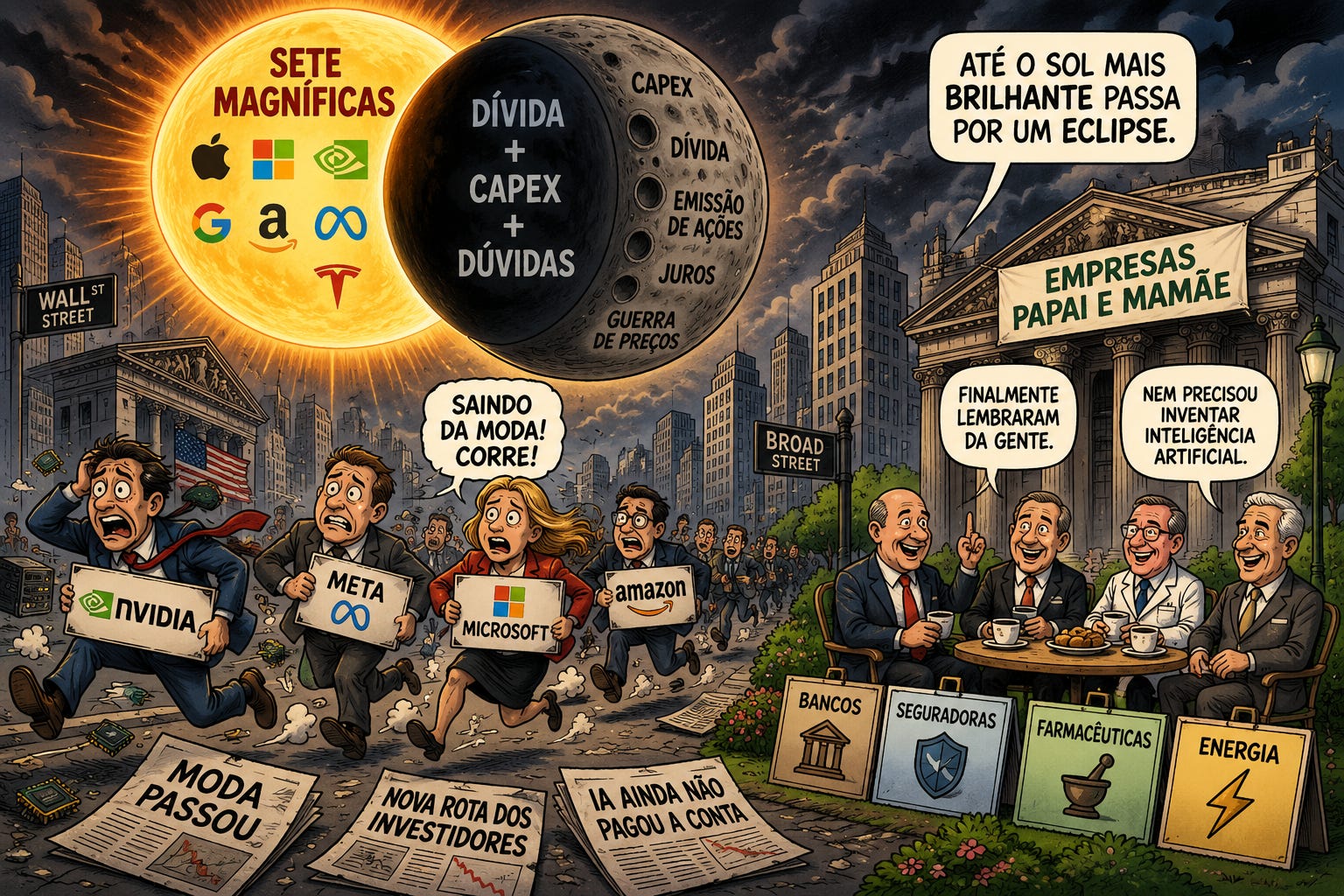
Mentions of the “Magnificent Seven” have all but vanished from the headlines—something that should surprise no one who has followed the market for any length of time. With every new technology, a group of companies emerges to dominate the spotlight for a while, until the trend runs its course and a new protagonist takes center stage. Most recently, it was the turn of chipmakers—companies “rediscovered” overnight when demand for data centers exploded far beyond anyone’s expectations. Profits soared, and the market—as it always does—rushed to project that growth indefinitely into the future.
But a familiar problem cropped up: where does the money come from to sustain investments of this magnitude? Initially, companies tapped into their cash reserves—and these were substantial war chests. It wasn’t enough. They then turned to borrowing, and that’s when the snowball effect began. Each company launched an investment program as ambitious as its rival’s—a “pedal-to-the-metal” approach that left Wall Street skeptical about whether all that capital would ever pay for itself. The specter of billions invested in processing capacity failing to yield a return on capital is already haunting investors; they have begun unwinding positions in tech giants and shifting toward more traditional companies—what I often call “mom-and-pop” stocks: banks, insurers, and pharmaceutical firms—businesses that don’t promise dizzying growth but deliver predictable income.
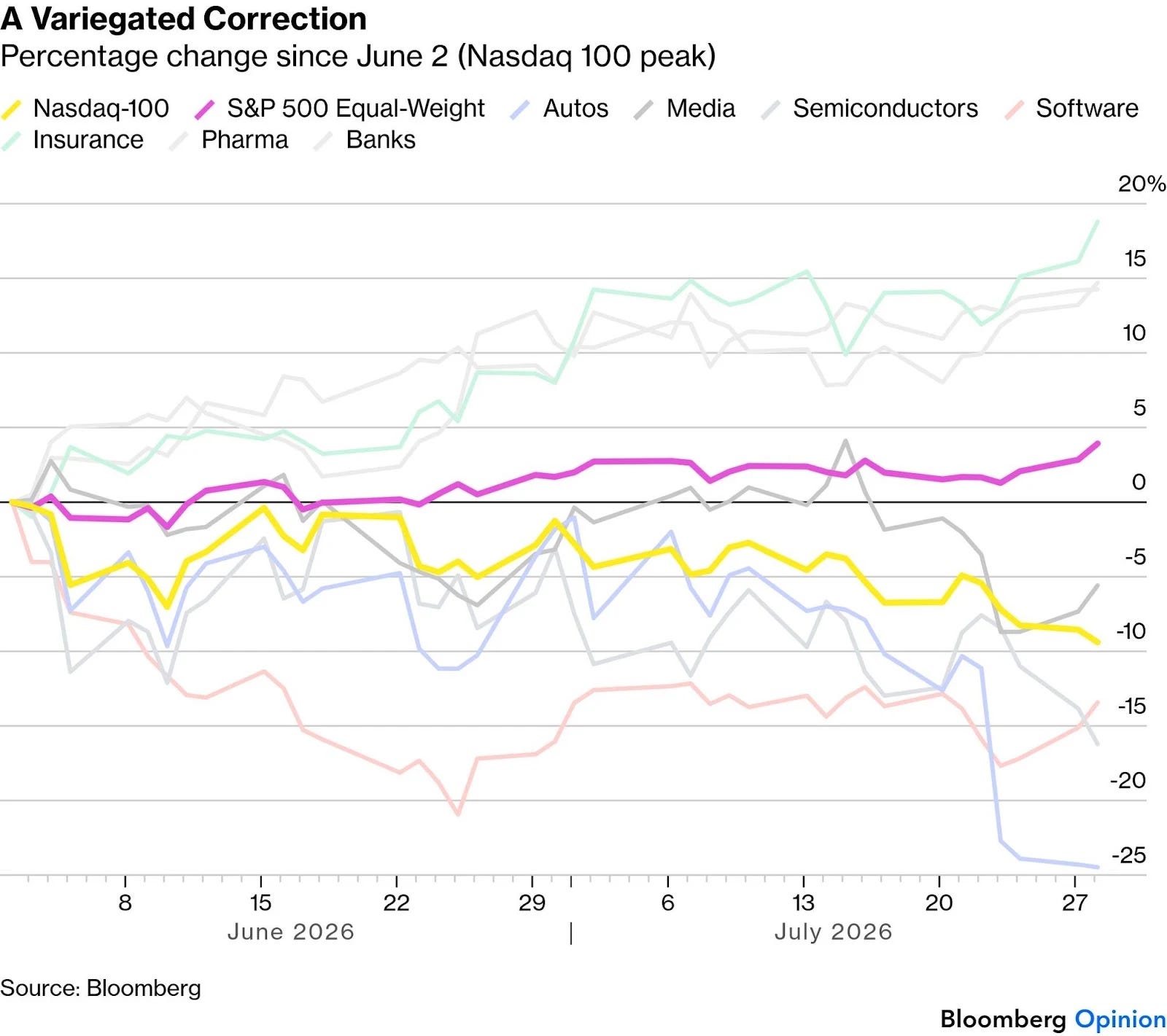
The results of this shift are already showing up in the numbers. The equal-weighted S&P 500—which assigns the same weight to each of the index’s five hundred companies—hit an all-time high and outperformed the Nasdaq 100, which is itself teetering on the edge of a 10% correction. The dispersion within the market itself is striking: the 25 best-performing stocks in the Russell 1000 during the first half of the year—most of them linked to semiconductors and AI infrastructure—have fallen by an average of more than 36% this month. Conversely, the 25 worst performers of the semester rose by 14%. The narrative is flipping right before our eyes, without any significant corporate news to justify such an abrupt turnaround.
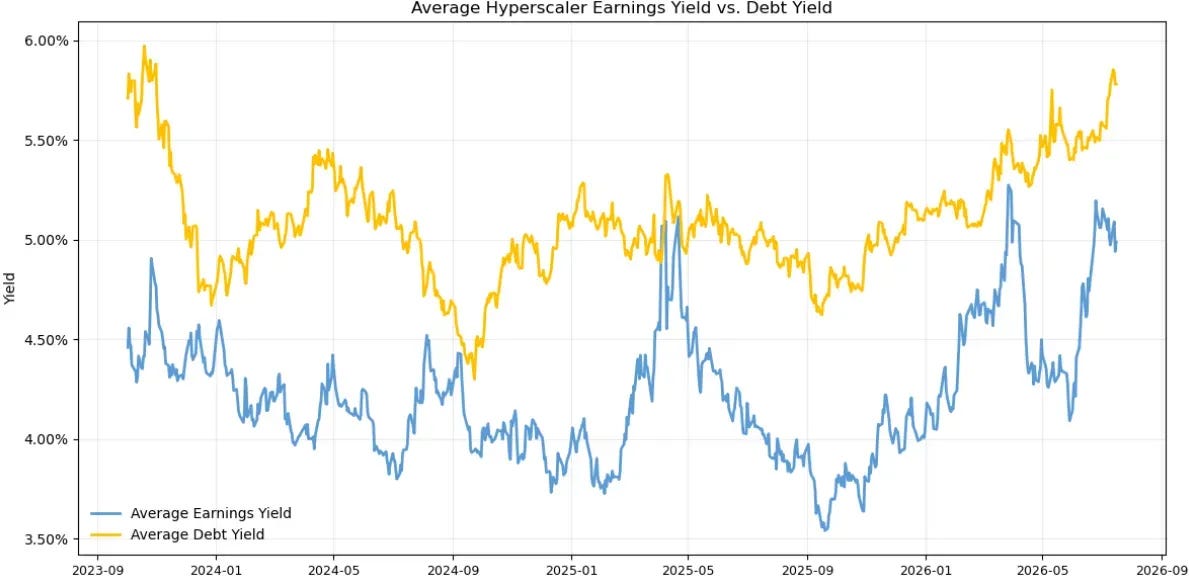
As investor appetite for tech stocks cools, the cost of financing that same technology is rising. A $12.5 billion bond offering linked to a Meta data center project in Texas priced at an annual rate of 7.5%—nearly three percentage points above the 10-year Treasury yield—representing a higher premium than that paid on a similar deal the previous year. New bond issuance by companies linked to artificial intelligence has already reached $270 billion this year, nearly double the total issued throughout last year.
Faced with these rising debt costs, the “hyperscalers”—the nickname the market has given the giants underpinning AI infrastructure—have begun to favor raising capital through equity issuance. Historically, this has been cheaper for them than debt, given the generous multiples at which their shares trade.
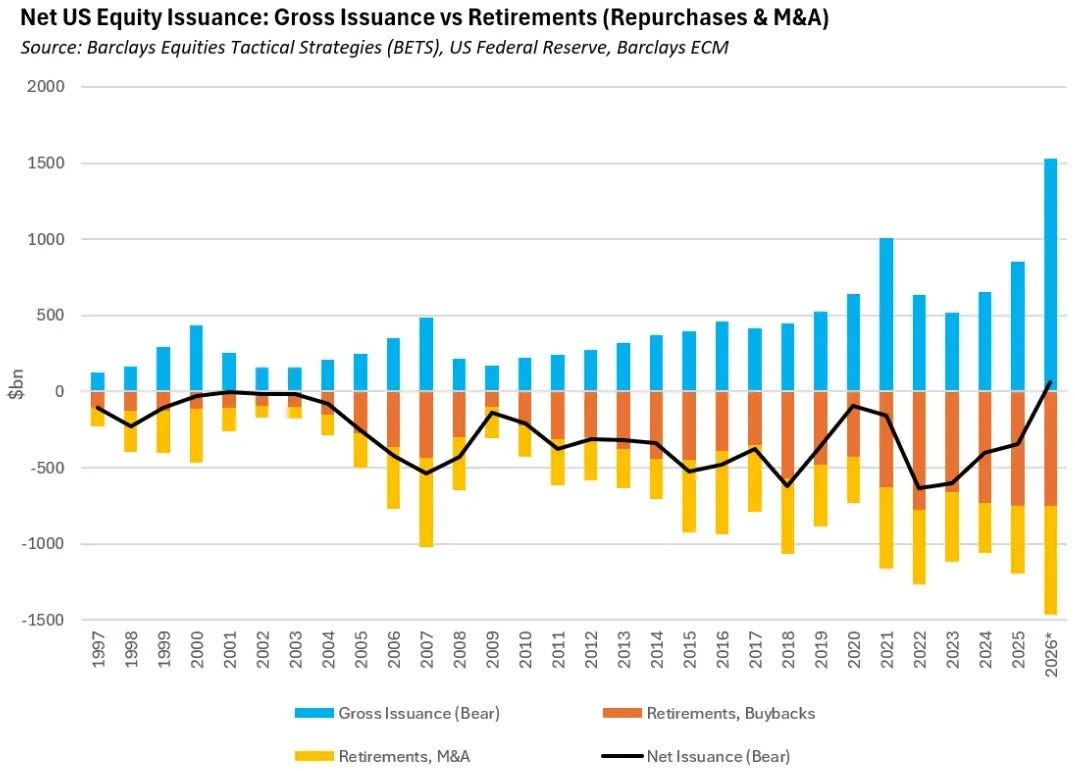
The result is that 2026 could become the first year in decades to see net equity issuance in the United States rise again, reversing the trend of share buybacks that has supported the stock market for so long.
Increased supply of stock in the market tends to put downward pressure on prices—yet another ingredient in the mix that has caused investors to lose steam regarding the “Magnificent Seven” narrative.
All of this has unfolded rapidly and intensely, and it is natural for investors to feel wary; after all, a vast amount of money is riding on something that is still new. Adding to this skepticism is the ongoing price war among service providers—a topic I discussed in my post “token-liquidation.” I have no doubt that many companies will go bust during this process, just as happened with the dot-coms in the early 2000s. But there is a significant difference between that moment and the present: back then, the billions in revenue projected by the market were merely a hope—a distant promise. Today, it is a reality already reflected in financial statements.
I cannot say whether what we are experiencing now is merely a passing fear, or if, ten years from now, the use of artificial intelligence will be so widespread—and in such diverse ways—that even a low price point multiplied by billions of users will justify current investments. Another point worth considering is that the “Magnificent Seven” are solid companies with decades-long track records; dismissing their executives as reckless strikes me as questionable. I can assure you that they face just as many uncertainties as we do—albeit perhaps fewer—and they certainly didn’t reach the top by acting like reckless gamblers.
It is worth noting that the “Magnificent Seven” never formed a homogeneous block. Apple—often criticized for failing to gain a strong foothold in artificial intelligence—has nonetheless overtaken Nvidia again as the world’s most valuable company, reaching a market capitalization of $5 trillion this week. It serves as a reminder that, even within the same group, fortunes can diverge significantly.
History, however, works against them: market leaders rarely stay at the top for long. Bloomberg’s John Authers titled his latest piece “The Sunset of the Magnificent Seven.” For now, I prefer to call it an eclipse—a passing phenomenon that obscures without necessarily extinguishing.
Technical Analysis
In the post “the-retirement-stock,” I made the following comments regarding the Ibovespa:
“The red Wave A looks ‘neat’—’by the book,’ as market jargon goes. Consequently, a red Wave C is required—though not yet visible—which should reach levels lower than red Wave A, around the 160,000 mark (a figure subject to further calculation).”
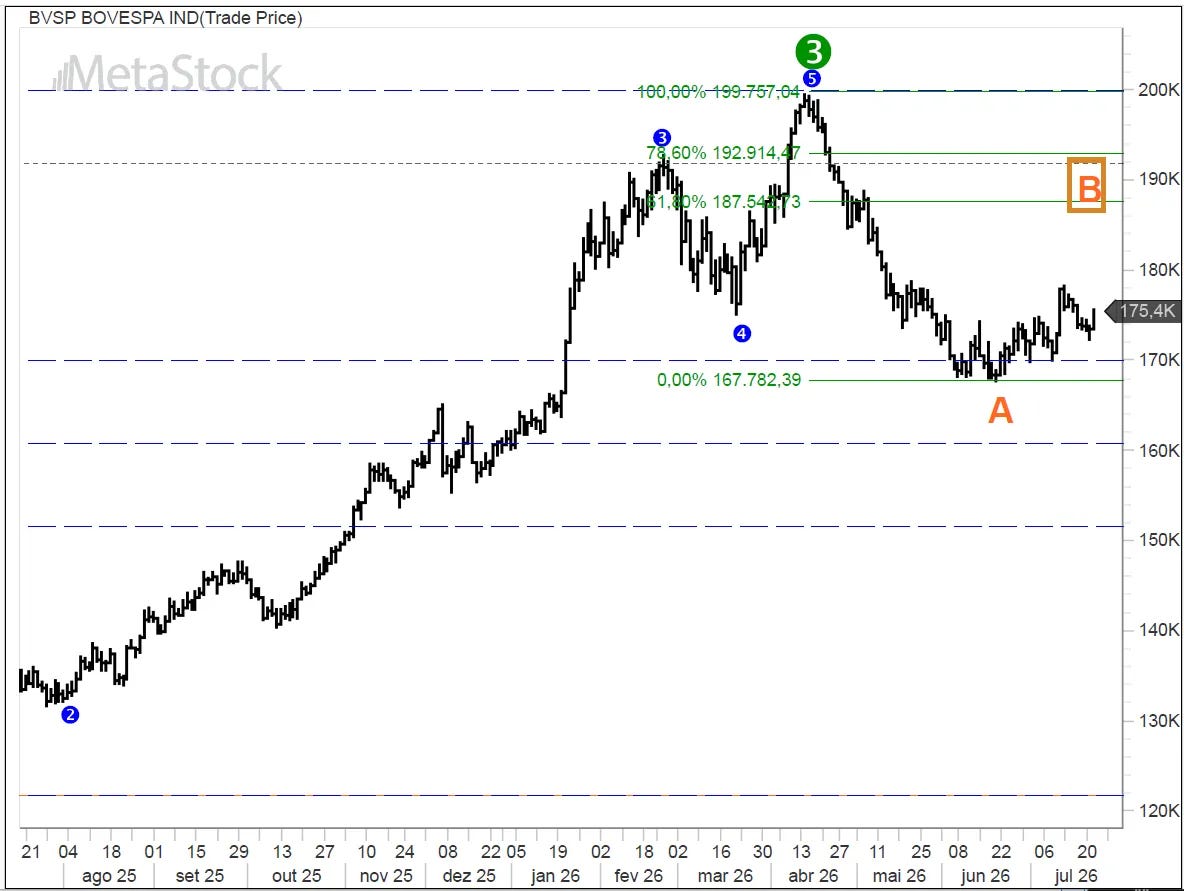
The Brazilian stock market is moving without much conviction—rising one day and falling the next—which is typical of corrections. With each passing day, I grow more confident that a red Wave B is underway; the short-term outlook suggests a triangle pattern (highlighted by the red ellipse), where the final leg is currently forming. An upward move should follow soon, taking the index to the levels indicated by the orange rectangle—I will be able to provide a more precise forecast if the triangle scenario proves correct.
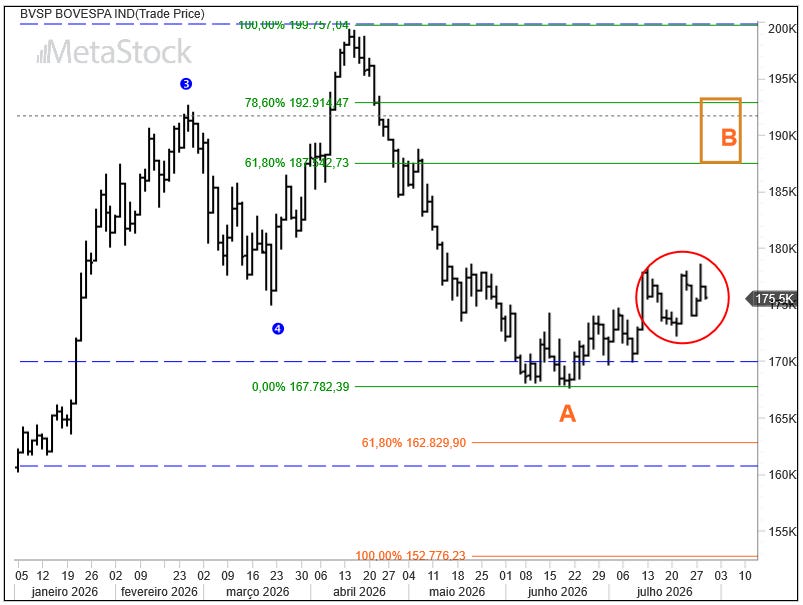
I ventured a buy recommendation a few days ago, but we were stopped out at breakeven. You may recall I mentioned that Wave Bs are very difficult to trade: they take two steps forward and one—or one and a half—steps back. Observe the movement since June of this year—where the orange “wave A” is located—and tell me if that isn’t how the stock market performed.
The S&P 500 closed at 7,316, down 1.52%; the USDBRL at R$ 5.1274, down 0.16%; the EURUSD at € 1.1449, up 0.55%; and gold at US$ 4,049, up 0.54%.
Stay tuned!
Original Post: Click Here
This is not an investment recommendation.
About the Author of this Post: David Gotlib has 45 years of experience in investment management. An engineer from Polytechnic School of the University of São Paulo, he was one of the founders of the first Brazilian hedge fund in 1993 (AUM US$ 1 billion). Later, he was Managing Director of Deutsche Bank Asset Management (AUM R$ 2.2 billion) until the company was sold to Bradesco. He is currently the manager of his own investment portfolio and the author of the blog Acertar na Mosca, where, since 2011, he has shared his thoughts on the global economy and the financial market on a daily basis.
Comments
Nothing yet. Say the first thing.
Sign in to join the conversation.