
Chapter 2
The Munger Approach to Life, Learning, and Decision Making
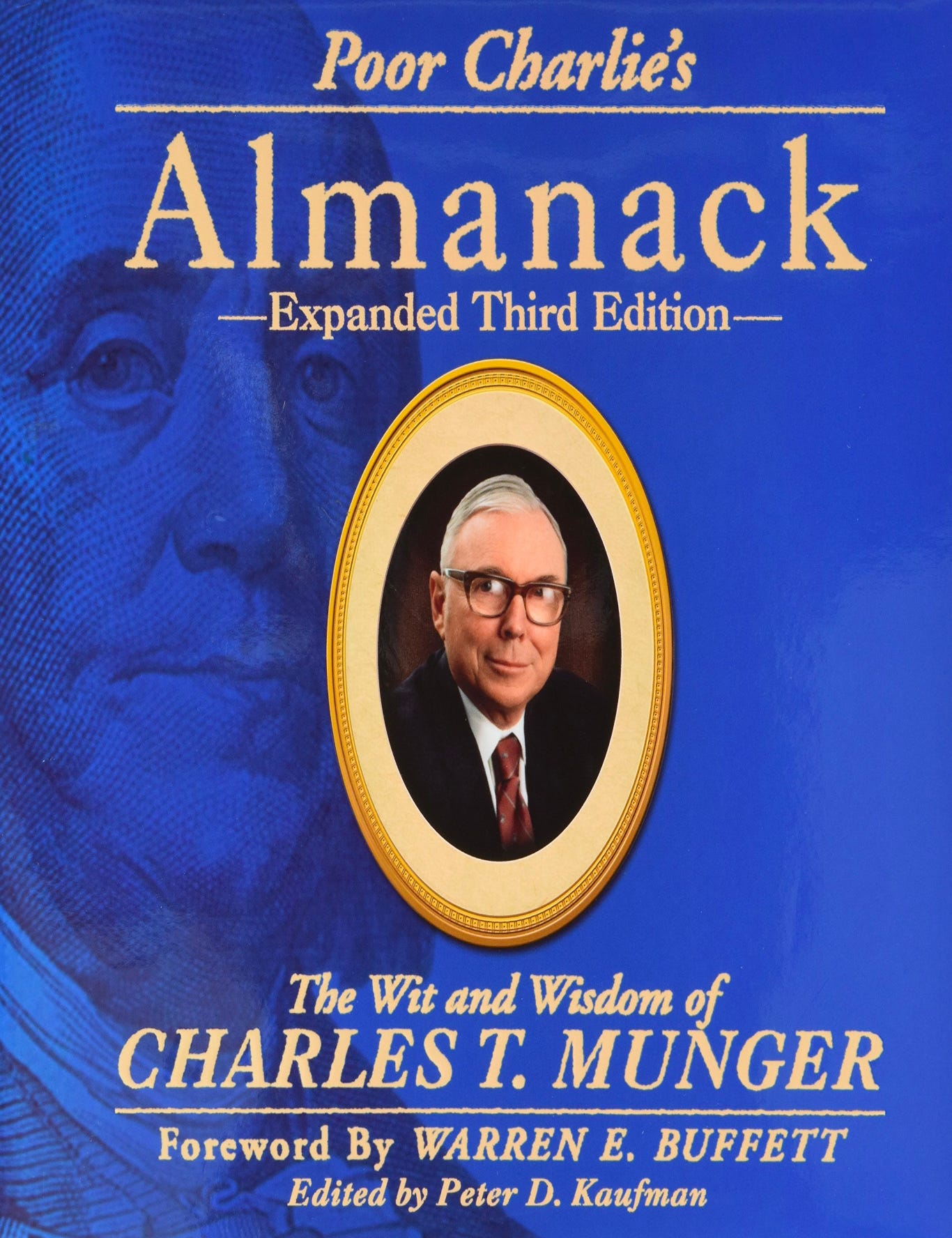
Chapter 2 of Poor Charlie’s Almanack introduces what Charlie Munger considers the foundation of sound judgment: worldly wisdom. Rather than focusing on stock-picking techniques or financial formulas, Munger argues that successful investing begins with learning how to think correctly. He believes that most investment mistakes are not caused by a lack of intelligence, but by narrow thinking and poor decision-making. Investors who wish to outperform over the long term must build a broad understanding of how the world works instead of becoming experts in only one field. This chapter lays out the intellectual framework that guided Munger throughout his remarkable career alongside Warren Buffett.
Munger begins by criticizing the modern educational system, which often encourages excessive specialization. Universities produce highly skilled professionals within individual disciplines, but many graduates fail to understand how those disciplines connect. Economists often ignore psychology. Engineers overlook incentives. Lawyers may know the law but fail to appreciate basic economics. According to Munger, reality does not organize itself into academic departments, so our thinking should not either.
Instead, he proposes developing what he calls a latticework of mental models. A mental model is a fundamental concept that explains how part of the world operates. Every important discipline—economics, mathematics, psychology, biology, engineering, physics, history, statistics, and even evolution—contains a handful of core ideas that repeatedly explain human behavior and real-world outcomes. The objective is not to become an expert in every field, but to master the few truly important concepts from each one and integrate them into a coherent decision-making system.
For investors, this idea has profound implications. Financial statements alone rarely tell the complete story about a business. Understanding consumer psychology, competitive dynamics, incentives, technological change, network effects, organizational behavior, and human biases often provides a much greater advantage than simply memorizing accounting ratios. Munger argues that investors who rely on only one analytical framework resemble a carpenter whose only tool is a hammer. When every problem looks like a nail, mistakes become inevitable.
This observation leads to one of Munger’s most famous ideas: “To the man with only a hammer, every problem looks like a nail.” He warns that professionals naturally become prisoners of their own specialties. Accountants see accounting solutions. Lawyers see legal solutions. Economists see economic explanations. Investors fall into the same trap when they evaluate every company using only valuation multiples or discounted cash flow models. The world’s complexity requires multiple perspectives. The best investors constantly switch between different mental models depending on the situation.
Another major theme of the chapter is the importance of understanding human psychology. Munger believes that nearly every significant investment mistake ultimately traces back to predictable flaws in human behavior. People become overconfident, follow crowds, fear losses more than they value gains, seek confirmation for existing beliefs, and react emotionally during periods of uncertainty. Markets amplify these tendencies because investors constantly influence one another.
Rather than assuming people behave rationally, Munger urges investors to expect irrational behavior as the norm. Successful investing therefore requires recognizing psychological biases not only in other market participants but also in ourselves. The investor who understands human nature gains an enormous competitive advantage because markets frequently misprice assets when emotions dominate rational analysis.
Closely related is Munger’s emphasis on incentives, a subject he repeatedly describes as one of the most powerful forces governing human behavior. People generally respond to incentives exactly as incentive systems encourage them to behave, even when those behaviors produce undesirable outcomes. Executives, brokers, analysts, consultants, politicians, and corporate managers all make decisions within structures that reward certain actions.
For investors, understanding incentives often reveals more about a company’s future than reading its annual report. Executive compensation plans, ownership structures, customer relationships, regulatory environments, and industry economics all shape behavior. Whenever investors fail to examine incentives carefully, they risk misunderstanding why decisions are being made.
Munger also stresses the importance of probabilistic thinking. Investing rarely offers certainty. Instead of searching for perfect predictions, investors should estimate probabilities and make decisions when the expected outcomes are favorable. This approach requires accepting uncertainty while remaining rational. Good decisions can occasionally produce poor outcomes, just as bad decisions sometimes appear successful because of luck. Therefore, investors should judge their decisions by the quality of their reasoning rather than by short-term results.
This naturally connects with another key lesson: always focus on avoiding stupidity before pursuing brilliance. Munger frequently remarks that it is easier to become consistently successful by eliminating obvious mistakes than by trying to discover spectacular opportunities. Investors often spend enormous energy searching for the next multibagger while ignoring basic errors such as excessive leverage, overconfidence, inadequate diversification, emotional trading, or poor risk management.
One of Munger’s recurring principles is inversion—the habit of solving problems by considering the opposite perspective. Instead of asking, “How can I become wealthy?” he encourages investors to ask, “What behaviors almost guarantee financial failure?” The answers are usually straightforward: excessive debt, frequent speculation, emotional decision-making, ignoring incentives, failing to learn continuously, and refusing to admit mistakes. By systematically avoiding these behaviors, long-term success becomes much more likely.
The chapter also highlights the importance of continuous learning. Munger argues that knowledge compounds exactly like capital. Every new mental model increases the usefulness of all previous knowledge because ideas reinforce one another. Reading broadly across many disciplines therefore produces exponential returns over decades. History, biology, engineering, mathematics, philosophy, and psychology all contribute insights that improve investment decisions.
This lifelong learning mindset distinguishes exceptional investors from average ones. Markets evolve, industries change, technologies emerge, and competitive advantages disappear. Investors who stop learning gradually become less capable of interpreting new information. Munger himself devoted several hours every day to reading, believing that intellectual curiosity represented one of the greatest competitive advantages available.
Another central idea is the importance of independent thinking. Munger warns against following popular opinion simply because it is widely accepted. Financial markets constantly create social pressure to conform. During bubbles, optimism becomes contagious. During crashes, pessimism spreads just as rapidly. Investors who depend on consensus inevitably buy high and sell low.
Instead, Munger advocates building convictions based on facts, logic, and careful analysis. Independent thinking does not mean automatically disagreeing with everyone else. It means reaching conclusions through one’s own reasoning rather than borrowing the opinions of others. The ability to remain rational when the crowd becomes emotional represents one of the defining characteristics of outstanding investors.
Humility also occupies an important place within Munger’s framework. Despite his extraordinary success, he consistently reminds readers that reality is too complex for anyone to understand completely. Investors should therefore remain willing to change their minds whenever new evidence appears. Confidence should come from disciplined reasoning rather than from certainty. Recognizing the limits of one’s knowledge often prevents catastrophic mistakes.
Throughout the chapter, Munger repeatedly returns to the idea that successful investing is fundamentally a byproduct of good thinking. Superior returns do not primarily result from discovering secret information or predicting market movements. They emerge from consistently making slightly better decisions than others over very long periods. Better decisions arise from broader knowledge, stronger mental models, sound psychology, rational judgment, and relentless curiosity.
For stock investors, Chapter 2 may be the most important part of Poor Charlie’s Almanack. Rather than offering formulas for beating the market, Munger provides something much more valuable: a framework for improving the quality of one’s thinking. He argues that investment success begins long before analyzing companies or building portfolios. It begins by constructing a mind capable of understanding reality from multiple perspectives, recognizing psychological traps, evaluating incentives, embracing lifelong learning, and remaining intellectually humble.
Ultimately, Charlie Munger’s message is simple but profound. Wealth is not created by isolated moments of brilliance but by decades of rational decision-making. Investors who develop a multidisciplinary understanding of the world, continuously refine their judgment, and patiently apply timeless principles will enjoy an enduring advantage over those who rely only on technical knowledge or market forecasts. In Munger’s view, the greatest investment anyone can make is not in stocks, but in building a better mind.
Enter your email below and receive more content like this delivered fresh to your inbox.
Did you enjoy it? Then click below and share it with your friends!
Comments
Nothing yet. Say the first thing.
Sign in to join the conversation.