
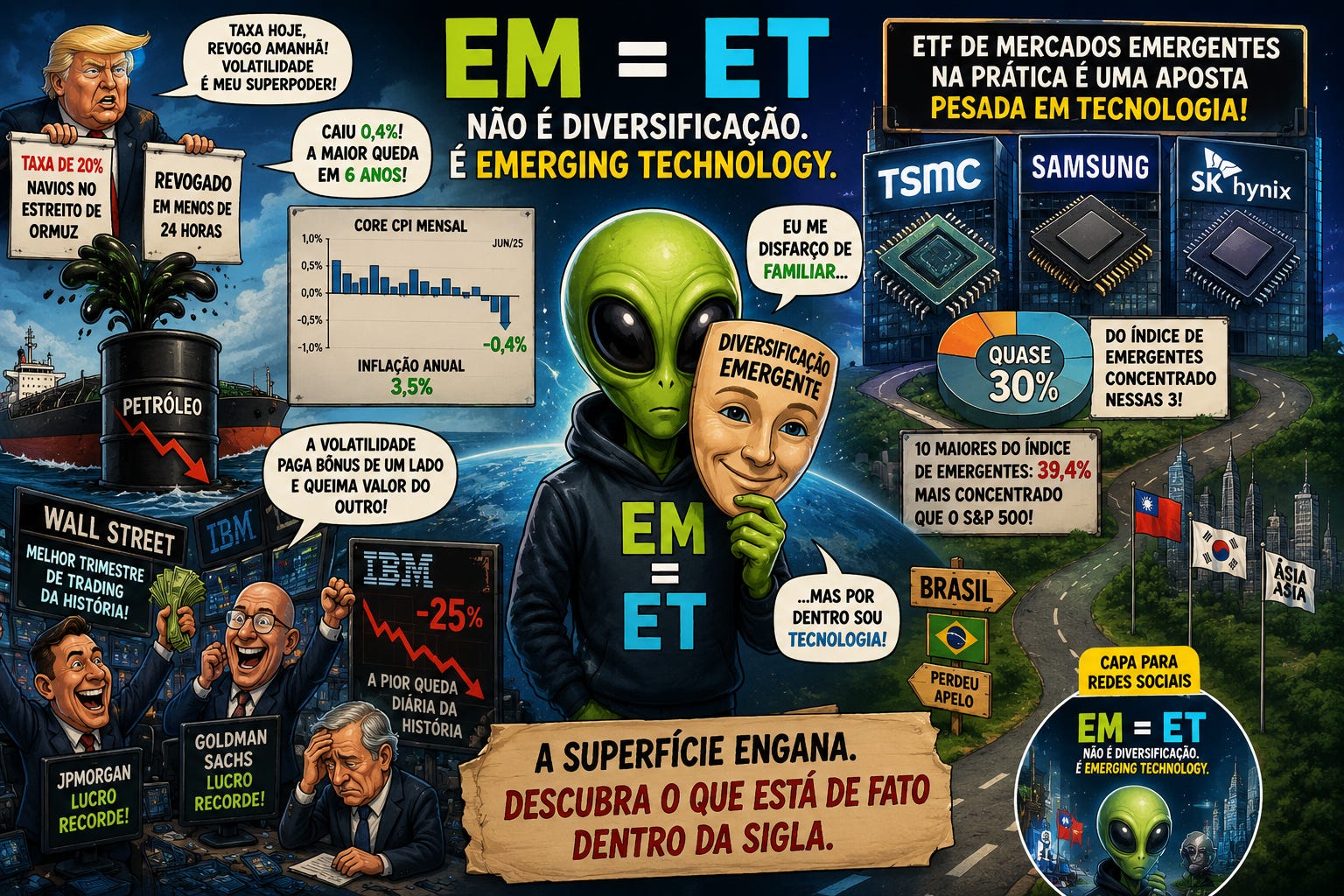
Yesterday was a “reversal day,” and the market celebrated as if it were a victory. The June CPI fell 0.4%—the largest monthly drop in six years—and annual inflation retreated to 3.5%.
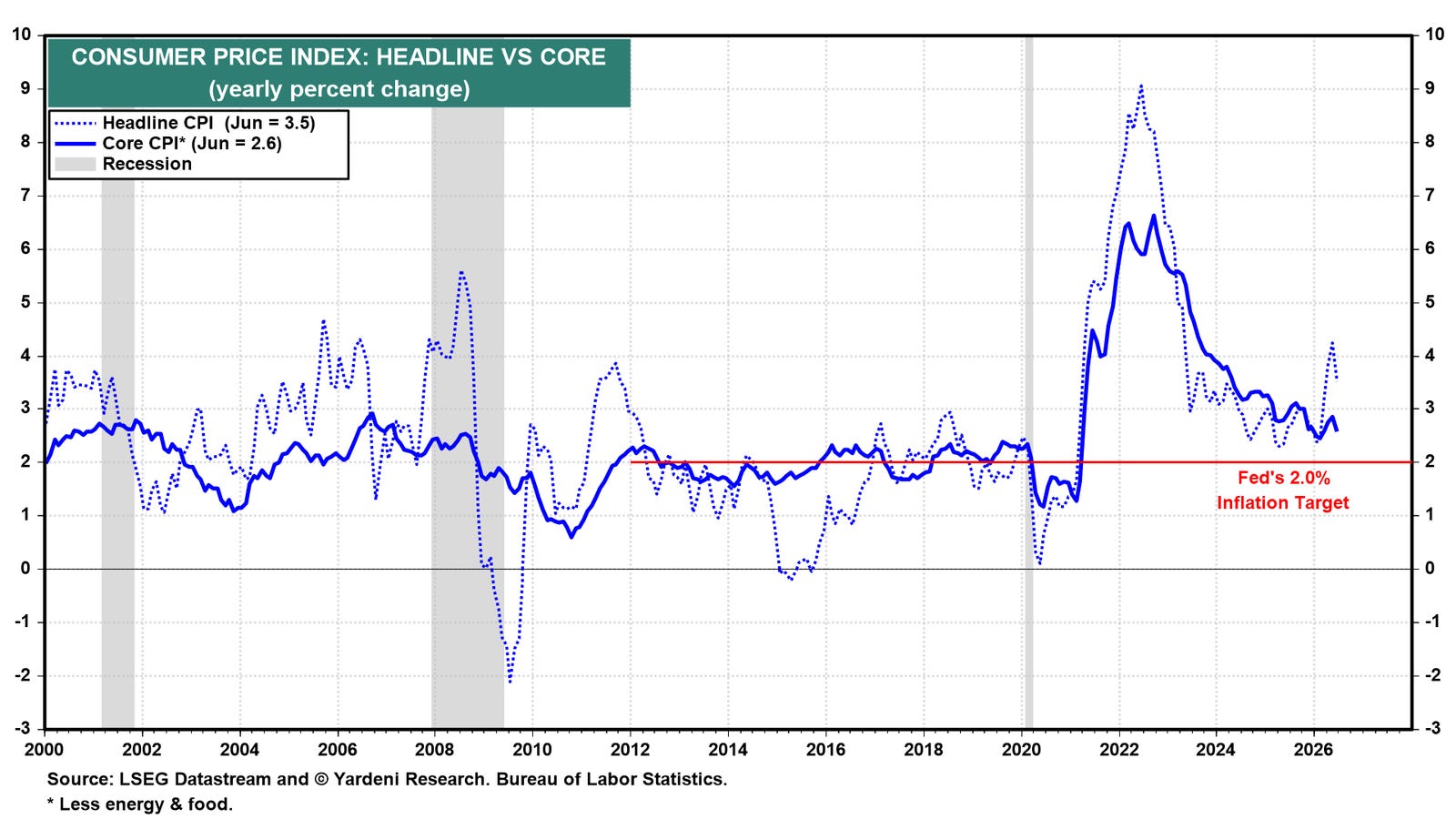
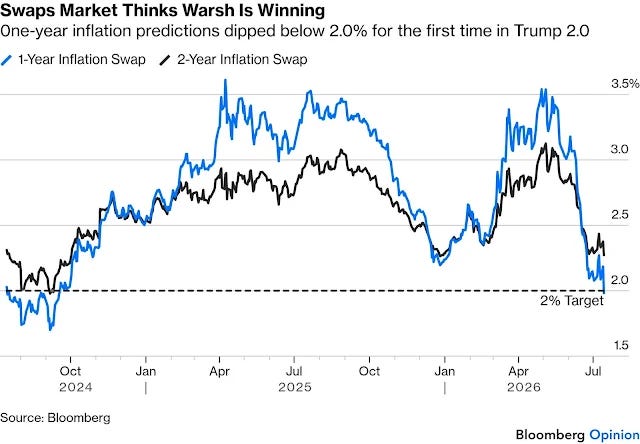
However, this “good news” was aided by a player that deserves no credit whatsoever: oil. Hours earlier, Trump announced a 20% tariff on ships in the Strait of Hormuz and revoked the measure in less than 24 hours—the kind of chaotic move that drives down the price of a barrel for a day, only for it to vanish the next. Without that one-off energy hiccup, there would have been no reversal to celebrate. Kevin Warsh, in his first testimony as Fed Chair, had the good sense to avoid the trap and refused to declare the “mission accomplished” that Wall Street wanted to hear—yet the swaps market has already gone all-in: for the first time since the 2024 election, one-year breakeven inflation fell below the 2% target, with the market celebrating victory before the final whistle.
It is the same selective euphoria that allowed Wall Street to pocket the best trading quarter in history—JPMorgan and Goldman Sachs had never profited so much from volatility—on the very same trading day that IBM plummeted 25% (its worst daily drop ever) after failing to convince anyone of AI’s actual value to its balance sheet. AI anxiety pays bonuses on one side of the table while burning market value on the other—all in a single day.
And this tendency to see diversification where there is actually concentration has a direct parallel elsewhere in the market: international allocations.
For nearly two decades, holding stocks outside the United States has been an exercise in patience. At the start of 2025, the ETF tracking developed markets (excluding the U.S.) was trading at virtually the same price level as in June 2007. The emerging markets ETF showed a similar pattern. Over the same period, the S&P 500 nearly quadrupled.
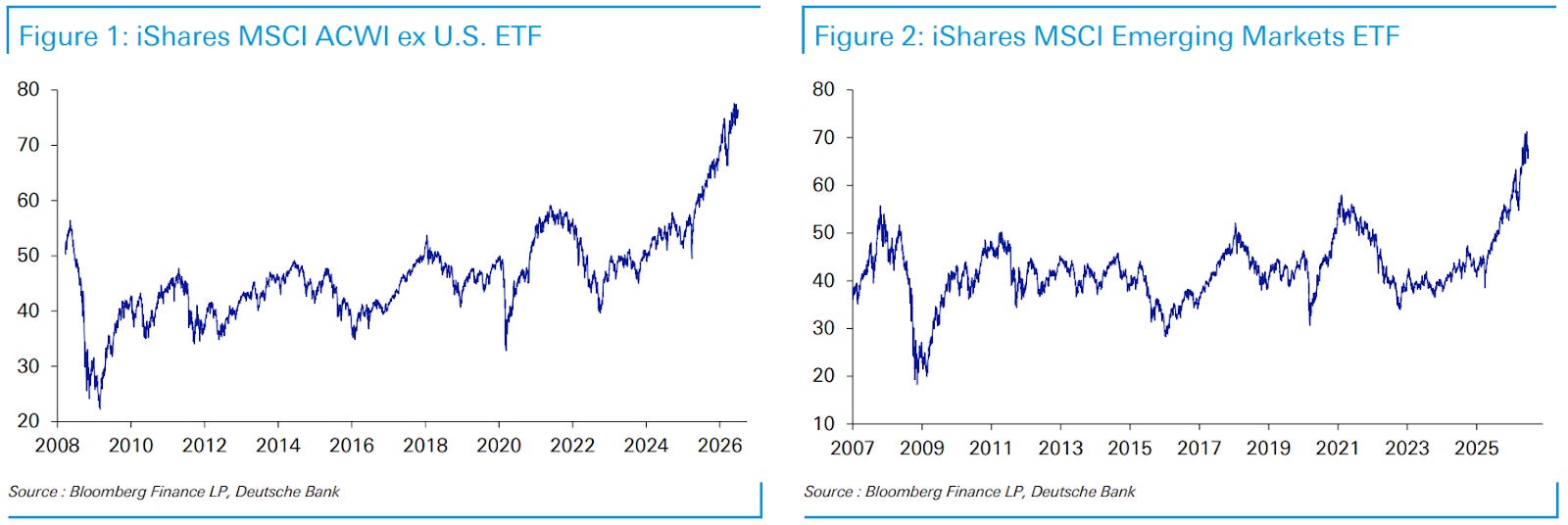
Recently, that picture has changed. “Old economy” sectors—financials, energy, materials, and industrials—which have always carried more weight in non-U.S. indices, have regained momentum. This shift is driven by a new geopolitical focus on defense and industrial self-sufficiency, as well as artificial intelligence capital expenditure (capex) spilling over into energy, hardware, and materials—precisely the sectors where emerging market and “rest-of-world” indices are historically overweight. Fiscal activism is also playing a role: German stimulus is the most visible example among developed economies, but Mexico is also investing heavily in rail infrastructure, even while attempting to reduce its deficit. European banks, which had struggled for nearly fifteen years, have seen a repricing alongside improved profitability. Meanwhile, the dollar—which rose about 40% between 2010 and 2024, acting as a constant drag on returns for U.S. investors holding unhedged foreign assets—may be nearing a plateau; it fell more than 9% in 2025, its worst performance since 2017.
However, there is a catch to this narrative of “renewed diversification.” The three largest holdings in both the emerging markets index and the ex-U.S. index are currently TSMC, Samsung, and SK Hynix; these three names account for nearly 30% of the emerging markets index and about 10% of the ex-U.S. index. This concentration at the top is revealing: the ten largest names in the global ex-U.S. index make up just 16.8%—a moderate figure. In contrast, the top ten names in the emerging markets index account for 39.4%—a higher level of concentration than the S&P 500 itself, which stands at 36.7%.
In short: anyone buying an emerging markets ETF today to diversify their portfolio is, in practice, making a heavy bet on semiconductors and technology. Brazil, which emerged as a destination for foreign capital flows early in the year, has recently lost its appeal; interest has shifted to Asia—precisely where TSMC, Samsung, and SK Hynix are based. Hence the provocative title: “EM” isn’t an acronym for “emerging diversification.” It stands for *Emerging Technology*—an “ET” that, like any good alien, disguises itself as something familiar before revealing its true nature.
The common thread linking today’s two topics is simple: whether looking at yesterday’s inflation data or the actual composition of emerging market indices, appearances can be deceiving. A single month of favorable CPI data doesn’t erase a decade of higher expectations. An ETF labeled as a diversification tool might, under the hood, actually be another concentrated bet on the same old value chain. It is always worth asking what lies behind the acronym before putting your trust in it.
Technical Analysis
In the post “navigating-new-seas,” I made the following comments regarding the IBOVESPA:
“What I can say is that the market is undergoing a correction, contained within the red ellipse. In situations like this, I look for further clues by examining charts with shorter timeframes, as shown below. Here are the possibilities:
1) Red wave B is underway and could take the market to the 187.5k level (↑ 10%) or 192.9k (↑ 12%); or
2) Red wave A hasn’t finished yet, and further declines could occur below 168k... I consider option 1 more likely and will wait for a breakout above the level marked with the red symbol—at 174.2k.”
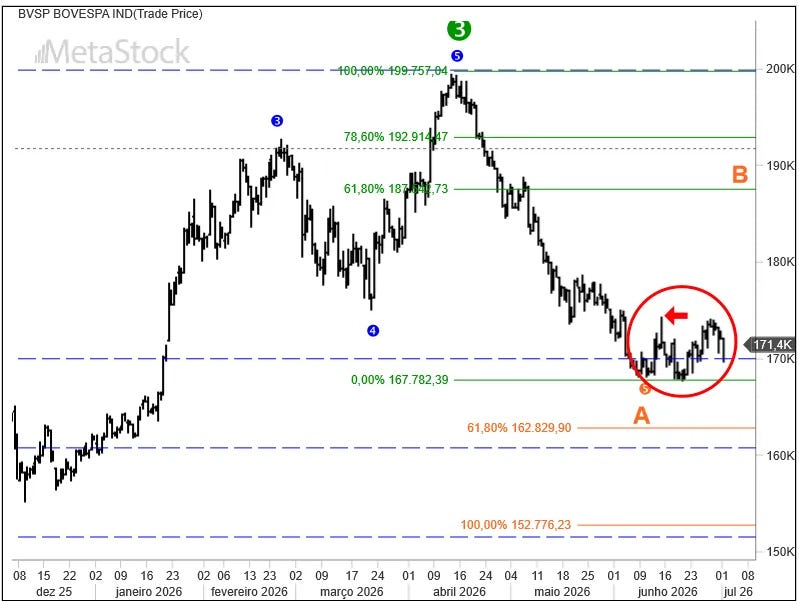
The breakout occurred on July 10th, triggering a long trade at 174.2k, just as I mentioned in the post above. I have to say, it takes a lot of courage to enter a correction—especially a wave B. As an old guru I used to follow used to say: wave Bs are profit killers.
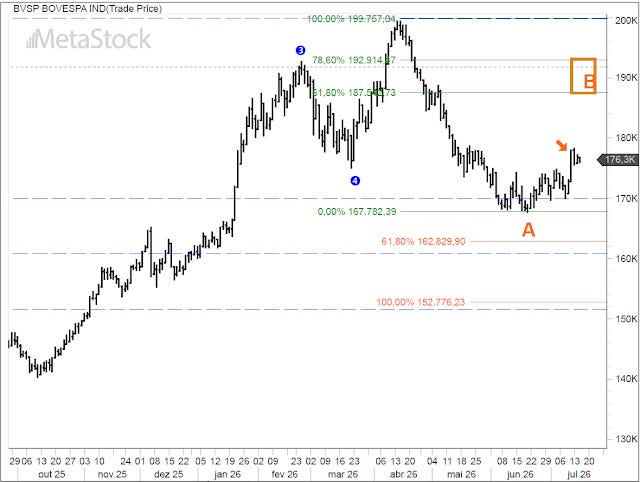
Where should I place the stop-loss? Ideally, it would be at 172.6k, which could result in a loss of approximately 1%—nothing catastrophic—but I’m going to use the entry level of 174.2k since my confidence in this trade is low. The target is marked on the chart below, between 187.5k (+7%) and 192.9k (+10%).
Another factor bothering me is that the rally indicated by the orange symbol needs to reach 181.6k quickly.
“David, it looks like you’re treading very carefully here, but...”
Exactly. Anyone experienced with Elliott Wave knows that navigating a wave B is a heroic feat: this wave tends to move two steps forward and one to one-and-a-half steps back. Keep an eye out, as I might exit the trade at any moment. A brief comment on yesterday’s match between France and Spain, in which the French were considered the favorites. I am very fond of the French—after all, I made many friends during my time at BFB—but I detest Mbappé; he is an arrogant fellow and a massive jinx, given his track record of losses wherever he goes. The press tried to compare him to Messi, but he doesn’t even come close to the brilliant Argentine player.
The S&P 500 closed at 7,572, up 0.38%; the USDBRL at R$ 5.0925, unchanged; the euro at € 1.1469, up 0.38%; and gold at US$ 4,057, up 0.11%.
Stay tuned!
Original Post: Click Here
This is not an investment recommendation.
About the Author of this Post: David Gotlib has 45 years of experience in investment management. An engineer from Polytechnic School of the University of São Paulo, he was one of the founders of the first Brazilian hedge fund in 1993 (AUM US$ 1 billion). Later, he was Managing Director of Deutsche Bank Asset Management (AUM R$ 2.2 billion) until the company was sold to Bradesco. He is currently the manager of his own investment portfolio and the author of the blog Acertar na Mosca, where, since 2011, he has shared his thoughts on the global economy and the financial market on a daily basis.
Comments
Nothing yet. Say the first thing.
Sign in to join the conversation.