
Today I have the pleasure of interviewing Brazilian investor Filipe Ramos.

From March 2018 to November 2023 his historic performance will be the envy of anyone.
His portfolio returned 308.21% in the period, versus 48.07% for Ibovespa.
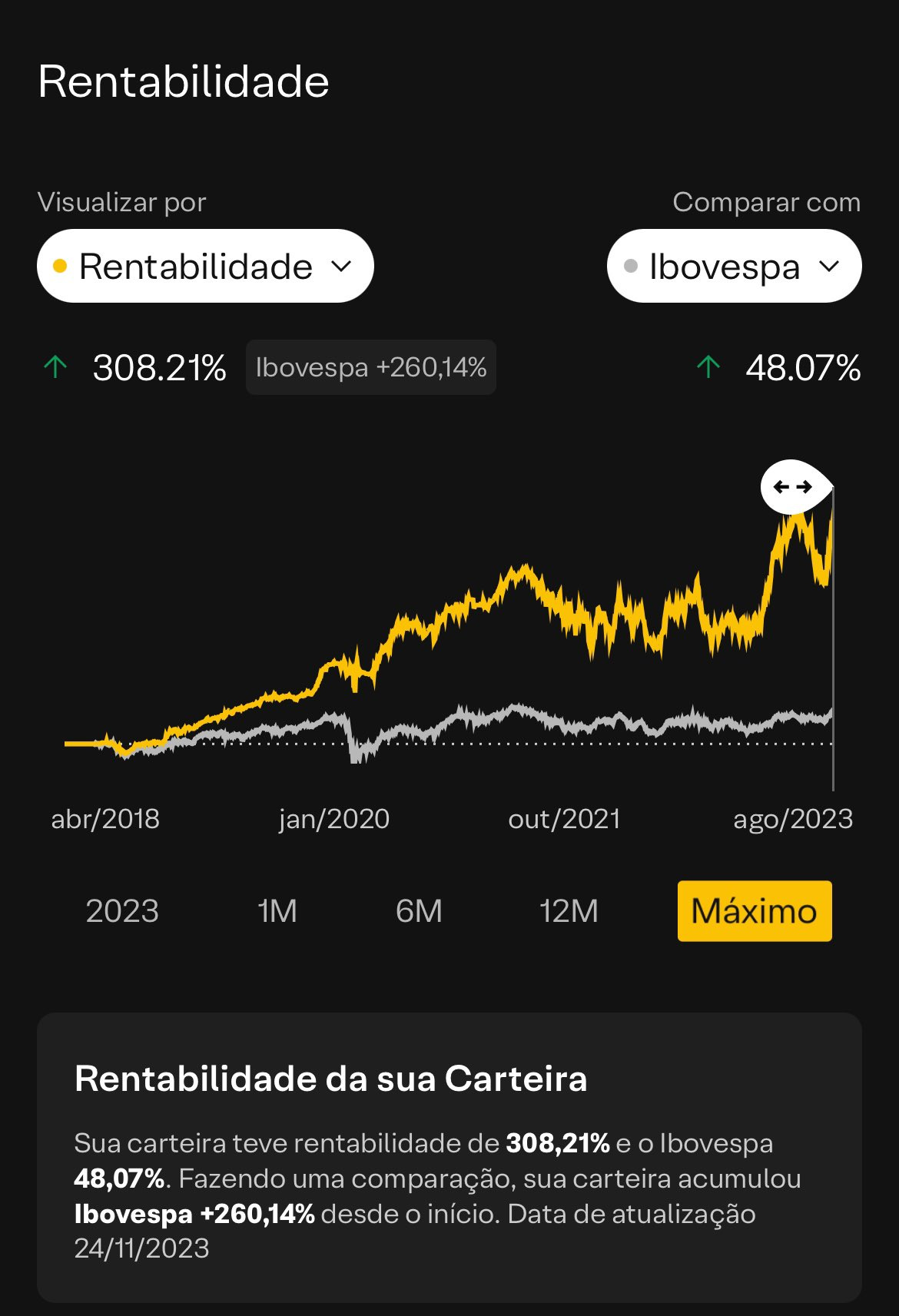
This guy knows how to generate real value.
Shall we meet him?
BZ: Filipe, could you tell us a little about yourself?
FR: I am 46 years old, married, a father of two, and hold a degree in Business Administration from PUC/MG. I began my professional career as a trainee at ABN Amro (formerly Banco Real) and later worked as a Middle Market manager at Unibanco before leaving to become an entrepreneur. I launched several businesses across sectors ranging from fashion retail to civil construction; when they succeeded and reached their peak, I would sell them, and when they didn’t work out, I would close them down—selling off inventory, the leasehold, and so on. That was when I realized I was simply curious about business—I enjoyed the mathematical side of things but didn’t care for managing day-to-day operations. I saw that the financial market offered a way to focus on the best parts of the job while relying on the country’s top minds to handle the actual operations. Today, I make my living from the market, even though no one in my family has any connection to it—quite the opposite, in fact; they ask if I “gamble on the stock market”... haha.
BZ: What is your strategy for making money on the stock market?
FR: I initially started out with a “buy-and-hold” approach based on reading research reports, which proved to be a very shallow and naive strategy. It was only after encountering Howard Marks’s theory of market cycles and the field of behavioral finance that I realized the market held inefficiencies I could exploit to make money—specifically by trading in line with cycles and against the herd. Although it sounds simple, it required mental conditioning: building a foundation of “value” thinking alongside an understanding of herd psychology, as well as training my “gut” to handle the pressure—since being a contrarian means fighting against our own survival instincts. I highly recommend the following books: *The Most Important Thing* (Howard Marks), *Mastering the Market Cycle* (Howard Marks), *The Psychology of Money* (Morgan Housel), *Stocks for the Long Run* (Siegel), *The Little Book That Beats the Market* (Joel Greenblatt), *Beating the Street* (Peter Lynch), and *Manias, Panics, and Crashes* (Charles P. Kindleberger). I also really enjoy biographies, but regarding the topic at hand, those are the ones that made the biggest impression on me.
BZ: What is your process for finding a new buy opportunity? What filters do you use?
FR: First, I examine macroeconomic conditions to understand where we are in the cycle. Next, I identify the sectors that specifically benefit from that stage of the cycle—looking for clear catalysts—while never neglecting fundamentals, so as to avoid permanent capital loss. Within those sectors, I look for companies with high-quality management that are trading at low multiples—situations that often arise due to a fleeting event that unsettles the market and creates such opportunities. “Owner-operated” companies (where there is “skin in the game”) always have an edge; provided the owner isn’t unscrupulous, returns tend to be superior—a fact backed by research. Last but not least, interacting with close friends in the industry—low-profile figures like those interviewed for this profile—adds significant value to the search for off-the-radar opportunities. A special thanks here to Thiago Ribeiro, who was interviewed for this feature.
BZ: How do you value a share: DCF, Multiples, implied IRR, a mix of the previous ones, …?
FR: I prefer looking at multiples, but I like to run my own calculations to filter out information that might mislead me into seeing value where none exists. At this stage, it is crucial to visualize the business in operation—going beyond the raw numbers—to identify its strengths, weaknesses, opportunities, and threats; the goal is to buy the existing business at a discount while getting the optionality and value triggers as a bonus.
BZ: How do you like to build your stock portfolio, considering the number of companies, sectors and concentration?
FR: I apply a rule of a maximum 20% allocation per stock and 30% per sector, and I never deviate from this; I use leverage for short positions—up to 15% in BOVV11 and IVVB11 (I do not short specific individual tickers)—which is the Club’s limit. I allocate 75% of the portfolio to approximately 10–12 companies, while the remaining 25% consists of small positions—such as initial exploratory trades, arbitrage opportunities, or holdings I am gradually unwinding as they approach my target price.
BZ: How often do you like to rebalance your portfolio?
FR: I analyze it daily, but I adjust the portfolio depending on the market—for instance, if a position has grown too large, if other opportunities have emerged, if I’ve concluded I was mistaken about the management, or if there has been a structural change in the investment case. In other words, it’s like running a holding company, constantly monitoring the businesses and the pricing of their assets or cash flows.
BZ: How long on average do you hold a position in your portfolio?
FR: It largely depends on the balance between operational profitability and asset appreciation. There are stocks I’ve held for five years that consistently deliver operational surprises and create significant long-term value, while others haven’t stayed in the portfolio for even 30 days because a specific trigger caused the price to surge close to my target. It’s important to look at your portfolio value every day and ask yourself: “If I had that amount of cash in hand today, would I buy exactly these same assets in the same position sizes?” If the answer is no, it’s time to adjust the portfolio. This protects you from falling in love with a stock or succumbing to loss aversion (the “average price” trap).
BZ: What are your favorite sectors on the Stock Exchange? And the ones you avoid? Why?
FR: I like sectors with clear growth opportunities that expand regardless of GDP growth—where players hold a small market share but possess a significant “moat,” such as competitive advantages derived from geographic location.
I avoid the airline industry, where you have to make numerous long-term capital expenditure (Capex) decisions while grappling with high volatility in short-term operating expenses (Opex). Ultimately, one need only look at history to see that this sector has left many investors by the wayside.
Another sector I dislike is major appliance retail; its history is littered with corporate casualties (Mesbla, Mapin, Ricardo Eletro, etc.), even though there are success stories—like Lojas Cem—that have managed to navigate the landscape very well for a long time.
Businesses that have to struggle mightily to generate cash—relying on a host of factors to align just right to turn a profit—are businesses where the odds are stacked against you.
I prefer businesses that offer a margin of safety and generate cash. Keep it simple; there’s no need to reinvent the wheel!
BZ: What is the cheapest company on the stock market today?
Comments
Nothing yet. Say the first thing.
Sign in to join the conversation.