
Today I have the pleasure of interviewing Brazilian investor Diego Lobato.
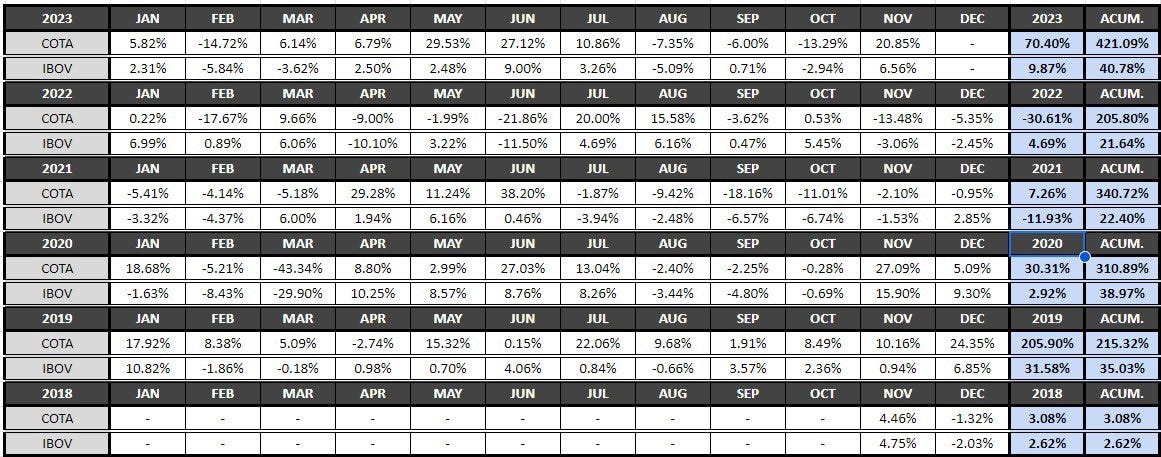
From November 2018 to November 2023 his historic performance will be the envy of anyone.
His portfolio returned 421.09% in the period, versus 40.78% for Ibovespa.
This guy knows how to generate real value.
Shall we meet him?
BZ: Diego, could you tell us a little about yourself?
DL: I am 38 years old, and I spent 15 of those years working in the automotive retail sector. However, in 2018, I decided it was time to start planning my transition to managing my own assets in the stock market. My goal was to make this shift gradually, aiming to complete the transition by 2023. Yet, an unexpected opportunity arose, and I ended up starting the process earlier than planned.
Even without available capital to invest, I began studying the financial market in early 2018. It was in November of that same year that I took the first step on this new journey by making my initial investment. From 2021 onwards, I dedicated myself fully to this new endeavor.
Over time, I realized that the stock market offers a range of advantages and opportunities compared to the business sector where I had previously worked.
My introduction to the financial market happened when I was just 13 years old, when my father—an investor himself—introduced me to that world. Back then, I bought my first shares of Petrobras. However, I must admit that the following years were a frustrating experience, and I eventually closed my brokerage account.
BZ: What is your strategy for making money on the stock market?
DL: There are countless opportunities in the Brazilian market, which undergoes intense economic cycles. Therefore, understanding these cycles is crucial to avoid following the herd. Whether in a bull market or a bear market, the market can become completely irrational, yet there is always a turning point. This year, for instance, with favorable economic data, we have entered a cycle of interest rate cuts, even though the outlook remains fraught with uncertainty. Regardless of the political landscape, the asymmetry tends to be favorable, as we have observed. It is precisely at these times that great opportunities arise, and you usually need to take a position contrary to the herd; otherwise, you will miss out on major market moves.
I believe in buying companies at a significant discount and selling when they approach their fair value. If you make good selections, it is hard not to succeed in the long run.
At some point—after dedicating a great deal of effort to studying and analyzing companies—the level of knowledge among investors tends to converge, differing only in the specific nuances of each manager’s approach. That is when emotional maturity becomes the decisive factor, and that is an extremely challenging aspect. It is virtually impossible to significantly outperform the average (such as a benchmark index like the Ibovespa or the Small Cap index) without enduring substantial temporary losses.
BZ: What is your process for finding a new buy opportunity? What filters do you use?
DL: Initially, I prioritize analyzing sectors where I have expertise, looking for relevant opportunities.
I perform quick multiple-based calculations to assess whether a specific asset is worth investigating. If it looks promising, I analyze balance sheets and quarterly reports, participate in conference calls, speak with the company, and study historical data. I also build a detailed model to project future results and identify growth potential. Additionally, I like to stay in touch with the company on a quarterly basis to keep up to date on execution versus my projections.
I maintain frequent communication with friends who are fund managers and investors, seeking to leverage their knowledge and experience regarding specific cases and sectors. This helps me deepen my analysis more efficiently. Furthermore, they can alert me to opportunities I might not have considered, which is extremely valuable.
BZ: How do you value a share: DCF, Multiples, implied IRR, a mix of the previous ones, …?
DL: I generally use various multiples to determine an asset’s target price, taking into account earnings projections and indicators such as ROE, ROIC, PEG, and Capex, as well as the asset’s history and the sector in which it operates. Based on this data, I establish a fair multiple to set the asset’s target price.
BZ: How do you like to build your stock portfolio, considering the number of companies, sectors and concentration?
DL: It is rare for a company to reach 20% of the portfolio’s net asset value, given the specific risks involved. On the few occasions when this has happened, the company demonstrated growth potential far exceeding the average of the others. Currently, the top five companies in my portfolio account for approximately 70% of the net asset value. However, regarding sectors, I generally limit exposure to 50% of the net asset value, though it is uncommon to have such high exposure to a single sector.
At times, highly significant opportunities arise in specific sectors. Recently, for instance, there was a significant opportunity in the construction sector, where I established a substantial position. However, throughout the year, I made significant adjustments to the size of individual holdings—both increasing and decreasing positions—as some companies showed limited remaining upside potential while others still held great potential.
BZ: How often do you like to rebalance your portfolio?
DL: Almost daily, depending on asset price fluctuations.
I seek to capitalize on market volatility to generate alpha. A simple example involves two assets, each with 100% upside potential: one rises by 20% while the other remains stable. In this scenario, rebalancing would be appropriate—reducing the position in the asset where upside potential has decreased and increasing the position in the asset where it has remained intact. This way, I increase the portfolio’s upside potential and reduce risk, provided the price movement wasn’t driven by changes in the company’s fundamentals.
BZ: How long on average do you hold a position in your portfolio?
DL: There is no specific timeframe, but most of the companies I invest in have been in my portfolio for several years. My standard practice is to adjust my exposure based on market asymmetry, increasing or reducing it as needed. If a company reaches its fair value or its share price rises too much relative to others, I am likely to replace it with another. One way to reduce risk is to always adjust position sizes based on upside potential. Furthermore, if there are positive or negative changes in a company’s fundamentals, additional analysis is required.
BZ: What are your favorite sectors on the Stock Exchange? And the ones you avoid? Why?
DL: No, but I generally end up investing most of my time in areas where I have specific skills and knowledge. There are sectors where I lack expertise, and naturally, I tend to steer clear of them. However, if I can grasp the investment thesis and feel confident about the risk-reward profile, I am willing to invest—even if it means taking a smaller position.
Furthermore, I prefer analyzing smaller companies that don’t receive much sell-side coverage and aren’t included in the portfolios of major investment funds. These companies often present attractive investment opportunities precisely because of their low liquidity. A good example from this year is Plano e Plano, a company in the construction sector. At the beginning of the year, my analysis indicated an upside potential of 350%; because there was limited analyst coverage, I was able to build a significant position and wait for the results to materialize.
BZ: What is the cheapest company on the stock market today?
Comments
Nothing yet. Say the first thing.
Sign in to join the conversation.