
A single unilateral move against a pillar of the transatlantic relationship draws notice. Three of them make a pattern. The US made all three within half a month, and none of them involved warning Brussels beforehand. The first piece of the pattern was a currency trade when the Treasury sold euros to prop up the yen. As the Financial Times writes:
The ECB was made aware of the US’s move to sell euros to buy yen on Friday after the trade had been executed, according to several people familiar with the matter.
The lack of co-ordination highlights the unusual nature of the first joint Washington-Tokyo effort to boost the yen in almost 30 years. Typically, the US would have been expected to use dollars in such an operation.
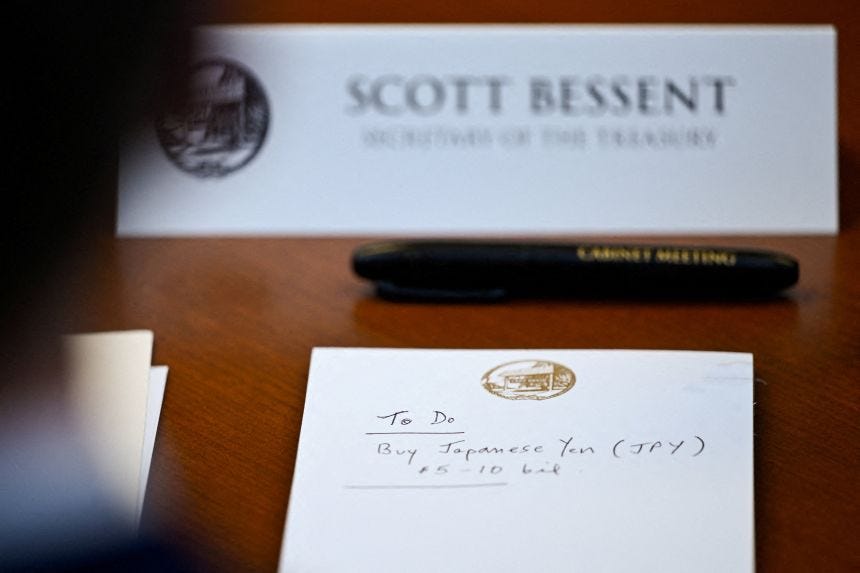
The exact euro amount wasn’t disclosed. One number became public when a photograph of Bessent’s to-do list put the US share at $5 billion to $10 billion. ECB officials called the sale an unprecedented breach of a norm that’s held since 1945: western central banks coordinate currency intervention rather than ambushing each other with it.
The second piece was a loyalty test: Washington sent NATO allies a questionnaire scoring their support for Trump's foreign policy, with the results informing a troop-posture review due in December:
Has the country “been publicly supportive” of US foreign policy? What “restrictions” has the country placed on the US military using its bases?
The document also tries to assess whether countries are spending money with US defense contractors. And it asks whether they have “publicly opposed regulations” that “inhibit” contracts with US firms. Overall, it queries: “Has the country shown alignment with the US approach to ‘strong, clear, and quiet’?” — referencing a line from Defense Secretary Pete Hegseth.
For allies claiming they’re in the crosshairs, calling such a move a humiliation isn’t far off. When NATO’s secretary-general, Mark Rutte, says, “We are Russia’s next target,” the only consistent answer to a questionnaire asking whether they’ve been publicly supportive of US foreign policy is yes.
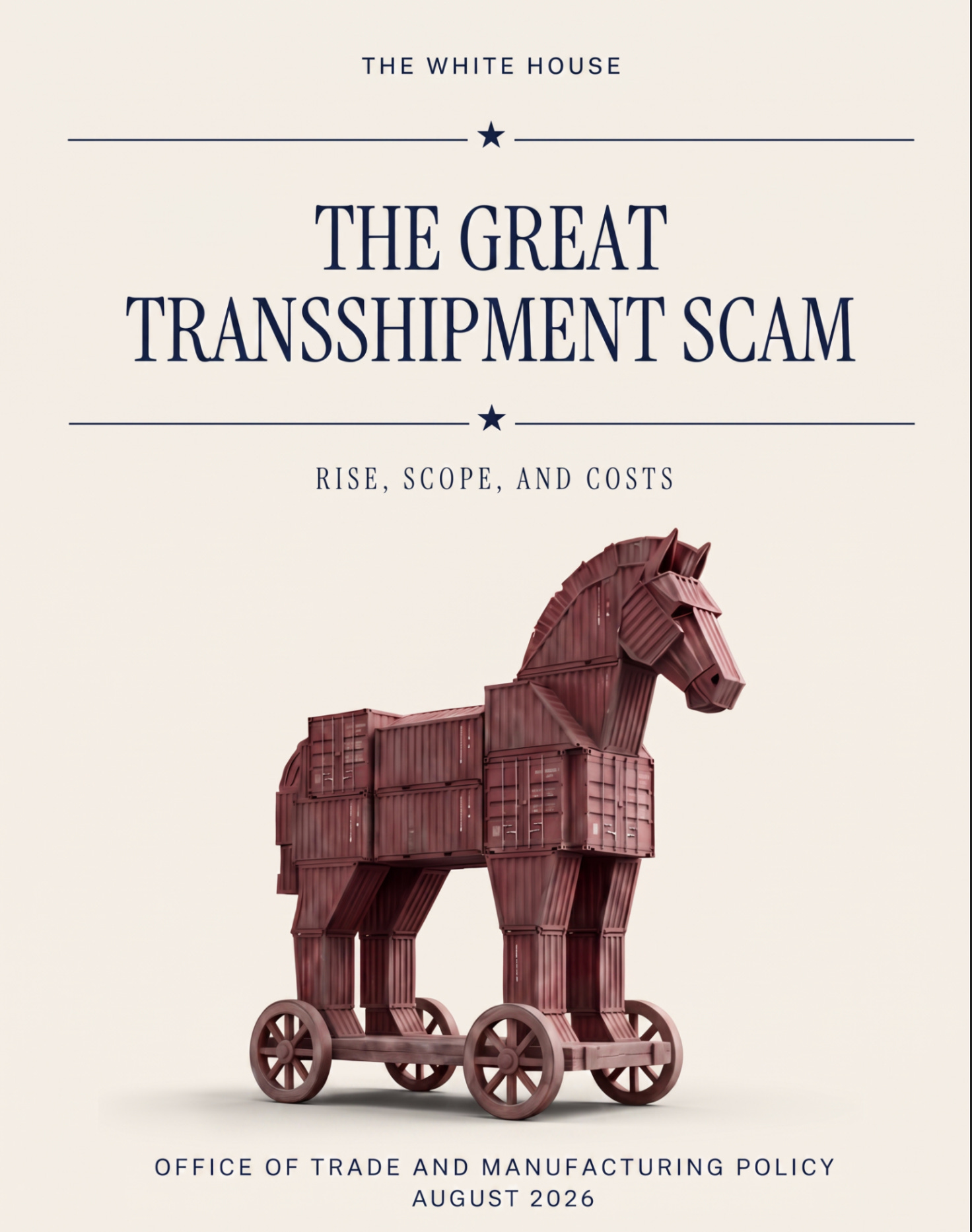
The third piece of the pattern was a tariff accusation: with a fragile truce holding in the globally defining US-China trade war, Washington accused the EU of helping Beijing dodge the tariffs. Brussels Signal reports on the White House document:
Within the EU, the report singles out specific member states by functional role. Poland, the Czech Republic, Hungary and Romania are identified as part of a “Central and Eastern European processing belt”, where Chinese components can undergo final assembly, testing, repackaging or finishing before being shipped to the United States under European documentation.
Belgium and the Netherlands are listed among “developed logistics platforms”, valued for their advanced customs systems, deep-water ports, trading houses, bonded warehouses and global re-export networks.
The envisioned remedies for illegal transshipment include immediate interdiction, penalty tariffs, and sanctions, alongside a "direct path to exclusion" from the US market.
Trump has shown he’s willing to throw convention overboard three times this month—monetary, defense, trade—in what looks like a squeeze to align Europe with US interests. The obvious element missing from it is energy. Europe’s gas storage sits at a multi-year low, Brussels has committed to phasing out Russian energy entirely, and the US is now Europe’s most important LNG supplier. That looks like the next lever Washington can pull to achieve any policy goal it might consider appropriate. Time to check how pulling it plays out across Europe.

At today’s injection rate, EU-wide storage is on pace to reach 823 TWh by October 1. That’s 73% full. Measured against EU rules, that’s already a shortfall. Since 2022, the bloc has required storage to reach 90% full sometime between October and December, with flexibility added in 2025 that allows 80% under “difficult conditions” and as low as 75% if those conditions turn “persistent.” In other words, at 73%, Europe is below the crisis floor. Of course, it gets worse if current injection rates do not hold.
Once winter withdrawal starts, things move fast as storage needs to close the gap between what LNG terminals can deliver and what furnaces burn. Last winter, that drawdown averaged 4 TWh a day across October through March.
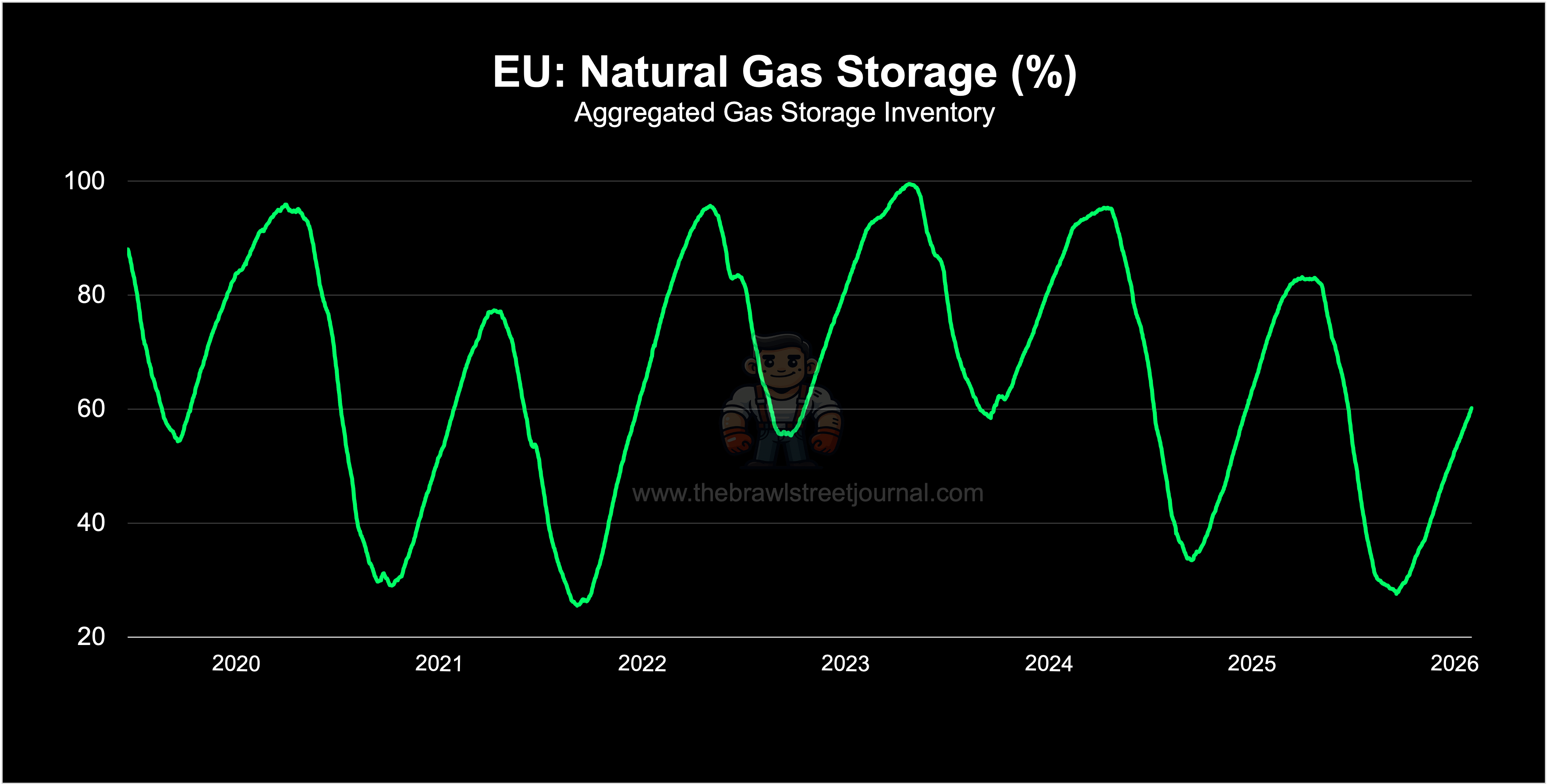
Now take US LNG out of that supply. At a 65% share of Europe’s imports, losing it removes 2.6 TWh a day from what’s arriving at the terminals. Withdrawal has to run faster to cover it: 6.6 TWh a day instead of 4 TWh. At that accelerated pace, storage doesn’t make it through winter. It hits the technical floor already by mid-January, the coldest time of the year when withdrawal historically peaks.
In the past, Europe bid away volumes from Asia. When cargoes were up for grabs on the spot market, European buyers could pay whatever it took to redirect them. But Asia has stopped relying on the spot market alone. Instead, Chinese companies, for example, rushed into long-term contracting starting in September 2021.
Spot prices at the Japan Korea Marker (JKM) quadrupled that year. As a result, China alone accounted for roughly 40% of all new LNG contracts signed globally that year, by volume, and those contracts run 15 to 20 years. That contracting locked in 38 million tonnes a year, which equals 16% of the EU’s annual gas consumption.
Europe’s suicidal climate policy made sure its buyers wouldn’t follow a similar strategy to secure cargoes. The European Commission plans an effective phase-out of unabated gas-fired power by 2040, which is choking off any incentive to sign such long-term contracts.
Looking at the EU as a whole obscures the full picture though, because security is a country-by-country question. As of August 14, aggregate EU storage reads 60% full, but the numbers in member states diverge widely. Poland’s tanks, for example, are nearly full (88%), yet that only covers 13% of what the country burns in a year. Belgium’s storage barely registers against its own consumption, just 2%. Austria is the most secure of the countries with the biggest storage capacity, holding 81% of a full year’s demand. That’s mostly because it’s a transit hub for gas headed elsewhere.
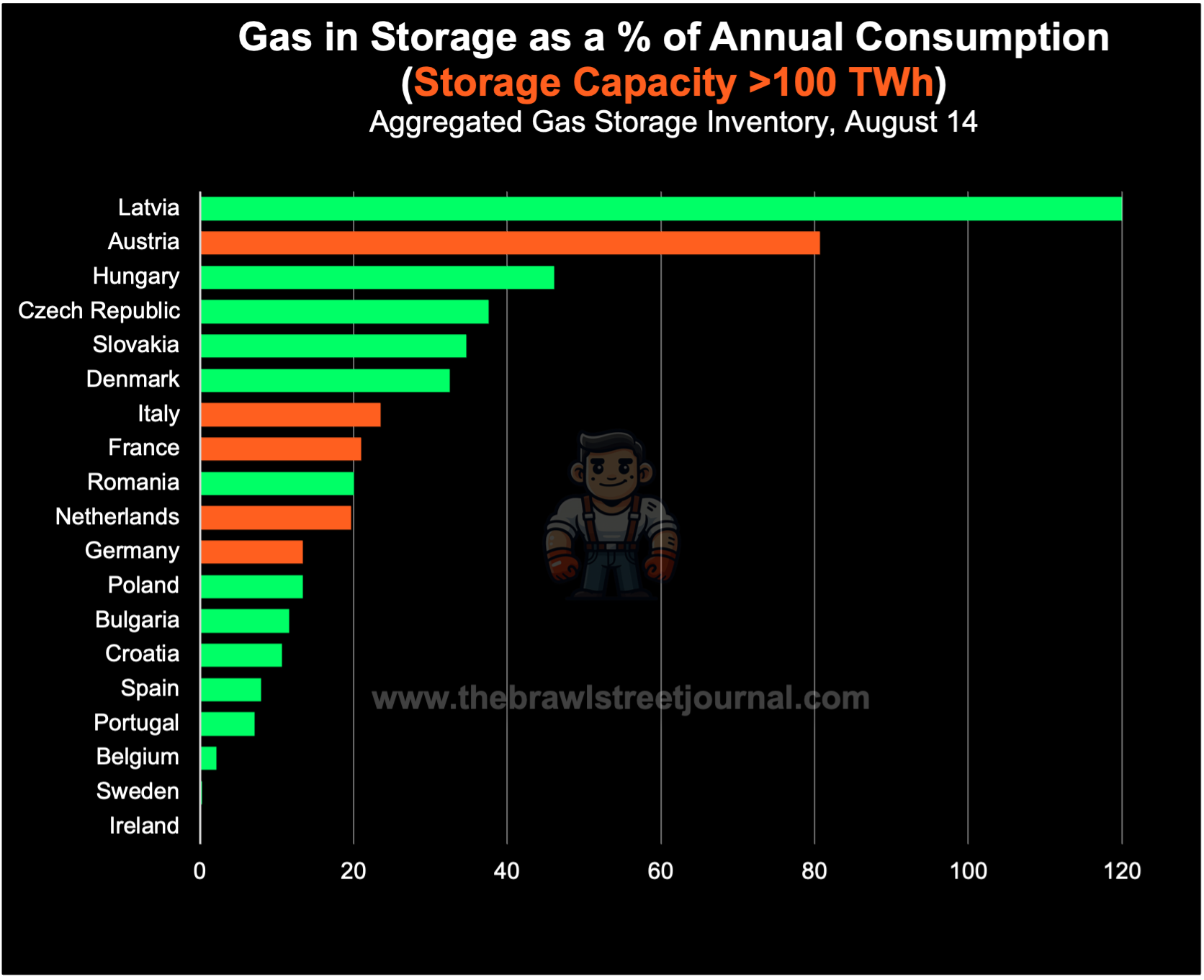
The EU has a solidarity mechanism for a shortage: storage-rich states are supposed to send gas to a neighbor running dry. That’s a promise that sounds comforting as long as member states get along. But will that solidarity hold if that means asking citizens to cut down on heating and ration gas for domestic industry?
That’s the extreme case, but it’s serious enough not to ignore. Assuming that energy scarcity has the potential to unravel a political entity like the EU isn’t crazy given how quickly this would ripple through everyday life—a fact that’s easily forgotten, because Europe’s energy scarcity so far has only shown up as high prices and shuttered factories, not as a physical shortage.
It isn’t a scenario that’s hard to imagine either. Trump’s dislike of the EU as an institution is no secret, and this administration has already steamrolled Brussels three times this month. Strategic thinkers in Washington have likely gamed this out.
Of course, the EU wouldn’t be in this predicament if it hadn’t drawn a line between “good” and “bad” molecules, or if it were willing to drill for its own gas domestically. No one other than Europe is to blame for this open flank. And Washington doesn’t have to force its way through it.
Share this with anyone counting on solidarity!
📨 People in boardrooms, energy desks, and hedge funds keep forwarding this. Stop getting it late — subscribe now!
No posts
Comments
Nothing yet. Say the first thing.
Sign in to join the conversation.