
Ukraine’s drone strategy is to a large extent attributed to Mykhailo Fedorov, the recently ousted defense minister. Remarkably, 35-year-old Fedorov—the country’s youngest minister when he became Minister of Digital Transformation in 2019—has no military background. As a marketing specialist, he was brought in by President Zelensky to run the social media campaign that helped him surge to a landslide victory in April 2019.
The drone strategy has in recent weeks been portrayed in the Western press as a turning point for the war. Australia’s ABC gives an exemplary account:
On June 26, Ukrainian President Volodymyr Zelenskyy announced he was ordering a 40-day strike campaign to take the war to the heart of Russia and “press for an end to the war” in Ukraine.
Since then, Kyiv has sharply escalated attacks on Russia in a series of high-profile, long-range missile attacks, striking key supply lines and triggering a fuel crisis with sustained hits on oil and gas infrastructure, deep in the heart of enemy territory.
Analysts say these intensified attacks are increasing the strain on Russian businesses, people, and air defences.
While hard to independently verify, Ukrainian drones are reported to have hit every one of Russia's eleven largest refineries at least once. The damage goes past storage tanks and export terminals to include essential equipment that turns crude into diesel and gasoline, like distillation units and hydrocrackers. Following the attacks, Russia has banned most diesel exports, driving global prices higher.
According to RBN Energy’s daily blog, Russian refinery throughput fell from more than 5 million barrels a day in 2025 to about 3.8 million barrels a day in July, a 25-year low and roughly half the country's nameplate capacity.
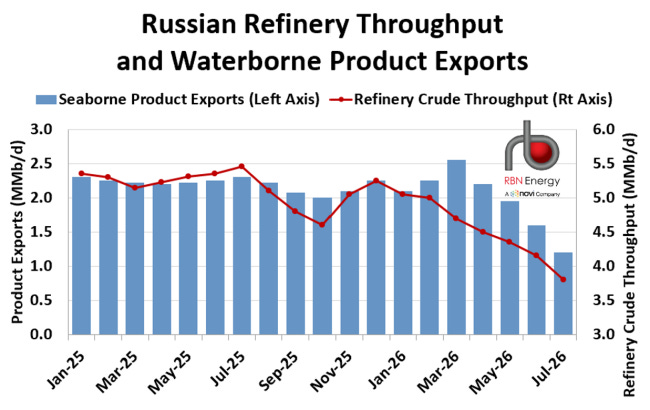
Given claims about the worsening state of Russia's economy now being a “liability” for Putin, the question as to how fast Russia can bring the refining capacity back online seems crucial, and the answer depends on how long the war continues. RBN Energy writes:
It’s important to note that some recovery could come fairly quickly if the Ukraine war were to stop any time soon. (Conversely, the condition of Russia’s refineries could become more dire the longer the war lingers.) If the war ended and the refinery attacks stopped, Russia could probably bring back 500+ Mb/d of refining capacity within a month or two and more than 1 MMb/d within six months, taking runs back to 4.5 MMb/d.
To some extent, the length of the rebuild depends on sanctions, specifically, how much of the repair Russia can do without Western parts. But media reporting that portrays these strikes as enough to force Russia to end the war may be attributable to the legacy of Fedorov’s media acumen.
Because, independent of the war and without having gotten press in the West, Russia is currently pursuing other energy megaprojects—bigger in scale than the gasoline distribution problem, and mostly untouched by Western coverage. Time to head into the Arctic for a closer look.

Turkish state-run news agency Anadolu Ajansı (AA) reported this week on Russia’s plans to commission approximately 30 gigawatts (GW) of nuclear power plant capacity in the country’s Far East, Siberia, and the Urals.
Putin describes the buildout as power for “the advanced processing of natural resources” in those regions. That points to the belt of mineral and hydrocarbon deposits running along Russia’s Arctic coast and down through its Siberian and Far Eastern interior.
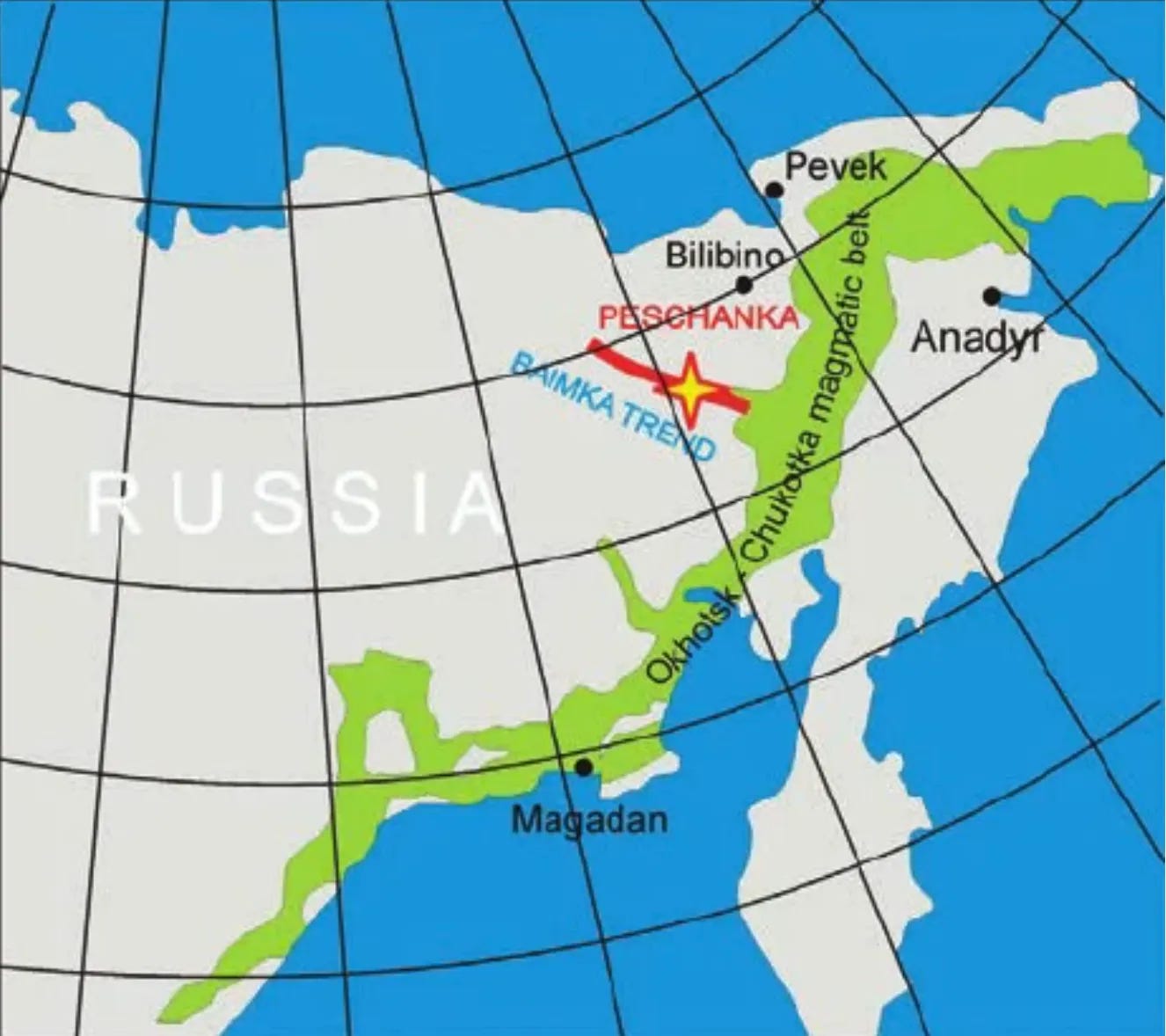
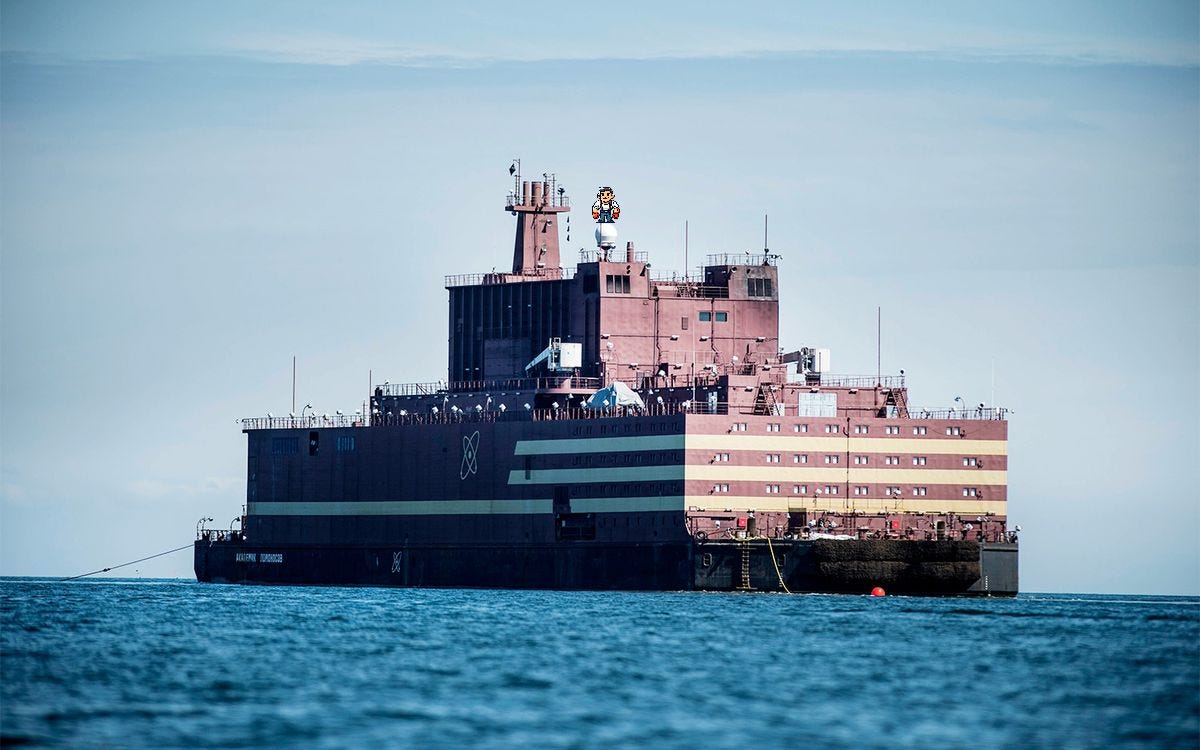
One confirmed project is a floating nuclear plant going in at Baimsky/Peschanka, in Chukotka, in Russia’s Arctic Far East. That power is needed to tap into the Peschanka deposit, one of the biggest undeveloped copper deposits in the world, which consists of an estimated 9.9 million tonnes of copper and 16.6 million ounces of gold. The plant is being built to process 70 million tonnes of ore a year, on a capital budget of about $8 billion.
Once it’s running, projected tax revenue to budgets is RUB 1 trillion, about $11.9 billion. For scale: Russia’s oil and gas sector generated RUB 9.06 trillion in tax revenue in 2021, the last full pre-war year—about $123 billion at the time. One mine’s projected tax take is about 11% of what the country’s entire oil and gas industry brought in before the war.
The next stop is the Kola Peninsula. The Kola NPP-2 project—four 600 MW units under construction—is located just outside all three regions Putin named. Rosatom owns a rare-earth mine on the peninsula, called Lovozero. The raw ore mined there gets shipped to another Rosatom plant, hundreds of miles away in the Urals, where it’s turned into usable material.
The rest of the belt runs through Siberia and the Far East as gas. Gazprom's fields at Yamal, in Siberia, and Sakhalin, in the Far East, are two more that Rosatom is in talks to power with floating plants. The plants would run field development before any gas comes out of the ground, since neither site has another power source to draw on. Land-based small modular reactors are also part of the buildout.
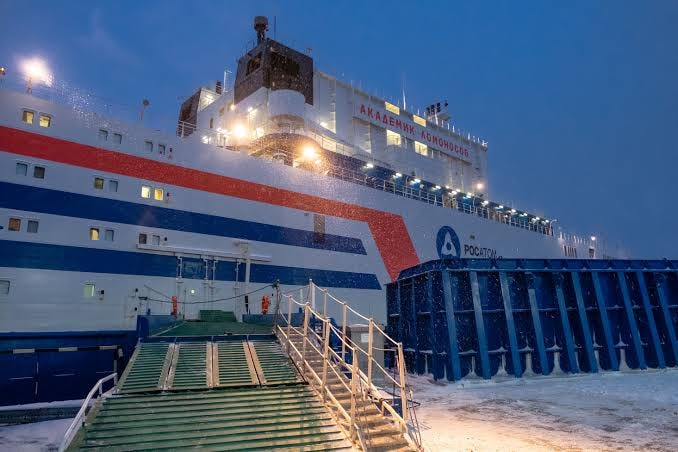
Rosatom has said it’s studying floating plants for practically all major Arctic mining and hydrocarbon projects along the Northern Sea Route, on top of the land-based SMR program already under construction in Yakutia. A 5-year refueling cycle for a nuclear plant is an obvious advantage. Diesel or coal deliveries arrive only once or twice a year, and in such remote places, hauling fuel in can cost several times more than producing the power itself.
The country's nuclear strategy isn't limited to domestic expansion. World Nuclear News quotes Alexei Likhachev, Director General of Rosatom:
On the international front, 28 units are currently being built in nine countries - India, China, Turkey, Egypt, Iran, Bangladesh, Hungary, Uzbekistan and Kazakhstan, where “we have nearly completed surveys at the site where the two VVER-1200 [Rosatom’s 1,200 MW pressurized water nuclear reactor] units will be located”.
“We are working to further expand our international presence and already have signed agreements for the construction of 17 more power units in six countries.”
Right now, Rosatom is suffering from a cash crunch, cutting its overall investment budget by nearly 50% this year. As a result some of the projects outlined above may not materialize as announced. And statements from a company, and a country, this deep in a mutual propaganda war with the West (besides the kinetic one) have to be taken with a grain of salt. Nevertheless, 28 units under construction across nine countries are still real, ongoing builds no Western vendor currently matches.
The track record supports it too: Russia owns the world's only civilian maritime nuclear fleet, and as Decouple pointed out, its floating plants descend from the first generation of Russian nuclear submarines through three further generations of icebreakers, accumulating over 400 reactor years of operation.
The week AA reported the 30 GW plan, the major Western coverage of Rosatom wasn't an assessment of that buildout. Instead, Politico ran a story on a confidential letter from Egypt's nuclear regulator to Rosatom, alleging “deliberate negligence” and concrete and foundation defects across four reactor units at El Dabaa.
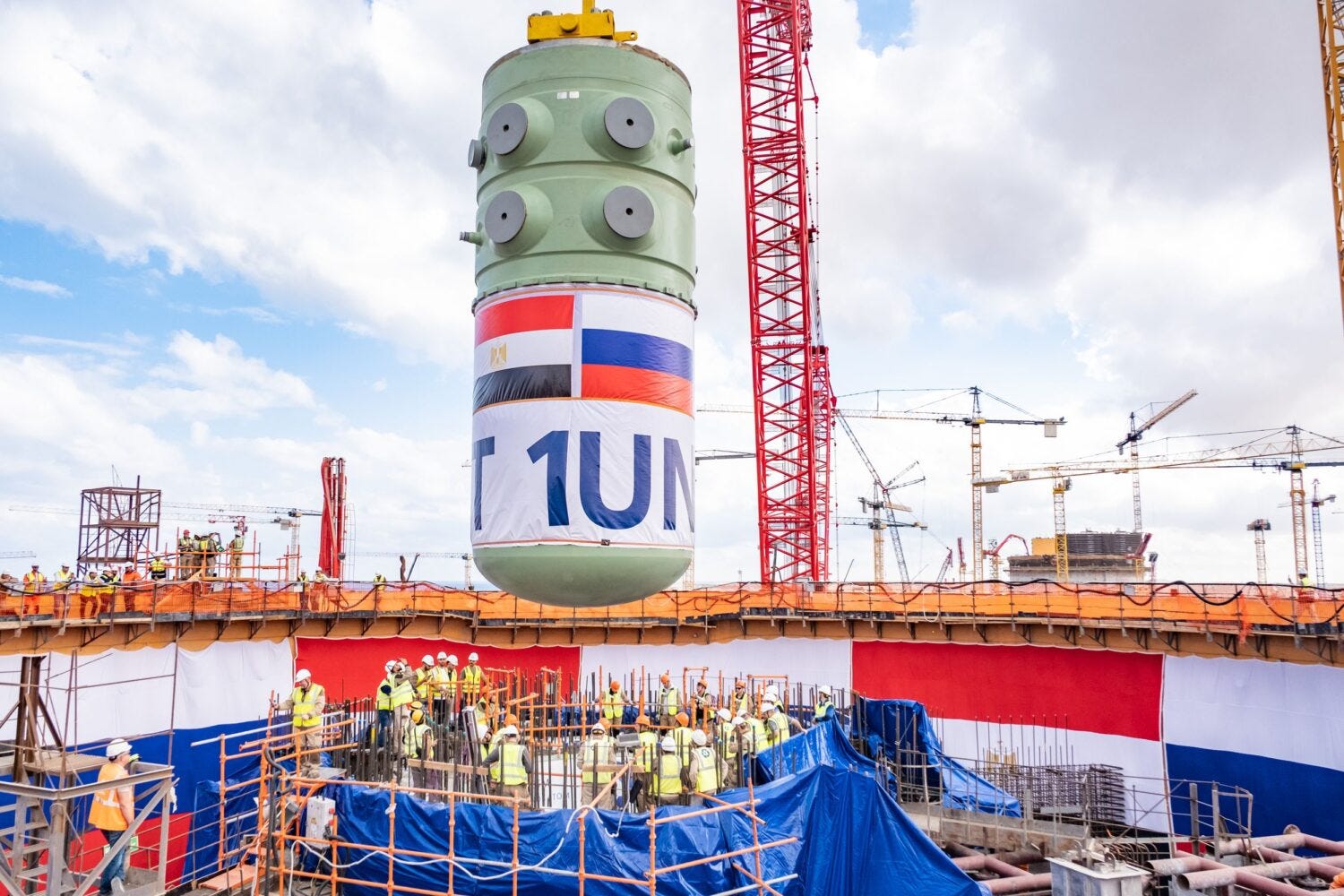
Whether that leak was opportunistic is worth pondering. It came from an unnamed “intelligence official,” which is an unusual source for a corporate-safety story. A strategic leak and a true story aren’t mutually exclusive, though. The timing leaves open whether this is straight reporting, or a media instrument in the vein of Fedorov.
But assuming Rosatom can get out of that slump, the influence its energy policy buys is a kind of global reach Europe isn’t even trying to match today. It might make the refinery destruction look like a footnote in history by comparison.
Share this article with anyone watching only half of the energy story!
📨 People in boardrooms, energy desks, and hedge funds keep forwarding this. Stop getting it late — subscribe now!
No posts
Comments
Nothing yet. Say the first thing.
Sign in to join the conversation.