

There is a strange moment before every high-pressure performance.
You are still technically the same person. Same brain. Same body. Same notes. Same slides. Same playbook. But sometimes you need to become someone slightly different. The person who can walk into the room and start the talk. The person who can step to the line and take the shot. The person who can speak clearly to their boss while their heart is trying to escape their chest.
Watch any video of Ronnie Coleman (8-time Mr. Olympia champion and bodybuilding legend) approaching a heavy lift and you will often hear the same cue: “Light weight, baby.” Watch Rafael Nadal before any serve and you will see the same small sequence of movements every time. Tug of the shorts. Wipe of the nose. Tuck of the hair behind each ear. It looks superstitious. It is not. Most elite performers have some version of this, and the same idea translates straight into clinical performance, public speaking, exams, and any other moment that demands you show up at your best.
Most people try to solve this by thinking harder. They reread. They rehearse. They over-caffeinate. They catastrophize. But performance is not just a knowledge problem. It is a state problem.
Your brain is constantly asking: who am I right now, and what would a person like me do next? That question gets answered by your mindset, your clothes, your posture, your music, your breath, your environment, the opening line you say to yourself. Not because cues are magic, but because they tell your brain which version of you is showing up.
Here is the system I actually use to cross that bridge.
1. Harness your adrenaline
Anxiety and excitement feel almost identical in your body. Racing heart. Tight chest. Heightened alertness. The difference is the story your brain attaches. Anxiety says danger. Excitement says opportunity. Trying to “calm down” usually fails because the arousal is already there.
A 2024 review pooled 44 randomized trials of stress reappraisal. People who briefly reframed their nerves as useful energy performed better than those who tried to suppress it (Bosshard and Gomez, 2024).
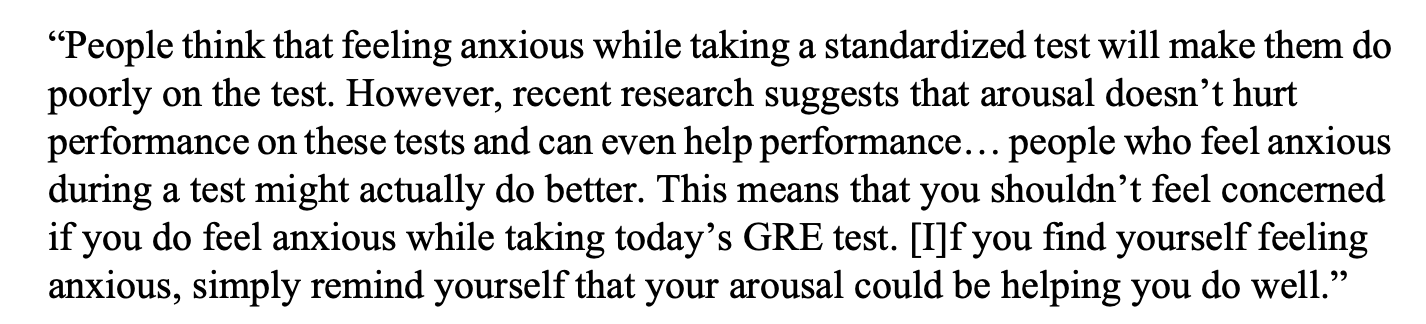
In one study, students preparing for the GRE were given a brief message before a practice test telling them that stress did not mean they were going to perform poorly. Instead, they were told this arousal could be their body mobilizing energy to help improve performance. These students scored higher on the actual math GRE, taken weeks later, than a control group (Jamieson et al., 2010).
Protocol:
Reframe your feelings of stress as “I’m excited,” not “I’m anxious.”
Avoid telling yourself to “calm down.” It often backfires.
Frame your racing heart as fuel, not failure.
Use a one-line script: “This is my body getting ready.”
2. Use a cue phrase, not a pep talk
Most people’s default self-talk is vague and hostile. Don’t mess this up. You always choke. Why are you like this? That is not honesty. It is a bad pre-game speech. Your brain needs a reliable switch.
That is what Ronnie Coleman’s “Light weight baby” actually was. Not motivation. Not bravado. A two-word command that told his nervous system how to interpret 800 pounds before he ever touched the bar. The weight did not change. The story attached to it did. And the story is what your brain uses to decide how much of itself to commit.
A meta-analysis of 32 studies found that self-talk consistently improved sport performance, with the strongest effects for fine-motor tasks and tasks people had not practiced before. Trained self-talk worked better than whatever people happened to mutter on their own (Hatzigeorgiadis et al., 2011).
In a separate cycling study, 24 athletes who practiced motivational self-talk for two weeks lasted 18% longer on a time-to-exhaustion test than controls, with reduced perceived effort at the same workload (Blanchfield et al., 2014).
Protocol:
Pick four key cue phrases that motivate and are specific to you. Two for the early-mid phase (”feeling good,” “smooth and steady”). Two for the hard part near the end (”push through this,” “you’ve got this”).
Make them specific. Running: “Feeling good.” High-pressure moment: “One breath, then go.” Presenting: “Slow is smooth.”
Rehearse them during normal training before relying on them under pressure. Drop the ones that feel flat. Replace them with phrases that actually land with you.
Use them during the task, especially for effort-dependent tasks, not just before. The above athletes deployed their cues mid-effort, when the urge to quit peaked.
3. Borrow an identity
“I am about to give a presentation” is fragile. Your brain can argue with it. Are you, though? You’re nervous. You haven’t rehearsed enough. “I am a presenter” or “I am the best candidate” is harder to argue with. When you take on a role, your brain stops asking whether you can do the task and starts asking what someone like you would do next. Action becomes a consequence of identity instead of a battle of motivation.
In one study, children who took on a role like Batman before a boring task persevered longer than children who simply tried to focus, with the strongest benefit for those who fully imagined being the character (Shachnai et al., 2022; White et al., 2017). The adult version is less about pretending and more about choosing the identity before the task: writer, runner, doctor, presenter.
Protocol:
Before the task, name your role confidently: “I am the presenter walking into the room” or “I am the best candidate.”
Ask what that person would do for the next 5 minutes.
Pick a role that already feels true. Not aspirational fantasy.
Pair the role with the right outfit (see #4 below). The cue is stronger when your brain has both signals.
This is the end of the free preview.
The first three tools are enough to start: aim the adrenaline, use a coaching cue, and step into the role.
Below: four more evidence-based strategies that build the rest of the system, plus the 5-minute performance routine I use right before high-stakes moments.
Comments
Nothing yet. Say the first thing.
Sign in to join the conversation.