
This is an occasional series looking at neuroscience beyond clinical trials: how the nervous system shapes everyday experience. Brain Trials’ core coverage of neurodegeneration drug development continues next week.
If you drink in the evening, there’s a good chance you’ll wake in the small hours. More than a third of adults report waking in the middle of the night several times a week, and alcohol is one of the most reliable triggers.1 The exact hour varies with how much you drank and when you stopped; but for a lot of people, it lands around 3 AM.
You know the feeling. A few drinks in the evening, you fall asleep fast, sleep like a rock for four or five hours — and then you’re wide awake with a pounding heart, a racing mind, and no chance of getting back to sleep.
It’s not a malfunction. What you’re experiencing is your autonomic nervous system pulling itself back to baseline after a chemical disruption. It’s not one mechanism. It’s five, firing in concert. Understanding them changes how you think about it.
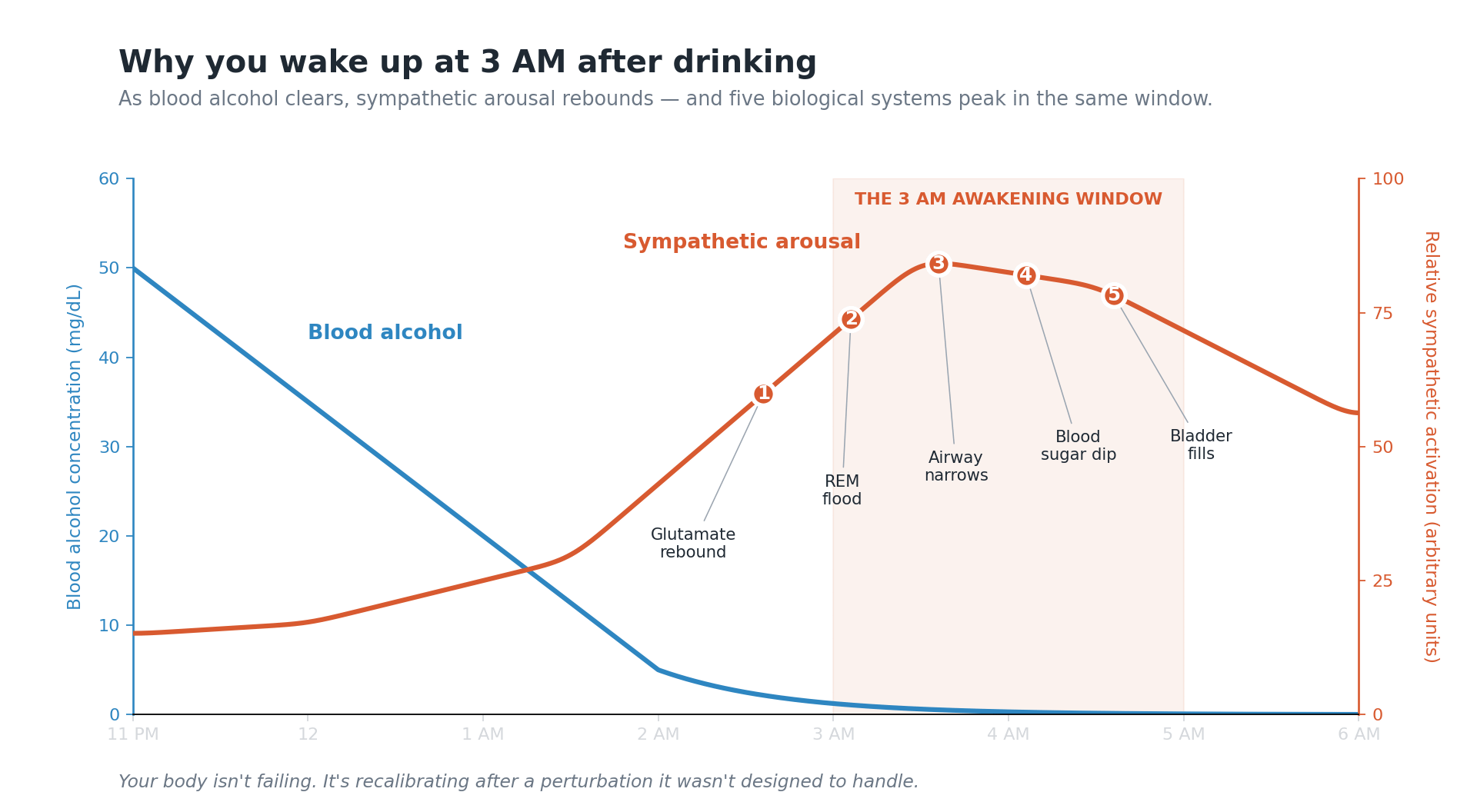
Alcohol enhances GABA, the brain’s main inhibitory neurotransmitter, and suppresses glutamate, its main excitatory one. This is why it’s sedating. Your brain gets quieter. Muscle tone drops. You feel relaxed, then drowsy, then unconscious.
But your brain does not passively accept being silenced. As the liver clears alcohol (roughly one standard drink per hour) the suppression lifts, and both systems overcorrect. Glutamate surges. Norepinephrine spikes. The sympathetic nervous system, your body’s fight-or-flight branch, snaps to attention.2
This is the rebound. Your heart rate rises. You feel alert, wired, anxious — at 3 AM, in a dark room, with no threat in sight. The threat was chemical. The response is neurological. And it peaks at exactly the point where blood alcohol approaches zero, which for two or three drinks consumed over the evening is — right around the middle of the night.
Alcohol suppresses rapid eye movement (REM) sleep in the first half of the night. A recent meta-analysis of 27 studies confirmed that pre-sleep alcohol delays REM onset and reduces total REM duration in a dose-dependent manner.3 Your brain, deprived of the dreaming phase it uses for emotional processing and memory consolidation, compensates by flooding the second half of the night with intense REM. This is called REM rebound.
The result: vivid, emotionally charged dreams (sometimes nightmares) and more frequent awakenings. You’re not just waking up. You’re waking up from inside a dream your brain was urgently trying to finish.
Alcohol relaxes the muscles of the upper airway: the tongue, soft palate, and pharyngeal walls. This is why people snore more after drinking. A systematic review and meta-analysis found alcohol significantly raises the risk of sleep apnea, with a dose-response relationship: the more you drink, the greater the effect.4 In people with undiagnosed obstructive sleep apnea (roughly 10–17% of middle-aged men) alcohol makes it substantially worse, increasing breathing pauses and lowering blood oxygen.
Each apnea event triggers a micro-arousal: a brief, often unconscious surge of sympathetic activation to restart breathing. Stack enough of those on top of the glutamate rebound and the second half of the night becomes biologically nothing like the first.
Alcohol impairs the liver’s ability to produce glucose through gluconeogenesis, by as much as 45% compared to placebo.5 In people who haven’t eaten adequately before drinking, or whose glycogen stores are low, this can drop blood sugar enough to trigger a counter-regulatory hormone response — cortisol and adrenaline rise to mobilize glucose.
This is most pronounced in people who drink on an empty stomach. In well-fed social drinkers, the effect is more modest, but it still adds to the arousal pile. Your body isn’t anxious because something is psychologically wrong. It’s defending its fuel supply.
Alcohol suppresses antidiuretic hormone (vasopressin), which normally tells your kidneys to retain water overnight. Without it, urine production climbs, often dramatically. By 3 or 4 AM, your bladder is full, and the signal to wake and empty it arrives at the same time as everything else on this list.
This one feels trivial next to the neuroscience. It isn’t. A full bladder is a sympathetic stimulus. It adds to the pile.
Here’s the part that matters even if you don’t drink. Alcohol doesn’t invent the 3 AM awakening: it exploits machinery that’s running every night, in everyone.
Two things make the pre-dawn hours the most awakening-prone stretch of the night, regardless of what you drank. First, sleep gets lighter as the night goes on. You front-load your deep, slow-wave sleep in the first few hours; by the early morning you’re cycling through lighter stages and more REM, where the smallest disturbance (a noise, a full bladder, a warm room) can surface you to wakefulness.6
Second, your cortisol starts climbing in the small hours. The body’s natural cortisol rhythm bottoms out around midnight and begins its ramp toward the morning peak well before you wake — a built-in tilt toward arousal that begins, for many people, around 2 to 3 AM.7
That’s why stress and anxiety produce the same 3 AM wake-up alcohol does. If your baseline cortisol is already elevated, the pre-dawn rise crosses the waking threshold earlier. The same is true for a blood sugar dip from a late, carb-heavy meal, or the lighter, more fragmented sleep that comes naturally with age. Different triggers, identical window — because they’re all acting on the same system, at the same vulnerable hour.
Alcohol is simply the most reliable, most reproducible way to push that system over the edge. It’s a controlled experiment your body runs on itself, on a Friday night.
Five systems, one awakening. That convergence is why the experience is so reliable — it’s not one fragile pathway, it’s several independent mechanisms peaking in the same two-hour window, on top of a nervous system already tilting toward wakefulness.
And here’s the part that changes the framing. None of this is your body failing. All of it is your body working. The glutamate rebound is your brain restoring excitatory tone. The REM flood is your brain recovering the dream sleep it was denied. The cortisol rise is your endocrine system preparing you for the day. The sympathetic surge is your brainstem restarting breathing through a narrowed airway.
You wake at 3 AM with a pounding heart and think something is wrong. The truth is closer to the opposite: everything is working. Your autonomic nervous system is doing precisely what it evolved to do, defending your equilibrium through the most vulnerable hours of the night. Alcohol just turns the volume up.
The problem isn’t the rebound. The problem is what we keep asking the system to absorb (the nightcap, the late meal, the unrelenting baseline stress) in a world that rarely lets it settle. That’s a different kind of question, and one worth sitting with.
Sleep well. Maybe skip the nightcap.
I left two threads out of the main piece to keep it tight: the adenosine system’s role in the sedation-then-rebound cycle, and how chronic stress resets the cortisol rhythm so the pre-dawn rise comes even earlier. If there’s interest, I’ll go deeper on either. Let me know in the comments.
If this kind of analysis (looking at what the body is actually doing instead of what we assume it’s doing) is useful to you, consider subscribing. Brain Trials covers neuroscience through the lens of evidence, measurement, and biology that doesn’t always do what we expect.
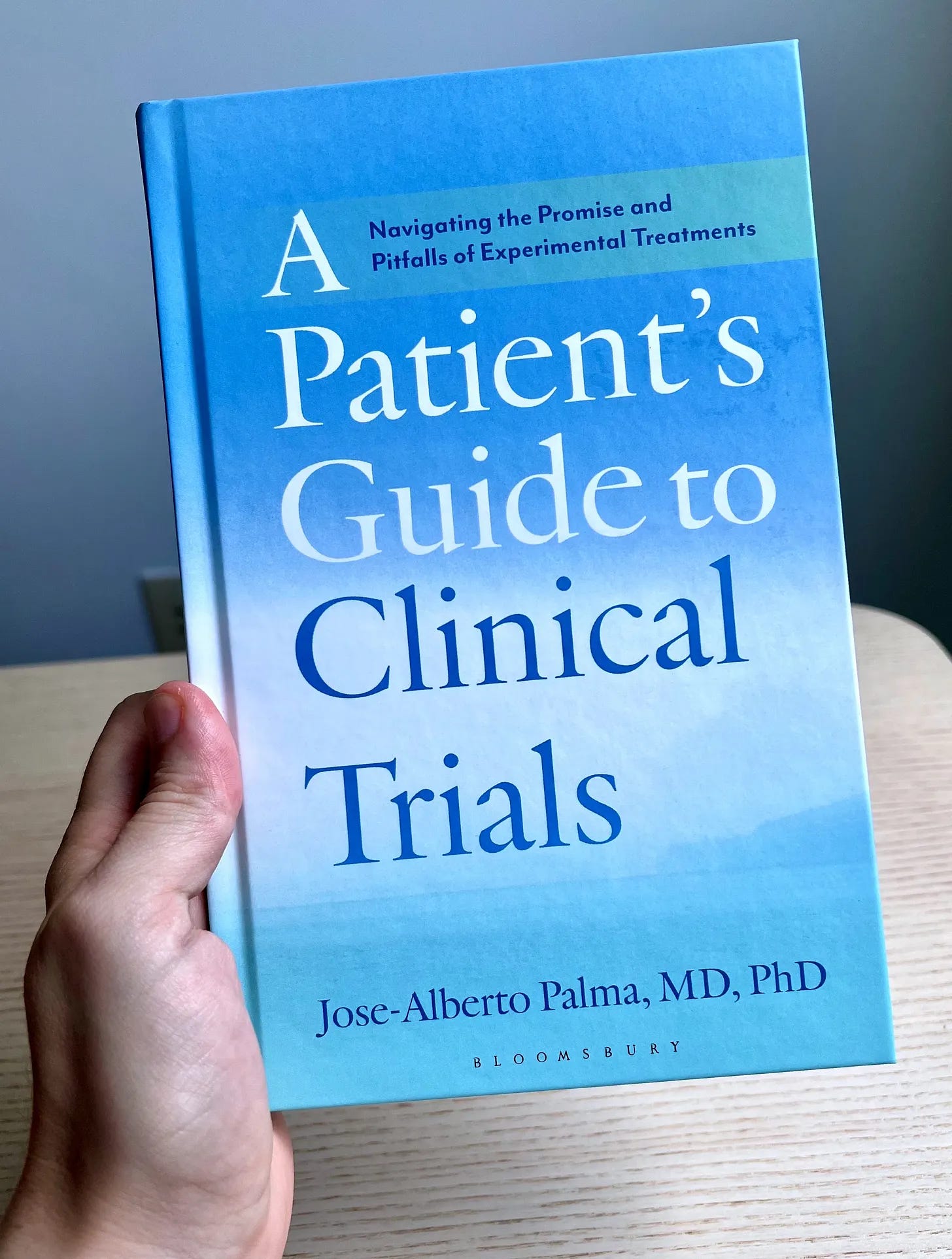
Knowing how to read what your body is telling you matters - whether the context is a clinical trial or a Tuesday at 3 AM. I wrote a book about that.
A Patient’s Guide to Clinical Trials: Navigating the Promise and Pitfalls of Experimental Treatments (Bloomsbury) — available now.
Views expressed here are my own and not necessarily those of my employer.
Thakkar MM, Sharma R, Sahota P. Alcohol disrupts sleep homeostasis. Alcohol. 2015;49(4):299–310. doi:10.1016/j.alcohol.2014.10.015
Gardiner C, Weakley J, Burke LM, et al. The effect of alcohol on subsequent sleep in healthy adults: a systematic review and meta-analysis. Sleep Medicine Reviews. 2025;80:102030. doi:10.1016/j.smrv.2024.102030
Simou E, Britton J, Leonardi-Bee J. Alcohol and the risk of sleep apnoea: a systematic review and meta-analysis. Sleep Medicine. 2018;42:38–46. doi:10.1016/j.sleep.2017.12.005
Siler SQ, Neese RA, Christiansen MP, Hellerstein MK. The inhibition of gluconeogenesis following alcohol in humans. American Journal of Physiology – Endocrinology and Metabolism. 1998;275(5):E897–E907. doi:10.1152/ajpendo.1998.275.5.E897
Surveys of middle-of-the-night waking find that more than a third of adults wake several nights per week (Ohayon, Sleep Medicine, and U.S./European population data summarized by the National Sleep Foundation). The 35% figure refers to nocturnal awakening generally; alcohol is one of the most consistently identified triggers, not the sole cause.
The fuller story involves adenosine. Alcohol initially boosts adenosine — the same sleep-pressure molecule caffeine blocks — which is part of why a nightcap makes you drowsy. As alcohol clears, adenosine tone falls and the wake-promoting systems of the basal forebrain are released from inhibition, compounding the glutamate/norepinephrine rebound. Thakkar et al. (2015) review this in detail.
Gardiner et al. (2025), Sleep Medicine Reviews — a systematic review and meta-analysis of 27 studies. Even moderate intake measurably delays and shortens REM.
Simou et al. (2018), Sleep Medicine — pooled analysis showing alcohol raises sleep apnoea risk by roughly 25%, with a clear dose-response gradient.
Siler et al. (1998), American Journal of Physiology — stable-isotope tracers quantified a 45% reduction in gluconeogenesis in the five hours after alcohol ingestion in healthy men.
Slow-wave (deep) sleep dominates the first half of the night; the second half is richer in REM and lighter NREM stages, lowering the arousal threshold. This is standard sleep architecture, well described in any sleep-medicine text and in the AASM scoring manual.
The cortisol awakening rhythm reaches its nadir around midnight and begins rising in the pre-dawn hours toward a peak shortly after waking. An elevated baseline (from chronic stress) shifts that threshold earlier, which is one mechanism behind stress-related early-morning waking.
Comments
Nothing yet. Say the first thing.
Sign in to join the conversation.