
A drug that reduces tau in the brain, slows cognitive decline at a rate comparable to lecanemab and donanemab, and represents the first tau-directed therapy in Alzheimer’s history to show both biomarker impact and clinical benefit in a randomized trial; and the company says the primary endpoint was missed.
That is the puzzle at the center of the Phase 2 CELIA results for diranersen (formerly BIIB080) and intrathecally administered anti-MAPT antisense oligonucleotide (ASO), announced by Biogen on May 14 via press release. In January 2026, I flagged this readout as the single most important mechanism-validating test in Alzheimer’s disease outside amyloid - and most important readout in any neuroscience trial in 2026.
The results are as important as predicted, and they may say more about the trial design than about the drug.
CELIA enrolled 416 participants with mild cognitive impairment or mild dementia due to Alzheimer’s disease, all with confirmed amyloid pathology, none previously treated with anti-amyloid therapy. They were randomized to placebo or one of three intrathecal diranersen regimens over 76 weeks:
60 mg every 24 weeks (two lumbar punctures per year)
115 mg every 24 weeks
115 mg every 12 weeks
The primary endpoint was dose response in CDR-SB, not whether diranersen beat placebo on CDR-SB, but whether higher doses produced proportionally greater cognitive benefit.
That choice deserves scrutiny.
In the Phase 1b study (Mummery et al., Nature Medicine 2023, n=46), and the subsequent Long-Term Extension (Edwards et al. JAMA Neurol, 2023) CSF tau reduction plateaued at roughly 50–60% across the two higher dose levels tested; 60 mg Q4W and 115 mg Q12W both converged on the same ceiling. More drug did not mean more tau reduction above that threshold. Crucially, when treatment was stopped, tau suppression at the higher doses didn’t rebound, it persisted for months, indicating the ASO has a very long pharmacodynamic half-life in the CNS.
That durability justified CELIA’s boldest design decision: testing 60 mg Q24W, a dose given just twice a year, at half the frequency of anything studied in Phase 1b. This was a pharmacological extrapolation, not a tested regimen.
But it also means all three CELIA doses were likely to produce the same ~60% tau reduction.
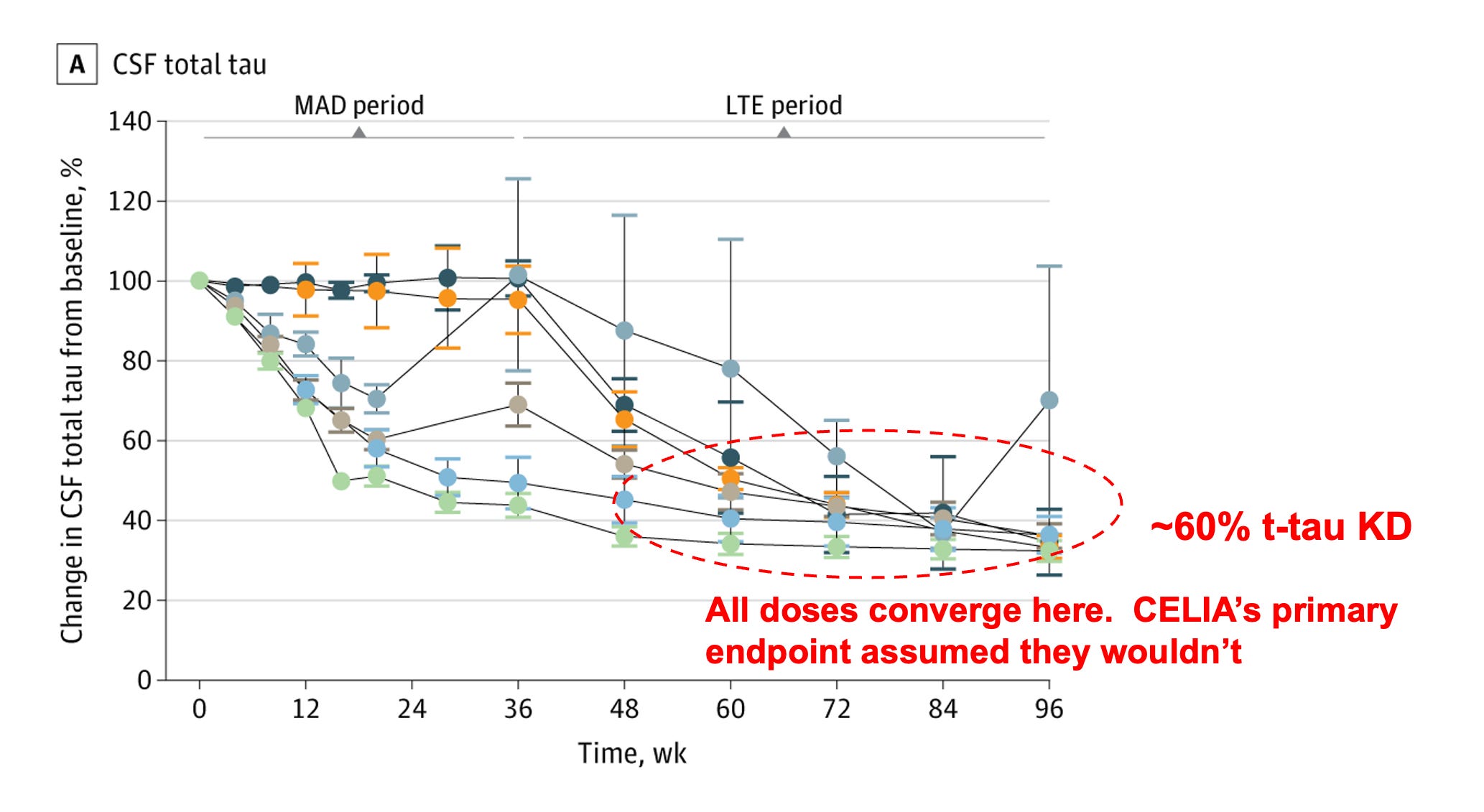
If the biomarker is flat across your dose range, expecting the clinical endpoint to show a dose-dependent gradient is a bet against your own pharmacology.
Why make that bet? One possible reason: a dose-response trend test requires fewer patients than multiple head-to-head comparisons of each dose against placebo. It’s statistically efficient. It may also have been biologically wrong.
There is a further problem. CELIA was originally designed to enroll approximately 735 participants. The final enrollment was 416, roughly 57% of the planned sample. Biogen has not publicly explained the reduction.
Whatever the reason, the consequences for the primary endpoint are straightforward. A dose-response trend test with ~104 participants per arm has substantially less power than one with ~184. A trial running at 57% of its planned sample size, with a primary endpoint that the Phase 1b biomarker data already suggested would be difficult to meet, was working with the odds stacked against it twice over.
The primary endpoint was missed. No statistically significant dose-response on CDR-SB at Week 76.
But every dose slowed cognitive decline. Pre-specified analyses demonstrated slowing across all three dose groups — with the strongest signal at the lowest dose, 60 mg every 24 weeks, the regimen never tested in Phase 1b. On a recent investor call, Biogen described the CDR-SB slowing as “nominal” — meaning numerically present but not formally tested as a pre-specified primary comparison — and comparable to the 25–30% slowing observed with approved amyloid-targeting therapies.
That comparison deserves emphasis. If the effect size holds, diranersen at two lumbar punctures per year is producing a cognitive benefit in the same range as the anti-amyloid drugs that took decades and tens of thousands of patients to validate — through a completely independent mechanism.
Biomarkers moved robustly. CSF tau and tau PET both showed sustained reductions across all doses throughout the 18-month treatment period, consistent with the ~60% plateau seen in Phase 1b and confirming that the Q24W extrapolation held.
Safety was generally consistent with Phase 1b, with one flag: serious adverse events were more frequent at the highest dose (115 mg every 12 weeks). We don’t know what those SAE were.
Biogen is advancing diranersen to Phase 3.
Read this slowly: This is the first ever randomized Phase 2 study of any tau-targeted therapy to demonstrate both biomarker reduction and cognitive benefit in early Alzheimer’s disease.
After decades of tau-targeting failures (vaccines, antibodies, small molecules) the ASO tested in CELIA is the first to produce evidence that inhibiting tau protein production (via degradation of the MAPT mRNA) may meaningfully slow disease progression. Tau pathology correlates more tightly with cognitive decline than amyloid does. If this holds, it’s a new pillar of Alzheimer’s treatment, not an incremental advance.
That’s the optimistic read. Here’s what we still can’t assess.
The “inverted” dose-response is less surprising than it looks. If all three doses were hitting the same ~60% tau reduction ceiling, there was no biological basis for a dose gradient. The lowest dose produced the best clinical signal likely because it achieved the same tau suppression while carrying less safety burden. More frequent lumbar punctures and higher drug exposure bought nothing except more serious adverse events.
This reframes the missed primary entirely. CELIA may not have failed because tau reduction doesn’t work. It may have failed because a halved trial was asked to detect a dose-response gradient that the drug’s own pharmacology had already shown doesn’t exist. Had CELIA been run at full enrollment as a straightforward superiority test of 60 mg Q24W versus placebo, we might be reading a very different press release. That possibility is as frustrating as it is important.
“Nominal” is doing a lot of work. Biogen’s comparison to lecanemab and donanemab effect sizes is encouraging but not confirmatory. Without confidence intervals, the placebo trajectory, and the individual dose-arm curves, we cannot tell whether 25–30% slowing is a robust finding or a favorable point estimate from an underpowered trial. The word “nominal” means Biogen can see a number that favors them but cannot call it statistically significant. That distinction is the difference between a validated signal and a promising trend.
No data have been shown. No CDR-SB point estimates, no p-values, no tau PET effect sizes, no breakdown of serious adverse events. The field is working with a company’s interpretation of its own data. That is not the same as seeing the data.
The Q24W bet changes the feasibility conversation. Two lumbar punctures per year is a radically different proposition from four or twelve. If the Phase 3 confirms 60 mg Q24W as the dose, the compliance barrier (the main practical objection to intrathecal therapy in Alzheimer’s) drops substantially.
All participants were anti-amyloid naïve. The cognitive benefit occurred without amyloid removal, supporting tau as a standalone target. But the real-world future is almost certainly some sort of combination or sequence . CELIA tells us nothing about how tau reduction interacts with amyloid clearance, the question the field most needs answered.
The CDR-SB separation at 60 mg Q24W versus placebo. Is it a clean 25–30% with tight confidence intervals, or a noisy estimate? The difference between “comparable to lecanemab” and “in the range of lecanemab if you squint” is everything for Phase 3.
The tau PET data by dose. If tau PET is flat across all three doses (mirroring the CSF plateau) the trial design critique hardens: dose-response was never the right primary for this drug.
The adverse events breakdown. The nature and reversibility of those serious adverse events, in particular, will determine whether the inverted dose-response is biology, toxicity, or both, and that distinction will drive Phase 3 dose selection.
Any explanation for the enrollment reduction. 735 planned, 416 enrolled. The field deserves to know why.
Full data: AAIC 2026, London, July. I’ll be there.
If this type of analysis is useful to you, the kind that reads the press release, checks it against the earlier data, and asks whether the trial was designed to let the drug succeed, consider subscribing. Brain Trials covers neuroscience drug development through the lens of evidence, methodology, and what the numbers actually show.
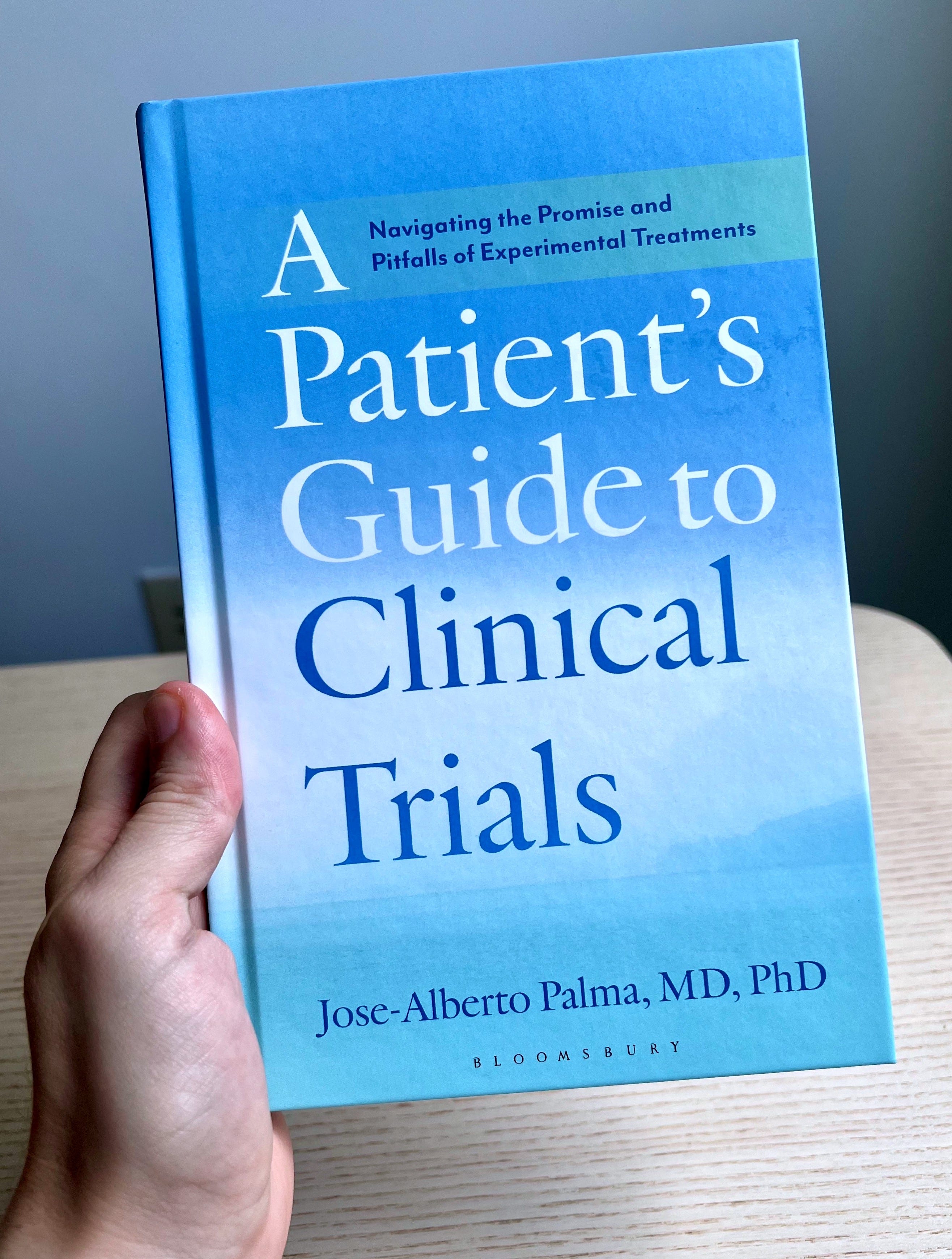
A press release that gives you adjectives instead of numbers is an invitation to wait, not to celebrate. Knowing the difference is what clinical trial literacy is about. I wrote a book about that.
A Patient’s Guide to Clinical Trials: Navigating the Promise and Pitfalls of Experimental Treatments (Bloomsbury) — available now.
This analysis represents my personal views, not necessarily my employer’s view, and is based entirely on publicly available information.
Comments
Nothing yet. Say the first thing.
Sign in to join the conversation.