

On May 21, Biogen and Denali Therapeutics announced that the Phase 2b LUMA study of BIIB122 (DNL151), a brain-penetrant, oral LRRK2 kinase inhibitor, had failed in patients with early-stage Parkinson’s disease (PD).1 The drug did not slow progression on the primary endpoint. Secondary endpoints showed no benefit either. Both companies are discontinuing BIIB122 in idiopathic PD.
Denali continues to develop BIIB122 in PD patients who are pathogenic LRRK2 variant carriers through the Phase 2a BEACON study, which reads out in the first half of 2027.
In January, I listed LUMA as one of the 10 most important neuroscience clinical trial readouts of 2026.
The failure itself isn’t surprising: most Phase 2 trials in neurodegeneration fail.
What’s worth dwelling on is how it failed: the drug did exactly what it was designed to do at the molecular level, and the patients didn’t improve. That gap is where the real lessons sit, and most coverage is gliding past it.
LUMA enrolled 648 patients with early-stage PD, aged 30–80, with or without a pathogenic LRRK2 variant. They were randomized to BIIB122 or placebo for 48 to 144 weeks. The primary endpoint was time to confirmed clinical worsening on the combined MDS-UPDRS Part II + Part III scale.1
The drug missed the primary and secondary endpoints. No statistically significant slowing of progression vs placebo. Secondary endpoints also showed no benefit. Biogen and Denali called development off in idiopathic PD on the day they released topline.
But the pharmacology worked. Exploratory biomarker analyses showed >90% peripheral LRRK2 kinase inhibition (measured by phosphoserine-935 on LRRK2 itself) and ~30% reduction in CSF phospho-Rab10, the downstream kinase substrate that serves as a readout for LRRK2 activity in the central nervous system.
The drug reached the brain. It engaged its target. The disease was unmoved. This is the disconnect worth examining. I offer, at least, three explanations for it, and they lead to very different conclusions.
Peripheral kinase inhibition was >90%. CSF phospho-Rab10 reduction was 30%. That gap is the first place Biogen and Denali will look, because it’s the explanation that let the strategy continue: dose higher, design a better-brain-penetrant molecule, run a biger trial.
Peripheral LRRK2 inhibition is easy to achieve because peripheral immune cells are accessible to drug. Reducing LRRK2 kinase activity in midbrain dopaminergic neurons is harder, the blood-brain barrier limits exposure, and CSF biomarkers are an imperfect proxy for what’s happening inside basal ganglia neurons. A 30% reduction in CSF phospho-Rab10 may mean that intra-neuronal LRRK2 kinase activity was reduced by something like 30%, or it may mean it was reduced by considerably less. Either way, “two-thirds of LRRK2 kinase activity is still running” is a reasonable upper bound on what the drug actually achieved at the site of disease.
But this explanation has problems.
Inferring from this readout to intra-neuronal kinase activity in mid-brain dopaminergic neurons assumes a 1:1 relationship that, to my knowledge, has never been formally validated. The 30% figure may understate or overstate what’s happening inside the relevant cells.
And dose escallation is not available: LUMA almost certainly used the highest tolerable dose, with the cealing set by LRRK2-related animal safety signals (lung and kidney effects). “Dose higher” sounds reasonable, but it’s likely not feasible without a different molecule.
Interestingly, Ionis LRRK2 ASO (intrathecal) achieved substantially higher CSF target engagement than BIIB122. They never got to test what the effect on clinical endpoints was, because Ionis LRRK2 ASO was discontinued after the Phase 1, likely for strategic/commercial reasons.
In any case, the field has not shown that more CNS exposure with a LRRK2 inhibitor should produce better clinical outcomes in PD.
This is the explanation almost no one is talking about, and it’s the most interesting one.
LRRK2 is a large, multidomain protein. It contains kinase activity, GTPase activity, and scaffolding functions mediated by its WD40 and other domains.2
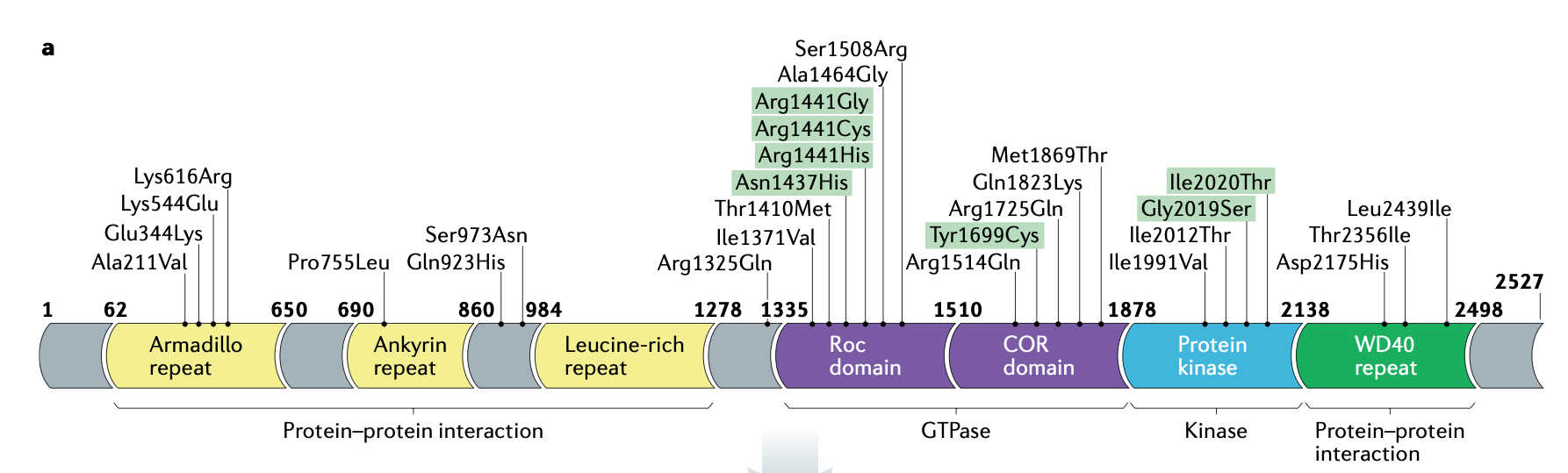
BIIB122 is a selective kinase inhibitor: it blocks just one of LRRK2’s biochemical functions. The others continue to operate at baseline.
There’s another way to drug LRRK2, an intrathecal ASO that targets LRRK2 messenger RNA and lowers the total protein, thus inhibiting not just the kinase activity, but all of the activities. As briefly mentioned above, Ionis had one (ION859, also known as BIIB094).
Its Phase 1 REASON study, published in Nature Medicine in March, showed something striking: in CSF, ION859 (BIIB094) reduced total LRRK2 by up to 59% and phospho-Rab10 by up to 50%, substantially more central target engagement than BIIB122 achieved in LUMA.3 It also reduced lysosomal cathepsins in CSF, suggesting downstream effects on lysosomal biology: exactly the pathway LRRK2 is thought to disrupt in PD.
By every biomarker measure that mattered, the ASO worked better than the kinase inhibitor.
Biogen and Ionis discontinued ION859 somewhere in 2025-2026.4 The public reason was pipeline rationalization. The practical reason was almost certainly commercial: ION859 requires intrathecal administration every four weeks — twelve lumbar punctures per year, for a patient population that progresses over a decade or more.
Tofersen has shown intrathecal dosing can work in ALS, but ALS is a faster, more severe disease, with patients motivated by acute decline.
Parkinson’s is a different proposition. A monthly lumbar puncture is a challenging commercial proposition in this indication.
So Biogen had two LRRK2 mechanisms. One produced better central target engagement, hit all three LRRK2 functions, and required intrathecal dosing nobody could realistically commercialize. The other produced more modest central target engagement, hit only kinase activity, and was conveniently oral. Biogen bet on the convenient one. The bet has now failed.
That doesn’t prove kinase inhibition is insufficient. But it removes the strongest counter-argument: the better-engaged target didn’t get a fair Phase 2.
LUMA included patients with and without pathogenic LRRK2 variants. The genetics-driven hypothesis says variant carriers (whose disease is, by definition, driven by LRRK2) should benefit most from LRRK2 inhibition. The topline didn’t break out carrier versus non-carrier results, and Biogen has not publicly released that subgroup analysis.
That subgroup analysis is the most important data point still outstanding.
If LRRK2-variant carriers in LUMA also showed no benefit, it’s a powerful signal that adult kinase inhibition isn’t enough to alter the trajectory of LRRK2-driven disease — that the damage is done before the drug arrives, or that other pathways have taken over. If carriers did benefit but were diluted by the non-carrier majority, then LUMA’s trial design buried a real signal.
BEACON will tell us. Denali’s Phase 2a study in pathogenic LRRK2 variant carriers is the cleanest possible test of the genetics-stratified hypothesis. Readout: first half of 2027.
In parallel, biotech company Neuron23 is testing a different stratification approach with NEU-411, a brain-penetrant LRRK2 kinase inhibitor with similar mechanism to BIIB122 but a different patient-selection strategy.5 Their NEULARK Phase 2 trial uses a SNP-based “companion diagnostic” that the company claims identifies up to 30% of idiopathic PD patients as having “LRRK2 pathway overactivity.” Combined with the ~2% with pathogenic mutations, they define this expanded population as “LRRK2-driven PD.” NEULARK uses a Roche-developed digital biomarker as its primary endpoint rather than MDS-UPDRS.
The Neuron23 bet is bold and worth flagging skeptically. It assumes three things are simultaneously true: that LRRK2 kinase inhibition is the right mechanism, that their SNP signature actually identifies responders, and that the digital biomarker primary endpoint will detect a slowing effect that MDS-UPDRS would have missed.
Each of those is an unvalidated assumption.
Their trial could vindicate any one of them, or none.
The honest landscape after LUMA looks like this:
BIIB122 in idiopathic PD: discontinued.
BIIB122 in LRRK2 variant carriers (BEACON): continuing, reads out H1 2027. The genetics-stratified hypothesis test.
Ionis LRRK2 ASO (better CNS target engagement): dead, likely for commercial/strategic/feasibility rather than scientific reasons.
NEU-411 with SNP stratification (NEULARK): ongoing, bets on patient enrichment in idiopathic PD.
Other early-stage LRRK2 programs: now under a cloud, with Phase 2 derisking far from settled.
That’s a thin pipeline for what was, until two weeks ago, considered the most genetically validated target in idiopathic Parkinson’s.
There’s a deeper problem with the entire LRRK2-inhibition hypothesis that almost no one in the field articulates publicly, because the implication is that a decade of drug development may have been pushing the wrong direction on the same lever.
Start with what we know about LRRK2 biology in patients.
LRRK2 gain-of-function mutations (most prominently G2019S) increase the lifetime risk of developing Parkinson’s disease. Penetrance is incomplete (roughly 30% by age 80), but the risk increase is real and driven by kinase overactivation. The rational therapeutic hypothesis follows directly: if increased kinase activity raises the probability of getting PD, then lowering kinase activity should reduce that probability. This is the bet BIIB122, NEU-411, and every other LRRK2 kinase inhibitor program has been built on.
But there’s a second fact about LRRK2-mutation PD that the field has been quieter about. Once LRRK2 mutation carriers actually develop Parkinson’s, their disease is consistently milder than idiopathic PD. A large prospective cohort study published in Brain in 2024 and led by my friend Lucy Norcliffe-Kaufmann (then with 23andMe) confirmed what smaller studies had been showing for over a decade: LRRK2-G2019S carriers with PD have slower motor progression, lower rates of cognitive impairment, less REM sleep behaviour disorder, less hyposmia, and better survival than matched idiopathic patients.6 More strikingly, at least one-third of LRRK2-G2019S carriers with PD show no classic Lewy body pathology anywhere in the brain, including in the substantia nigra. Their disease is a milder version of idiopathic PD (some could argue that is, in fact, a different disease, but that’s a topic for a different post).
Hold those two facts side by side. LRRK2 mutations increase the risk of developing incident PD, but decrease severity and alter the pathology once PD develops.
The kinase activity that’s pathogenic for disease initiation is, maybe (perhaps), doing something completely different (possibly protective, possibly neutral) once disease is established.
If that’s right, the entire premise of inhibiting LRRK2 in established disease may be backwards. LUMA enrolled patients with already-manifest PD. The drug suppressed kinase activity that, in those patients, may not have been the driver of their ongoing degeneration. At best, inhibition does nothing. At worst, it pushes the molecular phenotype away from the milder LRRK2-mutation pattern, toward the more aggressive idiopathic pattern — potentially accelerating the very progression it was designed to slow.
The uncomfortable implication: for established idiopathic PD, the rational therapeutic move might be the opposite of what the field has been trying. A LRRK2 activator (or some other intervention that nudges patients toward the molecular state of LRRK2-mutation PD) could slow progression precisely because LRRK2-mutation PD progresses more slowly. I’m not aware of a serious activator program anywhere. There probably should be one.
This reading also predicts that BEACON (BIIB122 in pathogenic LRRK2 carriers) might fail in a particularly informative way: by failing to slow disease in patients whose disease was, on natural history grounds, going to be slower anyway. We won’t know until 2027. But the question is worth asking before the data arrive, because the interpretation will be contested either way.
The conventional explanations for LUMA (exposure, mechanism, patient selection) all have answers the field can give. The activator paradox doesn’t. It implies that the entire therapeutic strategy may have been a decade-long bet in the wrong sign on the right molecule.
LUMA is the second major hypothesis failure in idiopathic PD in three years. Anti-alpha-synuclein antibodies, such as prasinezumab, also failed their primary endpoints, at least in unselected populations (that did not prevent Roche from continuing the development of prasinezuman in an ambitious, ongoing Phase 3 trial).
Two genetically and mechanistically grounded approaches, two clinical disappointments.
The conservative read of this pattern is that trials were too short, patients too advanced, doses too low, endpoints too crude. Fix those things, and the mechanisms might still work. The surviving pharma companies will articulate this read, and, perhaps, they might be right.
The harder read is the one the activator paradox implies. The field has been running a single coherent bet for more than a decade: that adult LRRK2 inhibition in established Parkinson’s will slow progression. LUMA was that bet’s most rigorous test, and it failed across every endpoint. The conventional explanations each have answers. The activator possibility doesn’t, and it implies we may have been wrong not in the level of the lever, but in its direction.
We won’t know which read is correct until BEACON reports, or until someone finds the moral and commercial courage to test a LRRK2 activator in established disease. Until then, the honest position on LRRK2 in idiopathic PD is that the past decade’s confidence about kinase inhibition deserves more skepticism than the field is currently offering it.
A negative trial like LUMA is not a setback to be optimized past. It is, sometimes, the field telling itself something it doesn’t want to hear.
I left out the GBA angle, the subgroup analyses from prasinezumab’s PADOVA trial, and the question of whether the LRRK2-activator hypothesis deserves a serious development program. If there’s interest in any of these for a follow-up, let me know in the comments.
If this kind of analysis is useful to you, the kind that reads a negative trial as data rather than as a verdict, consider subscribing. Brain Trials covers neuroscience drug development through the lens of evidence, mechanism, and the questions a press release won’t ask itself.
A negative trial is not a verdict. It’s an experiment that ran. Knowing how to read what it actually tested, and what it didn’t, is what clinical trial literacy is about. I wrote a book about that.
A Patient’s Guide to Clinical Trials: Navigating the Promise and Pitfalls of Experimental Treatments (Bloomsbury) — available now.

This analysis is based entirely on publicly available information and represents my personal views, not necessarily those of my employer.
References
Biogen Inc. and Denali Therapeutics Inc. Topline results from the Phase 2b LUMA study of BIIB122 (DNL151) in idiopathic Parkinson’s disease. May 21, 2026. https://investors.biogen.com
Phase 1 REASON study of BIIB094 (LRRK2-targeting antisense oligonucleotide) in Parkinson’s disease. Nature Medicine. 2026. doi:10.1038/s41591-026-04262-4
Alessi DR, Sammler E. LRRK2 kinase in Parkinson’s disease. Science. 2018;360(6384):36–37. doi:10.1126/science.aar5683
Schneider SA, Alcalay RN. Precision medicine in Parkinson’s disease: emerging treatments for genetic Parkinson’s disease. Journal of Neurology. 2020;267(3):860–869. doi:10.1007/s00415-020-09679-6
Neuron23 Inc. NEULARK Phase 2 trial of NEU-411 in early Parkinson’s disease. Company press release, November 19, 2024.
Hentati et al. Genetic analysis and natural history of Parkinson’s disease due to the LRRK2 G2019S variant. Brain. 2024;147(6):1996–2008. doi:10.1093/brain/awae073
Cook DA, et al. LRRK2-related Parkinson disease. GeneReviews. Bethesda (MD): University of Washington; 2006 [updated 2025]. — for the neuropathology and clinical phenotype summary.
Biogen Inc. and Denali Therapeutics Inc. “Biogen and Denali Therapeutics Provide Update on Phase 2b LUMA Study of BIIB122 (DNL151) in Early-Stage Parkinson’s Disease.” Press release, May 21, 2026. The exploratory biomarker findings (>90% peripheral LRRK2 inhibition, ~30% CSF phospho-Rab10 reduction) are from the same release.
LRRK2 is a 286-kDa multidomain protein. Its catalytic core contains a Ras-of-complex (ROC) GTPase domain and a kinase domain, flanked by leucine-rich repeats, ankyrin repeats, and a C-terminal WD40 scaffolding domain. The kinase activity drives the most-studied disease-associated readouts (Rab phosphorylation, lysosomal disruption), but the GTPase and scaffolding functions are biologically active and not targeted by selective kinase inhibitors. For a readable overview, see Alessi & Sammler, Science 2018; for the disease genetics, see Schneider & Alcalay, 2020.
Phase 1 REASON trial of BIIB094 (ION859), an LRRK2-targeting antisense oligonucleotide. Nature Medicine(online March 2026), doi:10.1038/s41591-026-04262-4. Intrathecal administration every 4 weeks. CSF total LRRK2 reduced by up to 59%, phospho-Rab10 reduced by up to 50%, independent of LRRK2 variant status. Cathepsins and other lysosomal proteins also reduced, suggesting downstream pathway engagement.
Biogen discontinued BIIB094 (ION859) in May 2025 as part of pipeline rationalization. Reported in FierceBiotech, May 27, 2025. The public statement cited portfolio prioritization; the practical constraint is that intrathecal Q4W dosing — twelve lumbar punctures per year — is difficult to commercialize in a slowly progressing disease with a typical decades-long treatment horizon.
Neuron23 Inc. “Neuron23 Unveils Groundbreaking Phase 2 Trial in Early Parkinson’s Disease.” Press release, November 19, 2024. NEULARK Phase 2 trial of NEU-411, a selective LRRK2 kinase inhibitor. Primary endpoint is a Roche-developed digital biomarker rather than MDS-UPDRS. Stratification uses a SNP-based companion diagnostic developed in collaboration with QIAGEN, Sano Genetics, and Quest Diagnostics. Trial initiated early 2025; primary readout has not yet been announced.
The most recent and largest natural history study is the 23andMe prospective cohort: 1,286 LRRK2 G2019S carriers vs. 109,154 controls, 3.5 years of self-reported follow-up, published in Brain in 2024 (the authors describe LRRK2 G2019S PD as “a slowly progressive predominantly motor subtype” with lower rates of hyposmia, REM sleep behaviour disorder, and cognitive impairment). The neuropathology finding — that approximately one-third of LRRK2 G2019S PD cases lack classic Lewy body pathology — is reviewed in the GeneReviews entry on LRRK2-related Parkinson disease and in the broader literature on LRRK2-PD pathology. The clinical observation of milder progression and better survival in LRRK2-PD has been independently replicated in multiple cohorts since Healy et al., Lancet Neurology 2008.
Comments
Nothing yet. Say the first thing.
Sign in to join the conversation.