
A neuroscience piece this week. Clinical trials return next week with a summary of AAIC. If you're new here: Brain Trials covers both the science of neurological disease and the trials that shape how it's treated.
A 29-year-old construction worker jumped down from scaffolding and landed on a plank. A 7-inch nail went straight through his boot, entering from the sole, exiting through the top, visible on both sides. He was in agony. Every small movement made it worse. His coworkers carried him to the emergency room, where the pain was severe enough that he was sedated with fentanyl and midazolam before anyone attempted to remove the nail.
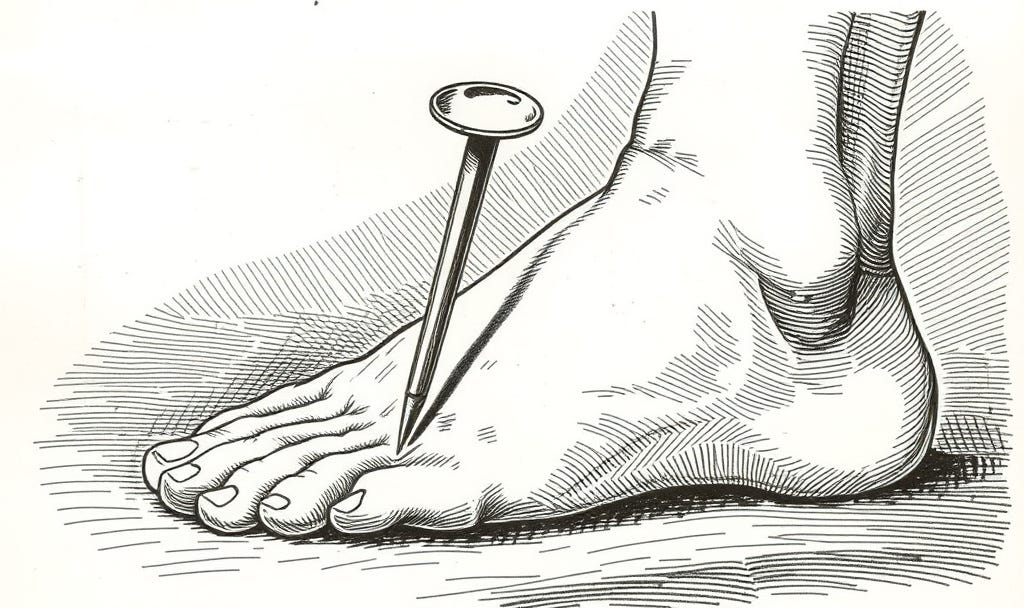
Then they cut the boot off.
The nail had passed cleanly between his toes. His foot was untouched. No puncture, no blood, no scratch. The nail had not entered his body at all.
The pain had been real. The injury had not.1
The instinct is to call this psychological: “he thought himself into pain,” “it was all in his head.”
But that framing is wrong, and it matters that it’s wrong, because it implies the pain was imaginary. It wasn’t. The pain was generated by his nervous system through the same biological machinery that produces pain from an actual wound. The difference was in what triggered it.
Our nervous system is built to act on predictions, not on confirmed information. When the construction worker landed on the nail and looked down to see 7 inches of steel protruding from both sides of his boot, his brain made a prediction: catastrophic foot injury. That prediction activated a full pain response, the same cascade of nerve signals, stress hormones, and inflammation that a real wound would have triggered, before the body had any opportunity to verify whether the tissue was actually damaged.
This is also why we worry. Worry is predicting that things, mostly bad things, will happen. But 91% of the things we worry about will never happen. However, the system that generates the worry doesn’t know that, and it doesn’t need to. It runs on prediction, not confirmation.
This is not a design flaw. It is the design.
In the environment where this system evolved, the cost of the two possible errors was radically asymmetric. A false positive (pain without injury, flinching at a shadow) costs you a moment of discomfort and a dose of adrenaline you didn’t need. A false negative (no pain from a real injury, no flinch from a real threat) costs you your life. So the system is calibrated to over-predict. It would rather generate a hundred false alarms than miss one real one. Every ancestor you have survived because their nervous system shot first and asked questions later.
The construction worker’s body did exactly what it was supposed to do. It saw the nail, predicted the injury, and executed the response.
The prediction was wrong. But the system that made it worked perfectly.
There is a mirror-image case that makes the point even sharper.
In 2007, a construction worker using a nail gun felt it discharge unexpectedly, striking him in the jaw. He felt a mild toothache. He noticed a small bruise under his chin. He assumed the nail had missed him, and went back to work. For six days he ate, slept, and worked normally, with nothing more than a minor ache.
On the sixth day, he went to his dentist. An X-ray revealed a four-inch nail embedded in his skull, having passed through his jaw and into his brain.2
Six days. A nail in his brain. Almost no pain.
The reason is the same mechanism, running in reverse. His brain predicted, based on the available context (a glancing blow, a bruise, no visible wound, the ability to keep working) that no serious injury had occurred. So it didn’t generate a serious pain response. The prediction was catastrophically wrong. But the system was doing the same thing: acting on what it expected, not on what had happened.
Two construction workers, two nails, two opposite outcomes. One had excruciating pain from a nail that never touched him. The other had almost no pain from a nail lodged in his brain. In both cases, the nervous system responded to its own prediction rather than to the physical reality.
The body doesn’t wait to find out what’s real. It acts first. The facts catch up later, if they catch up at all.
The nail cases are vivid, but the phenomenon they illustrate is not rare. It runs quietly through the most controlled setting in medicine: the randomized trial.
The clinical term is the nocebo effect, the placebo effect’s Bizarro twin.
Where the placebo effect produces benefit from an inert treatment, the nocebo effect produces harm. A patient who is told a drug may cause nausea is more likely to experience nausea, even if they received a sugar pill. The prediction generates the symptom.
I have seen this firsthand. In a double-blind, placebo-controlled trial I was running, one participant (a man in his fifties) was randomized and began treatment. Within days, he developed severe nausea and vomiting. Nausea was listed as a potential side effect in the informed consent form he had signed before enrollment, as it is in most trials. The symptoms were intense enough that he decided to withdraw from the study.
When the blind was opened, he had been assigned to placebo. He had received no active drug at all. He had developed the exact side effects he had been warned about, severely enough to drop out, from a capsule containing nothing.
His nervous system did what the construction worker’s did. It received a prediction: “this drug may cause nausea”, and executed the response. The drug wasn’t real. The nausea was.
This is not a curiosity. Nocebo-driven adverse events are a measurable problem in clinical research. Trials routinely report adverse-event rates in placebo arms that mirror whatever the informed consent document warned patients about. In some pain trials, placebo-arm dropout rates due to “side effects” exceed 20%. The act of telling a patient what might go wrong becomes, for some patients, the thing that makes it go wrong.3
The construction worker, the man in my trial, the person who feels a sharp object underfoot and floods with adrenaline before they’ve looked down — all of them are running the same ancient software. A prediction engine that was built to keep you alive in a world where the penalty for hesitation was death, and the penalty for a false alarm was nothing.
That engine is still running. It runs when you read a list of drug side effects and start feeling them. It runs when you check your symptoms online and develop new ones. It runs when you lie awake at 2 AM convinced something is wrong with your body, and by morning the feeling has passed, because the prediction expired when the context changed.
The system is not broken. The predictions it makes are not irrational. They are the best guesses of a machine that has been optimizing for survival for half a billion years, in an environment where threats were physical, immediate, and lethal.
The fact that the same machine now generates pain from a nail that isn’t there, or nausea from a pill that contains nothing, is not a sign that the machine is failing. It is a sign that the world the machine was built for and the world it now operates in are no longer the same place.
The nail was not there. The pain was. The distance between those two facts is where most of what we don’t understand about the body actually lives.
Have you ever felt pain, or panic, or nausea, from something that turned out not to be real? I suspect most people have at least one story like this. I'd like to hear yours.
If this kind of writing is useful to you — the place where neuroscience, evolution, and clinical medicine meet — subscribe for more. The next few months on Brain Trials will explore this territory in depth.
Footnotes
Fisher JP, Hassan DT, O’Connor N. Minerva. BMJ. 1995;310:70. The case appeared in the Minerva column — a brief clinical-vignette format, not a full case report — and the original account is short. It has been widely cited in the pain literature as an illustration of prediction-driven pain. As with any single case anecdote, the details should be held with appropriate caution; the underlying neuroscience of predictive pain processing is independently established. ↩
Reported in multiple sources; the case was a nail-gun injury where a four-inch nail was discovered on dental X-ray six days after the incident. The patient experienced minimal pain despite the nail having penetrated the skull and entered the brain. ↩
For a review of nocebo effects in clinical trials, see Colloca L, Miller FG. “The nocebo effect and its relevance for clinical practice.” Psychosomatic Medicine. 2011;73(7):598-603. Placebo-arm adverse-event rates that mirror informed-consent warnings are documented across multiple therapeutic areas. ↩
Comments
Nothing yet. Say the first thing.
Sign in to join the conversation.