
The Alzheimer’s Association International Conference (AAIC) opens in London on July 12, 2026. The program runs to something like 800 podium presentations and several thousand posters, and in the days afterward a familiar ritual plays out: the trade press extracts a handful of headline numbers, each company’s data is described as “encouraging,” and the difference between a genuinely new result and a reformatted version of last year’s disappearing.
I want to do something narrower and, I hope, more useful.
Below are four programs I’ll be watching in London. For each one I’ve tried to answer a single question before the data lands: is this a genuinely new readout, or an update wearing the grammar of one? The distinction matters, because the amount of new information in a presentation should determine how much your view of a drug is allowed to move — and the press cycle almost never makes that distinction for you.
One note on how I built this. Unlike the vaguer previews you’ll see elsewhere, the session times and abstract titles below come from the actual conference planner, which lets me be specific about what is and isn’t being shown. Where a program is presenting something new, I say so. Where it’s presenting a repackaging of data we already have, I say that too — even when the underlying science is genuinely good.
What it is: full Phase 2 CELIA results, presented publicly for the first time. Session: Tuesday July 14, 14:17, Developing Topics — Biogen.
This is THE readout of the conference, at least in the tau space. Diranersen (formerly BIIB080) is an antisense oligonucleotide that suppresses production of tau by degrading MAPT mRNA — a fundamentally different mechanism from the antibodies that dominate the field. CELIA is its Phase 2 trial in early Alzheimer’s disease, and AAIC is where the topline efficacy, biomarker, and safety data arrive as a complete dataset for the first time.1
Biogen already released some results in a press release, which I discussed a few months ago:
That “for the first time” is what separates this from everything else on my list. The other programs here are showing extensions, real-world data, or mechanism studies that build on results already in the public record. CELIA is a genuine first look at whether lowering tau production slows disease.
What I’ll be watching, specifically: the primary endpoint result on clinical decline (CDR-SB), and whether it separated from placebo and how much; the tau PET and fluid-biomarker changes, and whether the degree of tau lowering tracks the degree of clinical effect; the dose-response relationship across the tested doses; and the safety profile, because intrathecally delivered ASOs in neurodegeneration carry their own risk considerations. If the clinical and biomarker signals move together in a dose-dependent way, this becomes one of the most important tau results in years. If tau drops substantially but cognition doesn’t follow clearly, that is itself one of the most informative possible outcomes — a clean test of whether tau lowering, by itself, does what the field has assumed it should.
Either way, this is the one where the largest amount of genuinely new information will be on the table. Watch it most closely.
What it is: interim open-label extension data (new), plus Phase 3 design and simulation talks (partly previewed).Session: Tuesday July 14, 14:02–15:00, Featured Research Session — Roche/Genentech (five talks).
Roche is giving trontinemab a full five-talk Featured Research Session, and I want to be precise about which parts are new, because this is exactly the kind of session that gets described wholesale as a “readout” when only some of it is.2
Trontinemab is Roche’s “Brainshuttle” anti-amyloid antibody — engineered with a transferrin-receptor-binding element that ferries it across the blood-brain barrier, which at least in principle allows high brain exposure at low doses and may reduce the ARIA (amyloid-related imaging abnormalities) that constrain the existing antibodies. The headline Phase 1b/2a data — rapid, deep amyloid clearance with a low ARIA rate — was presented at AAIC and CTAD in 2025. That is not new.
What is new at AAIC 2026 is the interim open-label extension data: longer-term safety and amyloid-removal results, and interim long-term biomarker results, from patients followed past the original readout. This genuinely matters, and for a specific reason — durability and delayed ARIA. Amyloid clearance at 28 weeks is one thing; whether clearance is sustained, and whether the favorable ARIA profile holds as cumulative exposure rises, is the question the extension data begins to answer. ARIA events often cluster during titration, so a low early rate can understate the eventual burden. The OLE is the first look at whether trontinemab’s early advantages persist.
The other three talks are design and modeling rather than results. There’s a simulation of amyloid clearance in Phase 3 (a modeling exercise, not trial data); a rationale talk for preclinical AD as the optimal intervention stage; and the design of PrevenTRON, the Phase 3 prevention trial in cognitively unimpaired, biomarker-positive individuals. The two symptomatic Phase 3 trials (TRONTIER 1 and 2) were already announced in 2025 — so the genuinely new design disclosure here is PrevenTRON’s, which is worth attention as the program’s move into prevention. But a trial design is a statement of intent, not evidence of effect. Read it as the former.
Net: one substantial new data readout (the OLE), one genuinely new design disclosure (PrevenTRON), and three talks that are context around them. A potentially good session. Not five readouts.
What it is: a 3-year LEADER real-world update (new and consequential), plus a large body of subcutaneous-formulation and real-world evidence (mostly incremental). Multiple Developing Topics sessions, July 12–14 — Eisai/Biogen.
Eisai is presenting more than fifty abstracts, and the volume itself is a kind of trap: fifty presentations feel like fifty findings, when most are facets of a few underlying datasets. Two things here are worth your attention, and they are not the same size.3
The one that matters most is the 3-year LEADER update (Tuesday July 14, 16:17). LEADER is a large multicenter real-world study of lecanemab in clinical practice. CLARITY-AD, the pivotal trial, showed lecanemab slowing decline over eighteen months. Three years of real-world data is the first substantial look at what happens at the longer horizon — and there are three broad possibilities, each with different implications. The benefit could be sustained or grow in absolute terms, strengthening the disease-modification case and the argument for treating early and long. It could attenuate as underlying progression reasserts itself, which would sharpen the question of how long to treat and when the risk-benefit balance shifts. Or the picture could be mixed across subgroups. The accompanying LEADER analyses by APOE4 status, sex, race, and concomitant medications (same session) are where the subgroup texture will be. This is the lecanemab readout to actually watch.
The larger bloc of abstracts concerns the subcutaneous formulation — including the first real-world data on at-home subcutaneous administration (Tuesday July 14, 16:47). This is operationally important: at-home dosing changes access, infusion-center burden, and the practical experience of treatment. But it was substantially previewed through 2025 and regulatory filings, and it’s a delivery-and-logistics story, not a question of whether the drug works. I’ll cover it as such. There’s also a genuinely useful post-marketing safety abstract on how clinicians actually manage ARIA in practice in Japan (July 12) — the kind of real-world safety data that rarely makes headlines but changes how the drug is used.
Watch the 3-year data. Read the subcutaneous material as texture on convenience, not as new evidence of efficacy.
What it is: DIAD biomarker data (largely already shown at CTAD 2025) plus baseline characteristics of the sporadic-AD cohort. The sporadic-AD efficacy readout is NOT at this conference. Featured Research Session, Monday July 13 — Eisai.
This is the program where the gap between what’s being presented and what people will think is being presented is widest, so it’s worth being careful.4
Etalanetug is an anti-tau antibody targeting the microtubule-binding region (MTBR) of tau — the domain implicated in tau seeding and spreading. It’s being tested in two combination trials, both on a lecanemab background: the Tau NexGen Phase 2/3 trial in dominantly inherited AD (DIAD) — a rare genetic form affecting under 1% of people with Alzheimer’s — and Study 202, a Phase 2 trial in early sporadic AD, the common form that represents the real commercial and clinical question.
Here’s the distinction that matters. The AAIC data is about DIAD: that etalanetug reduces plasma eMTBR-tau243 (a novel biomarker of tau tangle pathology) while increasing plasma p-tau and t-tau. This is mechanistically interesting — it’s consistent with the antibody engaging tau and mobilizing it — but the headline eMTBR-tau243 reduction was already presented at CTAD in December 2025. What’s genuinely new at AAIC is largely confirmatory and mechanistic: a companion CSF immunoassay supporting the biomarker, and a preclinical Fc-receptor uptake study.
Crucially, the Study 202 abstract at AAIC is titled around baseline imaging characteristics of participants — that is, a description of who enrolled in the sporadic-AD trial, not what the drug did to them. The Study 202 efficacy readout — the one that would tell us whether adding a tau antibody to lecanemab helps patients with the common form of Alzheimer’s — is not at this conference.
So watch etalanetug as a mechanism-and-biomarker story: does the tau-mobilization pattern hold, does the new CSF assay strengthen the biomarker case, does the sporadic-AD cohort look well-matched enough to give the eventual efficacy readout a fair test? Those are the right questions. “Does the combination work in sporadic AD” is the wrong question to bring to London, because the data that answers it isn’t being shown here. When you see etalanetug described as a Phase 2 combination-therapy readout this week, that’s the confusion to correct.
A few things I’ll be tracking, and one worth flagging precisely for what it isn’t:
Posdinemab (J&J) — In November 2025, J&J stopped the Phase 2 AUTONOMY trial after a scheduled data review found no slowing of cognitive decline versus placebo, and ended development of posdinemab, its anti-phospho-tau antibody.5 The program is over. And yet J&J still has AUTONOMY abstracts at AAIC 2026 — a tau-PET-versus-cognition correlation study and a screen-failure-by-race analysis. Both are legitimate uses of the data: the trial enrolled and scanned over 400 participants, and that baseline dataset has real natural-history and methodological value. But notice what’s happening. A failed trial is being mined for the papers it can still yield, and if you weren’t tracking the outcome you might see “Phase 2b AUTONOMY tau-PET data at AAIC” on the program and assume a live, encouraging readout. The drug failed 6 months ago. This is the cleanest example I can give you of why the question isn’t “is there data” but “what does the data being shown — and the data not being shown — actually tell you.” When you see AUTONOMY on the schedule this week, the headline already happened, and it was negative.
A tau gene therapy approaching the clinic (Voyager) — the item I find most genuinely novel among the posters is VY1706, a blood-brain-barrier-crossing AAV gene therapy targeting MAPT, presented as an IND-enabling primate study (poster, Monday). This matters because of what it is, not what it shows: nearly every tau program in development is an antibody or an oligonucleotide, and this is a gene-therapy approach to the same target — a fundamentally different modality moving toward first-in-human testing. The AAIC program also includes at least one other AAV-based MAPT program at a similar preclinical stage (Aviado Bio’s AVB-406) and an siRNA (Alnylam’s ALN-5288), so this isn’t a solo effort — it’s an early signal that tau-lowering by gene therapy and RNA-tarteged therapies, not just antibodies, is becoming a real branch of the pipeline. Poster-level, preclinical, no clinical data yet. But it’s the kind of thing worth noting now so that when it reaches patients in a year or two, you saw where it started.
The GLP-1 and brain-delivery posters — semaglutide mechanistic work from Novo Nordisk, and several transferrin-receptor brain-delivery platforms beyond trontinemab. Directional signals about where investment is flowing, not results.
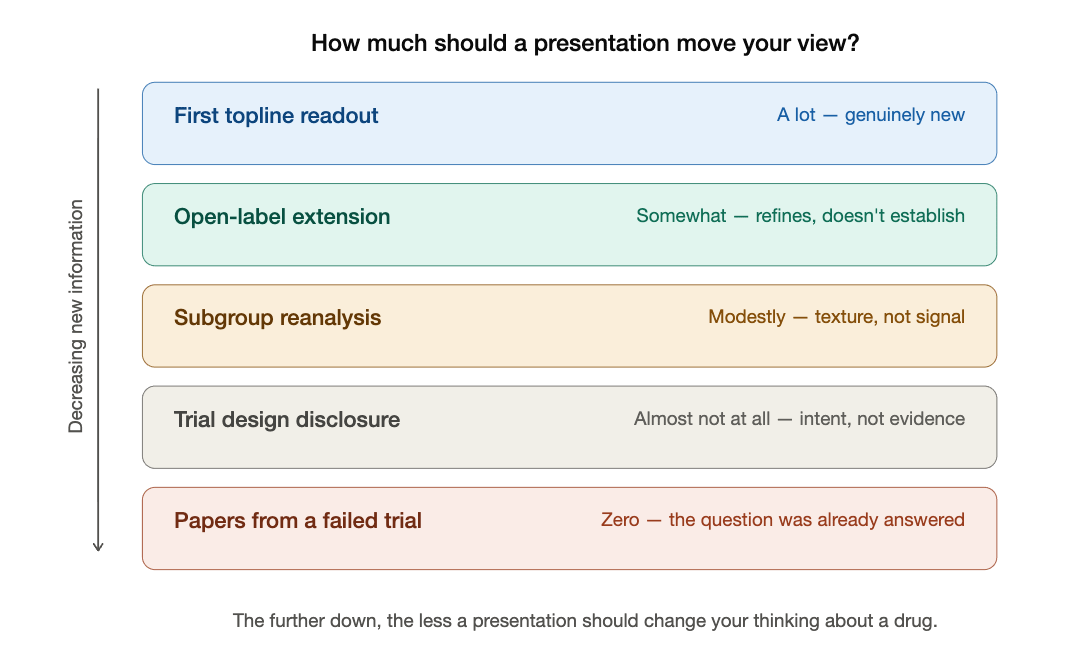
If there’s a single filter I’d hand you for reading the AAIC coverage as it comes, it’s this: before reacting to a number, ask whether it’s the first time that number has been shown — and whether the trial it came from has already reported its result. A first-in-human or first-topline result earns a real update to your thinking. An open-label extension refines it. A subgroup reanalysis of an existing dataset refines it less. A trial design, however elegant, is a statement of intent and should move your view of the science almost not at all. And an analysis drawn from a trial that has already failed tells you about tau biology or trial operations, but nothing new about whether the drug worked, because that question was already answered, and the answer was no.
By that filter, the hierarchy this week is roughly: diranersen’s CELIA topline (genuinely new, potentially field-shaping), trontinemab’s extension data and lecanemab’s three-year LEADER update (new and consequential, refining rather than establishing), and most of the rest (texture, mechanism, and intent — valuable, but not the place to let your view swing).
Disclosure: This preview is based entirely on the public conference program, company public disclosures, peer-reviewed literature and represents my personal views, not necessarily those of my employer.
Sources
AAIC 2026 conference planner, Alzheimer’s Association International Conference, London, July 11–15, 2026.
Eisai. “Eisai to Showcase Alzheimer’s Disease Portfolio with More Than 50 Presentations at AAIC 2026.” June 2026.
Eisai. “Eisai Presents New Data on Anti-Tau Antibody Etalanetug (E2814) at CTAD 2025.” December 1, 2025.
Roche AAIC/CTAD 2025 trontinemab Brainshuttle disclosures.
den Heijer et al. (etalanetug DIAD Phase 1b/2, Study 103). PubMed 41964075, 2026.
Johnson & Johnson. “Johnson & Johnson Statement on the AUTONOMY Study.” November 2025. (Posdinemab Phase 2 discontinued for lack of efficacy.)
Session: “Topline Results from CELIA: A Phase 2 Study to Evaluate the Tau-Targeting ASO Diranersen (BIIB080) in Patients with Early Alzheimer’s Disease.” Tuesday July 14, 14:17, Developing Topics Session, Biogen. Diranersen (formerly BIIB080) is a MAPT-targeting antisense oligonucleotide administered intrathecally. ↩
Trontinemab Featured Research Session, Tuesday July 14, 14:02–15:00 (Roche/Genentech): (1) long-term safety and amyloid removal from the Phase Ib/IIa Brainshuttle OLE, 14:02; (2) interim long-term biomarker results from the OLE, 14:14; (3) simulation of amyloid clearance in Phase 3, 14:26; (4) evidence supporting preclinical AD as the optimal intervention stage, 14:38; (5) PrevenTRON Phase 3 prevention-trial design, 14:50. The Phase Ib/IIa topline (≈91% amyloid PET negativity at 28 weeks; ARIA-E <5%) and the TRONTIER 1/2 symptomatic Phase 3 designs were disclosed in 2025. ↩
Eisai/Biogen: ~52 abstracts. Key items: three-year LEADER update (Tue Jul 14, 16:17) and LEADER subgroup analyses by APOE4/sex/race/concomitant meds (Tue Jul 14, 16:27); subcutaneous formulation overview and safety (Sun Jul 12, 16:17 and 16:32); first real-world at-home subcutaneous administration data (Tue Jul 14, 16:47); post-marketing observational study on ARIA management in Japan (Sun Jul 12, 14:14). ↩
Etalanetug (E2814) is an anti-MTBR tau antibody. AAIC abstracts: “Etalanetug Reduces Tau Tangle Specific Plasma E-MTBR-tau243 in DIAD While Increasing Plasma P-tau and T-tau” (Mon Jul 13, 09:12); “Baseline Imaging Characteristics of Participants in a Phase 2 Trial of Etalanetug and Concurrent Lecanemab” (Mon Jul 13, 09:52); plus a novel CSF eMTBR-tau243 immunoassay poster and an Fcγ-receptor macrophage-uptake poster. The eMTBR-tau243 reduction in DIAD was first presented at CTAD 2025 (Dec 2025). Two trials: Tau NexGen (Phase 2/3, DIAD, NCT05269394) and Study 202 (Phase 2, early sporadic AD, NCT06602258), both adding etalanetug to lecanemab. Study 202 efficacy results are not part of the AAIC 2026 program. ↩
Johnson & Johnson statement on the AUTONOMY study, November 2025: the Phase 2 trial of posdinemab (JNJ-63733657) was stopped after a scheduled data review found no slowing of cognitive decline versus placebo, and development was discontinued. AUTONOMY (NCT04619420) enrolled participants with early symptomatic AD and intermediate tau, pre-screened with a plasma p217+tau assay and confirmed by tau PET; 422 participants were randomized. The AAIC 2026 abstracts drawn from the trial include a tau-PET spatial-pattern-versus-cognition analysis and a screen-failure-by-race analysis. ↩
Comments
Nothing yet. Say the first thing.
Sign in to join the conversation.