
Back in May, when Biogen put out the CELIA topline results, I wrote that a press release offering adjectives instead of numbers was an invitation to wait, not to celebrate:
I made two structural arguments there that I won’t relitigate at length: i) that a dose-response primary endpoint was a bet against the drug’s own pharmacology (Phase 1b showed CSF tau bottoming out at roughly 60% across doses, so there was little biological reason to expect a dose gradient), and, ii) that a trial quietly cut from a planned ~735 participants to 416 was underpowered to win that bet anyway.
Then I closed with four questions the full AAIC data would have to answer.
The data are now out, just presented in London on July 14 2026. Here is a link to the presentation.
I’ll take the four questions in order, because the answers, taken together, point somewhere the topline framing did not: the cleanest dose-response in this trial is not in the efficacy data at all. It’s in its toxicity.
One thing up front, because it hasn’t changed and it’s the real achievement: on the biology, diranersen (BIIB080, originally IONIS-MAPTrx) works. What the full data revise is not whether the drug hits tau (it clearly does) but what we can say about tau-lowering translating into clinical benefit, and at what cost.
In May the worry was whether the low-dose CDR-SB effect would be a clean 25–30% with tight confidence intervals (the range Biogen compared to lecanemab and donanemab) or a noisy estimate. The full numbers answer: closer to squinting.
At the lowest dose (60 mg every 24 weeks), CDR-SB decline slowed 26% versus placebo — numerically in the amyloid-targeting therapies (ATT) range. But the nominal p-value was 0.12, which does not clear even the study’s deliberately generous threshold (two-sided alpha of 0.1). The two higher doses slowed CDR-SB by 14% (p=0.33) and 9% (p=0.53). So the “comparable to lecanemab and donanemab” comparison survives only at the lowest dose, only numerically, and — unlike the approved drugs, which hit significance on CDR-SB as their primary — it does not reach statistical significance here.
The full secondary panel is worth seeing, because its shape matters more than any single number. Everything below is nominal and unadjusted, in a trial whose primary already missed:
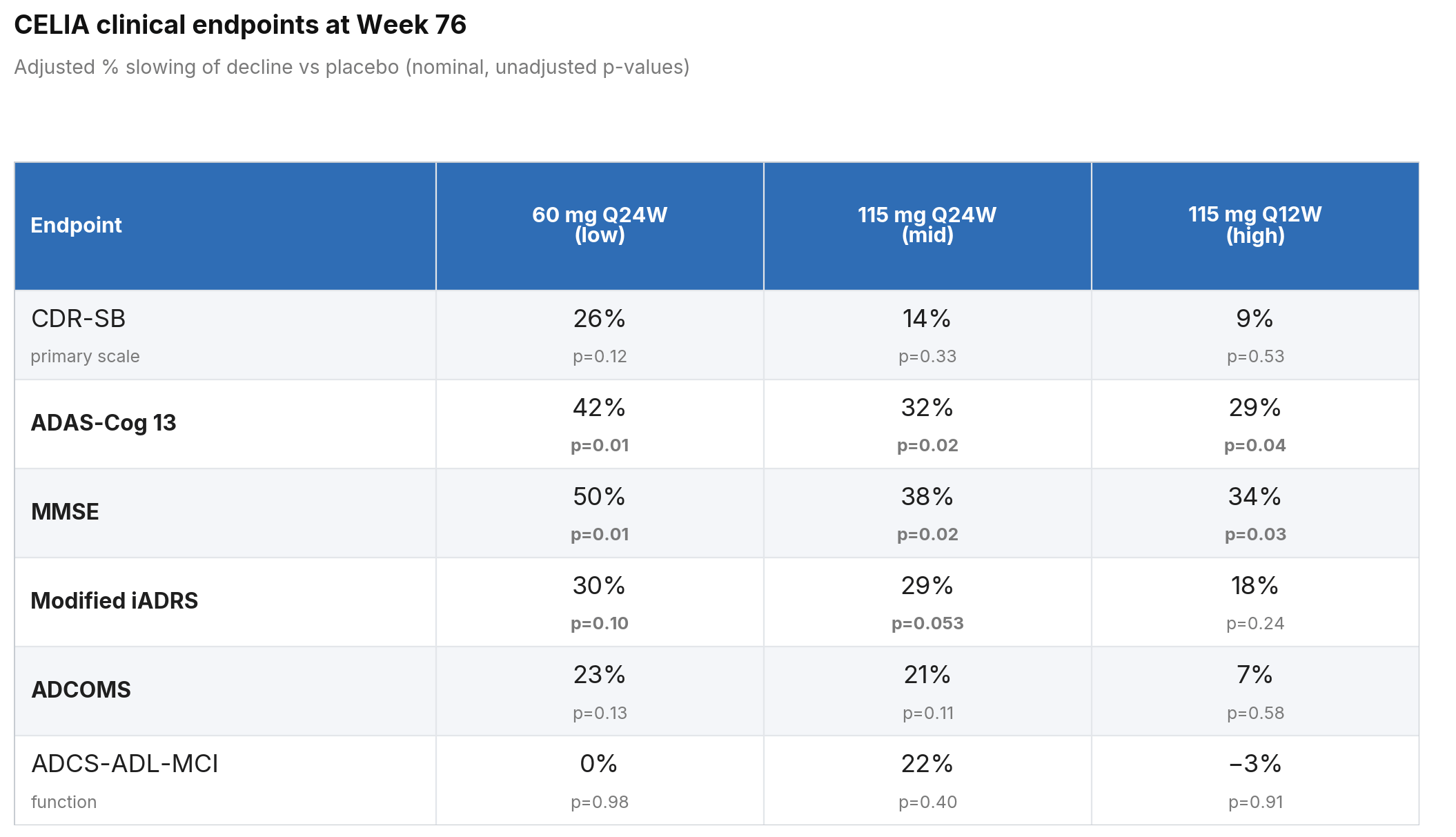
Two features stand out, and neither was visible from the topline.
First, the endpoint hierarchy is inverted.
CDR-SB, the global scale the trial was built on, is the weakest of the cognitive readouts (26%, not significant), while the softer, noisier scales, MMSE and ADAS-Cog, are the strongest (50% and 42% at the low dose). When the most rigorous measure is the faintest and the softest measures are the loudest, that is a reason to be more cautious, not less. A 50% slowing on MMSE would exceed anything the approved ATT showed on their primaries, and extraordinary magnitudes on uncorrected secondary scales, in the smallest arm, are exactly what noise looks like when you have six endpoints and three doses.
Second, function did not follow cognition. On daily functioning (ADCS-ADL-MCI), the low dose showed no benefit (0%), the mid dose 22%, the high dose slightly negative. Real disease modification tends to move cognition and function together, as ATTs did; here they diverge, and the company acknowledges the ADL pattern “showed a different pattern,” with follow-up ongoing.
None of this makes the signal fake: a 26% CDR-SB slowing and consistent direction on 5 of 6 scales is more than most tau-targeted trials ever produced. But it is a hypothesis for Phase 3, not the clean, significant, coherent effect that “proof of concept” implies.
Across all three doses, diranersen produced robust, durable CSF total-tau reductions (roughly 50–65%) and reductions in tau on PET across multiple brain regions, while the placebo group’s tau PET rose. Moving tau PET at all is something most tau programs never managed; doing it across every dose is close to unprecedented for the class. On target engagement, the drug does exactly what it was designed to do.
In May I predicted the CSF tau curves would be flat across doses — the ~60% plateau from Phase 1b: and they are.
That confirms the design critique: a dose-response primary was asking for a gradient the pharmacology had already ruled out. On tau PET the picture is slightly different — the highest dose showed the numerically largest reduction (small substudy, 16–36 per arm, overlapping error bars) — not flat, but pointing the wrong way for the efficacy story.
Because here is the thing the full data do: the arm that lowered tau the most did the worst clinically. That single dissociation kills the two tidiest explanations at once. It is not a conventional dose-response (more drug lowered tau more but helped less), and it is not the “less tau is better” story some have floated (tau lowering wasn’t meaningfully less at the low dose — identical on CSF, greater at the high dose on PET).
What’s left is a benefit that saturates at the lowest dose, offset by something that grows with dose. Which is exactly the third question.
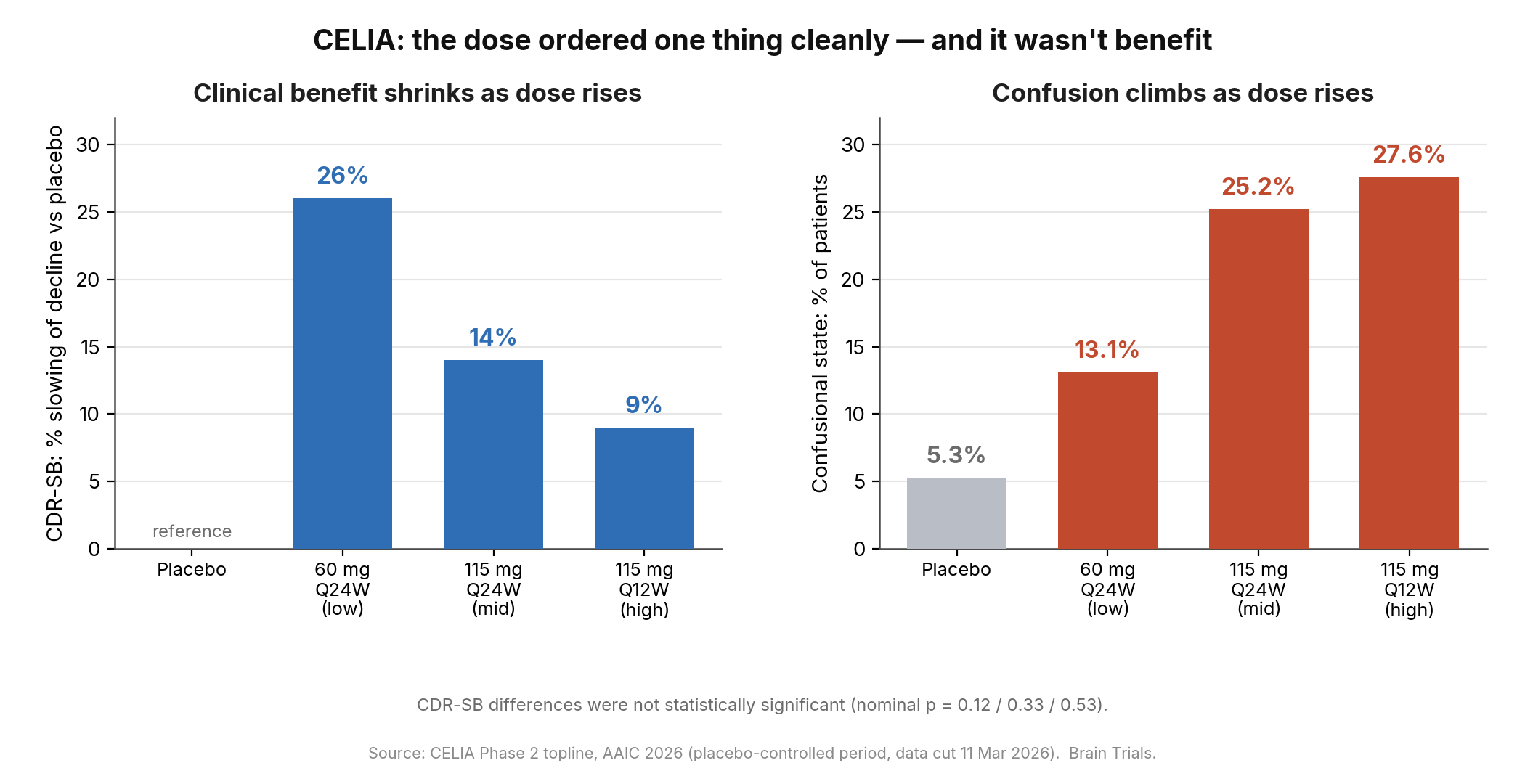
This was the question I most wanted answered: the topline said only that serious adverse events were “more frequent at the highest dose,” and I wrote that the nature of those events would decide whether the inverted dose-response was biology, toxicity, or both. The breakdown is now here, and it does not read like biology.
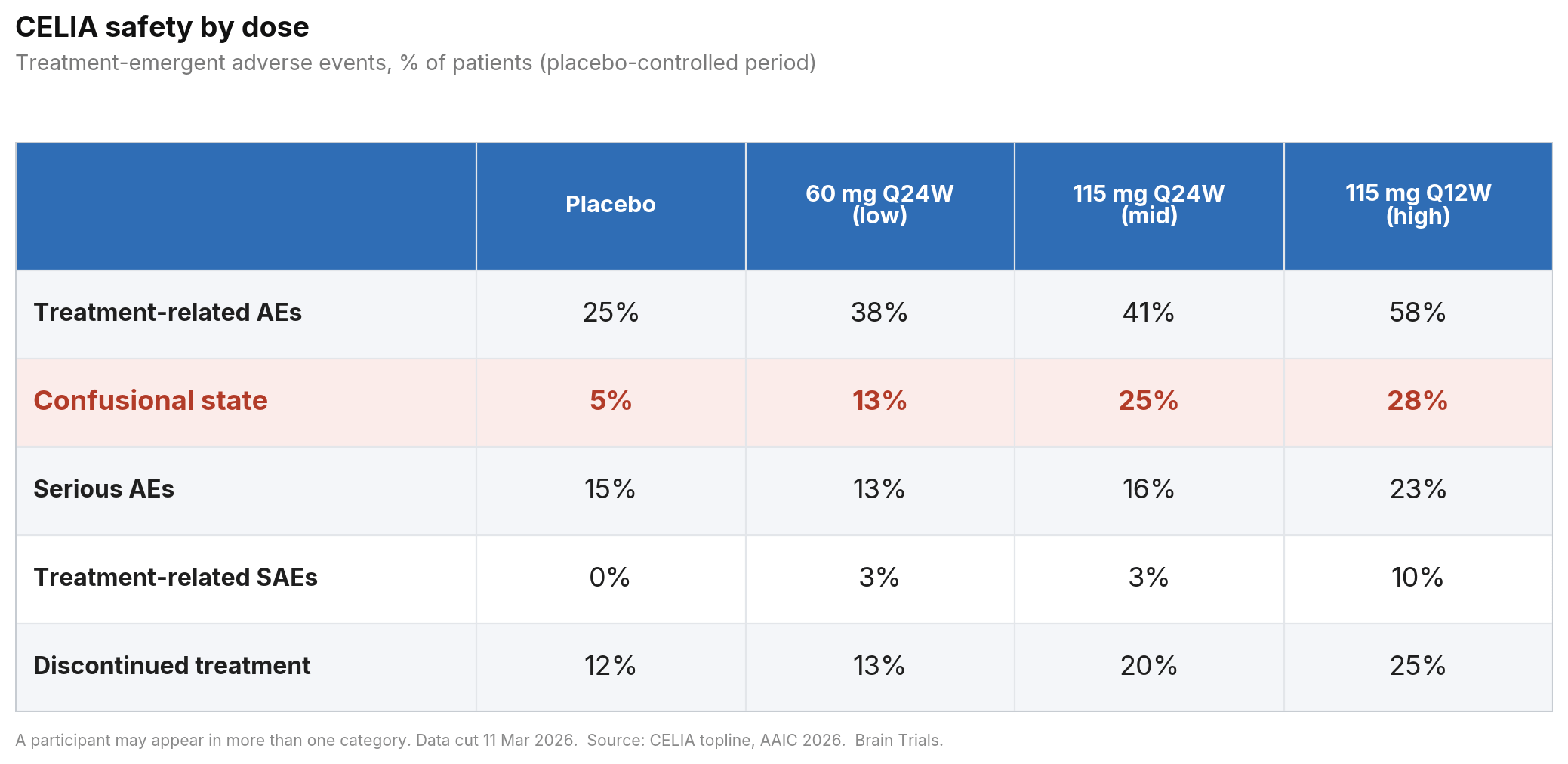
Look at confusional state: roughly one in twenty on placebo, better than one in four on the two 115 mg arms. This is a trial whose endpoints are cognition — CDR-SB, MMSE, ADAS-Cog, all administered by sitting a patient down and testing them. If a quarter to nearly a third of your higher-dose patients are having confusional episodes in the days around dosing, that is not a footnote to the efficacy result; it is plausibly part of it — either directly (you cannot test cleanly through a confusional episode) or as the visible tip of a process that is the opposite of neuroprotection. And it tracks dose almost perfectly, in lockstep with treatment-related SAEs (0 → 3 → 3 → 10%) and treatment discontinuation (12 → 25%).
So the answer to the question: the most orderly dose-response in CELIA is a toxicity gradient. Biogen characterizes the confusional episodes as mild-to-moderate, transient, and not causing discontinuation, and notes that ARIA — the ATT complication — “is not anticipated with this mechanism.” The ARIA point is true and beside the point; nobody expected ARIA from a tau ASO. The relevant question is one the intrathecal-ASO field already knows to ask.
Confusion, encephalopathy, and CSF inflammation are not novel to diranersen. They recur across intrathecally delivered antisense oligonucleotides, and where they have been studied by dose, they are dose-related:
NIO752 (Novartis, a tau ASO in progressive supranuclear palsy) produced encephalopathy with acute mental-status changes and CSF pleocytosis in its Phase 1 in PSP, at the higher doses, which Novartis attributed to ASO “class effects … in the absence of an infectious process.”
Tominersen (Roche, huntingtin ASO) carried “possibly inflammatory” toxic effects in the NEJM report, with pleocytosis, arachnoiditis, and hydrocephalus, and more overall SAEs on the more frequent (Q8W) schedule than the less frequent one.
Tofersen (SOD1 ALS) has the best-quantified version — roughly 7% serious neurologic events including myelitis, radiculitis, aseptic meningitis, and intracranial hypertension — serious enough to be in the label.
Nusinersen (SMA) carries post-marketing signals of aseptic meningitis and real-world CSF-inflammation reports.
The common thread is neuroinflammation triggered by the oligonucleotide in the CSF compartment — and it scales with how much drug you put in, how often. Diranersen’s own Phase 1b already showed the early edge of this: a case of CSF pleocytosis at 115 mg (which resolved) and two confusional-state cases, also at 115 mg. The confusional-state gradient in CELIA is what that class effect looks like when you dose 400 people.
This is the sharpest thing to say about the readout, and it’s about what Biogen didn’t show. For a compound whose plausible dose-limiting problem is CSF inflammation and neuronal stress, CELIA was silent on the exact measures that would speak to it:
No CSF pleocytosis / white-cell data, even though Phase 1b reported a pleocytosis case and the whole ASO class is defined by this signal.
No neurofilament light (NfL), the workhorse marker of axonal injury — even though in Phase 1b, NfL fell in the placebo and 10 mg groups and rose in the 30, 60, and 115 mg groups. The paper called that “no dose-responsive effect,” fair given the tiny numbers, but the direction — treated arms drifting up, controls drifting down — is exactly what you would re-examine at scale before declaring proof of concept.
No volumetric MRI. In Phase 1b, ventricular volume grew more in every active arm (0.5–0.7% of intracranial volume at six months) than in placebo (0.2%) — two-to-three-fold — and the authors themselves raised “pseudoatrophy” from inflammatory edema and gliosis as a cause they could not rule out, adding that further work was needed to assess inflammation or gliosis. CELIA was the further work. It did not report the number.
No GFAP, the astrocytic-activation marker that would round out the inflammation picture.
I do not know what these numbers would show, and they may be reassuring — that is the point. A dose-dependent confusional syndrome in a class defined by CSF inflammation, layered on Phase 1b hints of rising NfL and ventricular enlargement, is exactly the situation in which you show the safety biomarkers. Their absence from the marquee presentation, while the tau-lowering curves get the spotlight, is a choice worth naming.
The fourth question from May — why the trial was cut from ~735 planned to 416 enrolled — the AAIC presentation did not touch. The deck reports 416 randomized and moves on. So that question is still open, and it still matters: a dose-response primary is precisely the endpoint a 43% enrollment shortfall makes hardest to hit.
Two smaller gaps, both new with the full data:
The low-dose arm (the one that carried the result) also had the lowest baseline amyloid PET burden (about 85 Centiloid versus 93–95 in the others) and the fewest ApoE4 homozygotes, both of which would tend to flatter it. It is not a clean confound (that same arm had more patients at the more advanced CDR-1 stage), but with only 60 patients randomized, the smallest arm is the one most exposed to chance and to imbalances like these.
And the analysis I most wanted is absent: this is a tau drug enrolled without any tau stratification, yet there is no subgroup analysis asking whether baseline tau burden predicts response — the single most load-bearing question for a tau program, answerable in this dataset and not shown.
If the 2-year extension shows the low-dose separation widening while the safety gradient persists, the toxicity-offset reading strengthens and the low dose starts to look like a real therapeutic window.
If the higher doses catch up as the acute confusional episodes wash out, that revives a version of the dose-response story and undercuts my argument — I’d want to see it.
If the effect evaporates with more follow-up and multiplicity control, it was noise.
And if Biogen releases the NfL, volumetric, GFAP, and CSF-cell data and they are flat across doses, I’d be reassured on the neuroinflammation hypothesis. The data would settle it, which is why not showing them is the problem.
Two months ago the honest move was to wait, because a topline of adjectives couldn’t tell us whether the low-dose signal was real, whether tau lowering tracked benefit, or whether the dose-response inverted because of biology or harm. The full data reward the wait with a clearer, and more sobering, picture.
What CELIA proves is real and worth restating: you can lower tau in the human brain — a lot, durably, across every dose — and move tau on PET, with a regimen as light as two lumbar punctures a year that 82% of patients completed and 94% carried into the extension. (That last figure quietly answers the practical worry I raised in May about whether older patients would tolerate chronic lumbar punctures.) That is proof of mechanism, and a genuine achievement in a target that has broken better-funded programs.
What it does not prove is that lowering tau slows Alzheimer’s. The primary missed. The clinical signal is real in direction but faint on the hardest scale, absent on function, largest at the smallest dose, and not significant where it counts. Its cleanest dose-response is a confusional syndrome climbing from 5% to 28%, in a molecule from a class defined by CSF inflammation — and the safety biomarkers that would tell us whether that reflects neuronal injury were left unreported.
In May I said this readout would say more about the trial design than about the drug. Having seen the full data, I’d revise that only slightly: it says a great deal about the drug’s pharmacology, which is impressive — and it says the question of whether tau-lowering helps patients is still open, now handed to a Phase 3 that will have to be built around the lowest dose and designed, this time, to let the drug answer it.
Before you go: I’ve read CELIA as a missed-primary trial with a real but awkwardly-shaped signal and an under-discussed safety gradient — and I know that reading is contestable. If you were at AAIC, work in tau biology or trial design, or simply see it differently: is the low-dose “win” biology, toxicity, or noise? And how much do you weight the biomarkers CELIA didn’t report? The comments are open — I’d like to read the counterarguments.
If this kind of analysis — separating what a trial’s data actually show from how they’re being framed — is useful to you, consider subscribing. Brain Trials reads neurodegeneration trials through the lens of evidence, methodology, and what the numbers can and can’t support.
If you want the longer version of how to read trials like this one, what the endpoints mean, why a missed primary isn’t the whole story, how to weigh benefit against harm, I wrote that book.
A Patient’s Guide to Clinical Trials: Navigating the Promise and Pitfalls of Experimental Treatments (Bloomsbury) — available now.
This analysis represents my personal views, not necessarily those of my employer, and is based entirely on publicly available information.
Comments
Nothing yet. Say the first thing.
Sign in to join the conversation.