
What happens when a country decides Alzheimer’s drugs don’t work and stops paying for them?
France ran that experiment.
The results are uncomfortable.
France stopped reimbursing cholinesterase inhibitors (ChEIs) for Alzheimer’s disease (AD), citing limited efficacy.
A nationwide natural experiment shows discontinuation led to accelerated cognitive decline over 1–4 years compared with continued treatment.
No clear difference in mortality was observed.
These real-world, target trial–emulated data support sustained cognitive benefit of ChEIs and question the rationale for withdrawal of coverage.
When France delisted reimbursement for ChEIs in 2018 due to questions about long‑term benefit and safety, this created a quasi‑natural experiment permitting causal inference from observational data.
The authors of a recently published paper in The Lancet Regional Health Europe used the French National Alzheimer Database (BNA) and Méotis networks to emulate an intention‑to‑treat clinical trial comparing patients who discontinued vs continued ChEIs after delisting. Inverse probability treatment weighting and mixed modeling were applied to estimate cognitive trajectories (MMSE) and pooled logistic regression for survival.
Moreover, this is a great example of the use of emulated trials in neurodegenerative therapeutics where RCTs aren’t feasible. Emulated trials have been used to study statins in cardiovascular disease, chemotherapy sequences in cancer, real-world vaccine effectiveness, and diabetes therapies. By mimicking RCTs in observational data, they provide a practical way to estimate causal effects.
At 1 year, the discontinuation group showed ~0.97 MMSE points greater decline compared to continuers (95% CI 0.68–1.27; p<0.001).
By 4 years, this gap widened to ~1.8 MMSE points (95% CI 0.91–2.71; p<0.001).
There was no statistically significant difference in mortality over five years (RR ~1.10, 95% CI 0.95–1.29).
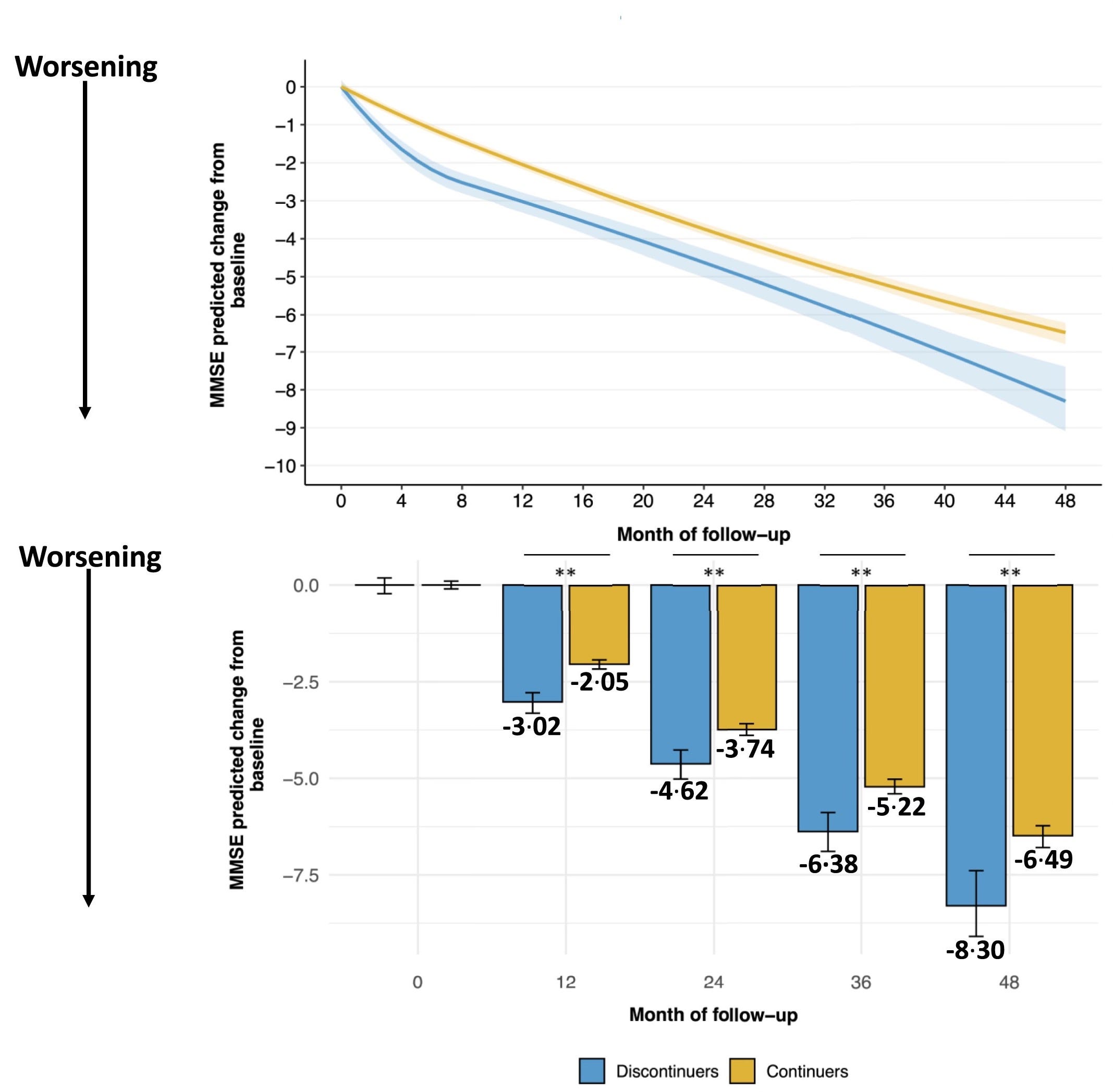
These findings align with prior randomized clinical trials and meta‑analyses suggesting modest ChEI cognitive benefit but extend them in a large, real‑world setting with long follow‑up and causal emulation methodology.
The observed ≈1–2 point MMSE divergence over years is clinically meaningful over typical disease progression timelines.
No survival benefit was found, suggesting effects are symptomatic/cognitive rather than disease-modifying, fully consistent with most ChEI literature.
Caveats: Despite rigorous adjustment, residual confounding and limitations of observational data remain; and the policy context (delisting) likely influenced prescribing and follow‑up patterns in ways difficult to fully adjust for.
For years, many have dismissed ChEIs in AD due to its ”marginal” effect. If you believe ChEIs are “ineffective”, this paper makes that position harder to defend.
IThis study doesn’t make them transformative — but it does suggest we may be systematically underestimating small symptomatic effects when viewed at population scale. In other words, reimbursement policy may be systematically underestimating small benefits — and that matters for how we evaluate future disease-modifying therapies.
Readers - Do you think 1–2 MMSE points over 4 years is clinically meaningful? Would this have changed reimbursement decisions in France or other countries?
Thanks for reading. If you found this entry interesting, please, share it so that others can receive more like this in their inbox.
Views expressed here are my own and not necessarily those of my employer. All data mentioned and discussed are publicly available.
For nearly two decades, I’ve worked as a neurologist and clinical trialist. Over time, I realized that the people who most need clear information about trials are often the least served by academic writing.
That’s why I wrote A Patient’s Guide to Clinical Trials: Navigating the Promise and Pitfalls of Experimental Treatments (Bloomsbury Publishing) — a plain-language guide to how trials work, what to expect, and how to weigh risks and benefits.
Now available wherever books are sold.
Comments
Nothing yet. Say the first thing.
Sign in to join the conversation.