
Stem-cell–derived dopamine neurons can survive and produce dopamine in the human brain, confirmed by PET imaging.
Early trials (Kyoto/Sumitomo, BlueRock) have been small and open-label, so clinical efficacy remains unclear.
Dyskinesia signals expose a challenge: transplanted neurons release dopamine continuously and cannot be titrated like drugs or DBS.
Japan just granted conditional approval to Sumitomo based on early data, meaning patients could receive these therapies before efficacy is proven.
A key question is whether these therapies will offer any advantage to available therapies for advanced PD, such as DBS, dopaminergic agonists, or infusions.
Two years ago, I wrote about dopaminergic cell replacement for Parkinson’s disease. At the time, the field felt tantalizingly close, but still fundamentally speculative.
That has now changed.
Within the last year, two clinical programs published results in Nature, showing that stem-cell–derived dopaminergic neurons can survive, integrate, and produce dopamine in the human brain.
For a field that has struggled for decades, through fetal tissue transplants, inconsistent results, and ethical controversies, this is a milestone.
But the key word here is milestone, not breakthrough.
The trials demonstrate something extremely important: the biology works, and the cells survive and produce dopamine, as expected.
What they do not yet demonstrate is whether cell replacement meaningfully improves patients’ lives - or whether they are better than approved options such as deep brain stimulation or dopaminergic therapies.
The current clinical landscape is dominated by two programs that reached human trials almost simultaneously. One comes from Japanese academia, although it will be supported by industry. The other from industry. Both are built on the same fundamental idea: replace the dopamine neurons that die in PD, injecting (via stereotactic neurosurgery) dopaminergic stem cells into the basal ganglia of patients.
The most advanced Western program is led by BlueRock Therapeutics, a subsidiary of Bayer.
Their therapy, bemdaneprocel (BRT-DA01), uses dopaminergic neuron precursors derived from human embryonic stem cells (hESc) that are surgically implanted into the putamen. The goal is simple: allow these cells to mature into dopamine-producing neurons and restore striatal dopamine signaling.
In the Phase 1 exPDite trial published a few months ago in Nature, 12 patients with Parkinson’s disease underwent bilateral implantation as part of a low-dose and a high-dose cohort.
The study achieved its primary goal: safety.
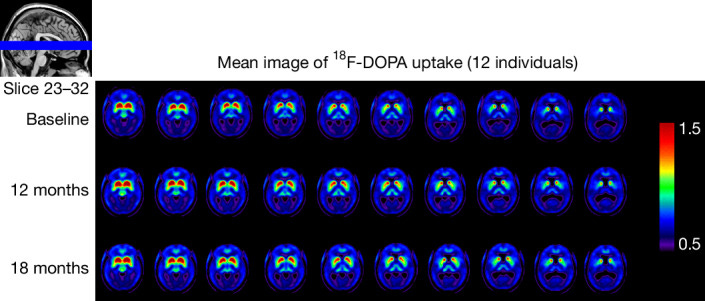
No serious adverse events related to the cell product were reported, and imaging confirmed survival and engraftment of transplanted neurons.
Importantly, F-DOPA PET imaging showed increased dopaminergic activity in the putamen, providing strong evidence that the transplanted neurons were biologically active, as shown in the figure:
Clinical outcomes were exploratory.
Patients receiving the high-dose cohort demonstrated substantial reductions in motor scores. At 24 months, the high-dose group showed a mean reduction of approximately 21.9 points in MDS-UPDRS Part III, while the low-dose cohort showed smaller or inconsistent changes.
These improvements persisted in longer follow-up, with good trends reported out to three years.
But interpretation is complicated.
The study was open label, small (n=12), not sham controlled. In Parkinson’s disease trials, placebo effects (especially in surgical and interventions considered “high tech”) can be very substantial.
For that reason, the real test of the therapy will come in the ongoing exPDite-2 Phase 3 trial, which will randomize roughly 100 patients in a double-blind, sham-surgery–controlled design.
That study will measure ON time without troublesome dyskinesia, the endpoint traditionally required by the FDA in advanced PD populations with motor complications.
If positive, it would represent the first successful randomized trial of pluripotent stem-cell–derived neuron replacement in Parkinson’s disease.
Running in parallel is a program developed at Kyoto University, based on induced pluripotent stem cells (iPSCs).
Importantly, this program is not using embryonic cells, but allogenic pluripotent stem cells (PSc), therefore devoid of ethical concerns surrounding the abortion and use of human embryos, necessary to obtain ESc.
The cells are differentiated from a clinical‑grade iPSC line (QHJI01s04) homozygous for a common Japanese HLA haplotype, allowing “off‑the‑shelf” use in many patients.
One Phase I/II trial has been completed: an investigator‑initiated open‑label study at Kyoto University Hospital (2018–2024, 7 patients). Sumitomo has IND‑cleared trials in the US (an investigator-initiated study at UCSD and a planned Sumitomo‑sponsored multicenter study)
The Kyoto trial implanted up to ~2–5×10^6 cells per hemisphere (low vs high dose) with bilateral putaminal grafts and 15 months of tacrolimus immunosuppression. The results of the initial trial were quite similar to BlueRock’s with some caveats.
Imaging showed increased F-DOPA PET uptake, indicating that the transplanted cells survived and were producing dopamine. The grafts were surviving and working as expected.
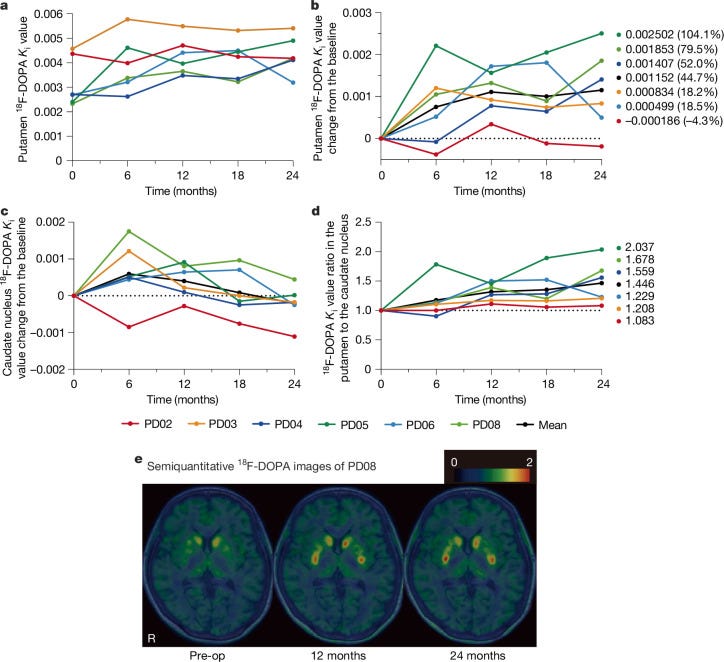
Clinical outcomes were mixed but encouraging.
Motor scores were largely stable over two years, which is not trivial in a progressive neurodegenerative disease. Some patients showed improvement in OFF-state motor symptoms.
But as with the BlueRock study, interpretation is constrained by the design.
The trial was open label, extremely small, uncontrolled. For that reason, the Kyoto study should be viewed primarily as biological proof of concept.
It demonstrates that dopaminergic neurons derived from iPScs can survive and function in the human brain.
What it does not yet demonstrate is clinical efficacy.
The most revealing signal emerging from these studies is the relationship between dopamine synthesis and dyskinesia.
Let’s look at the often overlooked supplementary Tables.
This one is from the Kyoto/Sumitomo trial:
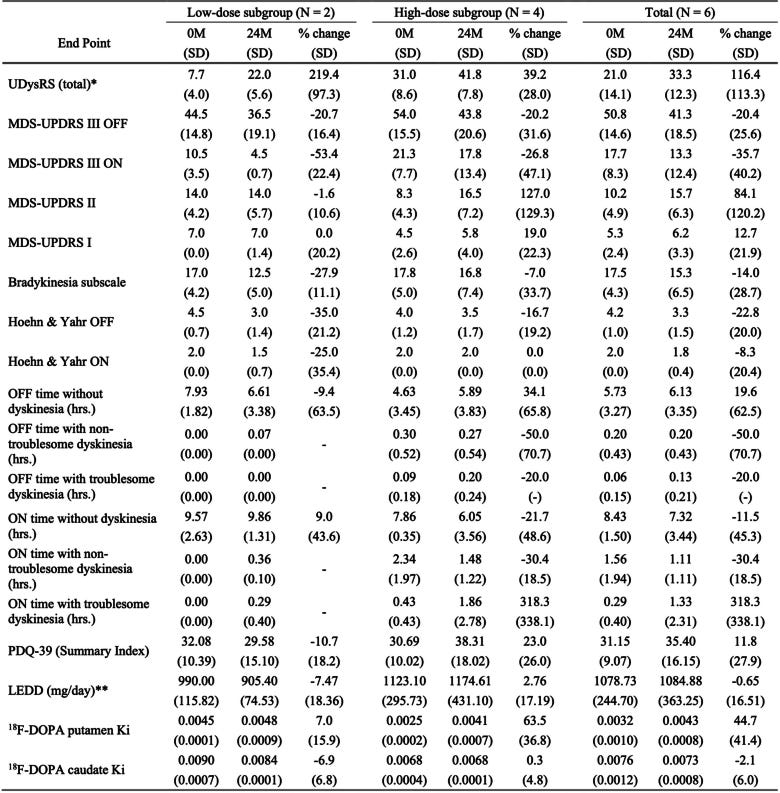
The change in dyskinesia is best exemplified by the UDyRS - there is a increase of 116%. This is not new. Earlier fetal tissue transplantation studies occasionally produced graft-induced dyskinesias, likely reflecting excessive, unregulated dopamine release.
Unlike oral therapies or DBS, the cell implants have no way to tune up or down the If the therapy restores dopamine effectively, dyskinesia risk may increase—particularly in patients still receiving levodopa.
However, this brings us to the clearest problem this therapies have.
Both Sumitomo and BlueRock are positioning these dopaminergic cell therapy as potential alternative to DBS, treatments typically given as adjunctive to levodopa (e.g., dopaminergic agonists, COMT inhibitors, safinamide, etc) and continous infusions (e.g., apomorphine, foslevodopa-foscarbidopa, intraduodenal levodopa).
The efficacy in this population (advanced PD with motor complications) is measured by ON time without (meaningful) dyskinesia.
Go back to the table above: the low-dose group, the ON time without dyskinesia improved 9% (this is good, but unclear if better than approved treatments), wheras in the high-dose group it decreased by -11.5% (meaning, the patients were worse than at baseline).
Let’s look at the BlueRock ON time data:
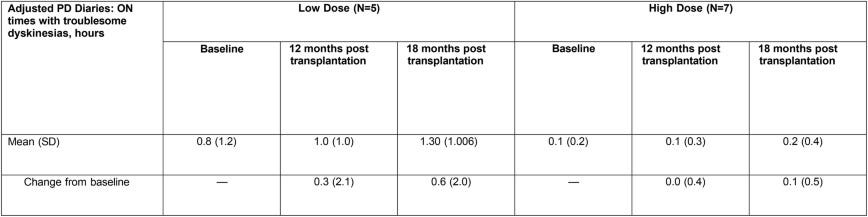
It barely changed, +0.6 after 18 months (not clinically meaningful) in the low dose and +0.1 (essentially nothing) in the high dose. At least it didn’t worsen, like the Kyoto’s high dose group.
In terms of dyskinesia, the article mentions “UDysRS scores were similar to the baseline in both cohorts” - which is good.
Interestingly, BlueRock also reported the Levodopa Equivalent Daily Dose in the participants. If cell therapy works, one might expect a significant reduction in dopaminergic medication requirements.
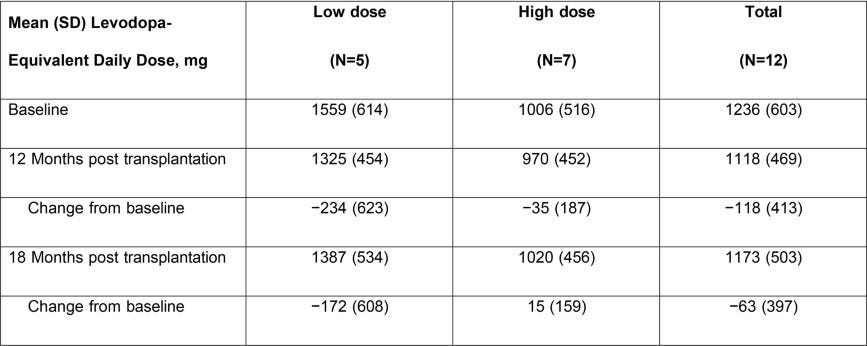
It looks like the reduction in LEDD was quite notable at 12 months (-200 mg and -35 mg in the low and high dose group respectively), but significantly abated at 18 months (-170 mg and +15 mg at 18 months).
Overall, what these results are telling us is that these dopaminergic therapies appear to have no meaningful effect on the endpoint of interest in this population (ON time withoy dyskinesia), they might increase extra movements (dyskinesia, at least in the case of Sumitomo/Kyoto) and they do not meaningfully reduce levodopa requirements - all compared to baseline.
Of course, this is a small trial, not controlled by sham. We will need to see what happens in the sham-controlled trials.
The Kyoto/Sumitomo program is also interesting for its aggressive regulatory strategy.
Because the Japanese “conditional approval pathway for regenerative medicine” allows licensing based on phase I/II data, a positive safety/efficacy signal could lead to conditional/time-limited approval (likely by 2026–2027).
Raguneprocel has Sakigake designation (priority review) and is supported by Phase I/II safety data we just reviewed above.
In fact, PMDA just granted conditional approval (as they have done for other regenerative therapies).
Approval would be time-limited pending confirmatory studies, and therapies that received “conditional approval” were later removed from the market because they were unable to prove their efficacy in a larger trial. Notably, HeartSheet (Terumo, an autologous skeletal myoblast cell sheet for serious heart failure), the first product granted conditional/time-limited approval in 2015 was withdrawn in 2024 after failing to demonstrate sufficient post-approval clinical benefit.
Thus, the Japanese conditional approval should not be mistaken for proof that the product works.
Kenai/Ryne Therapeutics’ RNDP-001 is an allogeneic iPSC-derived dopamine progenitor now in open-label Phase 1 (first patient dosed in 2024) for twelve PD (NCT07106021) with study completion expected in 2031 .
Aspen Neuroscience’s ANPD001 is an autologous iPSC dopaminergic neuron precursor in an open label Phase 1/2a (ASPIRO) in nine patients (NCT06344026). Study completion expected in 2030.
iRegene (NCT06167681) Region Skane (STEM-PD, NCT06167681) continue recruiting or following participants.
The only autologous therapy (by Aspen) avoids immunosuppression but have higher manufacturing complexity and cost. All the other ones (including Sumitomo and BlueRock) require immunossuppression.
The next phase of the field will be determined by sham-controlled randomized trials.
The Sumitomo Phase 1/2 trials in the US are in the earlier stages: in late 2023 a small protocol was opened at UCSD (open label, investigator‑led, non-cryopreserved cells N=7 NCT06482268). Also, in 2024 Sumitomo’s IND was cleared for a multicenter, double‑blind (active vs sham) study using cryopreserved cells (DSP-1083) in 25 patients with PD (NCT06753331), with study completion planned in 2030.
BlueRock’s exPDite-2 Phase 3 trial of bemdaneprocel will also be sham-controlled, enrolling 100 patients with PD (NCT06944522). Recrutiment started in 2025 and is ongoing with study completion planned in 2032.
Only this type of design can disentangle true biological benefit from placebo effects.
At the same time, the Japanese regulatory pathway will allow cell therapy to enter clinical practice before those trials are completed. The field of cell therapies for Parkinson’s might enter a fascinating (and potentially controversial) period.
For the first time, a regenerative therapy might be used in patients while the scientific community is still determining exactly how well it works.
After decades of anticipation, dopaminergic cell therapies for PD have finally crossed an important threshold.
The biology seems to work. Transplanted neurons can survive, integrate, and produce dopamine in the human brain.
What we do not yet know is whether that biological success translates into meaningful, consistent clinical benefit - and whether this benefit is superior to approved, available therapies (the preliminary data suggest they don’t).
The ongoing trials will determine whether cell therapy becomes one of the most important advances in PD treatment, or just another brilliant idea that fails when tested against placebo/sham.
Readers - What is your level of enthusiasm with dopaminergic cell therapies for Parkinson’s disease? If you were (or indeed are) a patient with PD, would you use them? Why would you, or why wouldn't?
Thanks for reading. If you found this entry interesting, please, share it so that others can receive more like this in their inbox.
Views expressed here are my own and not necessarily those of my employer. All data mentioned and discussed are publicly available.
For nearly two decades, I’ve worked as a neurologist and clinical trialist. Over time, I realized that the people who most need clear information about trials are often the least served by academic writing.
That’s why I wrote A Patient’s Guide to Clinical Trials: Navigating the Promise and Pitfalls of Experimental Treatments (Bloomsbury), a plain-language guide to how trials work, what to expect, and how to weigh risks and benefits.

Now available wherever books are sold.
Comments
Nothing yet. Say the first thing.
Sign in to join the conversation.