

Key takeways - TL;DR
A Phase 2a randomized trial (n = 34) found that a single 10-minute IV infusion with the psychedelic dimethyltryptamine (DMT) produced a large antidepressant effect at 2 weeks (≈7-point MADRS difference vs placebo; d ~0.8).
The signal is biologically plausible and operationally attractive (very short-acting psychedelic).
Functional unblinding was likely and may inflate effect size; replication in larger trials is essential.
Promising early data, but far from practice-changing; the next, larger study will determine whether this survives translation.
Thanks for reading Brain Trials! Subscribe for free to receive new posts.
Two years ago, I wrote about the psychedelic space as oscillating between hype and hope. This new randomized trial of intravenous DMT sits squarely in the “early hope” category, but still very early.
The Study
Published in Nature Medicine, this Phase 2a randomized, double-blind, placebo-controlled trial (n = 34) evaluated a single 21.5 mg IV DMT infusion over 10 minutes plus supportive psychotherapy in adults with moderate–severe major depressive disorder.
Primary endpoint: change in MADRS at 2 weeks.
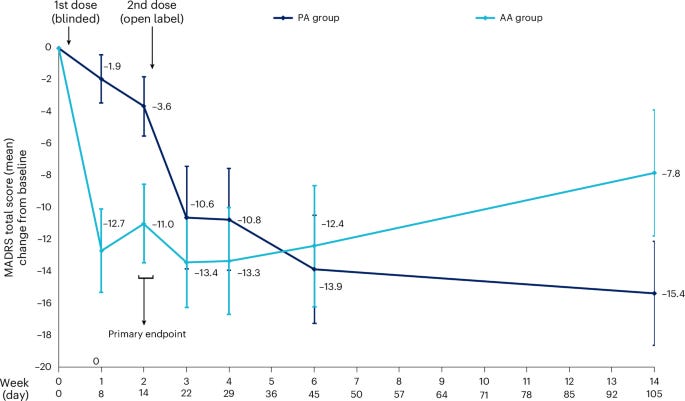
Result: Mean difference −7.35 MADRS points vs placebo (95% CI −13.62 to −1.08; P = 0.023), effect size ~0.8.
At week 2, all participants then entered an open-label phase and received a dose of DMT; antidepressant effects persisted for up to 3 months.
Safety in this small sample was reassuring: mostly mild–moderate AEs (transient anxiety, nausea), no serious adverse events reported.
Why This Is Interesting
Chemically, DMT is structurally related to serotonin (5-HT) and belongs to the same broad family as psilocybin and LSD, but with a very different pharmacokinetic profile. DMT is very short-acting (plasma half-life ~5 minutes). That makes it operationally different from psilocybin:
10-minute infusion vs multi-hour psychedelic sessions
Potentially lower infrastructure burden
More scalable if efficacy holds
From a translational standpoint, that matters.
The Methodological Reality
Blinding in psychedelic trials is inherently fragile.
At this dose, IV DMT produces intense acute psychoactive effects. Participants almost certainly inferred allocation. That introduces expectancy amplification — a known inflation risk in small trials with subjective endpoints.
This does not completely invalidate the study, but:
Effect size may be partially expectancy-driven
Replication in larger trials is essential
Active comparator designs may be necessary
If imperfect blinding automatically invalidated studies, much of psychiatry would collapse, including ketamine and ECT trials. The real question is whether the signal survives scale.
DMT’s short pharmacokinetics may actually be an operational advantage relative to longer-acting psychedelics.
But this study is too small to answer the questions that matter most:
Does the effect replicate in a larger, more diverse population?
Does benefit persist meaningfully beyond several weeks?
How does it compare to ketamine or psilocybin?
What safety signals emerge at scale?
My take
A single short IV DMT infusion produced a statistically and clinically meaningful antidepressant signal in a rigorous but very small randomized trial.
The biology is plausible.
The operational model is attractive.
The blinding is imperfect.
The sample is very, very small.
This is an early signal, not yet a paradigm-changing result.
The next trial will matter far more than this one.
Readers - What are your thoughts on psychedelics for neuropsychiatric indications? Which are the most likely to succeed? Are there other strategies that could be used to overcome the noted challenges? Please share your thoughts, questions, and experiences in the comments below!
Thanks for reading. If you found this entry interesting, please, share it so that others can receive more like this in their inbox.
Views expressed here are my own and not necessarily those of my employer. All data mentioned and discussed are publicly available.
For nearly two decades, I’ve worked as a neurologist and clinical trialist. Over time, I realized that the people who most need clear information about trials are often the least served by academic writing.
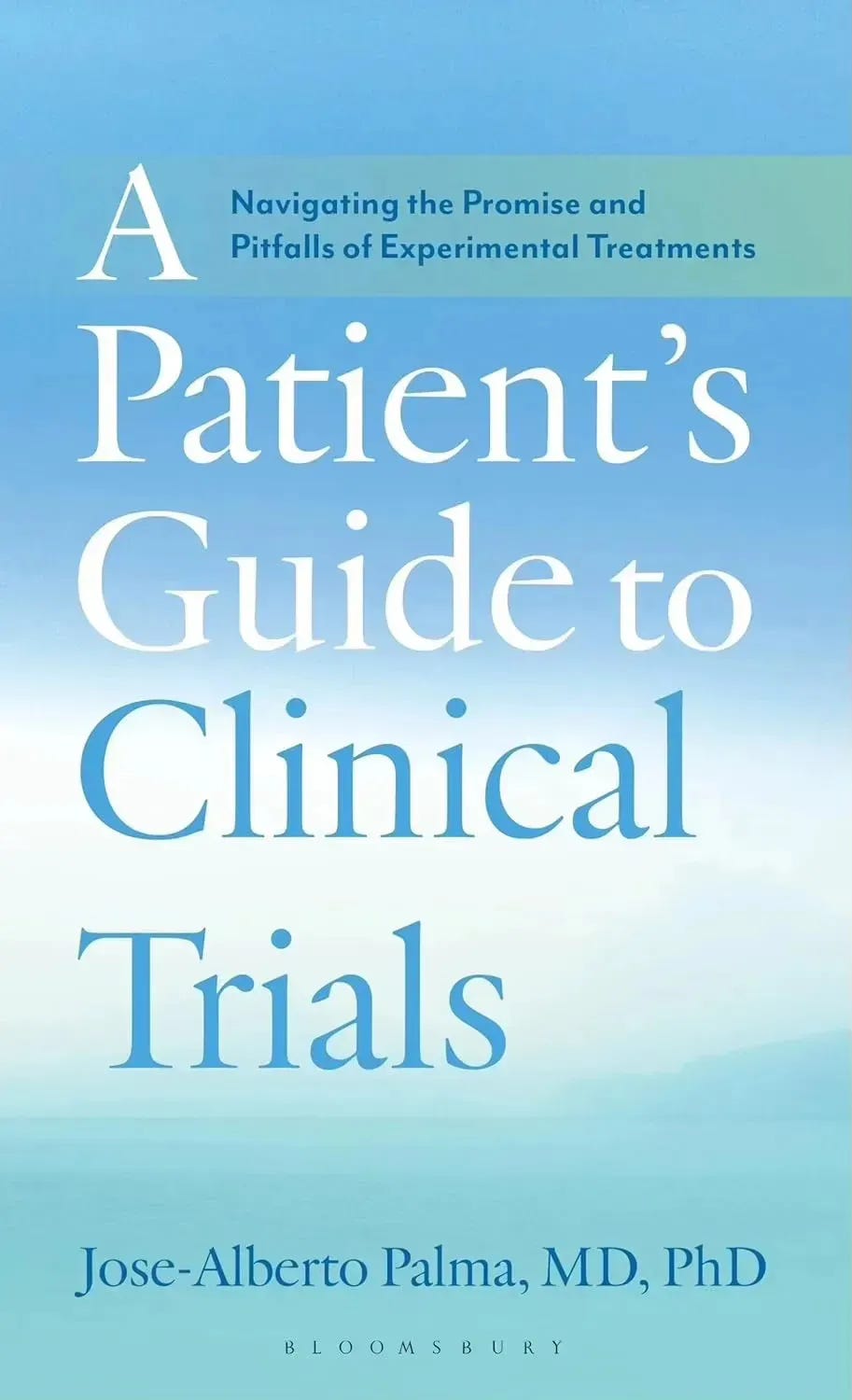
That’s why I wrote A Patient’s Guide to Clinical Trials: Navigating the Promise and Pitfalls of Experimental Treatments (Bloomsbury Publishing) — a plain-language guide to how trials work, what to expect, and how to weigh risks and benefits.
Now available wherever books are sold.
Comments
Nothing yet. Say the first thing.
Sign in to join the conversation.