
A neuroscience beyond clinical trials piece this weekend. Brain Trials’ core coverage of neurodegeneration drug development continues next week.
The vagus nerve is having a moment. Cold plunges to “reset” it. Humming and gargling to “tone” it. Ear clips that promise to stimulate it while you scroll. A whole shelf of advice claiming that your vagus nerve is the hidden switch behind your anxiety, your inflammation, your bad sleep, your unhappy gut. And that a few daily tricks can flip it back on.
Some of this rests on legit science, even very high-caliber science. But most of the health claims attached to it are not supported by evidence.
So let me walk through it: what genuinely reaches the vagus nerve, what the FDA-approved treatments actually do, and where the wellness pitch turns into wishful thinking.
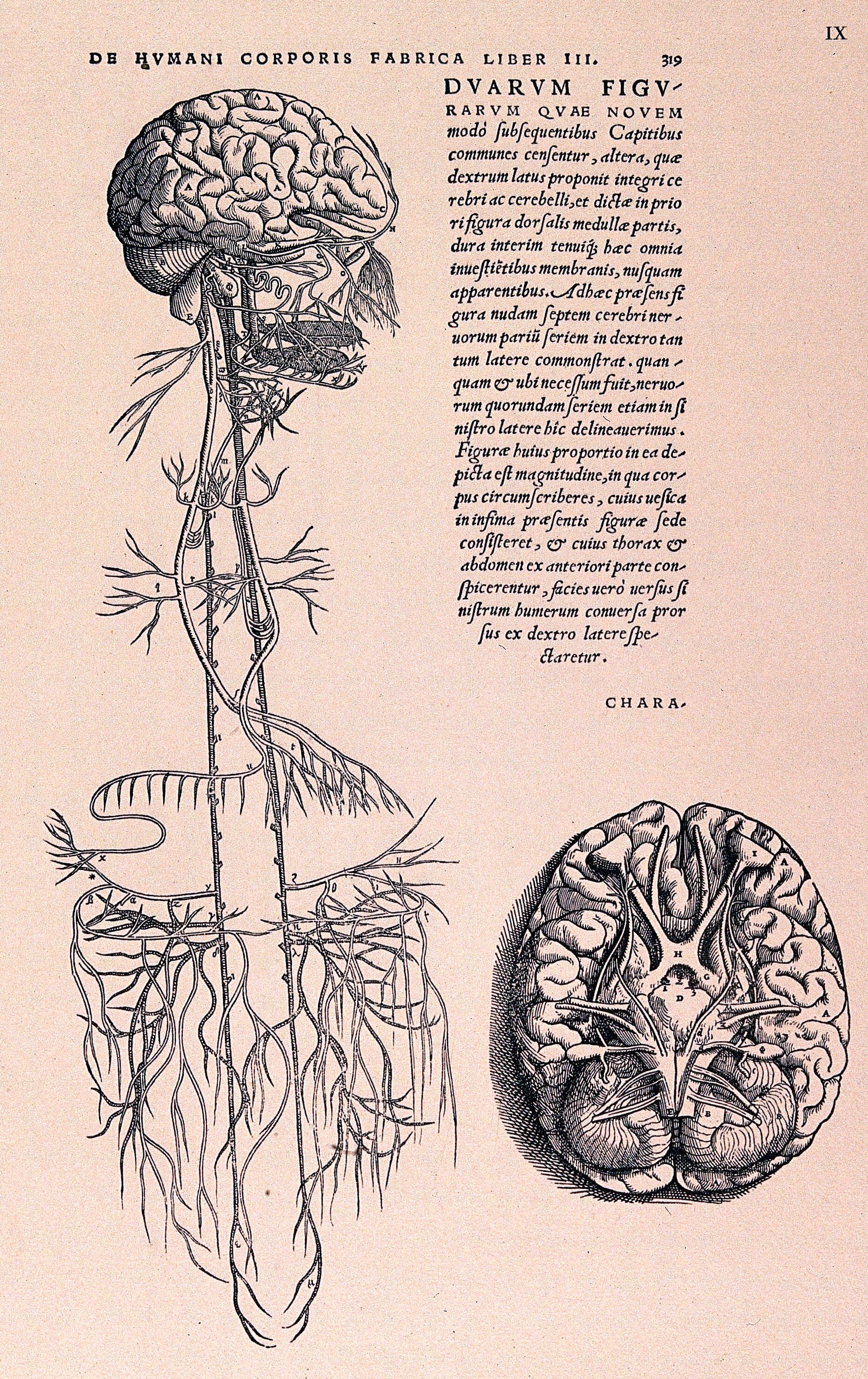
The vagus is the 10th cranial nerve. It wanders from the brainstem down to the heart, the lungs, and the gut. Vagus is Latin for “wandering.” It’s the main nerve of your parasympathetic system, the “rest and digest” side that slows your heart, eases your breathing, and runs digestion. Most of the vagal fibers actually carry signals the other way, from your organs up to your brain. It’s less of a control knob than a giant sensory cable reporting on the state of your body.
Here’s the finding that launched the whole field: around 25 years ago, a team led by neurosurgeon Kevin Tracey showed that the vagus nerve also carries an off-switch for inflammation: stimulate it, and it signals the spleen to turn down inflammatory proteins like TNF (published in Nature in 2000).¹ That discovery, the “inflammatory reflex”, is important, and it’s the engine behind the serious end of vagus-nerve medicine.
Stimulating the vagus nerve is an FDA-approved treatment for specific diseases. It has been for almost 30 years. But notice what that treatment looks like.
For drug-resistant epilepsy, surgeons have been implanting vagus-nerve stimulators (VNS) since 1997. The FDA approved VNS for hard-to-treat depression in 2005, and for stroke rehabilitation in 2021. Also, a handheld unit pressed to the neck is cleared for certain headache disorders.²
And in July 2025, the FDA approved the first VNS for rheumatoid arthritis³ — the direct output of Tracey’s inflammation work. It’s a device about the size of a jelly bean, implanted on the vagus nerve in the neck, that fires for roughly 60 seconds a day. In its pivotal clinical trial (called RESET-RA, which enrolled 242 patients, tested against a sham implant), ~35% of patients whose arthritis hadn’t responded to standard medications reached a ~20%-improvement mark at 3 months, versus ~24% on the sham (placebo) group.⁴
That’s a real, first-of-its-kind result, and worth taking seriously. But it’s also worth reading honestly: a very modest benefit, in patients who had run out of other pharmacological options, delivered by a device that requires surgical implantation. And that’s the common thread across every approved use. VNS is a prescription, a procedure, for a defined disease — not a lifestyle upgrade.
Between the VNS surgical implant and the wellness gadget sits a genuine research tool: non-invasive stimulation through the ear. A teeny tiny branch of the vagus reaches the skin of the outer ear, and a clip can deliver a mild electric current there. Researchers are studying this “auricular” stimulation for depression, insomnia, and inflammatory diseases like inflammatory bowel disease and lupus.
All this is promising but unproven. When scientists test ear stimulation carefully against a sham, it often fails to move heart rate variability (HRV, a marker of both symptomatic and parasympathetic vagal tone) any more than the sham/placebo version does.⁵ It may prove useful for specific conditions; right now the evidence doesn’t establish that it does.
And treat the long list of conditions vagus-nerve stimulation is “being investigated for” (inflammatory bowel disease, PTSD, long COVID, etc) with the same care: a list of things a therapy might someday help is a marketing signal, not a result. The consumer ear clips sold for “vagal toning” are running well ahead of the science.
Now the cold plunges, the humming, the gargling, the breathing. Here I want to be fair, because the usual debunking overshoots.
Some of these do reach the vagus, briefly. Cold water on your face triggers the “diving reflex”, an autonomic, vagus-driven slowing of the heart. That’s real physiology.
And slow breathing, at around 6 breaths a minute, reliably increases HRV, the very marker most of the gadgets chase.⁶ This is the same respitaroy frequency that those reciting the Rosary, the ancient prayer in Catholic tradition, achieves. In fact, in head-to-head studies, slow breathing increases HRV more than the ear clip does.⁷ A free, centuries-old breathing technique beats the expensive thing at the one job they both advertise. Humming, chanting, gargling, and singing all regulate breathing in similar patterns, and may increase HRV.
So the idea that they nudge the vagus nerve isn’t completely crazy. The hacks are doing something. But the problem is the leap.
“Briefly nudges your autonomic tone” is not the same claim as “resets your vagus nerve, cures your anxiety, lowers your inflammation, heals your gut, fixes your long COVID.” That second claim (the one doing the selling) has essentially no evidence behind it. A cold shower can jolt your heart rate for a minute. It will not cure rheumatoid arthritis; showing even a modest effect there took a surgical implant and a controlled clinical trial.
A brief blip in a number on your smartwatch is not a therapy.
Here’s the fact that should end the “toning” conversation. For much of the 20th century, before modern acid-blocking drugs, one standard treatment for stomach ulcers was to cut the vagus nerve, a vagotomy, to reduce stomach acid. Surgeons did this to hundreds of thousands of people. But the people who had it did not lose the ability to rest, calm down, sleep, or feel well. They lived full lives with the vagus nerve severed. So cutting the vagus nerve is, in essence, harmless.
Sit with that. If wellbeing depended on a finely “toned” vagus nerve, severing it would be catastrophic. It isn’t — which means the wellness framing has the nerve backwards. It is not an underused muscle waiting to be strengthened.
And when the vagus does prove to matter in serious disease, it points the opposite way from anything an ear clip promises. Two large national studies, in Denmark⁸ and Sweden,⁹ found that people who’d had the full vagus trunk cut developed Parkinson’s disease at a lower rate decades later. The effect was modest and statistically fragile in the full cohorts, reaching significance only among those followed longest, and both sets of authors called it preliminary. But the direction held in both countries, and it fits a striking idea from the neuropathologist Heiko Braak: that in some people the misfolded protein behind Parkinson’s may begin in the gut and climb the vagus to the brain over decades. Cut the road, and you may slow the journey.
That’s the nerve as it actually is: a two-way highway carrying information, and sometimes disease, between gut and brain; not a wellness switch you turn up. You can’t “tone” a highway.
Step back and look at the assumption the whole trend rests on. It treats your vagus nerve as if it were a weak muscle you’ve neglected, or a switch you forgot to flip: hack it, tone it, reset it, and you’ll be calmer and healthier. You can watch it happen — someone checking an overnight heart-rate-variability score like a stock ticker, running breathing drills to move the number, a whole nerve recast as a bicep that’s gone soft, with their wellbeing pinned to its tone.
I’m a neurologist who have studied the autonomic nervous system for most of my professional life (including HRV and vagal tone) and the vagus nerve being sold to you barely resembles the one we measure in the autonomic lab. It isn’t weak, and it isn’t broken. It’s doing exactly what it evolved to do.
When your system seems “dysregulated” — a racing heart, wired-but-tired nights, a gut in knots, a body that won’t come down off alert — that is rarely a nerve that needs a hack. It’s an ancient, well-built reflex running its normal program in a world it was never designed for: an ancient, well-built reflex running its normal program in a world it was never designed for: too little sleep, a nightcap thatwakes you at 3 a.m., low-grade stress that never resolves, an alarm signal that never gets switched off because the “threat” is your inbox.
The things that genuinely improve vagal function aren’t tricks. They’re the unglamorous ones — sleeping enough, getting daylight in the morning and darkness at night, moving your body, spending fewer of your waking hours in fight-or-flight. Those don’t “boost” your vagus nerve so much as stop overriding it. The reflex is fine. The world is the problem.
So breathe slowly if it steadies you. Take the cold shower if you like how it feels. Just don’t mistake it for repairing something broken. You’re giving a perfectly good nerve a brief taste of the calm your day keeps taking away — and if you want more of that, the fix isn’t on your vagus nerve. It’s in your schedule.
A question for the crowd: do you track your HRV, or find yourself managing your “vagal tone” like a project? And of the hacks — ice bath, humming, ear clip, the “reset” app — has any of it actually changed how you feel? If one genuinely helps you, I’d like to know what it does. Tell me in the comments.
Related reading: Why You Wake Up at 3 a.m. After Drinking — what your autonomic nervous system is really doing, minus the hype.
If you like watching wellness claims checked against the actual evidence, consider subscribing. Brain Trials covers neuroscience and drug development through the lens of what the data really show, and what they don’t.
Telling a proven therapy from a persuasive wellness claim is the same skill as reading a clinical trial: what’s the evidence, how big is the effect, and what’s just a good story. I wrote a book about that.
A Patient’s Guide to Clinical Trials: Navigating the Promise and Pitfalls of Experimental Treatments (Bloomsbury) — available now.
This analysis represents my personal views, not necessarily those of my employer, and is based entirely on publicly available information. Nothing here is medical advice; decisions about any device or therapy belong with your own clinician.
The vagotomy–Parkinson’s association is suggestive, not settled. In both the Danish and Swedish register studies, overall vagotomy showed no significant association with Parkinson’s; a lower risk appeared only after full truncalvagotomy, and only in the longest-follow-up subgroups (Denmark, >20 years: HR 0.53, 95% CI 0.28–0.99; Sweden, >5 years: HR 0.59, 95% CI 0.37–0.93). Both author groups called the evidence preliminary.
Borovikova LV, Ivanova S, Zhang M, et al. Vagus nerve stimulation attenuates the systemic inflammatory response to endotoxin. Nature. 2000;405(6785):458–462. https://doi.org/10.1038/35013070
FDA-approved indications and timeline — epilepsy (1997) and depression (2005): “Evolution of the VNS Therapy System,” PMC8757869, https://pmc.ncbi.nlm.nih.gov/articles/PMC8757869/ ; cluster headache/migraine (gammaCore) and stroke rehabilitation (2021): Brain & Life, American Academy of Neurology, https://www.brainandlife.org/articles/vagus-nerve-stimulation-disorders-treatment
FDA approval of the SetPoint System for rheumatoid arthritis (July 31, 2025): Medscape, https://www.medscape.com/viewarticle/fda-approves-first-vagus-nerve-stimulation-device-rheumatoid-2025a1000keb ; SetPoint Medical press release, https://setpointmedical.com/setpoint-medical-receives-fda-approval-for-novel-neuroimmune-modulation-therapy-for-rheumatoid-arthritis/
RESET-RA trial (ClinicalTrials.gov NCT04539964): ACR20 at 3 months 35.2% (active) vs 24.2% (sham); summarized in PMC12889326, https://pmc.ncbi.nlm.nih.gov/articles/PMC12889326/
Szulczewski MT, D’Agostini M, Van Diest I. Expiratory-gated transcutaneous auricular vagus nerve stimulation (taVNS) does not further augment heart rate variability during slow breathing at 0.1 Hz. Appl Psychophysiol Biofeedback. 2023;48(2):233–243. https://doi.org/10.1007/s10484-023-09584-4
Zaccaro A, Piarulli A, Laurino M, et al. How breath-control can change your life: a systematic review on psycho-physiological correlates of slow breathing. Front Hum Neurosci. 2018;12:353. https://doi.org/10.3389/fnhum.2018.00353
Jensen MK, et al. Modulating heart rate variability through deep breathing exercises and transcutaneous auricular vagus nerve stimulation: a study in healthy participants and in patients with rheumatoid arthritis or systemic lupus erythematosus. Sensors (Basel). 2022;22(20):7884. https://doi.org/10.3390/s22207884
Svensson E, Horváth-Puhó E, Thomsen RW, et al. Vagotomy and subsequent risk of Parkinson’s disease. Ann Neurol. 2015;78(4):522–529. https://doi.org/10.1002/ana.24448
Liu B, Fang F, Pedersen NL, et al. Vagotomy and Parkinson disease: a Swedish register-based matched-cohort study. Neurology. 2017;88(21) (PMID 28446653). https://doi.org/10.1212/WNL.0000000000003961
Comments
Nothing yet. Say the first thing.
Sign in to join the conversation.