
Correction and clarification (July 1, 2026): An earlier version of this piece referred to glucosylceramide (GluCer) as “the central pharmacodynamic biomarker” for this program, which overstated its formal status. Peter Lansbury, who led the program from Lysosomal Therapeutics through the Bial trial, has noted, and the published trial record confirms, that the glycosphingolipid measures were formally exploratory, hypothesis-generating endpoints, not validated, confirmatory biomarkers, and that no glycosphingolipid biomarker was an endpoint in the Phase 2b ACTIVATE trial at all. I’ve corrected that characterization below.
Two points I continue to stand behind: first, the program’s own publications (den Heijer et al., Br J Clin Pharmacol 2021; and the Phase 1b trial registration) explicitly stated the expected direction (that GCase activation should lower substrate levels) so a documented directional prediction did exist, independent of whether GluCer was exploratory or not. The Phase 1b result was in the opposite direction. Second, the distinction between biomarker validity (was GluCer a reliable readout? genuinely uncertain at the time) and hypothesis directionality (which way did the program predict the marker would move? down, on the record) is, in my view, the crux. Uncertainty about the former does not dissolve a contradiction on the latter. Dr. Lansbury and I continue to discuss this, and he has indicated he will publish a fuller account, which I’ll link when it appears.
Here is a pattern that deserves a name.
A company develops a drug for a specific disease. The drug is designed to move a specific biological target in a one, clear direction. The company runs an early trial and measures the biomarker. The biomarker moves, but in the opposite direction to what the mechanism predicts. Instead of concluding the drug doesn’t work as intended, the company reframes the wrong-direction result as evidence that the drug is working, adjusts the hypothesis to accommodate the data, and continues development into a larger, longer, more expensive trial.
This has now happened, at least twice, in the Parkinson’s space within the last three years. In both cases, the drug hit its molecular target. In both cases, the downstream biomarker said the biology was moving in the wrong way. In both cases, the company presented the contradictory signal as confirmatory.
One program has already ended in a 273-patient Phase 2b failure. The other is being used to justify further studies.
GBA1 mutations cause reduced activity of glucocerebrosidase (GCase), a lysosomal enzyme that breaks down glucosylceramide (GluCer). The dominant hypothesis holds that GluCer accumulation promotes alpha-synuclein aggregation and drives neurodegeneration.
An allosteric GCase activator should increase enzyme activity and therefore decrease substrate — and the program's own publications stated this directional expectation explicitly, predicting that activation would lead to “lower levels of these substrates.” A drug that instead raises GluCer is moving in the direction opposite to its documented mechanistic prediction. Importantly, GluCer was an exploratory biomarker, not a validated, pre-specified primary or secondary endpoint — a distinction I return to below. But the predicted direction was on the record, and the result contradicted it.
That is what Bial’s pariceract (BIA 28-6156) did.
The Phase 1b trial (den Heijer et al., Movement Disorders 2023) enrolled 40 GBA-PD patients across four arms (10 mg, 30 mg, 60 mg, and placebo) for 28 days.1 The drug was well tolerated. And in the biomarker analysis, treated patients showed a treatment-related increase in intracellular glucosylceramide in peripheral blood mononuclear cells. Not a decrease. An increase. The substrate the drug was supposed to clear went up.
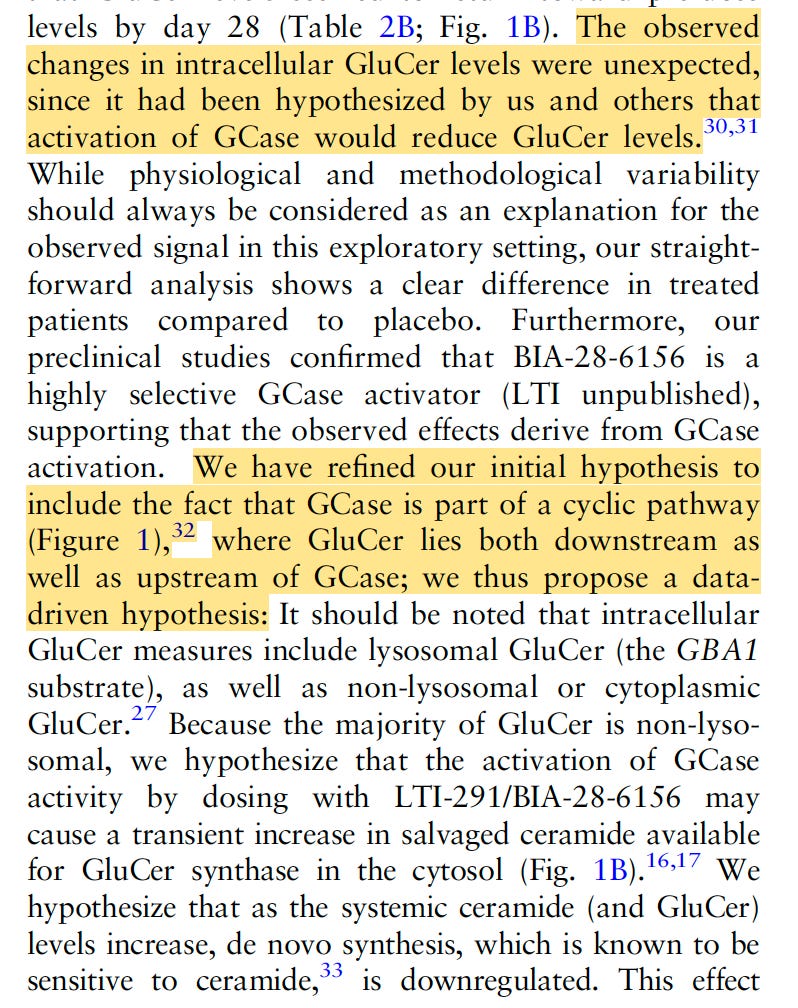
The authors did not conclude the drug had failed. They reframed the increase as confirmatory. The GluCer rise was “equated to increased GCase activity” and described as a “transient” effect, the idea being that enhanced enzymatic flux would temporarily raise substrate before a new steady state was reached. They simultaneously invoked Michaelis-Menten kinetics to argue that GluCer levels are insensitive to GCase activity above ~30% of normal, which would imply that no interpretable substrate change should have been expected in the first place.
The two arguments sit awkwardly together. If GluCer is kinetically insensitive to GCase activity, then a measured GluCer increase cannot simultaneously be evidence of increased GCase activity. You cannot use the same biomarker to claim the drug is working when it moves and to dismiss it as uninformative when it moves the wrong way. Lead author den Heijer defended the finding: “our preclinical studies confirmed that BIA-28-6156 is a highly selective GCase activator, supporting that the observed effects derive from GCase activation.”1 A 2024 review noted more cautiously that the observation “requires verification.”
It was not verified. It was scaled. Bial proceeded to the Phase 2b ACTIVATE trial, 273 genetically confirmed GBA-PD patients across 85 sites in 11 countries, randomized to two doses or placebo, treated for 78 weeks, with time to clinically meaningful motor progression as the primary endpoint.2
On June 9, 2026, Bial announced that ACTIVATE missed its primary endpoint and all key secondary endpoints.There was no separation from placebo. The drug did not slow progression. Bial’s Chief Scientific Officer confirmed the program’s discontinuation: “Based on the lack of demonstrated efficacy in this study, Bial has made the decision to discontinue further development of BIA 28-6156.”
Two hundred and seventy-three patients. Eighty-five sites. Eleven countries. Eighteen months of enrollment. Seventy-eight weeks of treatment. For a drug whose own Phase 1b biomarker had pointed the wrong way, and whose developers had reframed the wrong-direction signal as confirmatory rather than confronting it.
The NLRP3 inflammasome is an innate immune sensor. When activated, it drives release of pro-inflammatory IL-1β and IL-18. Preclinical Parkinson’s models have shown that NLRP3 inhibition reduces alpha-synuclein pathology, dopaminergic neuron loss, and microglial activation. TSPO-PET — an imaging marker of glial activation in the brain — is elevated in Parkinson’s versus controls. The mechanistic expectation is clear: an effective NLRP3 inhibitor should reduce the TSPO-PET signal. Roche pre-specified TSPO-PET as a pharmacodynamic endpoint in their Phase 1b trial.
Roche’s selnoflast (RO7486967) was tested in a 57-patient, placebo-controlled, 28-day Phase 1b study in early-stage idiopathic Parkinson’s disease, presented at AD/PD 2026.3
The cytokine-related target engagement was genuine. Ex-vivo LPS-stimulated IL-1β was suppressed by approximately 91% versus placebo (p = 0.003). CSF IL-18 fell by approximately 30% (p = 0.02). Plasma hsCRP decreased by approximately 58% (p = 0.01). The drug penetrated the brain, hit its target, and suppressed the inflammasome pathway exactly as intended.
Then came the TSPO-PET result.
In the midbrain (the brain region most affected in Parkinson’s) TSPO-PET signal increased by 41% in the selnoflast group versus placebo (80% CI: 24–60%, p = 0.0009). In the putamen, the increase was 42% (80% CI: 26–61%, p = 0.0006).3
Not a subtle signal. Not a noisy trend. A 41% increase at p < 0.001, in the exact brain region where an NLRP3 inhibitor should be reducing neuroinflammation. At Roche’s own pre-specified alpha of 0.20 (set intentionally lenient to detect weak signals), this result would have been significant ten times over. The TSPO-PET finding is the single most statistically robust result in the entire trial.
And it points in the opposite direction to the mechanistic prediction.
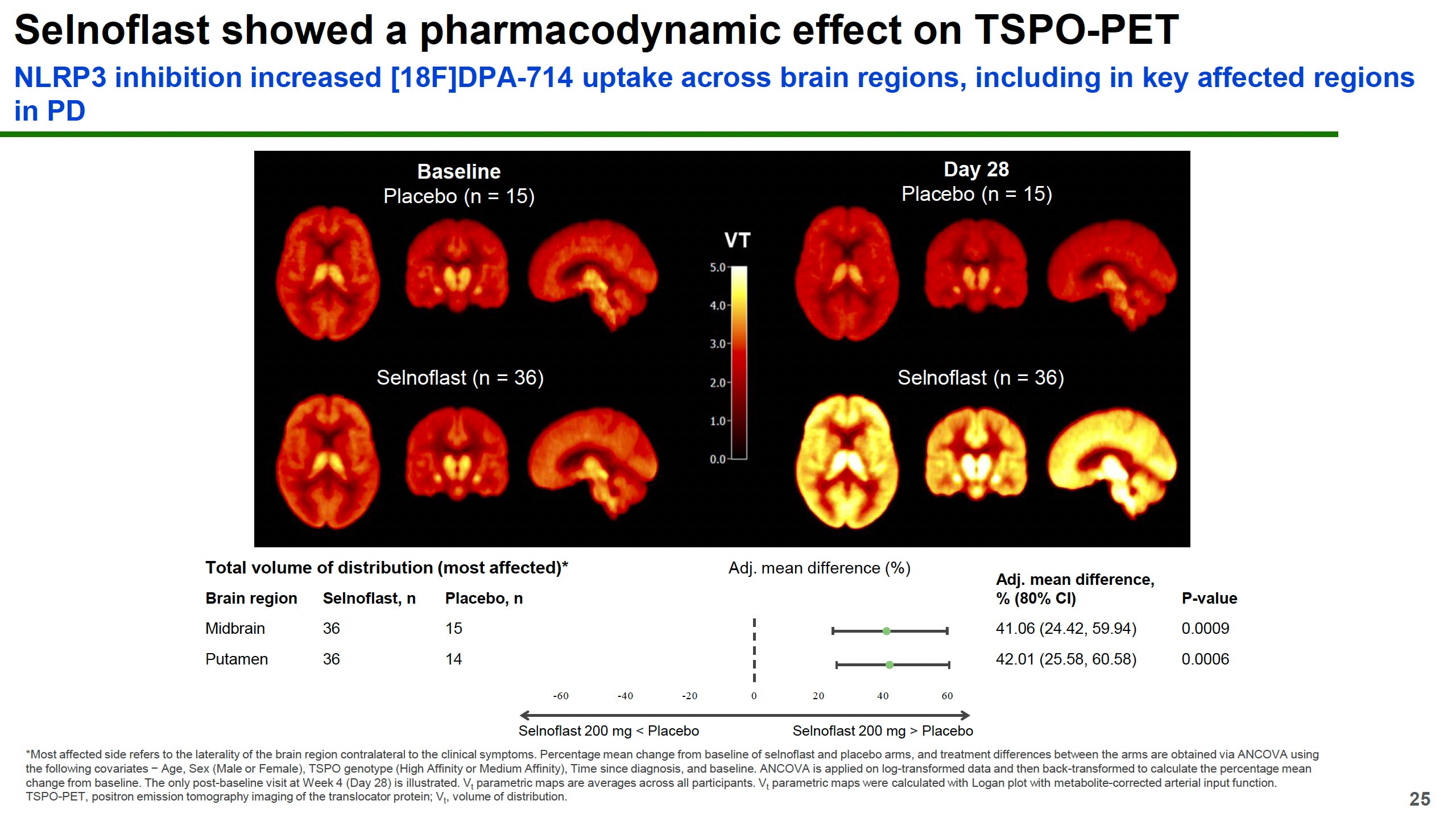
Here is how Roche presented the finding. The slide title read: “Selnoflast showed a pharmacodynamic effect on TSPO-PET.” The subtitle: “NLRP3 inhibition increased [18F]DPA-714 uptake across brain regions, including in key affected regions in PD.” The summary slide (later in the deck) concluded: “robust effects on the microglia marker TSPO-PET” and stated that “these early results support further studies.”3
Read that again. The biomarker that was pre-specified to demonstrate proof-of-mechanism moved in the opposite direction. The company described this as a “pharmacodynamic effect,” called it “robust,” and used it to justify further development.
There are many precedents for how to handle this situation honestly, and it comes from the same pathway.
One example: Sanofi’s venglustat attacked GBA1-related Parkinson’s from the opposite end: inhibiting glucosylceramide synthesisrather than activating its clearance. The MOVES-PD Phase 2 trial enrolled 221 GBA-PD patients across 52 sites in 16 countries. Venglustat achieved confirmed target engagement: dose-dependent glucosylceramide reduction in plasma and CSF. The drug did what it was designed to do at the molecular level.4
The clinical result: venglustat patients deteriorated more than placebo. The MDS-UPDRS Part II+III change was 7.29 (SE 1.36) with venglustat versus 4.71 (SE 1.27) with placebo — a non-significant difference (p = 0.17), but trending the wrong way, with more psychiatric and gastrointestinal adverse events in the treatment group.
What happened next was unusual in the field: the authors said so plainly. In response to correspondence in The Lancet Neurology, the MOVES-PD investigators stated: “No beneficial treatment effect of venglustat was shown compared with placebo and, therefore, the hypothesis was refuted.”5
That sentence, “the hypothesis was refuted”, is what scientific honesty sounds like in a clinical trial publication. Not “the data support further investigation.” Not “transient effects may precede a new steady state.” The hypothesis was tested. The result was clear. The program ended.

The term I’d use for what Bial and Roche have done is hypothesis flipping.
Groucho Marx said it better than any regulatory scientist: “Those are my principles, and if you don’t like them… well, I have others.” The pharmaceutical version: “This is my hypothesis, and if the data don’t support it… well, I have others.” Which is to say, reinterpreting contradictory pharmacodynamic data to preserve a program rather than accepting that the drug doesn’t work as intended.
In fairness, there are genuine scientific reasons why a wrong-direction biomarker might not be fatal. GluCer kinetics are complex. TSPO-PET is a contested biomarker, it may reflect glial density rather than activation state, and its specificity for pro-inflammatory versus anti-inflammatory microglia is unresolved.6 Roche could argue that the TSPO increase reflects a beneficial microglial phenotypic shift rather than worsened neuroinflammation. That argument isn’t unreasonable. But it is a post-hoc reinterpretation of a biomarker that was prospectively chosen as a proof-of-mechanism endpoint under the prediction that it would decrease. If the decrease had occurred, Roche would have presented it as evidence the drug reduces neuroinflammation. The increase occurred, and they present it as evidence the drug has a “pharmacodynamic effect.” That is not hypothesis testing. That is heads-I-win-tails-you-lose.
The cost of hypothesis flipping is not abstract. It is measured in patients and years.
Two hundred and seventy-three GBA-PD patients spent up to 78 weeks in ACTIVATE, a population that progresses faster than idiopathic PD and has no disease-modifying therapy. Every month in a failing trial is a month not spent in a trial that might work. Bial’s compassionate-use protocol for ACTIVATE completers (NCT07522606) is still open, extending exposure to a drug that has now been shown to do nothing. The investigators, the sites, the regulatory infrastructure, and the patient advocacy networks that made ACTIVATE possible could have been deployed on a program with a cleaner mechanistic signal.
And the foundational hypothesis itself is now under serious pressure. A 2024 analysis from McGill, Columbia, and Tel Aviv concluded that plasma glucosylceramide is principally regulated by ATP10D rather than GBA1, and that GluCer levels are associated with (but not necessarily causative of) PD. Independent work has found no evidence of substrate accumulation in Parkinson’s brains with GBA mutations. Both the substrate-reduction strategy (venglustat) and the substrate-clearance-via-activation strategy (pariceract) may have been built on a scientific premise that was never solid.
There is no regulatory rule dictating when a contradictory pharmacodynamic biomarker should halt a program. But there should be a scientific standard, and it should be simple.
Someone could argue that ACTIVATE was the prospective confirmation of their unexpected biomarker result. Bial tested it, failed, and now the drug is discontinued. Nothing wrong with that. That’s how drug development works.
I disagree: ACTIVATE was a large Phase 2 placebo-controlled trial. The primary endpoint was a clinical endpoint, whether the drug could slow the progression of disease over 78 weeks in almost 300 patients accross 85 sites. It was not designed to solve the question whether the GluCer increase was real, transient or persistent: that’s the mechanistic question Bial’s own paper said “required verification”.
If Bial wanted to do another study, then a 40-patient study over 3-6 months with serial GluCer measurements and a pre-specific rule would have been suficient: if the substrate normalizes, proceed; if it doesn’t, the “transient” rationalization is disproven and the program stops. Such a study would have cost a fraction of ACTIVATE, taken a fraction of the time, and resolved the mechanistic ambiguity before wasting the time of 273 GBA-PD, their families and the investigators.
What I’d propose if a company still wants to proceed after a contradictory biomarker result is: resolve the specific mechanistic ambiguity with fit-for-purpose study before scaling to an efficacy trial.
This isn't a novel proposal. The NIMH Fast-Fail Trials framework, first implemented in 2020 (Krystal et al., Nature Medicine), formalizes exactly this principle: pre-specify a mechanistic biomarker, pre-specify the direction it should move, and use the result as a mandatory go/no-go gate before proceeding to efficacy trials. The framework exists. The neurodegeneration field simply hasn't adopted it.
A Phase 2b trial is the wrong design to answer a biomarker/mechanistic question. It is expensive, slow, and requires many patients to test whether your Phase 1b biomarker was telling you the truth.
Sanofi showed what the alternative looks like with venglustat. The hypothesis was refuted. They said so. The field moved on. That clarity is worth more to patients, investors, and the scientific community than any amount of creative reinterpretation.
Let me know in the comments if you know of other examples of “hypothesis flipping” in neuroscience or other therapeutic areas. This is worth compilling. Also, I left out the broader question of whether the GBA1 substrate hypothesis itself is wrong (not just the drugs per se), the parallels to the LRRK2 story I covered last week, and the emerging argument for gain-of-function rather than loss-of-function models in GBA-PD. If there’s interest in any of these, let me know in the comments.
If this kind of analysis is useful to you , the kind that reads the Phase 1b before celebrating the Phase 2b, and asks whether the biomarker supported the hypothesis before it was tested, consider subscribing. Brain Trials covers neuroscience drug development through the lens of evidence, mechanism, and what the data actually show when you look closely.
A biomarker that points the wrong way is not a nuance to be explained. It is a signal to be heeded. Knowing when to stop is as important as knowing when to start. I wrote a book about that.
A Patient’s Guide to Clinical Trials: Navigating the Promise and Pitfalls of Experimental Treatments (Bloomsbury) — available now.

Disclosure: This analysis is based entirely on publicly available information, including conference presentations and peer-reviewed publications, and represents my personal views, not necessarily those of my employer.
References
den Heijer JM, et al. A Phase 1B Trial in GBA1-Associated Parkinson’s Disease of BIA-28-6156, a Glucocerebrosidase Activator. Movement Disorders. 2023;38(7):1197–1208. doi:10.1002/mds.29346
Bial Inc. Topline Results From ACTIVATE Phase 2b Study. Business Wire, June 9, 2026.
Pagano G, et al. A Phase 1b study of selnoflast in early stage Parkinson’s disease. Presented at AD/PD 2026 in Copenhagen, Denmark, March 17–21. https://medically.gene.com/global/en/unrestricted/neuroscience/ADPD-2026/adpd-2026-presentation-pagano-a-phase-1b-study-to-test-.html
Giladi N, et al. Safety and efficacy of venglustat in GBA1-associated Parkinson’s disease. Lancet Neurology.2023;22(8):661–671. doi:10.1016/S1474-4422(23)00205-3
Zimran A, et al. Venglustat in GBA1-related Parkinson’s disease. Lancet Neurology. 2024;23(2):137. doi:10.1016/S1474-4422(23)00455-6
Giladi N, et al. Venglustat in GBA1-related Parkinson’s disease — Authors’ reply. Lancet Neurology.2024;23(2):137–138. doi:10.1016/S1474-4422(23)00470-2
Krystal AD, et al. A randomized proof-of-mechanism trial applying the ‘fast-fail’ approach to evaluating κ-opioid antagonism as a treatment for anhedonia. Nat Med. 2020 May;26(5):760-768. doi:10.1038/s41591-020-0806-7.
den Heijer JM, Kruithof AC, van Amerongen G, et al. A Phase 1B Trial in GBA1-Associated Parkinson’s Disease of BIA-28-6156, a Glucocerebrosidase Activator. Movement Disorders. 2023;38(7):1197–1208. doi:10.1002/mds.29346. The key finding: “a treatment-related transient increase in intracellular glucosylceramide (GluCer) in PBMCs.” The authors’ rationalization: the increase was “equated to increased GCase activity” via a Michaelis-Menten kinetic argument, with the prediction that GluCer would later decline to a new steady state.
Bial Inc. “Bial Reports Topline Results From ACTIVATE Phase 2b Study in GBA-Associated Parkinson’s.” Business Wire, June 9, 2026. 273 patients, 85 sites, 11 countries, 78-week treatment period. Primary endpoint: time to clinically meaningful motor progression (MDS-UPDRS Parts II+III). Missed primary and all key secondary endpoints. Note: enrollment exceeded the original ClinicalTrials.gov target of 237, ultimately reaching 273 — a testament to investigator and patient commitment to a program whose mechanistic signal was unresolved.
Pagano G, Zinnhardt B, Mracskó EZ, et al. “A Phase 1b study to test the safety, pharmacokinetics, and pharmacodynamics of selnoflast in early stage Parkinson’s disease.” Presented at AD/PD 2026, March 17–21. 57 participants, 17 sites, 28 days. TSPO-PET [18F]DPA-714 total volume of distribution, most affected side: midbrain +41.06% vs placebo (80% CI: 24.42–59.94, p = 0.0009); putamen +42.01% (80% CI: 25.58–60.58, p = 0.0006). Pre-specified alpha for the study was 0.20; the TSPO increase was significant at p < 0.001. Note: all statistical analyses used ANCOVA with covariates including TSPO genotype (high vs. medium affinity binder), which strengthens the imaging result by controlling for a known source of TSPO-PET variability.
Giladi N, Alcalay RN, Cutter G, et al. Safety and efficacy of venglustat in GBA1-associated Parkinson’s disease: an international, multicentre, double-blind, randomised, placebo-controlled, phase 2 trial. Lancet Neurology.2023;22(8):661–671. doi:10.1016/S1474-4422(23)00205-3. 221 patients, 52 sites, 16 countries. MDS-UPDRS Part II+III change: 7.29 (SE 1.36) with venglustat vs 4.71 (SE 1.27) with placebo. Difference: 2.58 (95% CI: –1.10 to 6.27, p = 0.17). Not significant, but trending worse than placebo.
The published exchange in Lancet Neurology: Zimran et al. (doi:10.1016/S1474-4422(23)00455-6) urged the authors to consider that the substrate hypothesis was “probably wrong.” The investigators’ reply (doi:10.1016/S1474-4422(23)00470-2) stated plainly: “No beneficial treatment effect of venglustat was shown compared with placebo and, therefore, the hypothesis was refuted.”
TSPO-PET interpretation is genuinely contested. Human microglia, unlike rodent microglia, may not upregulate TSPO upon pro-inflammatory activation. Recent reviews argue the signal may reflect glial density rather than activation state and cannot distinguish pro- from anti-inflammatory phenotypes. A TSPO increase under an anti-inflammatory drug could therefore reflect microglial proliferation, reactive repopulation, or phenotypic shift rather than worsened neuroinflammation. This ambiguity is there, but it does not resolve the fundamental problem: the endpoint was pre-specified under the assumption it would decrease. If the decrease had been observed, it would have been claimed as proof of mechanism. The increase should not be claimed as the same thing. It’s not scientifically honest.
Comments
Nothing yet. Say the first thing.
Sign in to join the conversation.