
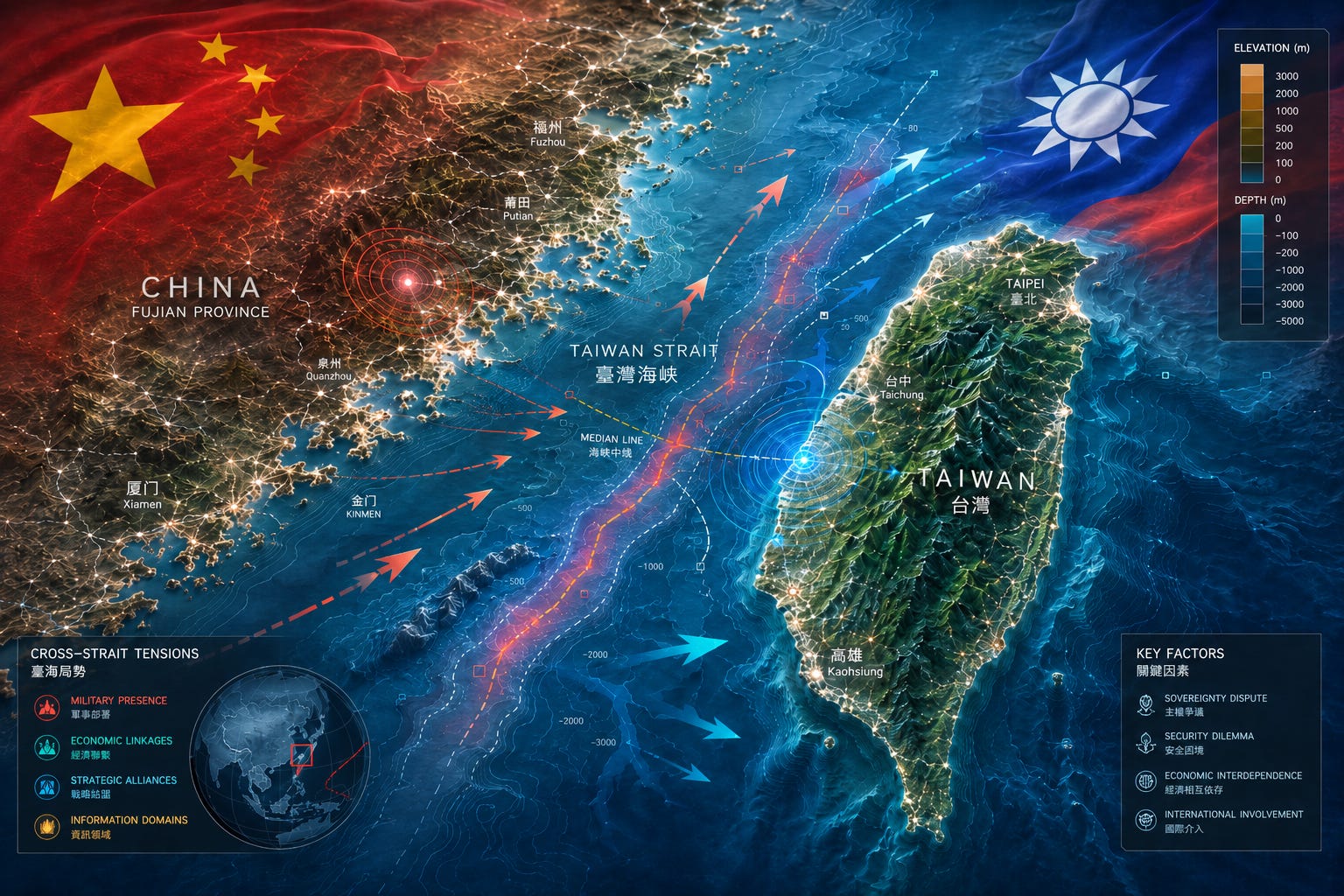
This installment converts the prior five into two reference instruments. The first is a comprehensive stakeholder map: every party with a material interest in the cross-strait outcome, its specific stakes, its leverage, and the conditions under which its position would move. The second is the Frictions and Lubricants framework — a systematic accounting of the forces pushing the system toward kinetic resolution against the forces restraining it, each with its source evidence, its current strength, and its intensification conditions. Where the cost ledger of Part 4 asked what action would cost and the silicon assessment of Part 5 asked whether Beijing could build its way around the question, this installment asks the integrative question that organizes the synthesis to follow: given who holds what stake and which way the force vectors point, what is the system’s current state, and where is it unstable?
The Taiwan question is not a contest between two parties but a dense field of stakeholders whose exposures to a kinetic outcome are radically unequal, and the inequality is the analytical key: it explains why each actor behaves as it does, and it locates the points at which the system is most likely to move. That is the central organizing claim of this installment, and the map that follows substantiates it party by party.
Three findings carry the weight. First, exposure is profoundly asymmetric across six dimensions — economic, strategic, technological, political, financial, and resource — and no single ranking captures it. The European Union faces a modeled first-year economic contraction of 10.9% in the war scenario, essentially identical to China’s own 11% and substantially larger than the United States’ 6.6%, yet carries almost no strategic or treaty exposure and a weak political mandate for forward action; the result is a structurally hedged Europe. The United States carries the lighter direct economic hit but the heaviest strategic, political, financial, and credibility exposure of any actor outside the strait, which is why its deterrence posture is the most aggressive and its transactional temptation the most consequential. Japan, alone, faces high-to-severe exposure across nearly every dimension at once, which is why its posture is the most aligned with Washington’s of any contingency partner not bound by a mutual-defense treaty covering Taiwan. The asymmetry is the organizing explanation, and it is a Reasonable Inference well supported by Bloomberg Economics’ February 2026 modeling and the observed behavior of each government.
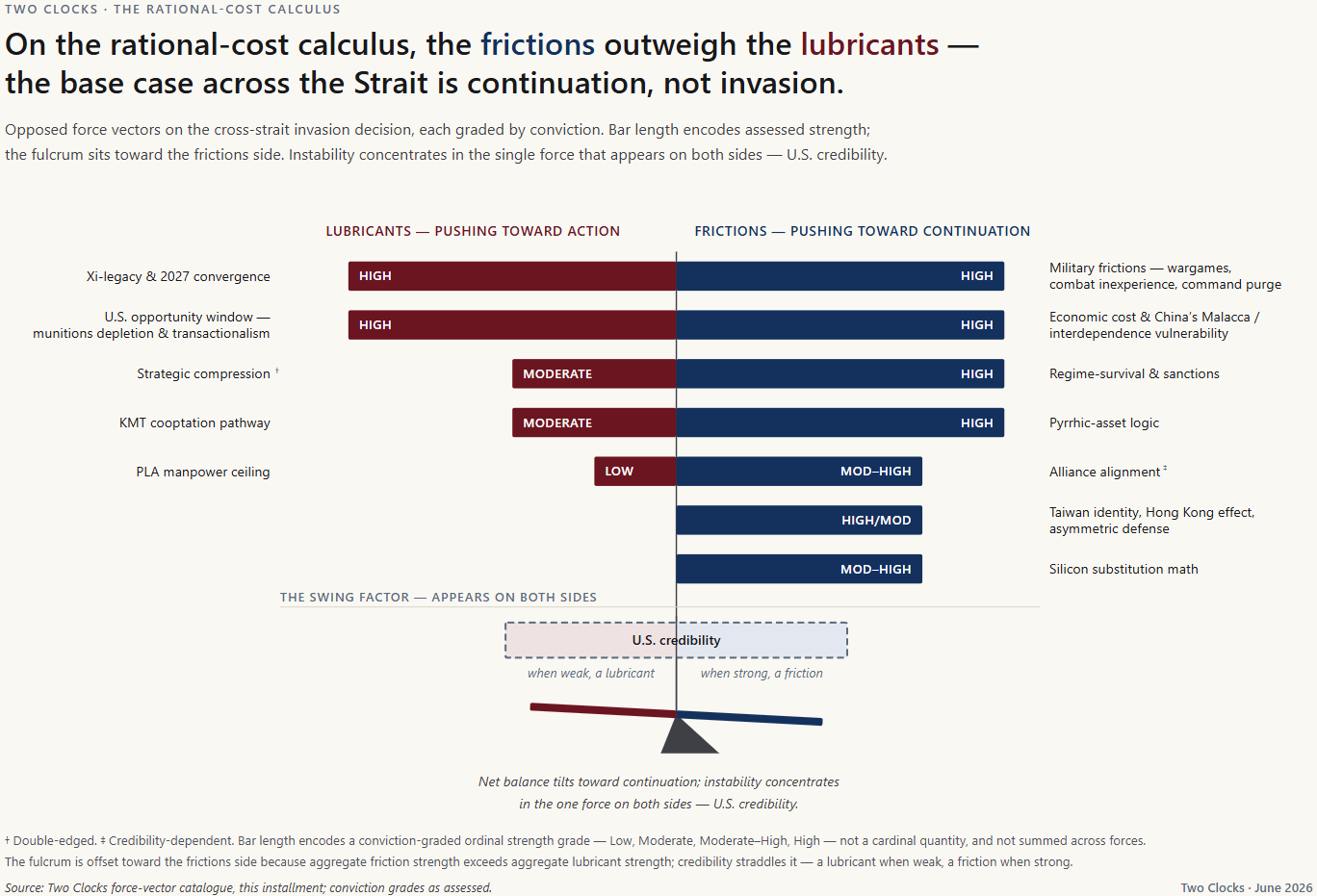
Second, on the rational-cost calculus the restraining forces — the frictions — currently outweigh the enabling forces — the lubricants. The wargamed military verdict, the order-of-magnitude economic cost the initiator itself would bear, the sanctions architecture demonstrated against Russia, the regime-survival risk of visible defeat, a freshly purged and combat-inexperienced high command, the substitution math of the silicon path, and a Taiwanese identity sealed against persuasion together push probability mass away from the catastrophic tail and toward the gray-zone median that Parts 1 and 2 identified. This is the Conviction of the assessment, and it is the reason the base case is continuation rather than conflict.
Third, the balance is unstable in one specific place. The most consequential friction — and the principal hinge of allied participation — is the credibility of the United States commitment, and the May 2026 Trump-Xi summit and its aftermath left that commitment in a state of unresolved ambiguity — a $14 billion arms package left unsigned as a bargaining chip, the second of the 1982 Six Assurances treated as negotiable, an institutional State and Defense apparatus insisting nothing has changed. The single most dangerous lubricant is not Beijing’s appetite, which the cost ledger constrains, but the convergence of Xi Jinping’s personal legacy timeline and the People’s Liberation Army’s 2027 capability milestone against a Washington that is distracted, transactional, and depleted of the long-range munitions a Pacific fight would demand. The system’s stability is therefore a function of two variables that move independently of Beijing’s preferences, and watching them is the work of Part 7.
The Direct Principals
The Allied and Treaty Principals
The Corporate Principals
The Asymmetric Exposure Decomposition
The Lubricants — Forces Toward Action
The Frictions — Forces Against Action
The Net Assessment as of Publication
What Would Change This Assessment
Comments
Nothing yet. Say the first thing.
Sign in to join the conversation.