
The artificial-intelligence buildout was supposed to be a story about one chip. The graphics processing unit — the GPU, the parallel-math engine that trains and runs large models — absorbed the capital, the headlines, and the scarcity. The central processing unit, the general-purpose processor that had run computing for four decades, was the commodity beside it: necessary, cheap, and finished as a growth market. The first-quarter 2026 earnings season retired that framing. Intel’s data-center revenue grew 22 percent on demand it could not fully supply; AMD’s grew 57 percent, lifting its data-center segment past Intel’s and its share of x86 server-processor revenue to a record; and the price of a server processor has risen as much as 20 percent since March 2026. The component-cost inflation this series has tracked across the physical economy is now re-rating the processor those components surround. The question has changed from whether the CPU matters to artificial intelligence to who captures the value that follows.
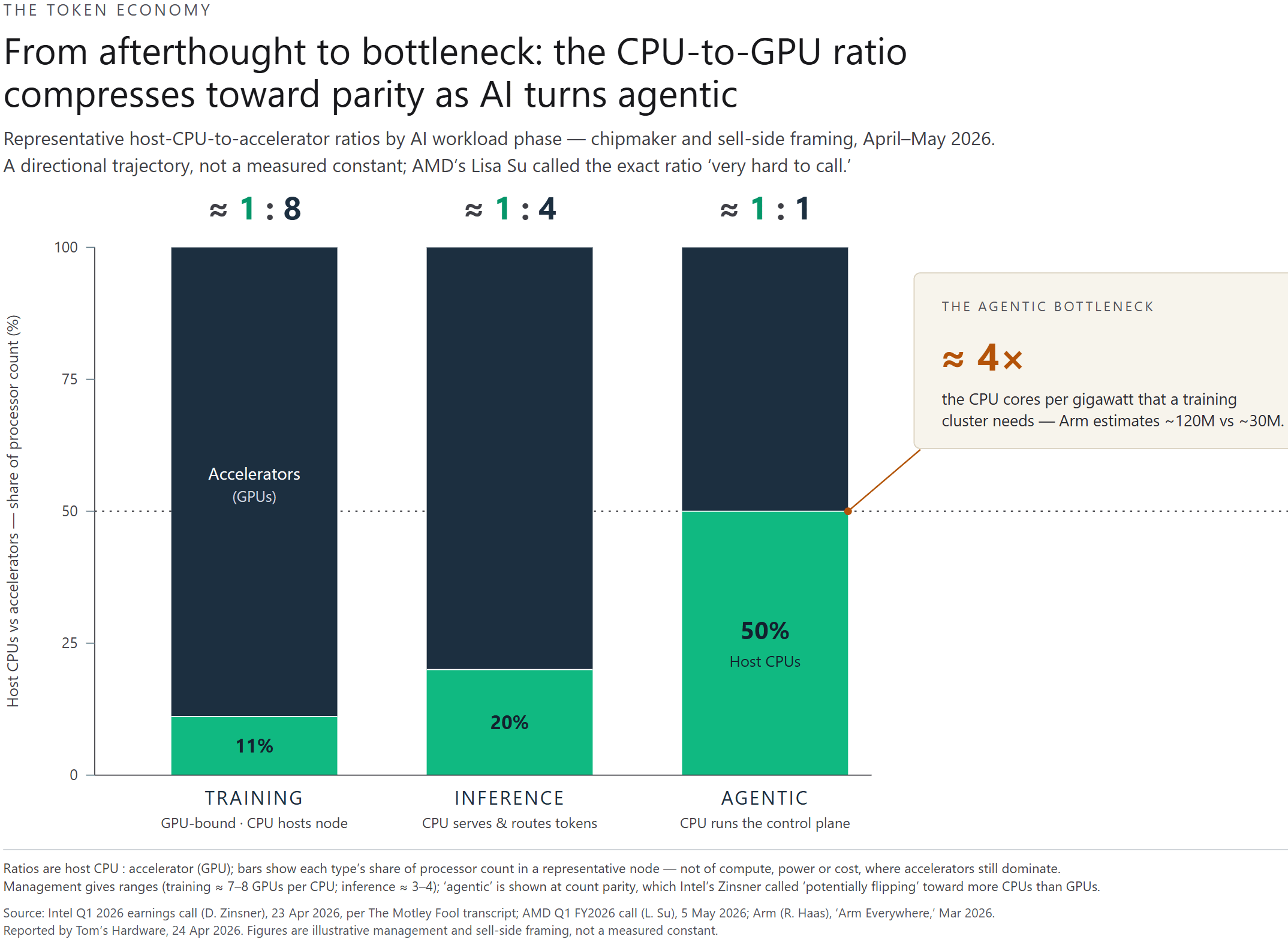
In an AI server, the accelerator does the heavy math and the CPU runs everything around it: feeding the accelerators, managing memory, scheduling work, and executing the sequential parts of a workload. During the training phase that defined the buildout’s first years, that supporting role required few processors — roughly one CPU for every eight GPUs. Training is one enormous parallel computation, the host keeping the accelerators fed.
Inference — running a trained model to answer a query — changes the arithmetic, and agentic systems change it further. An agent breaks a task into many small, sequential steps: calling tools, retrieving documents, checking results, deciding what to do next. Much of it is the kind that general-purpose processors handle, and runs continuously rather than in a burst. Both companies that build the x86 server processors at the center of this market — x86 being the Intel-and-AMD instruction set that has anchored data centers for two decades — describe the same shift, both with an interest in the telling. Intel’s chief financial officer told investors the ratio of CPUs to GPUs has moved from one-to-eight toward one-to-four and could approach one-to-one in agentic deployments; AMD’s chief executive made the same case while cautioning the exact ratio is “very hard to call.” Deployed ratios still vary widely by system and workload. But the direction is consistent, and the technical evidence points the same way: a study by Intel and Georgia Tech researchers found tool-heavy agentic workloads can leave the CPU responsible for up to 88 percent of end-to-end latency, a share that rises as GPUs get faster.
The market is pricing it. Server-processor prices have risen as much as 20 percent since March 2026, with another 8 to 10 percent expected in the second half, and Intel has prioritized server chips over consumer parts to meet demand it cannot fill. A category written off as commoditized is now allocated by scarcity. That re-rating is the phase change.
Part of the 2026 strength is ordinary — an enterprise refresh cycle, a richer product mix, and orders pulled forward ahead of rising memory prices. The structural overlay is the workload itself. Inference is the recurring half of AI compute — a model is trained, then queried billions of times — and the agentic systems now being deployed lean on the general-purpose processor in a way training never did. That composition shift is durable because it is architectural, not seasonal.
Supply cannot respond quickly, for the reason it cannot elsewhere in the buildout: the leading-edge capacity that makes these processors is itself the bottleneck. AMD builds its newest server chips on the 2-nanometer process of TSMC — Taiwan Semiconductor Manufacturing Company; Intel makes its own on the 18A process now ramping in Arizona. Both are the most advanced nodes in production, both constrained, both rationed.
The squeeze compounds through memory. Every processor sits in a system that needs dynamic random-access memory — DRAM — and DRAM is in structural shortage because the memory makers have redirected wafer capacity to high-bandwidth memory, the costly stacked DRAM that AI accelerators consume. Micron has said high-bandwidth memory takes roughly three times the wafer capacity of standard DDR5 to yield the same bits, so each wafer it shifts there sharply reduces conventional-DRAM output. Server-grade DRAM contract prices rose about 90 percent quarter over quarter in early 2026 — the steepest on record — with conventional DRAM forecast to rise another 58 to 63 percent in the second quarter. Forecasts put meaningful new capacity no earlier than late 2027, and the 2026 output gains come mostly from process migration, not new wafers. The processor is re-rating inside a server-cost inflation that will not clear quickly — the same dynamic, traced to its source, that the buildout’s component-cost line items first revealed.
The tape and the headlines have compressed all of this into a single, tidy story: Intel is back. The company’s first-quarter beat was its sixth consecutive one; its shares have risen roughly sevenfold from their 2025 low to an all-time high, past the dot-com peak that had stood since 2000; and its chief executive supplied the quotable line: the CPU is “reinserting itself as the indispensable foundation of the AI era.” The re-rating is real, and sell-side analysts have already mapped its winners. The popular version goes wrong in the attribution, in three places.
First, the x86 share is shifting toward AMD — though not as completely as the segment headlines imply. AMD set a record 46.2 percent of x86 server-processor revenue in the first quarter of 2026 on about a third of x86 units, the premium mix that lifts revenue above volume, and its data-center segment revenue passed Intel’s. But that segment crossover is partly the work of AMD’s Instinct accelerators, which it reports alongside its EPYC processors; on server processors alone, Intel still holds the majority of the revenue. Its own server revenue grew on a 27 percent rise in average selling prices even as it shipped fewer units, and its next performance-core Xeon, Diamond Rapids, does not arrive until 2027. The incumbent is defending its base, not expanding it — but it has not been displaced.
Second, at the hyperscalers — the cloud platforms where the marginal AI dollar is spent — the processor’s architecture is itself shifting. Amazon, Google, Microsoft, and NVIDIA each design their own server CPUs on Arm, the rival architecture dominant in phones and prized for performance per watt. At its fiscal-year results in May 2026, Arm reported that its designs had reached about 50 percent of the CPU compute deployed by the top hyperscalers, up sharply from a few years earlier. Amazon’s custom-silicon business — Graviton, Trainium, and Nitro — runs above a $20 billion annual rate; its newest Graviton processor reached general availability on June 10, 2026. Google’s next-generation tensor processing units — its custom AI accelerators — replace their x86 host chips with Arm-based Axion processors. In April 2026 Meta agreed to deploy tens of millions of those Graviton cores for the CPU-intensive work behind its agentic AI, one of the largest such commitments to date. The x86 incumbents are gaining demand in a segment whose fastest-growing buyers are building the alternatives themselves.
Third, the cleanest beneficiary of the re-rating is the one that profits whichever of those designs wins. Arm Holdings collects a royalty on the hyperscalers’ custom Arm processors — Amazon’s, Google’s, Microsoft’s, NVIDIA’s — and its data-center designs carry its highest royalty rates. In the year ended March 31, 2026, Arm’s data-center royalties more than doubled. The CPU is re-rating; x86’s two-decade ownership of the data-center socket is eroding at the same time — both true. Conflating the CPU’s comeback with Intel’s comeback misses the value moving underneath.
Below: how the re-rating’s value splits across the two x86 makers, the licensor that profits whoever wins, and the foundry that builds nearly all of it, with the valuation attached to each; and the milestones through 2027 that decide whether the comeback accrues to the category or to one company.
Comments
Nothing yet. Say the first thing.
Sign in to join the conversation.